
What's in this teardown
- What a conventional hybrid actually is
- What a plug-in hybrid actually is
- The one difference that drives everything else
- Electric range and what it really covers
- Charging a plug-in hybrid
- What happens if you never plug it in
- The commute distance that decides it
- The purchase price premium
- Weight complexity and maintenance
- Packaging cargo space and practicality
- Cold weather behaviour
- Resale insurance and running costs
- Incentives and the honest position
- Who a conventional hybrid actually fits
- Who a plug-in hybrid actually fits
- Where this sits against a full battery electric car
- Common mistakes in this decision
- A worked example
- The bottom line
The word hybrid now covers two genuinely different vehicles, and buyers are routinely shown both without anyone explaining which is which. One has a small battery it charges itself and a cable you will never own. The other has a battery several times larger, a socket, and a real electric driving range that ends when you exceed it. They look similar on a forecourt, they are often built on the same platform, and they behave very differently in ownership.
This teardown is strictly about those two. Neither vehicle here is a battery electric car, and the three-way comparison including a full EV is a different question that our teardown on EV versus hybrid already handles. What this page does is settle the narrower and more common decision: a conventional self-charging hybrid, or a plug-in hybrid, given your actual daily distance and your actual charging access. It covers what the battery size difference does, what happens if you never plug in, why the fuel economy figures on the window sticker are misleading for one of these formats and not the other, and the commute distance at which the extra purchase cost starts to make sense. Run your own numbers through the running cost calculator as you read, and the companion above will estimate what share of your miles would actually be electric.
The short answer: a conventional hybrid improves fuel economy on every trip and asks nothing of you. A plug-in hybrid can make short trips use no fuel at all, but only if you plug it in, and it costs more to buy. The deciding inputs are your daily distance and whether you can charge where you park overnight.
Key takeaways
- Both formats have a gasoline engine and can drive indefinitely on fuel; the difference is battery size and whether it can be charged externally.
- A plug-in hybrid that is never plugged in behaves like a conventional hybrid, which means the buyer paid a premium for capability they are not using.
- The break-even is driven by what share of your annual miles fall inside the electric range, which is a function of daily distance rather than total mileage.
- Plug-in hybrid batteries are small enough that a standard household outlet often refills one overnight, so a dedicated charger is helpful rather than mandatory.
- Published electric range figures are optimistic ceilings; cold weather, highway speed, and climate control all reduce them meaningfully.
What a conventional hybrid actually is
A conventional hybrid, sometimes called a self-charging hybrid or a full hybrid, pairs a gasoline engine with one or more electric motors and a small battery. The battery is charged in two ways: by the engine, which can run as a generator, and by regenerative braking, which recovers energy that would otherwise become heat in the brake discs. There is no plug and no external charging.
The battery is deliberately small because its job is not to store range, it is to smooth demand. It lets the car move away from rest on electricity, assist the engine under acceleration, allow the engine to shut off in traffic and at idle, and capture braking energy. Those interventions are individually small and collectively substantial, particularly in stop-start driving where a conventional car wastes the most energy.
The result is a car that behaves exactly like a conventional automatic in every respect a driver notices except that it uses less fuel, especially around town. There is no behaviour change required, no infrastructure needed, and no range anxiety of any kind, because the fuel tank defines the range and it refills in the usual way.
That absence of any demand on the owner is the format’s defining commercial strength. Nobody has to learn anything, install anything, or change any habit, and the efficiency benefit accrues automatically on every journey.
What a plug-in hybrid actually is
A plug-in hybrid, commonly abbreviated PHEV, has the same fundamental architecture with one change: a much larger battery, plus a socket that lets you charge it from an external supply. The battery is typically several times the capacity of a conventional hybrid’s, which is enough to provide a real all-electric driving range before the engine is required at all.
Operationally the car has two modes that most drivers experience as two different cars. With charge in the battery, it drives as an electric vehicle: quiet, smooth, no engine noise, no fuel consumed. When the battery is depleted, the engine starts and the car reverts to behaving essentially like a conventional hybrid for the rest of the journey.
That switch is the entire point of the format. It targets the observation that a large share of driving consists of short, repetitive local trips, and that if those trips can be covered on electricity while long trips continue to run on fuel, an owner gets most of the running cost benefit of an electric car without changing how they take a road trip.
The costs of that arrangement are real and are covered below: a higher purchase price, extra weight, two drivetrains to maintain, and a benefit that is entirely conditional on the owner plugging the thing in.
The one difference that drives everything else
Strip away the marketing and the distinction is a single decision made by the engineers: how big is the battery, and can it be filled from outside the car.
Everything else follows from that. A larger battery means more weight, which slightly reduces efficiency when running on the engine. It means more cost, both in the battery itself and in the charging hardware. It means more packaging volume, which frequently shows up as reduced cargo space or a raised boot floor. And it means a genuine electric range, which is the benefit being purchased.
The external charging capability is what converts the battery from a buffer into a fuel tank. A conventional hybrid’s battery is a flywheel: it stores energy the car itself generated and hands it back moments later. A plug-in hybrid’s battery is a reservoir: it stores energy that came from somewhere else and releases it over the following miles.
Understanding it in those terms clarifies why the ownership experience differs so sharply and why the buying decision hinges on the owner rather than on the car. A conventional hybrid delivers its benefit regardless of what you do. A plug-in hybrid delivers its benefit if and only if you regularly connect it to a supply. The vehicle is the same either way; the value is not.
Electric range and what it really covers
Plug-in hybrid electric range varies considerably between models and has generally been increasing as batteries have got cheaper, with many offering something in the region of a few dozen miles. That is a very different quantity from the hundreds of miles a battery electric car provides, and it is sized deliberately: enough to cover a normal day, not enough to cover a trip.
Two adjustments should be applied to any published figure. The first is that official range figures are measured under standardised conditions and real-world results are commonly lower, sometimes considerably. The second is that several everyday factors reduce it further: cold weather, cabin heating, highway speeds, hills, and a full load all draw more energy per mile.
The sensible planning approach is to take the published figure, reduce it by a meaningful margin for real conditions, and then ask whether your typical day still fits inside the result. If your daily round trip is comfortably under the discounted figure, you will run mostly on electricity. If it is close to it, you will run partly on the engine most days, and the arithmetic weakens quickly.
One structural advantage is worth noting. Because the engine is always available, running out of electric range in a plug-in hybrid is a non-event: the engine starts and you continue. That is a materially different experience from range anxiety in a battery electric car, and it is a large part of why some buyers choose the format, a comparison our teardown on maximising EV range approaches from the other side.
Charging a plug-in hybrid
Charging is simpler than most people expect, and it is one of the format’s genuine practical advantages over a battery electric car.
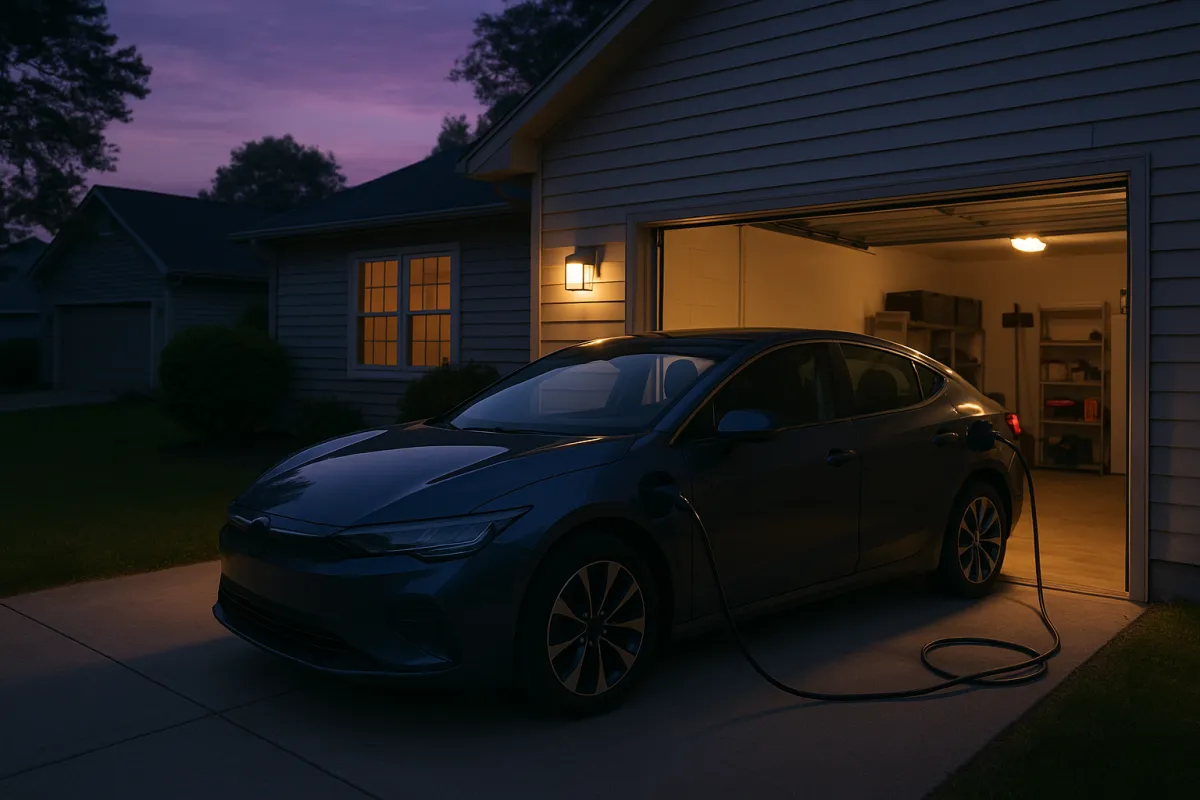
Because the battery is small, a standard household outlet can often refill one overnight. That means a plug-in hybrid frequently works with no installation, no electrician, and no equipment beyond the cable supplied with the car, which removes the largest barrier to electric driving for many households.
A dedicated home charging unit will do the same job much faster, typically in a couple of hours rather than overnight, which matters if you want to charge twice in a day or if your car sits at home for only a short window. Our guide to home EV charger installation covers what that involves and what it costs, and our teardown on charging an EV at home covers the routine.
Public charging is generally not part of the picture. Most plug-in hybrids do not support the very high power charging that battery electric cars use on road trips, and the small battery means a public session recovers relatively little range for the time spent. Some owners top up at workplace charging, which is genuinely useful because it can double the daily electric miles, but planning a journey around public charging in a plug-in hybrid is usually not worthwhile when the engine is right there. Our teardown on charging levels and connectors explains the categories.
What happens if you never plug it in
This deserves its own section because it is both the most common misunderstanding and the most common failure mode of ownership.
A plug-in hybrid that is never charged does not stop working. It manages its battery using the engine and regenerative braking, exactly as a conventional hybrid does, and it drives and refuels normally. There is no warning, no penalty, and no degraded mode.
What changes is the economics. The owner has paid a premium for a larger battery and a charging system, is carrying the extra weight of that battery on every journey, and is receiving in return the fuel economy of a conventional hybrid, or fractionally worse because of the weight. It is the automotive equivalent of buying a gym membership and not going.
This is not a hypothetical concern. Plug-in hybrids are frequently bought by people whose charging access is theoretical rather than actual: street parking, a shared garage, an apartment lot without outlets, or simply a routine that does not include plugging in. The car does not complain, so the mistake is invisible.
The honest test before buying is behavioural rather than technical. Where will the car be parked overnight, is there a socket within cable reach of that spot, and will you actually connect it most nights. If any of those answers is uncertain, a conventional hybrid delivers most of the benefit with none of the condition attached.
The commute distance that decides it
Because the benefit depends on what share of your miles fall inside the electric range, daily distance matters far more than annual mileage. Two drivers covering the same annual total can get very different results depending on whether those miles arrive as many short trips or a few long ones.
Share of annual miles driven on electricity by daily distance
Illustrative share of miles a plug-in hybrid with roughly 35 miles of usable electric range would cover on electricity, charging once overnight, at different daily round trip distances.
All figures are illustrative arithmetic for a single hypothetical range figure and a single overnight charge, not measurements of any real vehicle. The shape is the point: the electric share falls away sharply once the daily distance exceeds the electric range, because every mile beyond it runs on the engine.
The reading is that a plug-in hybrid rewards short repetitive driving and stops rewarding it quickly beyond that. A driver whose day fits inside the range comfortably converts almost all their driving to electricity. A driver whose day is double the range converts roughly half at best. And a driver whose commute is long enough to exhaust the battery in the first quarter of the journey is buying a heavy conventional hybrid.
Two adjustments improve the picture at the longer end. Charging at work, where available, effectively doubles the daily electric allowance. And splitting the day into two shorter trips with a charge between them achieves the same thing.
The purchase price premium
A plug-in hybrid typically costs meaningfully more to buy than the comparable conventional hybrid, because a larger battery and a charging system are genuine additional hardware. The gap varies by model and by market and moves as battery costs change, so treat any figure as illustrative and check current pricing on the specific models you are comparing.
For an illustrative planning figure, assume a premium in the region of several thousand dollars. That premium is the amount the fuel saving has to recover.
The recovery arithmetic is straightforward. Estimate the share of your annual miles that would be electric, using the chart above as a starting point. Estimate the fuel those miles would otherwise consume and its cost. Subtract the electricity cost, which our teardowns on EV charging cost at home and electric car cost per mile size properly. The difference is your annual saving, and the premium divided by that saving is the payback period.
Two honest caveats. First, that calculation is sensitive to fuel and electricity prices, both of which move, so run it at a couple of price assumptions rather than one. Second, it assumes you actually plug in, which returns to the behavioural question above.
For a broader view of what either format costs to run against a conventional car, our teardowns on electric car versus gas cost and monthly cost of an electric car set out the full comparison, and the running cost calculator takes your own numbers.

Weight complexity and maintenance
Both formats carry a gasoline engine, which means both retain the maintenance items that a battery electric car eliminates: oil and filter changes, air and fuel filters, spark plugs, coolant, and exhaust components. Neither is a low maintenance vehicle in the way a battery electric car is, a difference our teardown on whether electric cars are cheaper to maintain works through.
Both also benefit substantially from regenerative braking, which does much of the slowing and dramatically reduces friction brake wear. On a car kept for many years that is a real and frequently underappreciated saving.
The plug-in hybrid adds a larger battery and the charging hardware. Those are additional components, and a larger battery is a more expensive item if it ever needs replacing, though drivetrain warranties commonly cover battery components for extended periods and you should check the specific coverage on any car you are considering. Our teardowns on how long EV batteries last and EV battery replacement cost cover the general picture, with the caveat that plug-in hybrid batteries are much smaller than battery electric car batteries and the figures do not transfer directly.
The extra weight has a second-order effect worth knowing: it slightly reduces efficiency when running on the engine, and it can increase tyre wear. Neither is dramatic, but they mean a plug-in hybrid driven exclusively on fuel is marginally worse than the conventional hybrid it is based on.
Packaging cargo space and practicality
A larger battery has to go somewhere, and in most plug-in hybrids it goes under the boot floor or under the rear seats. The consequences are model specific and worth checking physically rather than on paper.
Common effects include a raised boot floor reducing overall load volume, the loss of a spare wheel well, a shallower under-floor storage area, and occasionally a reduced fuel tank capacity, which shortens the range on fuel once the battery is depleted. That last one is easy to miss and can be irritating on long trips.
Conventional hybrids are less affected because the battery is much smaller, though many still lose some under-floor space.
There is also a cable to store, which sounds trivial and is not: a charging cable lives in the boot, takes up space, and gets dirty. Owners frequently end up with a bag for it.
The practical instruction is to look at the actual car with your actual luggage in mind rather than comparing quoted litres. If you regularly carry bulky items, a raised boot floor can be a bigger daily irritation than a fuel saving is a daily pleasure. Our teardown on best electric SUVs covers packaging considerations in the larger body styles where the battery is easier to accommodate.
Cold weather behaviour
Both formats are affected by cold weather and the plug-in hybrid is affected more visibly, because it has an electric range to lose.
Cold reduces battery efficiency, and cabin heating draws significant energy. In a plug-in hybrid the combined effect can cut electric range meaningfully, which means a commute that fits comfortably in summer may not fit in January. Many plug-in hybrids also start the engine in very cold conditions for heating or emissions reasons regardless of battery state.
The mitigations are the same ones battery electric car owners use. Preconditioning the cabin while still plugged in draws the heating energy from the supply rather than the battery and is the single most effective step. Using seat and steering wheel heating in preference to cabin air is more efficient. And parking in a garage where possible reduces the starting deficit. Our teardowns on maximising EV range and extending EV battery life cover the techniques.
The important structural point is that a plug-in hybrid degrades gracefully in cold where a battery electric car degrades stressfully. Losing range in a plug-in hybrid means the engine runs sooner; losing range in a battery electric car means the trip needs rethinking. For buyers in genuinely cold climates that difference is part of the format’s appeal, and it should be weighed alongside the fact that winter also weakens the fuel saving arithmetic.
Resale insurance and running costs
Beyond fuel, several ownership costs differ between the two.
Insurance for a plug-in hybrid is commonly a little higher than for the equivalent conventional hybrid, because the vehicle costs more and contains more expensive components. The gap is usually modest and worth obtaining actual quotes for rather than assuming, since insurer treatment varies.
Resale is harder to generalise about. Plug-in hybrids have a smaller buyer pool than conventional hybrids, because a used buyer without charging access has no reason to want one, which can weaken demand. On the other hand a low-mileage plug-in hybrid with a healthy battery is attractive to exactly the buyer it suits. Our teardowns on buying a used electric car and selling a used electric car cover the used market dynamics, most of which apply here.
Fuel costs are the main event and are covered above. Electricity costs depend heavily on your tariff, and charging overnight on a cheaper rate materially improves the arithmetic, which our teardown on charging cost at home sizes.
The general shape is that a plug-in hybrid costs a little more in fixed costs and potentially a lot less in variable costs, which reinforces the same conclusion the rest of this teardown reaches: high electric mileage makes it work, low electric mileage does not.
Where a plug-in hybrid owner's annual miles come from
Illustrative split for a driver with roughly a 30 mile daily round trip who charges at home most nights and takes occasional long trips. Shares sum to 100.
Shares are illustrative for one hypothetical driver rather than measured data. Note the last slice: even a committed owner misses some nights, and every missed night converts a full day of driving from electricity to fuel.
Incentives and the honest position
Purchase incentives have historically been available for plug-in hybrids in some jurisdictions and generally not for conventional hybrids, on the reasoning that only the former can displace fuel entirely.
Those rules have changed repeatedly at both federal and state level, eligibility has been tied to varying conditions, and any statement of the current position ages quickly. This teardown therefore does not assert what is currently available.
What is safe to say is procedural. Check the current federal position and your own state’s programmes before assuming an incentive exists, and confirm that the specific model and trim you are considering qualifies, because eligibility is frequently model specific rather than category wide. Our teardown on the EV tax credit covers the general mechanics and should be read alongside a current check rather than instead of one.
Be particularly careful with a purchase whose economics only work if an incentive materialises. If the payback calculation requires a credit you have not confirmed you will receive, that is a reason to verify before signing rather than after. Where a dealer makes an incentive claim, ask for it in writing and check it independently.
There are sometimes non-financial incentives too, such as access to restricted lanes or parking privileges, which are also jurisdiction specific and change.
Who a conventional hybrid actually fits
The conventional hybrid is the right answer for a larger group of people than the current conversation suggests, and it is worth naming that group clearly.
It fits anyone without reliable overnight charging: street parking, apartment lots, shared garages, and anyone whose parking spot changes. It fits high-mileage drivers whose journeys are mostly long, because those miles run on the engine in either format and the plug-in premium buys nothing. It fits buyers who want the lowest purchase price consistent with better fuel economy. It fits people who do not want to think about the car at all, since the format asks nothing of the owner. And it fits drivers whose mileage is heavily urban and stop-start, which is precisely where a conventional hybrid’s efficiency advantage over a conventional car is largest.
It fits poorly for somebody with a short commute, home charging, and a willingness to plug in, because that person is leaving a substantial fuel saving on the table.
The most common error in this decision is buying the more advanced format because it sounds better rather than because the daily pattern supports it. A conventional hybrid bought by somebody whose life does not accommodate charging is a good decision; a plug-in hybrid bought by the same person is a worse car for more money.
Who a plug-in hybrid actually fits
The plug-in hybrid fits a narrower but clearly defined group, and for that group it is genuinely excellent.
It fits somebody with a daily round trip comfortably inside the electric range, a place to plug in overnight, and the habit of doing so. It fits households that want electric commuting but take enough long trips that a battery electric car would mean regular charging stops. It fits people in cold climates who want electric driving without winter range anxiety, because the engine removes the consequence of a shortfall. It fits one-car households where that car has to do everything, which is a genuinely awkward case for a battery electric car. And it fits drivers whose electricity is cheap overnight or comes partly from their own solar, a pairing our teardown on EV charging with solar explores.
It fits poorly for anyone whose charging access is theoretical, anyone whose daily distance greatly exceeds the electric range, and anyone whose long trips are rare enough that a battery electric car would work.
The test is not what kind of driver you would like to be. It is where the car will physically be parked at night and whether a cable can reach it. Everything else about this decision is downstream of that one fact.
Where this sits against a full battery electric car
Because many buyers are actually choosing among three formats rather than two, a brief orientation is useful, though the full comparison lives in our teardown on EV versus hybrid.
A battery electric car has no engine at all, the lowest running cost per mile, and the least maintenance, at the cost of requiring charging infrastructure that works for you and turning long trips into a planning exercise. Our teardowns on whether an electric car is worth it and planning an EV road trip cover both sides.
A plug-in hybrid is the compromise, carrying two drivetrains so that neither charging access nor long trips constrain it, and paying for that in weight, complexity, and purchase price.
A conventional hybrid is the low commitment option, improving on a conventional car without asking anything of the owner.
The useful ordering question is about charging first: if you have excellent charging access and few long trips, look at a battery electric car before either hybrid. If you have good charging access and frequent long trips, the plug-in hybrid is the format that was designed for you. If you have no reliable charging access, the conventional hybrid is the honest answer and the other two are aspirational purchases.
Common mistakes in this decision
- Buying a plug-in hybrid without confirmed overnight charging. The premium buys nothing if the car is never plugged in, and the extra weight makes it marginally worse than the hybrid it is based on.
- Reading published electric range as a working figure. Cold, speed, heating, and load all reduce it, so plan against a discounted number.
- Comparing on annual mileage rather than daily distance. The electric share depends on trip length, so two drivers with identical annual totals can get very different results.
- Ignoring the fuel tank. Some plug-in hybrids carry a smaller tank to make room for the battery, which shortens the range once the battery is empty.
- Assuming an incentive. Eligibility rules change and are frequently model specific. Verify before the purchase economics depend on it.
- Overlooking boot space. The battery goes somewhere, often under the boot floor, and a raised load area is a daily irritation for some households.
- Treating public charging as a plan. Most plug-in hybrids charge slowly on public equipment and the small battery means little is gained. The overnight plug is the plan.
Each of these comes from evaluating the vehicle rather than the routine, when the routine is what decides which format wins.
A worked example
Theory into practice on illustrative figures throughout. Our buyer is choosing between a conventional hybrid and the plug-in version of essentially the same car, at an illustrative premium of $5,000 for the plug-in.
She starts with the routine rather than the car. Her daily round trip is 26 miles. She parks on a driveway with a garage socket within cable reach. She takes roughly one long trip a month, and drives an illustrative 11,000 miles a year in total.
She discounts the published electric range for real conditions and works with a conservative figure, then estimates from the daily distance chart that she would cover roughly 85 percent of her miles on electricity in mild months and rather less in winter, so she plans on about 70 percent across a full year. That is an illustrative 7,700 electric miles a year.
She prices those miles both ways. At an illustrative fuel cost and an illustrative overnight electricity rate, the saving on those 7,700 miles comes to an illustrative $700 a year, which she checks in the running cost calculator with her own tariff. Against a $5,000 premium that is roughly a seven year payback, which is longer than she expected and is the number that actually informs the decision rather than the brochure.
She then adds the non-financial factors deliberately. She values the quiet electric commute. She does not want to plan long trips around charging. Her boot is rarely full. And she checks the current incentive position for the specific trim rather than assuming, since a credit would change the payback substantially.
Her conclusion is that the plug-in makes sense for her, but not because the payback is fast. It makes sense because she has the charging access that the format requires, and she is buying a driving experience she values alongside a saving that is real but slower than advertised. Had she been parking on the street, the same arithmetic would have pointed straight at the conventional hybrid. Run your own version in the running cost calculator.
The bottom line
A conventional hybrid and a plug-in hybrid are separated by one engineering decision, the size of the battery and whether it can be filled from outside the car, and every difference in ownership follows from it. The conventional hybrid improves fuel economy on every journey, costs less to buy, and asks nothing of you. The plug-in hybrid can eliminate fuel use on short trips entirely, costs meaningfully more, and delivers that benefit only if it is regularly plugged in. So the decision is not really about the cars. It is about where you park overnight, whether a cable reaches that spot, whether your daily round trip fits inside a realistically discounted electric range, and whether you will actually connect it most nights. If all four answers are yes, the plug-in hybrid is a genuinely good format and the payback improves with every mile you would otherwise have driven on fuel. If any of them is uncertain, the conventional hybrid delivers most of the benefit with none of the condition attached, and it is the honest choice rather than the compromise. Neither of these is a battery electric car, and if your charging access is excellent and your long trips are rare, our teardown on EV versus hybrid is the comparison to read next. Price your own routine in the running cost calculator, and let the driveway rather than the brochure decide.
This teardown compares two vehicle formats in general terms and is not vehicle purchase, financial, or tax advice, and it names no manufacturers or models on purpose. Every dollar amount, mileage figure, electric range, percentage, and payback period used here is illustrative and chosen to demonstrate the arithmetic rather than to describe any real vehicle, price, or market. Electric range, fuel consumption, battery warranty terms, cargo capacity, and fuel tank size vary substantially between models and change between model years, so confirm the specifications of the specific vehicles you are comparing rather than relying on any category generalisation. Purchase incentive rules at federal and state level have changed repeatedly and are frequently model specific, so verify the current position and the eligibility of your chosen trim before allowing an incentive to influence the purchase decision.
Frequently asked questions
What is the difference between a plug-in hybrid and a hybrid?
A conventional hybrid has a small battery that is charged entirely by the engine and by regenerative braking, and it cannot be plugged in. A plug-in hybrid has a considerably larger battery that can be charged from an external supply, which gives it a usable all-electric driving range before the engine is needed at all. Both have a gasoline engine and both can run indefinitely on fuel alone, which is what separates them from a battery electric car. The practical consequence is that a conventional hybrid improves fuel economy on every journey, while a plug-in hybrid can eliminate fuel use entirely on short ones, provided it is actually plugged in.
Do you have to plug in a plug-in hybrid?
No, and this is one of the most reassuring facts about the format for cautious buyers. A plug-in hybrid that is never charged simply operates as a conventional hybrid, using the engine and regenerative braking to manage its battery, and it will drive normally and refuel normally. What it will not do is deliver the economy the format is bought for, and it carries the weight and cost of a battery it is not using. An owner who never plugs in has paid a premium for capability they are not accessing, which is why realistic charging access matters more than the specification sheet.
Is a plug-in hybrid worth the extra cost over a hybrid?
It depends almost entirely on your daily distance and your charging access, and the arithmetic is straightforward once you have both. A plug-in hybrid typically costs meaningfully more to buy than the comparable conventional hybrid, and it recovers that premium through fuel not bought on trips completed within its electric range. Somebody with a short daily round trip and a place to plug in overnight can run most of their miles on electricity and recover the premium; somebody with a long commute or no home charging will run mostly on the engine and will not. Work out how much of your own annual mileage would fall within the electric range before deciding.
How far can a plug-in hybrid go on electricity?
Electric range varies considerably between models and has generally been increasing over time, with many plug-in hybrids offering something in the region of a few dozen miles rather than the hundreds a battery electric car provides. That figure is enough to cover a typical daily commute and errands but not a long trip. Real-world range falls in cold weather, with heavy use of climate control, at highway speeds, and with a full load, sometimes substantially. Treat any published range figure as an optimistic ceiling and plan around a lower working number, and check the specific model rather than assuming a category average.
Does a plug-in hybrid need a special charger?
Not necessarily, because plug-in hybrid batteries are small enough that a standard household outlet can often refill one overnight, which is a genuine advantage over battery electric cars. A dedicated home charging unit will do it much faster and is worth considering if your schedule is tight or your daily use is high enough that you want to charge more than once a day. Most plug-in hybrids do not support the very high power public charging that battery electric cars use, so public fast charging is generally not part of the ownership picture. Our guide to home charger installation covers what a dedicated unit involves.
Is a plug-in hybrid more expensive to maintain than a hybrid?
Both formats carry a gasoline engine and therefore keep the maintenance items a battery electric car eliminates, including oil changes, filters, and exhaust components. Both also reduce brake wear substantially through regenerative braking, which is a real saving on a long-lived vehicle. The plug-in hybrid adds a larger battery and a charging system, which are additional components that could eventually require attention, though drivetrain warranties commonly cover battery components for extended periods. In practice the routine maintenance difference between the two formats is modest, and the larger cost differences sit in purchase price and fuel.
What happens to a plug-in hybrid's battery in cold weather?
Electric range falls in cold weather for the same reasons it falls in a battery electric car: battery chemistry is less efficient at low temperatures and cabin heating draws significant power. A plug-in hybrid handles this more gracefully than a battery electric car because the engine is available as a backup, so a cold morning means the engine runs sooner rather than a journey becoming impossible. Preconditioning the cabin while still plugged in helps considerably, since the heating energy comes from the supply rather than from the battery. Expect meaningfully reduced electric range in winter and plan the break-even arithmetic around a full year rather than a mild month.
Should I buy a plug-in hybrid or just get a full EV?
That is a different comparison from the one on this page, and it turns mostly on charging access and long trip frequency. A battery electric car is generally cheaper to run per mile and simpler mechanically, but it requires charging infrastructure that works for you and it makes long trips a planning exercise. A plug-in hybrid is the compromise for people who want electric commuting without changing how they take long trips, at the cost of carrying two drivetrains. If you are weighing all three formats rather than just the two hybrids, our teardown on EV versus hybrid is the piece to read alongside this one.