What's in this teardown
- What heat actually does to an EV
- Why heat costs less range than cold
- Air conditioning is a cost per hour, not per mile
- Why the air conditioner is cheaper than a cabin heater
- The battery’s own cooling loop
- Why hot air is actually easier to drive through
- How much range you lose in heat, by condition
- A worked example: a 280 mile car on a hot day
- Where the hot day miles go
- Precooling on shore power is the biggest lever
- Why short hot trips are the expensive ones
- Why DC fast charging slows down when the pack is hot
- Back to back fast charges in summer
- Calendar ageing: what heat really costs you
- State of charge is the multiplier on heat
- Why the car runs its cooling loop while parked
- Where you park changes more than how you drive
- Tire pressure rises with the temperature
- Cabin comfort settings that cost almost nothing
- Planning a summer road trip around heat
- A practical hot day routine
- Common hot weather mistakes
- What a heat wave does not do
- The bottom line
Cold weather gets all the attention, and the summer version of the question gets waved away with a shrug about air conditioning. That is a mistake in both directions. Heat costs a real and measurable slice of range, smaller than winter’s but large enough to matter on a long summer leg, and it does something winter does not do at all: it quietly shortens the life of the battery underneath you. The range you lose to cold comes back in April. The capacity you lose to years of hot parking does not come back at all.
This teardown separates those two effects and prices each one against a single illustrative car, so the arithmetic stays visible from end to end. It covers why the air conditioner bills by the hour rather than by the mile, why cooling a cabin is structurally cheaper than heating one, what the pack’s own cooling loop draws while you drive and while you sit parked, why a hot battery makes a fast charger slow down, and what state of charge has to do with any of it. Our cold weather range teardown is the mirror image of this one and worth reading alongside it. Size your own summer number in about a minute with the companion estimator.
Key takeaways
- Heat costs far less range than cold: an illustrative 11 percent loss on a hot highway drive against roughly a third on a genuinely cold one, because the temperature gap is smaller and the air conditioner moves heat instead of making it.
- Air conditioning is the dominant slice, roughly 23 of the 31 miles lost on that illustrative hot drive, and it draws per hour rather than per mile, so slow traffic and short errands are punished hardest.
- The asymmetry that matters is not range at all: heat accelerates calendar ageing, so a summer of hot parking at a high state of charge costs permanent capacity that no season gives back.
- Fast charging slows when the pack is already hot, because high power charging generates heat and the car protects the cells by tapering earlier, which is why the second stop of a hot day feels slower than the first.
- Precooling on shore power, parking in shade, keeping the everyday charge limit moderate through summer, and leaving thermal management enabled recover most of what heat takes.
What heat actually does to an EV
Start by separating two questions that get answered as one. The first is what a hot day costs you today, in miles you can drive between charges. The second is what a hot climate costs you over years, in capacity the pack never gets back. These have different sizes, different mechanisms, and completely different fixes, and blurring them produces both of the wrong conclusions people reach: that summer is a non-event because the range readout looks fine, or that a heat wave is destroying the battery this afternoon.
The first question has a modest answer. A hot day makes the car run its air conditioning, run the pack’s cooling loop, and carry a little extra accessory load, and the total on a steady drive is illustratively around a tenth of range. That is real, it deserves planning on a long leg, and it is nothing like the winter penalty.
The second question has a bigger answer, and it arrives so slowly that nobody notices it happening. Temperature is one of the strongest levers on how fast a lithium ion cell ages while it is simply sitting there, and a car that spends its life parked in full sun in a hot climate will, over years, show more capacity loss than an identical car that lives in a garage in a mild one. That is the part of hot weather worth changing your habits over.
Why heat costs less range than cold
The asymmetry between the two seasons is not an accident of the weather, it is three separate structural advantages stacking in summer’s favour. Understanding them is what lets you predict your own numbers instead of memorising somebody else’s.
The first is the size of the temperature gap. Cooling a cabin from an ambient 100 degrees to a comfortable 75 means closing a 25 degree gap. Heating a cabin from an ambient 15 degrees to a comfortable 70 means closing a 55 degree gap, more than twice as far, and heat loss through glass and bodywork scales with that difference too. Winter is asking the climate system to do a fundamentally larger job.
The second is the machine doing the job. An air conditioner is a heat pump running in the cooling direction: it moves heat from inside the cabin to the outside air using a refrigerant cycle, so a kilowatt of electricity shifts substantially more than a kilowatt of heat. A resistive cabin heater, which many electric cars still use, cannot beat one kilowatt of warmth per kilowatt of electricity by definition. Summer gets leverage that winter does not.
The third is the battery itself. A warm pack has low internal resistance, delivers its stored energy freely, and returns full regenerative braking. A cold pack temporarily holds some of its capacity behind a door that only opens as it warms. In heat the battery is working near its happiest operating point, so unlike winter there is no capacity penalty layered underneath the climate control penalty.

Air conditioning is a cost per hour, not per mile
This single sentence explains most of what owners find confusing about summer range, so it is worth sitting with. The energy needed to move a car scales with distance: every mile costs roughly the same amount whether you cover it quickly or slowly. The energy needed to cool a cabin scales with time: the compressor runs while the car is switched on, and it does not care whether the wheels are turning.
The consequence is that your average speed sets the air conditioner’s share of the trip without changing its draw at all. Take an illustrative average compressor and blower draw of 1.5 kilowatts. At 56 miles per hour that is 1.5 divided by 56, or about 0.027 kilowatt hours per mile, a small addition on top of the roughly 0.29 kilowatt hours per mile the driving itself costs. At 20 miles per hour in town traffic the same 1.5 kilowatts becomes 0.075 kilowatt hours per mile, nearly three times as much, for identical comfort.
That asymmetry is the source of nearly every apparent contradiction in summer range reports. Two drivers with the same car in the same heat wave can honestly report very different losses because one of them is doing a two hour highway run and the other is doing a string of ten minute errands. They are not disagreeing about the car. They are buying different amounts of time.
Why the air conditioner is cheaper than a cabin heater
It helps to be concrete about the machine, because the comparison with winter turns entirely on it. A vapour compression air conditioning system has a compressor, a condenser, an expansion device, and an evaporator. Refrigerant absorbs heat from cabin air passing over the cold evaporator, the compressor raises its pressure and temperature, and the condenser dumps that heat into the outside air. Electricity is spent running the compressor and the fans, not on creating cold, because cold is not a thing you create.
Because the system moves heat rather than manufacturing it, the ratio of cooling delivered to electricity consumed is comfortably above one, and the smaller the temperature gap the better that ratio gets. On a mild summer afternoon the system barely works. On a 105 degree day with the sun beating through the glass it works hard, the compressor spends more time at high duty, and the average draw climbs. But even at its worst it is doing a smaller job more efficiently than a resistive heater does on a freezing morning.
There is a real ceiling on the saving, though. Recirculating already cooled cabin air is much cheaper than continuously cooling fresh outside air, which is why recirculation mode is the single most useful button in the climate control panel on a hot day. Fresh air mode asks the system to chill the entire outdoors, one blower load at a time.
The battery’s own cooling loop
The second draw on a hot day is one you never see in the climate control panel. Most modern electric cars circulate liquid coolant through the battery pack, and on a hot day that loop is working: a pump moving coolant, a radiator rejecting heat to the outside air, and on many cars a chiller that lets the air conditioning system pull heat out of the coolant directly when the radiator alone cannot keep up. That last mode is why hard summer driving can make the cabin cooling feel weaker; the compressor is being asked to serve two customers.
The load is genuinely small compared with the air conditioning or the driving, but it is not zero, and it rises exactly when you are asking the most of the car. Sustained high speed, repeated hard acceleration, towing, or a long climb all generate heat inside the pack and the motor, and the thermal system spends energy carrying it away. On the illustrative car in this teardown, thermal management and hot weather accessory load together account for roughly 8 of the 31 miles lost on a hot highway drive.
It is worth being clear about what that money buys. Active thermal management is the reason a modern pack tolerates hot climates far better than early air cooled designs did, and the reason repeated fast charging in summer does not simply cook the cells. The few miles it costs are the cheapest insurance on the car.
Why hot air is actually easier to drive through
Here is a small piece of physics that runs the opposite way from the winter story, and it is a genuine, if minor, summer bonus. Aerodynamic drag scales with air density, and air density falls as temperature rises. The same car at the same speed on a 95 degree afternoon is pushing through measurably less mass of air than it was on a 20 degree morning. At highway speed, where aerodynamics dominates the energy budget, that shows up as a small efficiency gain.
Rolling resistance moves in your favour too. Tire pressure rises as temperature rises, and a warmer, firmer tire deforms less per revolution and costs less energy. Lubricants in the drive unit and the wheel bearings are less viscous when warm, so the drivetrain itself spins more freely once everything is up to temperature. Roads are clear of the snow and slush and standing water that tax a winter drive directly.
None of these effects is large, and they do not come close to cancelling the air conditioner. What they do is explain why the non-climate portion of a summer drive looks so good: the drivetrain is genuinely more efficient in heat, and essentially the whole of the summer penalty is the climate system rather than the car. That is a much easier problem to attack than the four way stack that winter presents.
How much range you lose in heat, by condition
Any single percentage for summer range loss is misleading for the same reason it is misleading in winter: the loss depends on trip length and average speed at least as much as on the thermometer. What is honest is a set of scenarios showing the shape, priced against the same illustrative rated efficiency so the rows are comparable with each other.
Illustrative hot weather range loss by condition
Approximate percentage below rated range for one illustrative car; every figure moves with trip length, average speed, and how hard the cabin is cooled.
These are illustrative scenarios for one hypothetical car, not measurements of any model. Notice the ordering: the two worst rows are defined by slow speeds and short trips, not by the highest temperature.
Read the spread rather than any single bar. The distance between the top and bottom rows is about seven times, and almost none of it is explained by the temperature alone. It is explained by how long the compressor runs per mile covered. A commuter doing a 40 mile highway run in the heat lives near the bottom of that chart and will tell you summer costs them almost nothing, which is true for them. Put your own conditions into the companion estimator to see which row you land on.
A worked example: a 280 mile car on a hot day
Numbers land harder when they are worked all the way through, so here is one illustrative car followed end to end. Give it a rated range of 280 miles and 80 kilowatt hours of usable battery, which works out to a rated efficiency of 3.5 miles per kilowatt hour, or about 0.286 kilowatt hours per mile. Every figure here is a placeholder chosen to show the arithmetic, not a specification for any vehicle. It is deliberately the same car used in our cold weather teardown so the two seasons are directly comparable.
Now put it on a hot day, before any cabin cooling. Battery and drivetrain thermal management, blower load, and hot weather accessory draw together cost an illustrative 3 percent of efficiency, partly offset by thinner air, so 3.5 miles per kilowatt hour becomes about 3.4. That turns 280 miles of rated range into about 272, a loss of 8 miles with the air conditioning still switched off. Compare that with winter, where the equivalent step cost 56 miles.
Switch on air conditioning averaging 1.5 kilowatts, at an average speed of 56 miles per hour. That is 1.5 divided by 56, or about 0.027 kilowatt hours per mile of cooling, added to the roughly 0.295 kilowatt hours per mile the driving now costs. Total, about 0.321 kilowatt hours per mile. Divide 80 kilowatt hours by that and you get about 249 miles, which is 31 miles below rated, a loss of roughly 11 percent.
That is the whole summer story in one line: 31 miles lost against 93 for the same car on a cold day with a resistive heater. Change the inputs to match your own car in the companion estimator and watch both the range and the split move.
Where the hot day miles go
Thirty one miles is an abstraction until you see which mechanism took each piece. The chart below splits that loss, and the shares are of the loss itself rather than of the range. This is the picture that tells you which habit is worth changing.
Splitting a 31 mile hot day loss into its causes
Illustrative breakdown for the 280 mile car above on a hot highway drive with the air conditioning on; shares of the loss, not of the range.
On a slower trip the air conditioning slice swells, because the compressor bills by the hour while the wheels bill by the mile. On a fast highway leg the thermal management slice grows as the pack works harder. The split moves with the trip, not just the thermometer.
The strategy falls straight out of the chart. Almost three quarters of the summer penalty is the cabin, and the cabin is the part your habits can move. The thermal management slice is protection you should not want back. The remainder is physics you plan around. Compare that with the winter split, where cabin heating was the largest slice but the cold battery ran it close, and you can see why summer advice is so much simpler: there is one lever and it is the air conditioner.
Precooling on shore power is the biggest lever
Precooling is the summer twin of winter preconditioning, and it works for the same two reasons. The obvious one is that the energy comes from the wall rather than the pack, so the car leaves with a full battery instead of immediately spending miles on comfort. The less obvious and more valuable one is that the expensive part of the job, pulling a sun soaked interior down from an oven, finishes before you unplug. Once you are moving, the compressor settles into a much cheaper maintenance duty.
Put numbers on it with the same illustrative car. If precooling plus recirculation pulls the average on-road air conditioning draw from about 1.5 kilowatts to about 1.1, cooling costs about 0.020 kilowatt hours per mile instead of 0.027. Total energy per mile falls to about 0.314, range rises from about 249 miles to about 255, and the loss falls from about 11 percent to about 9. That is roughly 6 miles recovered for the price of remembering to set a departure time.
The comfort benefit is larger than the range benefit, and that is fine. A cabin at 130 degrees is genuinely unpleasant and a steering wheel at that temperature is hard to hold, so precooling is worth doing on its own terms. The range recovery is a bonus that arrives free when the cable is already connected.
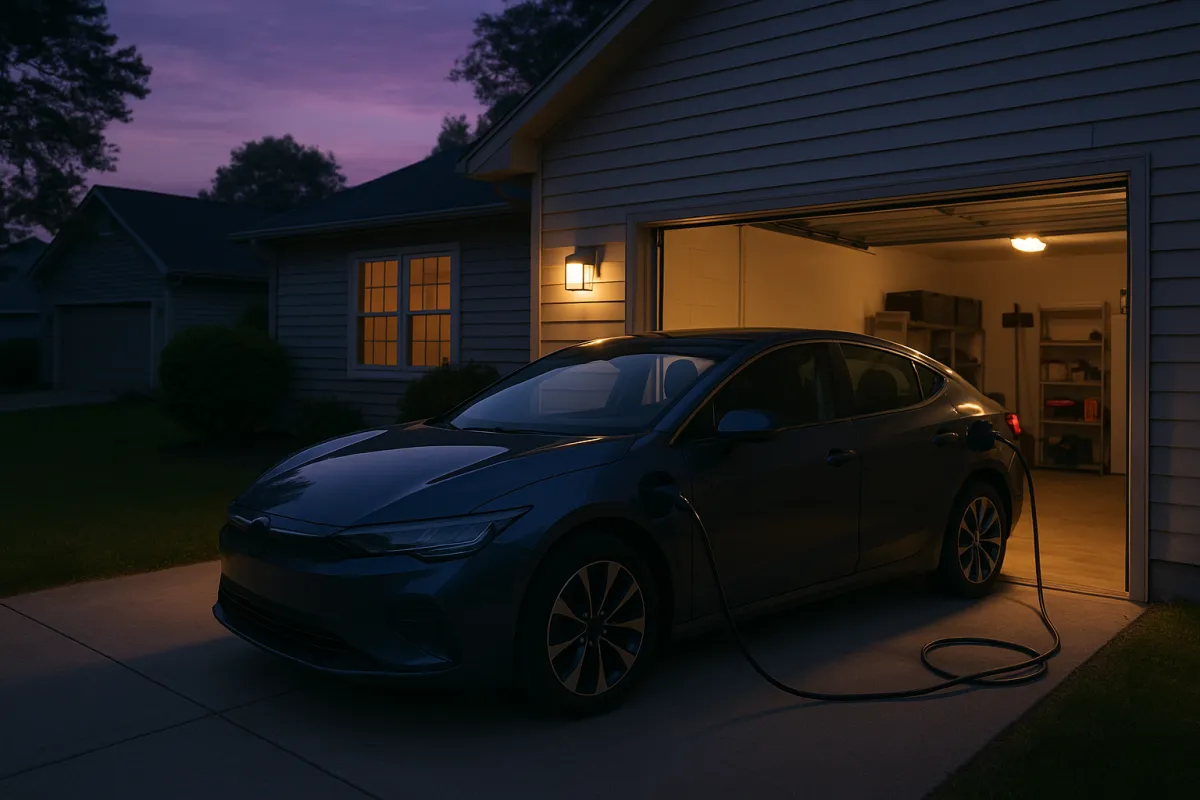
The caveat mirrors the winter one exactly. Precooling while unplugged still cools the cabin, but it spends pack energy to do it, so in that case it is a comfort purchase rather than a range one. It is still frequently the right call on a brutal afternoon. Just do not expect it to add miles when the car is not connected to anything.
Why short hot trips are the expensive ones
Cooling a heat soaked cabin is close to a fixed cost, and a short trip spreads that cost over very few miles. The first several minutes are the expensive part, because the system is not only chilling the air but pulling heat out of the seats, the dashboard, the trim, and the glass, all of which have been absorbing sun for hours. Once the interior stabilises, the compressor duty drops sharply.
Work an illustrative example. Take a 12 mile errand that takes about half an hour of stop and start driving, with the air conditioning averaging around 2.5 kilowatts because it is starting from a cabin that has been sitting in full sun. That is about 1.25 kilowatt hours of cooling. The driving itself, at an illustrative hot weather town efficiency of 3.4 miles per kilowatt hour, spends about 3.5 kilowatt hours. Total, about 4.75 kilowatt hours for 12 miles, an effective 2.5 miles per kilowatt hour against a rated 3.5. That is roughly 28 percent below rated.
The same car, same heat, on a two hour highway leg lands near 11 percent, because the fixed pull-down cost is spread across many more miles and the cabin spends most of the drive in cheap maintenance mode. Chaining errands into one trip rather than making four separate ones from a cold start is therefore a real summer saving, and it costs nothing except sequencing.
Why DC fast charging slows down when the pack is hot
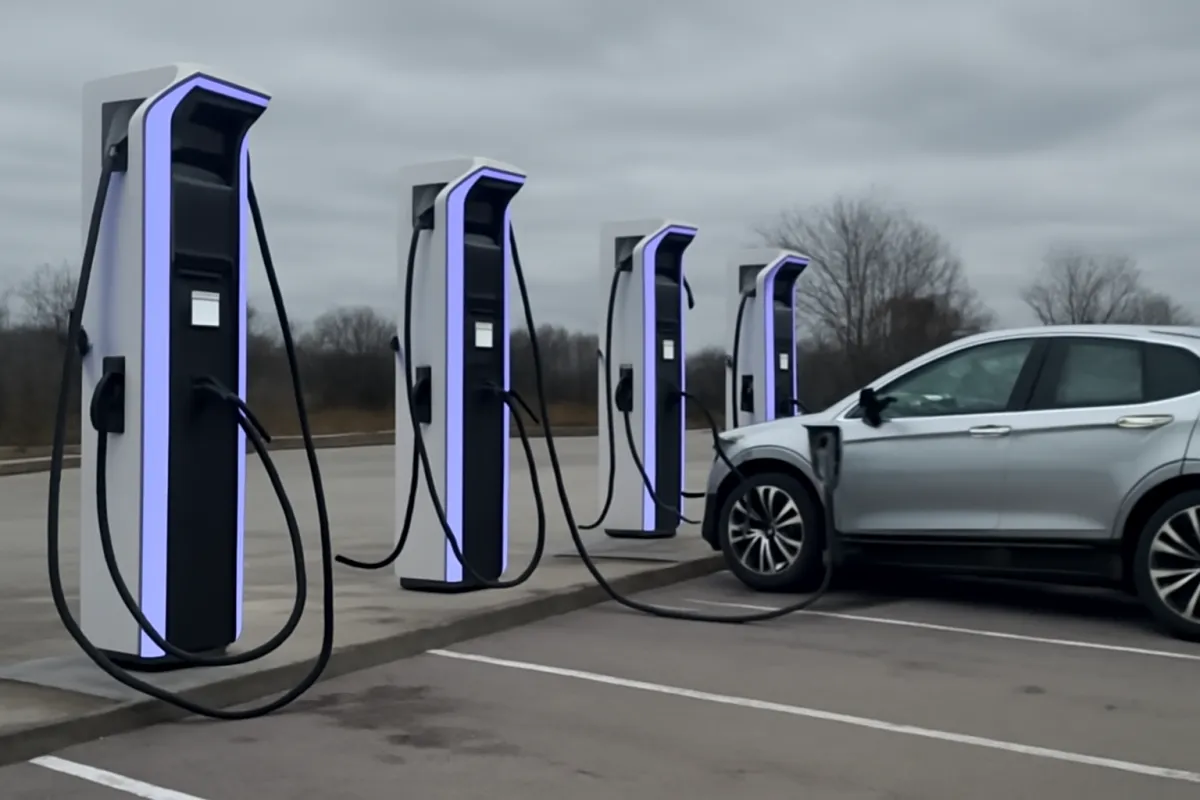
Fast charging in summer surprises people who assumed the winter problem was the only temperature problem. It is not. Charging at high power generates significant heat inside the cells, because current flowing through internal resistance dissipates energy as heat, and the faster the charge the more heat per minute. The battery management system’s job is to keep cell temperature inside a safe band, and its only tool for doing that is reducing the power it accepts.
On a mild day the cooling system has plenty of headroom, so it can carry that heat away as fast as charging creates it and the session runs its normal curve. On a very hot day the radiator is rejecting heat into air that is already hot, so the headroom shrinks. The pack reaches the temperature at which the car decides to protect it sooner, and the taper starts earlier in the session. You get the same shape of curve, just with the knee moved to the left.
This is worth planning around rather than fighting. Charging from a low state of charge is faster than charging from a middling one, so arriving at 10 or 15 percent and leaving at 60 gets more miles per minute than crawling from 60 to 90 in the heat. Our charge time teardown covers how the rate curve behaves in normal conditions, and the summer version is that curve with less patience.
Back to back fast charges in summer
The second charge of a hot day is often visibly slower than the first, and it is not the charger’s fault. After a fast session the pack is warm. You then drive a highway leg, which adds more heat, and arrive at the next stop warmer than you arrived at the last one. The cooling system has been working the whole time and has not had a chance to bring temperatures back down, so the car starts the second session with less thermal headroom and tapers sooner.
There is a practical shape to this on a long summer trip. Plan the first leg long, since the car is fresh and the pack is cool, and expect subsequent legs to run a little shorter and subsequent stops a little longer. Fighting it by arriving at a higher state of charge makes the problem worse, because charging above roughly 60 or 70 percent is already the slow part of the curve.
Two small habits help. Park in shade during the stop where shade exists, since a car sitting in full sun while charging is fighting solar load as well as charging load. And leave the car switched on with climate control running at a modest setting during the session rather than sitting in a sealed hot cabin, since the thermal system works better when it is awake. Our road trip planning teardown covers the general method that this fits inside.
Calendar ageing: what heat really costs you
Here is the part that justifies caring about heat more than the modest range number suggests. A lithium ion cell ages in two ways. Cycle ageing comes from charging and discharging: every full cycle causes a small amount of irreversible change. Calendar ageing happens regardless, while the car sits in a car park doing nothing, as slow parasitic side reactions consume lithium and grow resistive films on the electrode surfaces.
Calendar ageing is chemistry, and chemical reaction rates rise with temperature. A commonly cited rule of thumb across chemistry generally is that reaction rates roughly double for every ten degree Celsius rise, and while real battery packs do not follow anything that clean, the direction is not in dispute: a cell held hot ages faster than an identical cell held cool. That is why the same model of car can show noticeably different capacity after several years depending on the climate it lived in.
This is the honest asymmetry of the two seasons. Cold takes a large slice of range and gives all of it back. Heat takes a small slice of range and permanently keeps a little of the pack. If you live somewhere genuinely hot, the summer habit worth building is not about miles per charge at all. Our battery lifespan teardown covers what degradation actually looks like over time, and heat features heavily in it.
State of charge is the multiplier on heat
Temperature is not the only lever on calendar ageing, and it is not even the only one you control. State of charge matters too, because a cell held at a high state of charge sits at a higher voltage, and higher voltage drives the same side reactions harder. The two factors multiply rather than add: a hot pack at 100 percent is meaningfully worse for calendar ageing than a hot pack at 50 percent, and a cool pack at 100 percent is not especially stressful at all.
The practical translation is straightforward and does not require any sacrifice. Set your everyday charge limit to a moderate figure through the hot months, whatever your manual suggests for daily use, and charge to full only shortly before you actually leave on a long trip. A few hours at a high state of charge before a drive is a rounding error. A month of sitting at 100 percent in a hot car park is the thing to avoid.
The same logic applies to the bottom of the range. Leaving a car at a very low state of charge for a long period in heat is not kind to it either, and it removes the buffer the car needs to run its own thermal protection while parked. A mid range state of charge is the storage answer in both directions. Our battery life teardown works through the habits in detail.
Why the car runs its cooling loop while parked
If you have heard fans or a pump running on a parked electric car on a hot afternoon, that is thermal management doing its job, and it is one of the more reassuring noises a car can make. There are three common reasons for it. The pack may still be hot from a fast charge or a hard drive and is being brought back to a comfortable temperature. Ambient conditions may be hot enough that the car runs a periodic cooling cycle to keep cells out of a damaging band. Or the car may be conditioning the pack in advance of a scheduled departure or charge.
That activity draws energy, which is part of why a car left in full sun over a hot week loses a little more charge than one left in shade. The draw is small compared with driving, and the trade it makes is excellent: a fraction of a percent of charge per day in exchange for keeping the cells out of the temperature band that ages them fastest.
The temptation to disable it, where a car even allows that, should be resisted. Turning off the protection to save a trivial amount of standby energy trades a rounding error for exactly the stress this teardown is about. The one genuine caution is the opposite case: a car left unplugged for weeks in extreme heat can run its charge down through this activity, so long summer parking is a plugged in scenario if you have the option.
Where you park changes more than how you drive
Given all of the above, the single highest leverage summer habit has nothing to do with driving. It is where the car sleeps. A vehicle parked in full sun on dark tarmac reaches interior temperatures far above ambient, the bodywork and glass soak heat all day, and the pack underneath sits in that heat for hours. The same vehicle in a garage, under a carport, or in the shade of a building spends the day much closer to ambient.
The benefits stack in a satisfying way. A cooler car needs less energy to precool, so your first trip of the day is cheaper. A cooler pack starts a fast charging session with more thermal headroom, so the session runs faster. A cooler pack spends fewer hours in the temperature band that drives calendar ageing, so it keeps more capacity over the years. One decision, three payoffs.
Where a garage is not available, the substitutes are still worth real money. Park facing away from the afternoon sun, use a windscreen shade, crack the windows a fraction where it is safe to do so, and prefer the shaded end of a car park even if it means walking further. None of it is glamorous, and it is close to free.
Tire pressure rises with the temperature
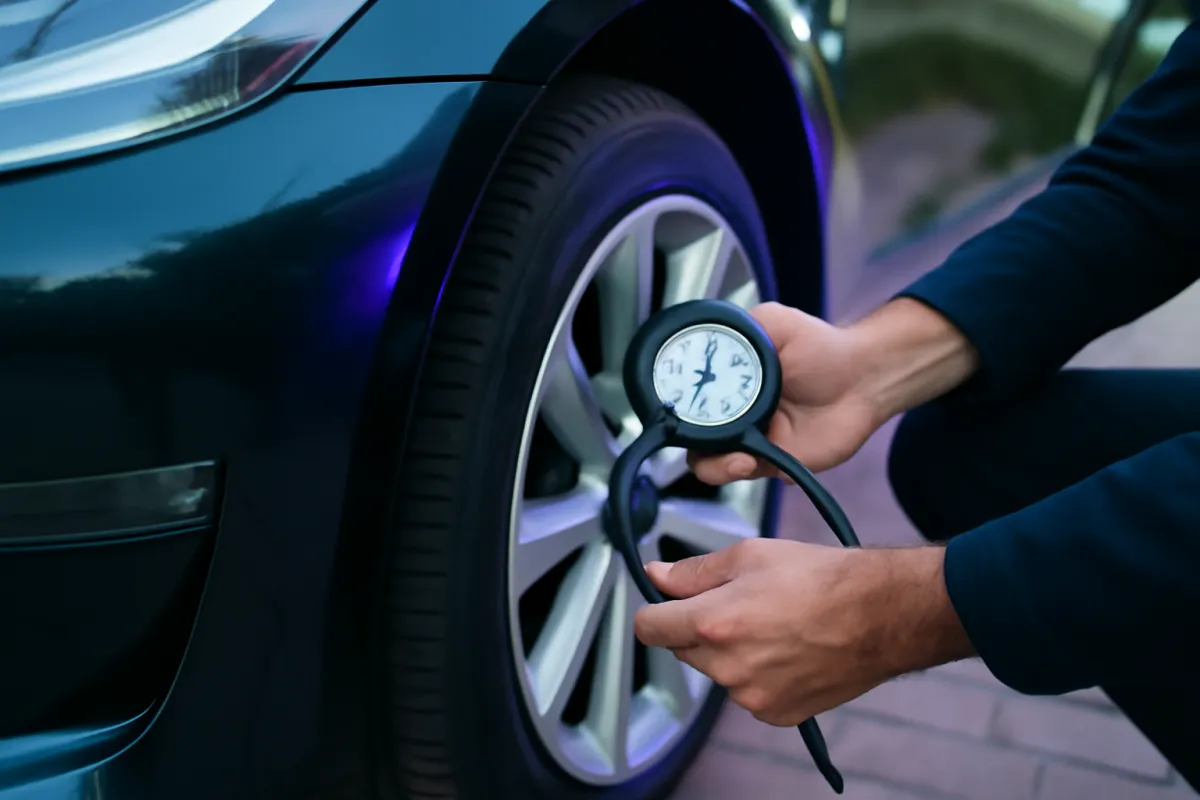
Pressure moves with temperature in both directions, and summer is the direction people forget. Air pressure rises as temperature rises, so a set of tires inflated correctly on a cool morning will read higher after an afternoon of highway driving on hot tarmac. That is normal and expected, and it is why every recommended pressure figure is specified cold, meaning before the car has been driven, not before the weather warms up.
The mistake to avoid is bleeding air out of a hot tire to bring it back to the door jamb figure. Do that and the tire is underinflated once it cools, which costs efficiency, wears the shoulders, and runs hotter under load, which is the opposite of what you wanted. Check pressures in the morning before driving, set them to the door jamb figure then, and leave the hot readings alone.
There is a genuine safety dimension here on long hot drives. Underinflated tires flex more, and flexing generates heat, which is precisely what you do not want on hot tarmac at highway speed with a heavy vehicle. Electric cars are heavy, so the margin matters more, not less. Our range maximising teardown makes the same point about the habits that pay off in every season.
Cabin comfort settings that cost almost nothing
Once you are moving, a handful of climate settings change the compressor’s duty far more than the temperature you dial in. Recirculation is the biggest of them. Cooling air that is already cool takes much less work than continuously chilling fresh outside air, so once the cabin has come down, recirculation keeps it there cheaply. Most cars start on fresh air to clear a hot cabin quickly and will switch automatically, but it is worth knowing where the button is.
Ventilated seats, where a car has them, are the summer equivalent of heated seats: they move air across your skin instead of chilling the whole cabin, which is a far smaller job. A modest cabin temperature with ventilated seats is usually more comfortable than an aggressive cabin temperature without them, and it costs a fraction as much.
Two smaller habits round it out. Dump the hottest air before you set off by opening windows for the first half minute of driving, so the system is not asked to cool 140 degree air. And close the sun blinds on a panoramic roof if the car has them, since a large glass area is a large solar collector directly above the cabin. None of this is a sacrifice, which is why these habits actually survive.
Planning a summer road trip around heat
A summer road trip is easier than a winter one on range and harder on time, and planning it well means knowing which of those two you are actually managing. Range is predictable in the heat: the loss is modest, the pack is not withholding capacity, and your estimate holds up well across a leg. What moves is the length of the charging stops.
Take the illustrative car at 249 miles of hot weather range. With a 15 percent arrival reserve that becomes about 212 miles of comfortable leg, and that is the figure to measure gaps between chargers against. Notice the reserve is smaller than the 20 percent this network recommends in winter, and that is deliberate: in summer the estimate is more trustworthy, so the reserve is protecting against detours and closed stalls rather than against a moving forecast.
Then add time rather than subtracting it. Assume the second and third stops run longer than the first, prefer sites with multiple stalls and some shade, and try to schedule the longest driving stretch for the morning or evening rather than the middle of a brutal afternoon. If the trip crosses genuinely extreme heat, treat charging stops as breaks for the people in the car too, since a hot cabin is a fatigue problem before it is an engineering one.
A practical hot day routine
Here is the whole teardown compressed into a sequence you can actually run. It takes almost no effort once it is a habit, and it collects most of what heat takes.
The night before, park in shade or a garage if you have one, leave the car plugged in, and set the everyday charge limit to a moderate figure rather than full. Set a scheduled departure time so the car precools the cabin and conditions the pack from the wall in the last stretch before you leave.
In the morning, check tire pressures cold against the door jamb figure if it has been a while. Get in to an already cool cabin, drive off with the windows briefly open if the car has been sitting anyway, then close up and let recirculation hold the temperature. Set a modest cabin temperature and use ventilated seats if you have them.
On the road, chain errands into one trip rather than making several from cold. If you are fast charging, arrive low rather than middling, park in shade during the session, and leave climate control running rather than sealing the car. At the end of the day, park in shade again, plug in, and let thermal management do whatever it decides to do. That is the entire routine, and it is worth roughly the difference between the top and bottom rows of the chart above. Run your own version of it through the companion estimator.
Common hot weather mistakes
A short list of recurring errors accounts for most of the bad summer experiences owners describe.
- Assuming summer is a non-event because the range readout looks fine. The range cost genuinely is small. The calendar ageing cost is the one that does not show up on any display until years later.
- Precooling while unplugged and expecting a range saving. It makes the car pleasant, which is worth doing, but the energy comes out of the pack. The range benefit only exists when the cable is connected.
- Bleeding air out of hot tires to hit the door jamb number. That figure is specified cold. Correcting a hot reading leaves you underinflated once the tires cool, which costs efficiency and runs hotter under load.
- Leaving the car parked at 100 percent in the sun. High state of charge and high temperature multiply as accelerants of calendar ageing. Charge to full shortly before a trip instead, not as a resting state.
- Blaming the charger when the second stop of a hot day runs slow. A warm pack has less thermal headroom, so the taper arrives earlier. Arriving at a lower state of charge helps more than switching networks does.
- Running fresh air mode for a whole hot drive. Continuously chilling outside air is the expensive way to stay cool. Recirculation once the cabin is down is close to free.
- Disabling thermal management to save standby energy. The draw is trivial and the protection is the reason the pack tolerates hot climates at all.
Each of these is a default rather than a decision, which is why they persist until something forces the issue.
What a heat wave does not do
It is worth ending the mechanism section by being clear about what heat does not do, because summer anxiety tends to overshoot in a few specific directions. A hot week does not permanently shrink your battery in any way you will notice. Calendar ageing is a years long process, and no single heat wave is a step change in it. If your range looks worse this week, that is the air conditioner and the traffic, not damage.
A hot pack does not become dangerous under normal use. Thermal management, charge power limits, and cell level protection all exist precisely to keep temperatures inside a designed band, and the car will slow a charge, reduce available power, or run its cooling loop for as long as it needs to. Reduced power on a hard summer climb is the system working, not failing.
And heat does not make an electric car a worse choice than a combustion one in a hot climate. Combustion cooling systems are also working hard in a heat wave, air conditioning in a petrol car costs fuel too, and a hot idling engine in traffic is a far less pleasant thing to sit behind. The genuine differences are the ones in this teardown: the charging taper and the calendar ageing, both of which are manageable with parking and charge limits rather than with a different powertrain.
The bottom line
EV range in hot weather falls by far less than most people expect, and the honest illustrative figure for a steady hot highway drive is around 11 percent, against roughly a third for the same car on a cold day with a resistive heater. Three structural advantages produce that gap: a smaller temperature gap to close, an air conditioner that moves heat rather than manufacturing it, and a warm battery that gives up its energy freely instead of holding some back. Nearly three quarters of what heat does take is the cabin, which means there is one lever rather than four, and it is the one you can reach.
The part worth changing habits over is the part that never shows on the range display. Heat is the condition most consistently associated with permanent capacity loss over a pack’s life, and it multiplies with a high state of charge. Park in shade, keep the everyday charge limit moderate through summer, charge to full only shortly before you leave, leave thermal management alone, and plug in for long hot parking. Those five habits cost nothing and act on the only summer effect that is permanent.
For the day to day, the routine is smaller still. Precool on shore power, use recirculation and ventilated seats under a modest cabin setting, chain errands into single trips, arrive at fast chargers low rather than middling, and plan summer legs from a real number with a 15 percent reserve rather than from the sticker. On the illustrative car in this teardown that turns a 31 mile loss into something nearer 25 and a 249 mile range into 255. Run your own rated range, battery size, cooling draw, and average speed through the companion estimator, write the resulting leg length on a note in the car, and summer becomes a number rather than a worry.
This teardown is an educational explainer about the physics and chemistry of running an electric car in the heat, written by people who like energy arithmetic rather than by battery engineers or your automaker, and none of it is professional, safety, or purchasing advice. Every range, efficiency, percentage, kilowatt, temperature, and mile figure above is illustrative and internally consistent for one hypothetical vehicle, chosen to make the arithmetic visible rather than to describe any real car; no test result, fleet measurement, or degradation study is being reported here. Thermal management behaviour, charge power limits, recommended charge limits, and hot weather storage guidance differ by manufacturer, model year, battery chemistry, and market, so treat your own owner’s manual as the only authority for your car. Nothing here is a reason to disable a protection the vehicle applies on its own, to leave people or animals in a parked cabin in heat, or to run tires at a pressure other than the one specified on the vehicle’s own placard.
Frequently asked questions
How much range does an EV lose in hot weather?
Much less than it loses in cold, and that surprises people who expect the two to be symmetrical. On the illustrative 280 mile car used throughout this teardown, a hot day with the air conditioning running at a typical draw lands near 249 miles, a loss of about 11 percent, against roughly a third on a genuinely cold day with a resistive heater. Short errands in extreme heat, where the cabin has been sitting in the sun and has to be pulled down from an oven, run nearer 28 percent below rated. Treat every one of those percentages as a shape rather than a specification, because the size depends on your trip length, your average speed, and how aggressively you cool the cabin.
Why does hot weather cost less range than cold weather?
Three reasons stack in your favour. Cooling a cabin from 100 degrees to a comfortable 75 is a much smaller temperature gap to close than heating a cabin from 15 degrees to 70, so there is simply less work to do. The air conditioner is a heat pump, so it moves heat rather than manufacturing it and gets more cooling per kilowatt than a resistive heater gets warmth. And a warm battery is a willing battery, with low internal resistance and full access to its stored energy, where a cold battery temporarily holds some capacity back. Heat takes a smaller bite out of range for all three reasons at once.
Does running the air conditioning drain an EV battery quickly?
It draws steadily rather than quickly, and the important detail is that it bills by the hour rather than by the mile. An illustrative average draw of 1.5 kilowatts costs about 0.027 kilowatt hours per mile at 56 miles per hour and roughly three times that in slow town traffic at 20 miles per hour, because the compressor keeps running while the wheels barely turn. On the illustrative car in this teardown the air conditioning accounts for roughly 23 of the 31 miles lost on a hot highway drive. That makes it the largest single slice by a wide margin, and the one your habits can actually move.
Is heat bad for an EV battery?
Heat is the condition most consistently associated with permanent capacity loss over a battery's life, which is the honest asymmetry at the centre of this teardown. Cold takes range temporarily and gives it back in spring, while heat takes a much smaller slice of range and quietly accelerates the chemistry that ages the cells. The relevant mechanism is calendar ageing, the slow set of side reactions that consume lithium and grow resistive films inside a cell whether or not the car is driven, and reaction rates rise with temperature. That is why parking in shade, keeping the state of charge moderate in summer, and leaving thermal management enabled matter more than any single hot day of driving does.
Why does my EV charge more slowly at a fast charger in summer?
For the same structural reason it charges slowly when cold, at the other end of the thermometer. High power charging generates heat inside the pack, and the battery management system will reduce the delivered power to keep cell temperatures inside a safe band. If you arrive with a pack that is already warm from a fast highway leg on a hot day, the cooling system starts the session with less headroom and the taper begins earlier. Back to back fast charges on the same hot day compound this, so the second stop is often noticeably slower than the first even at an identical charger.
Does precooling the cabin while plugged in save range?
Yes, for the same two reasons preconditioning helps in winter. The energy that pulls a heat soaked cabin down comes from the wall rather than from the pack, and the expensive part of the job is finished before you unplug, so the on-road compressor settles into a cheaper maintenance duty instead of fighting a 130 degree interior. On the illustrative car here, dropping the average on-road air conditioning draw from about 1.5 kilowatts to about 1.1 by precooling lifts range from roughly 249 miles to roughly 255 and cuts the loss from about 11 percent to about 9. Precooling while unplugged still makes the car pleasant, but it spends pack energy to do it.
Why does my EV run its cooling fans while it is parked?
Because thermal management does not stop when the car does. If the pack is hot after a fast charge or a long summer drive, the cooling loop keeps circulating coolant until temperatures settle, and on very hot days many cars will run a cooling cycle periodically while parked to keep cells out of a damaging temperature band. That draw is real but small compared with driving, and it is one of the reasons a car left in full sun loses a little charge over a hot week. Disabling that protection to save a fraction of a percent per day would trade a trivial saving for the exact stress that ages the pack, so leave it on.
Should I charge to 100 percent in the summer?
High state of charge and high temperature are the two factors most often cited together as accelerants of calendar ageing, and their combination is worse than either alone because a full cell sits at a higher voltage and higher voltage drives the side reactions faster. The practical implication is not to fear a full charge before a long summer trip, which is a few hours at a high state of charge and effectively harmless, but to avoid leaving the car parked at 100 percent in the sun for days. A moderate everyday limit, then charging to full only shortly before you actually leave, captures nearly all of the benefit. Follow your own manual, since chemistries and manufacturer recommendations genuinely differ.