What's in this teardown
- The short answer, in cents per mile
- The core formula: kWh per 100 miles times your rate
- What a mile actually costs at home
- Monthly cost, by how much you drive
- The four fuels on one chart
- Home versus public DC fast charging
- Off-peak charging: the biggest lever
- EV charging versus gasoline, per mile
- What moves your number
- Winter and the cost of cold
- Free and workplace charging
- Charging from your own solar
- The no-home-charging reality
- Demand charges and rate plans
- The annual saving against a gas car
- The five-year gap: home vs a charging station
- A year of charging by source
- A worked example: one commuter for a year
- Common charging-cost mistakes
- The bottom line
Short answer: Charging an EV at home costs roughly 4.5 cents per mile at an illustrative 30 kWh per 100 miles and a 15 cent electricity rate, which works out to an illustrative $23 to $68 a month for 500 to 1,500 miles of driving. Charging on an off-peak overnight rate roughly halves that. Against a 30 mpg gas car at $3.50 a gallon, home charging commonly saves a several-hundred-dollar to four-figure sum every year.
The most useful thing about an electric car is not a spec on the window sticker; it is the moment you realize your fuel now costs a few cents a mile and arrives while you sleep. Our EV ownership teardown leaned on that fact as the economic engine of the whole proposition, and our charger-install teardown covered the one-time cost of building the pump in your garage. This article is about the other number, the ongoing one: what the energy actually costs, every mile, every month, for as long as you own the car.
That distinction matters, because the two costs get mixed up constantly. Installing a home charger is a project that happens once and is done. Charging is a recurring bill that shows up on your electric statement forever, and it is almost always far smaller than people expect. This teardown prices it directly: the simple formula, the illustrative cents per mile at home, the monthly cost by how much you drive, the gap to public fast charging, the off-peak lever that is the biggest saving available, and the headline comparison against gasoline. You can run your own version in about a minute with our cost calculator.
Key takeaways
- The whole cost reduces to one formula: kWh per 100 miles times your electricity rate. At an illustrative 30 kWh per 100 miles and a 15 cent home rate, that is roughly 4.5 cents per mile.
- A typical home-charging bill runs an illustrative $23 to $68 a month for 500 to 1,500 miles of driving, and charging off-peak roughly halves it.
- Public DC fast charging commonly costs two to four times more per mile than home charging and can even exceed gasoline, so it belongs on trips, not in your daily routine.
- Off-peak overnight rates are the single biggest lever, often cutting home charging cost by half for a schedule you set once, a point that ties straight back to the charger-install teardown.
- Against a 30 mpg gas car at $3.50 a gallon, home charging commonly saves a several-hundred-dollar to four-figure sum every year, with the exact number driven by your miles and where you plug in.
The short answer, in cents per mile
Before any nuance, here is the number people actually came for. Charging an EV at home costs an illustrative 4 to 5 cents per mile at a common residential electricity rate, which for a typical driver works out to somewhere around $30 to $60 a month. Charge overnight on an off-peak plan and the per-mile figure can fall closer to 2 to 3 cents. That is the entire headline, and everything below is just showing the work and the variations.
To put it in a frame most people carry from gas cars: a mile that costs 4.5 cents in electricity would cost roughly 11 to 14 cents in gasoline for a comparable trip in an average car. So the same commute that quietly drains $150 a month from a gas tank often costs $40 to $50 charged at home. The reason the number feels too good is that gasoline has trained everyone to expect fuel to be a large, visible expense, while home charging turns it into a small line item buried in an electric bill you were already paying. The rest of this teardown makes that number yours instead of an average.
The core formula: kWh per 100 miles times your rate
Every cost figure in this article comes from one calculation, and it is genuinely simple. An EV’s energy use is measured in kilowatt-hours per 100 miles, much like a gas car’s miles per gallon, and a common figure for a typical EV is around 30 kWh per 100 miles. Your electricity costs a rate per kWh, commonly somewhere near 15 cents at home. Multiply the two and you get the cost of 100 miles: 30 times $0.15 is $4.50. Divide by 100 and you have your cost per mile, about 4.5 cents.
That is the whole engine. Cost per mile equals efficiency in kWh per 100 miles, divided by 100, times your rate per kWh. Cost per month is that per-mile figure times your monthly miles. Cost per year is the per-mile figure times your annual miles. Two inputs you can find in an afternoon, your car’s efficiency and your utility’s rate, produce every number that follows, and our cost calculator runs the arithmetic live if you would rather not do it by hand. Because the formula is so short, it is worth memorizing: it lets you sanity-check any charging cost claim, yours or a salesperson’s, on the back of a receipt.
What a mile actually costs at home
Put realistic numbers into the formula and the home-charging mile comes out cheap in a way that rewards a second look. At the illustrative 30 kWh per 100 miles and a 15 cent rate, a mile costs 4.5 cents and 100 miles costs $4.50. Nudge the rate to a low 10 cents and the mile drops to 3 cents; push it to a high 25 cent rate and it climbs to 7.5 cents, still comfortably under most gas cars. The rate is doing most of the work here, which is why the single most valuable thing you can look up is your own per-kWh price rather than trusting any national average.

Efficiency is the other dial, and it varies more than people expect between vehicles. A small, aerodynamic EV might use 25 kWh per 100 miles, dropping the 15 cent mile to under 4 cents, while a large electric truck or SUV might use 45 or more, pushing the same mile past 6.5 cents. The practical move is to read your car’s lifetime energy consumption from its own display, then plug your real efficiency and your real rate into the formula. Do that once and the vague “a few cents a mile” becomes a specific number you can budget against and compare with what your old gas car was quietly costing you per mile all along.
Monthly cost, by how much you drive
Because charging cost is purely miles times cost-per-mile, the monthly bill is one of the most predictable expenses in car ownership. Once you know your per-mile figure, your monthly cost is just your monthly mileage scaled against it, and that scaling is worth seeing laid out, because it reframes charging from a mystery into a line item you can plan around.
At the illustrative 4.5 cents per mile from a 30 kWh per 100 miles car on a 15 cent rate, here is roughly how the monthly bill grows with driving:
- 500 miles a month: about $23, the profile of a low-mileage second car or a short commute.
- 750 miles a month: about $34, a light-to-moderate driver.
- 1,000 miles a month: about $45, close to the average driver’s mileage.
- 1,250 miles a month: about $56, a longer commute or an active household.
- 1,500 miles a month: about $68, a high-mileage driver or a car doing a lot of family duty.
Two things stand out. First, even the high-mileage row is a modest number against a comparable gas fuel bill, which for 1,500 miles in an average car could easily run $170 to $200 a month. Second, every figure roughly halves if you charge off-peak, the lever the next few sections keep coming back to. Find your own row with our cost calculator, which lets you set your exact rate, efficiency, and charging mix rather than reading off an illustrative table.
The four fuels on one chart
The cleanest way to see where charging sits is to line up the four realistic ways to power a mile and let the widths speak. Every bar below is an illustrative cost per mile from the same formula: efficiency times rate, with public charging and gasoline priced at common figures.
Illustrative cost per mile, by fuel source
30 kWh per 100 miles; home 15 cents, off-peak 8 cents, public 45 cents per kWh; gas 30 mpg at $3.50.
The two home rows sit far below the fuel most drivers are used to, while public fast charging lands beside or above gasoline. The whole EV cost advantage is really the distance between the top two bars and the bottom two.
The chart settles most of the debate on sight. Home charging, at either rate, is a fraction of the cost of the gasoline mile most drivers have paid their whole lives. Public DC fast charging, by contrast, sits right beside gas and can pass it, which is the single most misunderstood fact about EV running costs. An owner who charges at home lives on the bottom two bars and saves accordingly; an owner who defaults to fast charging lives near the top and wonders where the savings went. The car is identical in both stories. Only the plug changed.
Home versus public DC fast charging
The gap between home and public charging is large enough to change the entire ownership math, so it deserves a clear-eyed look. Public DC fast charging commonly costs an illustrative two to four times more per unit of energy than home charging, and at busy or premium networks the multiple can be higher. Where a home mile costs 4.5 cents, a public fast-charging mile can cost 12 to 15 cents or more, which is why the chart above puts it beside gasoline rather than beside the home bars.
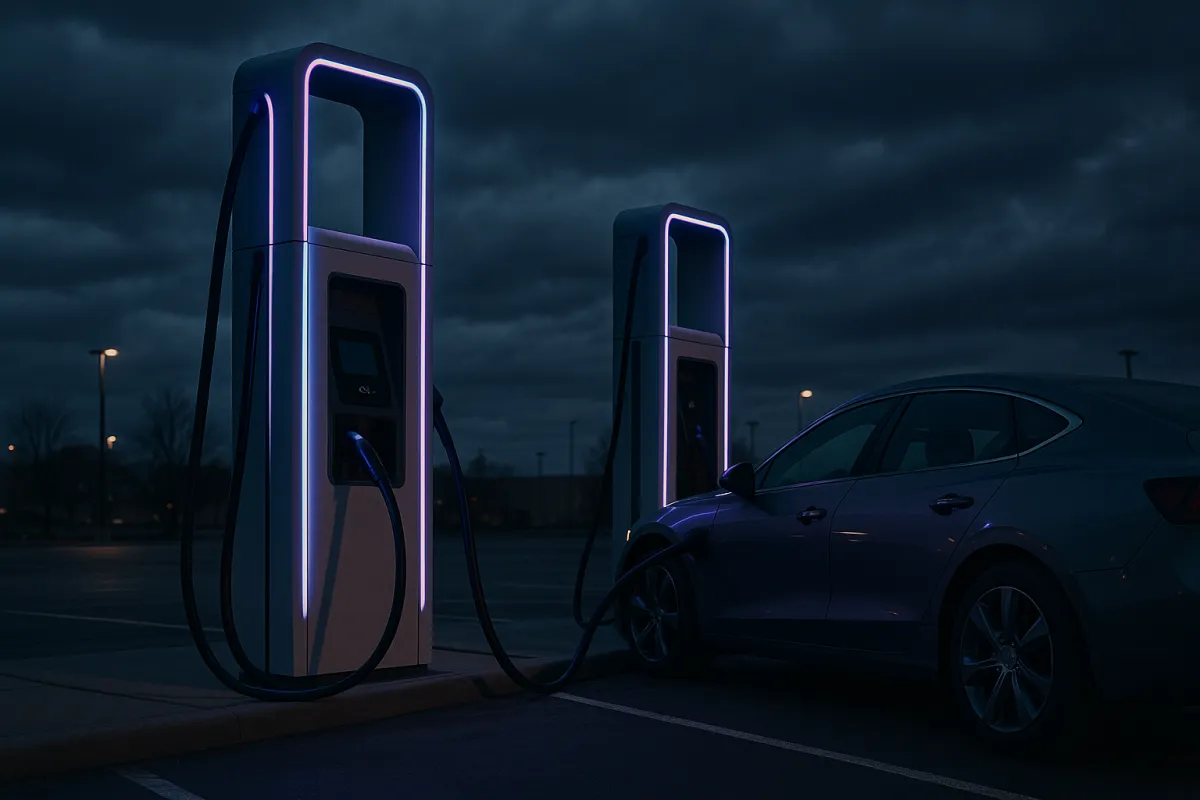
The reason is not gouging so much as economics. A DC fast charger is expensive hardware pulling enormous power, sited on real estate, often hit with utility demand charges for its peak draw, and run at a margin. All of that loads onto the per-kWh or per-minute price. Home charging carries none of it: you pay your ordinary residential rate for electricity you were already connected to. We price the station side of this gap in full, per session, per network, and per road trip, in our companion teardown of the cost of charging an EV at home vs a charging station, which is the other half of this comparison. The takeaway is not that fast charging is bad, it is genuinely useful on road trips and covered in the trip economics of our ownership teardown, but that its price is built for occasional convenience, not for daily fuel. An owner who can charge at home and reserves fast charging for travel captures the low-cost story in full; one who fast charges by default has, in cost terms, bought an expensive gas car.
Off-peak charging: the biggest lever
If there is one setting that most changes your charging cost, it is when the electrons flow. Many utilities now price electricity by time of day, and the gap between peak and off-peak rates is large: overnight off-peak rates commonly run a third to half of peak rates, and some utilities offer EV-specific plans with even deeper overnight discounts. Because an EV sits parked all night anyway, shifting its charging into the cheap window is close to free money, the car neither notices nor minds finishing at 4 a.m. instead of 8 p.m.
The size of the lever is easy to state. Take the 1,000-mile-a-month driver paying about $45 on a 15 cent standard rate. Move that same charging to an 8 cent off-peak rate and the bill falls to roughly $24, a saving near $250 a year for a schedule you set exactly once. This is the same lever our charger-install teardown flagged as the highest-yield setting in the entire project, and the tooling makes it automatic: every modern EV can schedule its own charging window, and most smart chargers duplicate the feature. The one-time setup is to check your utility for a time-of-use or EV rate, enroll if the overnight math wins, and set the schedule in the car or charger. After that, years of savings accrue with no further attention, which is about the best return any household setting offers.
EV charging versus gasoline, per mile
The comparison everyone actually wants is EV against gas, and the honest way to run it is per mile, because that is the unit both cars share. A gas car’s fuel cost per mile is its price per gallon divided by its miles per gallon. A 30 mpg car at $3.50 a gallon costs $3.50 divided by 30, about 11.7 cents per mile. A less efficient 20 mpg vehicle at the same price costs 17.5 cents, and a thirsty truck can pass 20 cents. Against those, the illustrative home-charged 4.5 cents is a fraction, and even the off-peak 2.4 cents makes the gap look almost unfair.
The comparison does move with prices, and it is worth being honest about the edges. At cheap gasoline and expensive electricity, the gap narrows; at expensive gasoline and cheap off-peak power, it becomes a chasm. But the structural reason home charging usually wins is that electricity is a more efficient way to buy motion than combustion: an electric motor turns most of its energy into movement, while an engine loses much of gasoline’s energy to heat. That efficiency advantage is baked into the physics, not the market, which is why the home-charged mile stays cheaper across a wide range of price scenarios rather than only when the numbers happen to line up. The one scenario that flips it is not gasoline getting cheap; it is the EV owner charging in public, which the previous sections already priced.
What moves your number
The illustrative figures assume a typical car and typical conditions, so it helps to know which dials actually change your result and which do not. Three genuinely matter. Efficiency is the largest: a car using 25 kWh per 100 miles costs a third less per mile than one using 33, before you touch the rate. Your electricity rate is the co-star, ranging widely by region and by time of day. And weather counts, since cold months raise energy use per mile, a variation the next section takes on its own.
Two things move the number less than people assume. Charging losses are real but already counted: roughly 10 percent of the energy pulled from the wall is lost as heat before reaching the battery, but the common 30 kWh per 100 miles figure is usually measured at the wall, so the loss is already inside the estimate rather than an extra charge on top. And battery size, despite intuition, does not change cost per mile at all. A bigger pack costs more to fill in one session because you are buying more kWh, but it also drives farther on that fill, so the per-mile cost is untouched. Battery size sets your range and your maximum single-charge bill; efficiency and your rate set what each mile costs. Keeping those straight prevents the most common mistakes in charging math, which our battery-life teardown untangles further on the range side.
Winter and the cost of cold
Cold weather is the one predictable thing that raises your cost per mile, and it surprises new owners who read a single winter week as a permanent problem. In cold conditions an EV uses more energy per mile for two reasons: heating the cabin draws real power, and a cold battery is chemically less efficient and often spends energy warming itself. The result is an illustrative 15 to 40 percent worse efficiency in harsh cold, which for those months raises the home-charged mile from, say, 4.5 cents toward 6 or 7 cents. It is a seasonal premium, not a new baseline, and it fully reverses as temperatures climb.
The good news is that the premium is partly recoverable. Preconditioning the cabin and battery while the car is still plugged in pulls that warm-up energy from the wall at your cheap home rate rather than from the battery on the road, which both preserves range and shifts the cost to your lowest-price electrons. Parking in a garage, even an unheated one, softens the effect, and the winter hit is smaller on a daily commute with home charging than on a cold-weather road trip leaning on public chargers, which combine higher rates with slower cold-battery charging. Averaged across a full year, the cold-weather cost is real but modest, a seasonal bump in an annual number that still lands far below gasoline.
Free and workplace charging
Some of the cheapest charging is the kind you do not pay for at all, and it changes the math enough to be worth planning around. Workplace charging, where an employer offers it, can cover a large share of a commuter’s miles at zero personal cost, which for a daily driver can mean the bulk of the year’s charging is simply free. Some retailers, hotels, and parking garages offer complimentary Level 2 charging as a draw, and while it is slow, it is genuinely free energy accumulated while you were parked anyway.
The practical way to think about free charging is as a rate of zero in the same formula. A driver who gets, say, half their miles from free workplace charging effectively halves their already-low home-charging bill, pushing their blended cost per mile toward 2 cents or below. That is not a reason to build your life around chasing free plugs, since the time cost of hunting them usually outweighs the small savings, but where free charging lands naturally in your routine, it is worth taking. The one caution is not to let occasional free charging talk you into skipping a home setup: the free plug is a bonus on top of home charging, not a replacement for it, because its availability is never guaranteed and its slowness makes it a poor sole source for anyone with real mileage.
Charging from your own solar
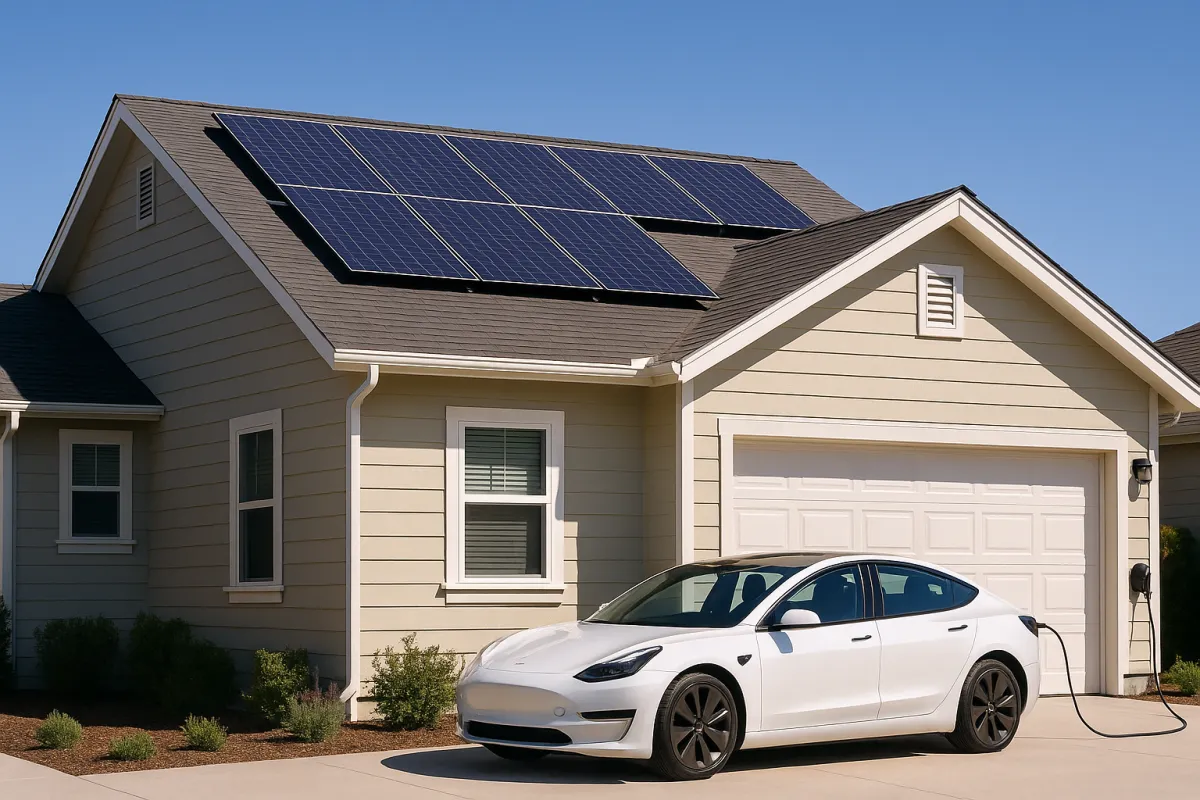
For households with rooftop solar, or plans for it, the charging cost question gains a second answer, and it can be the cheapest one of all. Electricity you generate and use yourself displaces power you would have bought at retail, so charging an EV from your own panels can drop the effective cost per mile toward the low single digits or even near zero for the self-consumed portion, depending on how your solar was financed and what your utility pays for exported power.
The catch is timing, and it is a real one. Solar output peaks at midday, precisely when most commuter cars are away from home earning their miles elsewhere. So the tidy image of a car sipping directly from the roof fits retirees, remote workers, and second cars far better than it fits a nine-to-five commuter, whose car is home to charge only after the sun is down. Where net metering credits your daytime export at a fair rate, the commuter still benefits: the solar bankrolls the overnight charging through the meter. Where export pays poorly, a home battery or a solar-aware charger that chases surplus in real time closes the gap, though that hardware deserves its own payback math rather than enthusiasm. The honest summary is that solar can make charging nearly free, but only if the timing of your generation and your plugging-in actually overlap, or your utility’s rules bridge them for you.
The no-home-charging reality
The illustrative cheap numbers in this teardown assume the thing a large minority of drivers lack: a place to charge at home. For apartment dwellers, street parkers, and anyone without a dedicated spot, the cost reality is honestly harder, and it deserves a straight accounting rather than a cheerful one. Leaning on public charging, especially DC fast charging, means living near the top bars of the earlier chart, at 12 to 15 cents a mile or more, which is where the EV’s fuel advantage narrows sharply and can disappear against an efficient gas car.
The number is not fixed, though, and the difference between a workable no-home-charging life and an expensive one is the charging mix. Our teardown of what a public charging station actually costs prices that life in detail, session by session and network by network, and is worth reading in full for anyone in this situation. A driver who anchors most miles on cheaper public Level 2 charging, workplace charging, or occasional access to a friend’s or relative’s outlet, and reserves DC fast charging for genuine need, can hold their blended cost far below an all-fast-charging figure. Some apartment complexes and workplaces are adding Level 2 with reasonable pricing, and right-to-charge rules in a growing list of places are slowly improving access, as our charger-install teardown covers for renters and condo owners. The essential move is to price your actual charging mix before buying the car, not after: the households that struggle with EV costs are rarely the ones without garages in the abstract, they are the ones who discovered their real charging mix at delivery.
Demand charges and rate plans
Two features of the electric bill can complicate the simple formula, and both reward a few minutes of attention. The first is the rate plan itself. Beyond the standard flat rate, many utilities offer time-of-use plans and dedicated EV plans that price overnight power much lower, which the off-peak section already crowned as the biggest lever. The catch is that time-of-use plans also price peak power higher, so the move only pays if your EV charging, and ideally your other big loads, genuinely shift off-peak. For an EV household that schedules overnight charging, it usually pays handily; for a household that cannot move its usage, it can backfire, which is why the enrollment decision deserves a look at your whole bill rather than the EV alone.
The second complication is demand charges, which mostly affect the price of public fast charging rather than your home bill. A demand charge bills based on the highest power draw in a period, and DC fast chargers pull enormous power, so networks often face steep demand charges that they pass through in their pricing. This is part of why public fast charging costs what it does, and why its price can vary by station, network, and time. At home, most residential customers are not billed demand charges at all, which is one more quiet reason the home-charged mile stays cheap. The practical step is to read your own rate schedule once, confirm whether an EV or time-of-use plan is available, and model it against your real usage in our cost calculator before switching.
The annual saving against a gas car
Stacking a year of charging against a year of gasoline is where the small per-mile gap turns into a number worth caring about. Take a driver covering 12,000 miles a year. At the illustrative home rate, that is about $540 of electricity; charged off-peak, closer to $290. The same 12,000 miles in a 30 mpg gas car at $3.50 a gallon is 400 gallons, about $1,400. So the annual fuel saving is roughly $860 charging at the standard home rate, and over $1,100 charging off-peak, every year the driver keeps driving.
Those savings are the recurring engine behind the break-even math in our EV ownership teardown, where the higher purchase price of an EV is slowly repaid by exactly this fuel gap. Scale it to a higher-mileage driver and the yearly saving grows past a thousand dollars easily; scale it to a thirstier gas car being replaced, and it grows again. The one scenario that erases it is the one this teardown keeps flagging: a driver who relies on public DC fast charging can spend as much as or more than the gas car they left, turning an $860 saving into roughly nothing. The saving, in other words, is not a property of the car. It is a property of the plug, the rate, and the miles, all three of which you control and can price in advance.
The five-year gap: home vs a charging station
The annual saving against gasoline gets the attention, but the quieter comparison, home charging against a public charging station for the same miles, compounds into a figure worth seeing on its own. The arithmetic is the same formula run twice. A driver covering 12,000 miles a year in a car using 30 kWh per 100 miles buys about 3,600 kWh annually. At an illustrative 15 cent home rate, that is roughly $540 a year and about $2,700 over five years. Buy the identical energy at a 45 cent DC fast-charging rate and the same five years cost about $8,100. The gap is roughly $5,400, kept or spent entirely by where the cable plugs in, and an off-peak home schedule stretches it past $6,000.
That five-year frame is worth holding onto because it reprices decisions that look small in the moment. A $25 fast-charging session against a $9 home charge reads as a minor convenience fee; the same habit repeated as a routine is a four-figure annual difference. It also puts the cost of building home charging in its true context: even a fully loaded charger install, priced in our charger-install teardown, is typically repaid several times over within that five-year window by the gap it unlocks. The full station side of the comparison, per-session pricing, network differences, memberships, and road-trip math, lives in our public charging station cost teardown. The short version is the one this section’s numbers already told: the station is a service you rent occasionally, and the driveway is where five years of cheap miles actually accumulate.
A year of charging by source
Most real owners do not charge exclusively one way; they charge mostly at home, sometimes on peak when they forget the schedule, and occasionally in public on trips. Seeing a realistic annual mix as one bar helps explain why a typical owner’s bill lands where it does, and where the money leaks.
A typical owner's year of charging, by source
Illustrative share of annual charging energy for a home-charging owner who travels occasionally.
Most of the year runs on the cheapest electrons, which is why a typical owner's bill stays low. The small public slice costs far more per mile than its share of energy suggests, and the peak-home slice is the one a charging schedule quietly recovers.
The mix explains the whole story. Because the large majority of energy comes from cheap home charging, the owner’s blended cost stays close to the home figure, not the public one. But notice that the small 15 percent public slice, priced at three or four times the home rate, costs far more than its share of energy implies, and the 20 percent home-peak slice is money left on the table by charging at the wrong hour. Both are recoverable: shifting the peak slice off-peak is a schedule setting, and trimming unnecessary public sessions is a habit. An owner who pushes their mix toward the leftmost segment is charging at the cheapest cost per mile a car can achieve, which is the practical goal every earlier section has been building toward.
A worked example: one commuter for a year
Numbers land harder as a story, so here is one driver run through three scenarios for a single year. She drives 12,000 miles, her EV uses 30 kWh per 100 miles, her home rate is 15 cents standard and 8 cents off-peak, and her old car was a 30 mpg sedan she fueled at $3.50 a gallon. The formula does the rest, and the three outcomes are strikingly far apart despite being the same car and the same miles.
Charging entirely at home on the standard rate, her year costs about $540. Setting an overnight schedule to catch the off-peak rate, the same year costs about $290, saving her roughly $250 for one evening of setup. Now run the pessimistic version: if she had no home charging and leaned on public DC fast charging at 45 cents per kWh, that same 12,000 miles would cost about $1,620, more than the gas car she replaced. Against the gas car’s $1,400 fuel year, home charging saves her about $860 on the standard rate and over $1,100 off-peak, while public-only charging would have cost her more than staying with gas. One driver, one car, one year, and a spread of well over a thousand dollars decided entirely by where and when she plugs in. Run your own version of her year in our cost calculator, and the abstract cents per mile become your actual annual number.
Common charging-cost mistakes
A few recurring errors distort people’s sense of what charging costs, in both directions.
- Quoting public fast-charging prices as if they were the norm. Fast charging is the expensive exception. Home charging, where most miles happen, costs a fraction of it, and conflating the two makes EVs look pricier to run than they are.
- Ignoring the off-peak rate. Charging on peak by default can nearly double the bill against an off-peak schedule you set once. It is the biggest lever and the easiest one to miss.
- Blaming battery size for a big charge cost. A large pack costs more to fill in one session but not more per mile. Cost per mile is efficiency times rate, full stop.
- Forgetting winter is temporary. A cold-weather efficiency hit reads as a permanent cost to new owners; it is a seasonal bump that reverses in spring.
- Calculating from the battery instead of the wall. The car’s own consumption display omits the roughly 10 percent charging loss the meter sees, so bill-based math should use from-the-wall figures.
Each mistake pushes the estimate toward a wrong conclusion, which is why the simple formula, run on your own rate and efficiency, beats any remembered rule of thumb.
The bottom line
Charging an EV at home is one of the cheapest fuels a car can run on, an illustrative 4 to 5 cents a mile at a common rate and often half that overnight, which turns a fuel bill that used to be large and visible into a small line on the electric statement. The whole thing reduces to one formula, kWh per 100 miles times your rate, and the biggest savings come from levers you fully control: charging off-peak, keeping public fast charging to trips, and knowing your car’s real efficiency. Against a typical gas car, that adds up to a several-hundred-dollar to four-figure saving every year, the recurring engine behind the ownership case our other teardowns build. Price your own miles, rate, and charging mix in our cost calculator, set the overnight schedule once, and the cheapest fuel station in town stays the one in your own garage.
This teardown is educational and independent, written by people who plainly enjoy the arithmetic, not by your utility or your accountant. Every cents-per-mile, monthly, and annual figure above is illustrative and will move with your electricity rate, your car’s real efficiency, the weather, the season, and the prices of gasoline and public charging where you live. Rate plans, time-of-use windows, demand charges, and any charging incentives differ by utility and region and change over time, so confirm your own tariff, your car’s consumption, and current fuel prices with the actual sources before you budget on any number here.
Frequently asked questions
How much does it cost to charge an EV at home?
Illustratively, at a common home rate of about 15 cents per kWh and a typical efficiency of 30 kWh per 100 miles, home charging costs roughly 4 to 5 cents per mile. For a driver covering 1,000 miles a month, that is about $45, and charging overnight on an off-peak rate can pull it closer to $25. The exact figure moves with your electricity rate, your car's efficiency, and the weather, but home charging almost always lands well under what the same miles cost in gasoline. The formula is simple enough to run yourself: kWh per 100 miles times your rate.
What is the cost per mile to charge an electric car?
Divide the cost of 100 miles of energy by 100. At 30 kWh per 100 miles and a 15 cent home rate, 100 miles costs about $4.50, so roughly 4.5 cents per mile, an illustrative figure. Off-peak overnight rates can drop that to around 2 to 3 cents, while public DC fast charging can push it to 12 to 15 cents or more. For comparison, a 30 mpg gas car at $3.50 a gallon costs about 11.7 cents per mile to fuel. Home charging is usually the cheapest fuel a car can run on.
Is it cheaper to charge an EV or buy gas?
For home charging, almost always cheaper, and often dramatically so. An illustrative home-charged mile at 4 to 5 cents sits well under a typical gas mile near 11 to 14 cents, which over a year of average driving is commonly a several-hundred-dollar to four-figure gap in the EV's favor. The comparison narrows sharply if you rely on public DC fast charging, which can cost as much as or more than gasoline per mile. So the honest answer depends less on the car than on where you plug it in, which is the theme this whole teardown keeps returning to.
How much does it cost to charge an EV per month?
It scales directly with your miles. Illustratively, at a 15 cent home rate and 30 kWh per 100 miles, expect about $23 a month at 500 miles, $45 at 1,000 miles, and $68 at 1,500 miles. Charging off-peak roughly halves those figures, while leaning on public fast charging can triple them. Because it is purely miles times cost-per-mile, your monthly charging bill is one of the more predictable numbers in car ownership once you know your rate and your driving.
Why is public charging so much more expensive than home charging?
Public DC fast charging commonly costs two to four times more per unit of energy than home charging, and sometimes more. The provider is paying for expensive high-power hardware, real estate, grid demand charges, and a margin, all of which load onto the per-kWh or per-minute price you see. Home charging carries none of that overhead: you pay your ordinary residential electricity rate, or a discounted overnight rate if your utility offers one. This is why the ownership case leans so heavily on home charging, a point we make in our EV ownership teardown, and why occasional road-trip fast charging is fine but everyday fast charging quietly erases the savings.
Does cold weather increase EV charging costs?
Yes, modestly and temporarily. In cold weather an EV uses more energy per mile, because heating the cabin and warming the battery draw power and the chemistry is less efficient, so winter efficiency commonly worsens by an illustrative 15 to 40 percent in harsh conditions. That raises your cost per mile for those months, not permanently. Preconditioning the car while it is still plugged in helps, since that energy comes from the wall rather than the battery. Averaged across a full year, the cold-weather premium is real but smaller than a bad week suggests.
Do you pay for charging losses when charging at home?
Yes, and it is already baked into the usual numbers. Charging is not perfectly efficient: roughly 10 percent of the energy drawn from the wall is lost as heat before it reaches the battery, so the kWh your meter counts is a little higher than the kWh the car stores. The common efficiency figure of around 30 kWh per 100 miles is typically a from-the-wall number, which means the losses are usually already inside the cost estimate rather than a surprise on top of it. If you calculate from the car's own battery-consumption display, add about 10 percent to reflect what the meter sees.
How much more does a charging station cost than charging at home over five years?
The gap compounds into real money. Illustratively, a driver covering 12,000 miles a year in a car using 30 kWh per 100 miles buys about 3,600 kWh annually. At a common 15 cent home rate that is roughly $540 a year, while the same energy at a 45 cent DC fast-charging rate runs about $1,620, a gap near $1,080 every year. Over five years that is roughly $5,400 kept by charging at home, and charging off-peak widens it further. The per-session difference feels small; the five-year difference is the price of a decent used car.
Does a bigger battery cost more to charge per mile?
No, and this is a common source of confusion. Cost per mile depends on efficiency, how many kWh the car uses to cover 100 miles, and your electricity rate, not on how big the battery is. A large battery costs more to fill from empty to full, because you are buying more kWh in one session, but it also drives farther on that fill, so the cost per mile is unchanged. Battery size sets your range and your maximum single-charge bill; efficiency and your rate set what each mile actually costs.