What's in this teardown
- What Is Regenerative Braking?
- How Regenerative Braking Works, Step by Step
- The Physics, Without the Jargon
- The Motor That Becomes a Generator
- Where the Energy Goes: Back Into the Battery
- Regen Versus Friction Brakes: The Blended System
- Regen, Engine Braking, and Friction Braking Compared
- One-Pedal Driving: How to Actually Use It
- Regen Levels and What to Set Them To
- How Much Energy Regen Actually Recovers
- Regenerative Braking Efficiency: What the Number Actually Means
- Regenerative Braking and Range
- Does Regen Mean Your Brake Pads Never Wear Out?
- Why Regen Weakens in Cold Weather and at a Full Battery
- Hard Stops, Emergencies, and Why the Friction Brakes Stay
- Where a Stop’s Energy Goes
- Reading Regen on the Dashboard
- Does Regen Work on Every EV and Hybrid?
- How to Turn Regenerative Braking Off, or Down
- The Proper Technique for Using Regenerative Braking
- Regen on Long Descents and Mountain Roads
- Regen and Efficient Driving Habits
- Regen, Traction, and Low-Grip Roads
- Common Misconceptions About Regenerative Braking
- A Worked Example: A Week of City Driving
- Common Mistakes and How to Think About Regen
- The Bottom Line
Short answer: Regenerative braking slows an electric or hybrid vehicle by running the drive motor backward as a generator. The turning wheels spin the motor, it produces current, and that current flows into the battery instead of being lost as brake heat. The torque needed to generate is the deceleration you feel when you lift off. It recovers waste energy rather than creating free range, and it weakens when the pack is full or cold.
Regenerative braking has one answer that covers both of the questions drivers arrive with, what is regenerative braking and how does regenerative braking work: the drive motor runs backward as a generator, so slowing the car pushes electricity into the battery instead of scrubbing the motion off as brake heat. That is why an electric car begins slowing the instant you lift off the accelerator, before your foot ever reaches the brake pedal. The vehicle sheds speed firmly and smoothly, and the range estimate on the dashboard holds steady or even climbs while it happens. What you are feeling is that conversion happening under you rather than a pad squeezing a disc. It is one of the reasons electric driving feels different from anything with an engine, and it is far simpler than the engineering name suggests.
This teardown covers what regenerative braking is, the mechanism that makes it work, and everything practical that follows from it: one-pedal driving and how to actually use it, what to set the regen level to, what it does and does not do for your brake pads, and the two honest limits, a cold battery and a full one. It also covers the safety line that matters, which is that regen handles routine slowing while the friction brakes remain the system you use for a hard stop. You can put your own mileage and electricity rate into our EV charging cost calculator to see the running-cost side of the same efficiency.
Key takeaways
- Regenerative braking slows the vehicle by running the drive motor backward as a generator, converting kinetic energy into electricity that flows into the battery instead of into brake heat.
- The same motor does both jobs: it drives the wheels on the way up to speed and generates on the way down, and the torque it produces while generating is the deceleration you feel.
- One-pedal driving is regen turned up far enough that lifting off slows the vehicle firmly, often to a stop, so the brake pedal becomes a reserve rather than an everyday control.
- The efficiency gain is illustrative and route-dependent, roughly 5 to 10 percent for highway-heavy driving and roughly 20 to 25 percent for stop and go city use.
- Regen weakens when the battery is full or cold, because a pack with no room or low temperature cannot accept charge, and it is never the system to rely on for an emergency stop.
What Is Regenerative Braking?
Regenerative braking is a way of slowing a vehicle that turns its motion back into electricity and stores it in the battery, instead of wasting it as heat in the brakes. It works because the electric motor that drives the wheels can be run the other way as a generator: the rolling wheels spin it, it produces current, and the effort of producing that current is felt at the wheels as deceleration. Every battery-electric vehicle and every hybrid has it, which is why an electric car begins slowing the moment you lift off the accelerator, before your foot reaches the brake pedal.
That is the whole answer, and the physical picture behind it is short. A moving vehicle carries kinetic energy proportional to its mass and to the square of its speed, and slowing down means getting rid of that energy somehow. A car with only friction brakes gets rid of it by pressing pads against spinning discs until the energy has all turned into heat, which radiates into the air and is gone. A vehicle with a traction motor and a battery has a second option: turn the motor into a generator and convert the motion into electricity that the pack can absorb.
You will see it under several names, and they all point at the same hardware. Regen braking is the everyday shorthand, shortened again to regen brakes in conversation and sometimes typed as two words, re gen braking. Energy recuperation is the phrase some manufacturers prefer. Regenerative brakes are not an extra set of brakes bolted to the axle: the phrase describes the drive motor doing the slowing, and the B position on a gear selector is a regen setting rather than a separate braking system. Drivers coming from a manual gearbox often describe the feel as engine braking that charges the battery, which is a fair first impression, and the section below sets out where that comparison holds and where it breaks down.
The word regenerative points at exactly that, the regeneration of usable energy from motion that would otherwise be wasted, which is also how fueleconomy.gov’s breakdown of where an electric car’s energy goes describes it. It is not an extra component bolted onto the drivetrain, and it is not a separate braking system with its own hardware. It is the drive motor, the power electronics and the battery already in the vehicle, operated in the opposite direction, the same components the DOE Alternative Fuels Data Center’s overview of how all-electric cars work lists. That is why regen is standard on essentially every electric vehicle and every hybrid: once you have a motor and a pack, the capability comes almost for free.
Two things follow immediately, and the rest of this teardown is mostly detail hung on them. First, regen only works when you are slowing down, so its benefit scales with how much slowing your driving contains. Second, it depends on the battery being willing to take the charge, so anything that limits charge acceptance, a full pack or a cold one, limits regen as well. Everything from one-pedal driving to the odd weak-regen morning traces back to those two facts.
How Regenerative Braking Works, Step by Step
How do regenerative brakes work, moment to moment? Here is the sequence, in order, from the moment your foot moves. You lift off the accelerator or press the brake pedal. The vehicle interprets that as a request for a certain amount of deceleration. The controller decides how much of that request the motor can supply, checking how much power the battery can accept right now given its state of charge and temperature. It commands the motor to generate at that level, and if the request exceeds what the motor can deliver, it blends in the friction brakes to make up the shortfall.
The motor then does the physical work. The wheels are still turning, and they are geared to the rotor, so the rotor is being spun mechanically. The power electronics change what they ask of the windings, and instead of pushing current in to create motion, they draw current out of the motion. Producing that current requires torque, and that torque acts against the direction of rotation, which slows the wheels. The current is conditioned to the right voltage and fed into the battery, where it is stored chemically exactly as if it had come from a charger.
The loop closes when you accelerate again and spend that stored charge. Nothing exotic happens at any step, and there is no separate regen hardware to fail. That is also why regen behaves so consistently in normal conditions and so noticeably differently when the battery is at an extreme of charge or temperature: the limiting factor is almost never the motor, it is what the pack will accept.
The Physics, Without the Jargon
The principle underneath is older than electric cars and genuinely simple: a motor and a generator are the same machine. Feed electricity into it and it produces motion. Feed motion into it and it produces electricity. A rotating magnetic field and a conductor moving relative to each other will produce current in one direction and torque in the other, and which one you get depends only on what the electronics ask for. The motor that pushes the vehicle forward is the same device that, spun by the wheels, produces the current flowing back to the pack.
Energy is never created or destroyed, only moved between forms, and that is the frame that makes regen make sense. Accelerating turns chemical energy in the battery into electrical energy, then into the kinetic energy of a heavy moving object. That kinetic energy has to go somewhere when you slow. In a petrol car it becomes heat in the brake discs, every joule of it, which is why racing brakes glow. In an electric vehicle a large share of it becomes electrical energy again and then chemical energy in the pack, ready to be spent a second time.
The rest still becomes heat, and this is the honest part. Some is lost to air resistance and rolling resistance while you are slowing, some to the friction brakes whenever they assist, and some to the unavoidable inefficiency of two conversions. Nothing here is close to perpetual motion. Regen simply recovers a fraction of what a petrol car wastes entirely, and that fraction, repeated over every deceleration of a driving day, is the entire benefit.
The Motor That Becomes a Generator
The traction motor is the heart of the mechanism, and understanding that it plays two roles removes most of the mystery. Under acceleration, the inverter feeds alternating current into the motor windings to create a rotating magnetic field, and the rotor follows that field and turns the wheels. To brake regeneratively, the inverter changes the relationship between the field and the rotor so that the rotor, driven mechanically by the wheels, induces current in the windings rather than following them.
Inducing that current is not free. It takes mechanical work, drawn from the only source available, which is the momentum of the vehicle. That work is felt at the wheels as braking torque, a drag that slows you. The more current the electronics pull, the stronger the torque and the harder the deceleration, which is exactly how a vehicle varies regen strength. A light lift produces a gentle slowing. A full lift in an aggressive setting produces firm deceleration that feels close to moderate brake pressure.
That variability is also why regen strength can be a software setting rather than a hardware choice. The vehicle is not switching between components when you change regen levels, it is changing how much current the inverter is instructed to draw on lift-off. The energy this recovers over a year is enough to notice on the electricity bill, and it stacks with the other efficiencies of an electric drivetrain. Our charging cost teardown prices what a mile of electricity actually costs, and regen is one reason that number sits lower than it otherwise would.
Where the Energy Goes: Back Into the Battery
The recovered energy does not disappear into a mystery box. It goes to the same place a charger fills, the traction battery. As the motor generates during braking, the power electronics manage voltage and current so the pack can safely accept the charge, and the state of charge rises by a small amount. On a long descent the effect becomes visible rather than theoretical, with the range estimate creeping upward as the vehicle holds speed downhill under regen, effectively banking the potential energy of the hill.
The reason regen can never fully recharge a vehicle is the same reason a dropped ball never bounces back to the height it started from. You lose energy at every stage: to aerodynamic drag while moving, to rolling resistance in the tires, to friction-brake heat whenever the pads assist, and to the round-trip inefficiency of converting motion to electricity and back into stored charge. Add to that the fact that accelerating a heavy object costs more energy than decelerating it can ever return, and the ceiling is obvious.
That ceiling still leaves a real gain. It is also the reason for one of the more counterintuitive facts of electric ownership, that many electric vehicles are more efficient in town than on the open road, the reverse of a petrol car. In town you brake constantly and regen works constantly. On the motorway you hold a steady speed, regen does almost nothing, and aerodynamic drag rises with the square of speed. Our range teardown leans on that asymmetry directly.
Regen Versus Friction Brakes: The Blended System
An electric vehicle keeps its conventional friction brakes, pads and discs at each wheel, and it does use them, so it is worth being precise about how the two systems share the work. For ordinary slowing the vehicle prefers regen, because regen recovers energy and spares the pads. When you press the brake pedal gently, many electric vehicles deliver that deceleration entirely through the motor and never touch the pads at all, calling in friction only when you ask for more deceleration than the motor can supply, or when the pack cannot accept the charge.
That handover is called blending, and it is handled by the brake controller in a fraction of a second, invisibly. Blending exists for a specific reason: the amount of braking the motor can provide is not constant, but the amount of braking the driver asks for has to feel constant. If the pedal produced weak deceleration on a full battery and strong deceleration on a half-empty one, the vehicle would be unpredictable and unsafe. So the controller continuously tops up whatever the motor cannot supply with friction, and the pedal feels the same either way.
The practical result is that the friction brakes become a reserve and a safety backstop rather than the everyday tool. They are always available, they do not depend on the battery, and they are what actually stops you in a hard stop. That reserve role is why they last so long, which is a genuine ownership saving that our maintenance teardown counts among the reasons electric vehicles cost less to keep running.
Regen, Engine Braking, and Friction Braking Compared
Three different mechanisms can slow a car, and the fastest way to understand regen is to line it up against the other two. All three take kinetic energy out of the vehicle. What separates them is which component does the converting, what form the energy takes afterwards, and which parts pay for it in wear.
| Braking method | What converts the energy | Where the energy ends up | What wears |
|---|---|---|---|
| Regenerative braking | The drive motor, spun by the turning wheels and run as a generator | Back into the battery as stored charge, minus the losses of converting it twice | Almost nothing mechanical, since the motor and inverter are doing their ordinary work |
| Engine braking | A petrol or diesel engine pumping and compressing air against a closed throttle | Heat in the engine and out through the exhaust, gone for good | Little in practice, though the engine and transmission carry the load instead of the brakes |
| Friction braking | Pads clamped against spinning discs | Heat radiated from the discs into the air, gone for good | Pads and discs, which is why both are consumables with a service interval |
Read across the middle column and the whole difference is there. Engine braking and friction braking are both ways of turning motion into heat and letting the air take it away. Regenerative braking is the only one of the three that puts the energy somewhere you can spend it again. That is the entire reason the technology exists, and it is why a battery-electric vehicle has no equivalent of engine braking to fall back on: the motor does that job, and it does it profitably.
The comparison also explains a piece of vocabulary. Manufacturers borrowed the B position on the gear selector from automatic transmissions, where it selected a lower ratio for more engine braking on a descent. In an electric vehicle the same lever raises regen instead, so the driver’s habit transfers even though the mechanism underneath is entirely different. If your instinct on a long hill is to drop a gear, a high regen level is the equivalent move, and the descents section further down covers how that plays out over a sustained grade.
A hybrid is the interesting middle case, because it has all three. It regenerates through the traction motor, it can engine brake through its petrol engine, and it has conventional friction brakes underneath. The control software chooses among them, which is why hybrid braking often feels less distinct than the firm lift-off deceleration of a battery-electric car. Our drivetrain explainer covers how the electric side of that arrangement is put together, and our hybrid comparison covers the ownership differences that follow from it.
One line in the table matters more than the rest for safety. Only friction braking is independent of the battery. Regen depends on a pack that can accept charge, so it can be reduced by cold or by a full battery, and engine braking does not exist in a battery-electric car at all. The pads and discs are the layer that always works, at any temperature and any state of charge, which is why they remain the system you use for a hard stop.
One-Pedal Driving: How to Actually Use It
One-pedal driving is regen turned up far enough that lifting off the accelerator slows the vehicle firmly, and on many models brings it to a complete, held stop, so in ordinary traffic you control speed almost entirely with a single pedal. Press to go, ease off to slow, lift fully to stop. The brake pedal is still there and still works exactly as it always did. You simply need it far less often, and in a calm day of city driving you may barely touch it.
Using it well is a technique, and it is learnable in about a week. Start by driving somewhere quiet and finding the neutral point, the accelerator position where the vehicle neither accelerates nor decelerates. Everything above that is power and everything below it is braking, and the whole skill is learning to move smoothly through that point rather than jumping across it. New drivers describe the first few minutes as lurchy, and what is actually happening is that they are stepping over the neutral point instead of passing through it.
Then work on distance rather than pressure. In a petrol car you hold speed and then brake. In one-pedal driving you decide how far ahead you want to stop and start easing off at that distance, letting the deceleration curve carry you in. Aim to arrive at walking pace without any late correction. Two practical notes: the brake lights do illuminate when lift-off deceleration is strong enough, so following drivers are warned, and you should still cover the brake pedal in traffic exactly as you would in any other vehicle, because covering it costs nothing and saves reaction time.
Regen Levels and What to Set Them To
Regen strength is adjustable on most electric vehicles, and the controls take a few common forms. Some expose named levels in a menu, from a light coast-heavy setting up to a strong one-pedal setting. Some use steering-wheel paddles that step through levels on the move, the way you would downshift a manual gearbox for engine braking. Some add a separate drive position, often labelled B for brake, that raises regen across the board. Some offer an adaptive mode that varies regen using navigation data and forward sensors, easing off when the road ahead is clear.
The honest starting recommendation is the strongest setting you find comfortable, and comfort is the real constraint rather than efficiency. Here is why: the efficiency difference between a moderate and a strong regen level is smaller than most people expect, because the brake pedal is blended anyway. On a light setting you coast further and then press the pedal, and that pedal press still recovers energy. What actually changes between levels is how often your foot moves and how the deceleration feels, not the fundamental efficiency of the vehicle.
So set it by situation. Strong or one-pedal is the best default for city and suburban driving, where you decelerate constantly and the reduced pedal shuffling is genuinely restful. A lighter setting suits long motorway runs, where lift-off deceleration mostly gets in the way of holding a steady speed, and it suits passengers who find firm lift-off deceleration unsettling. A lighter setting is also the more comfortable choice on ice, snow or gravel, for reasons covered below. Check once whether your vehicle remembers the level between drives or resets it, because rediscovering that at a junction is unpleasant.
How Much Energy Regen Actually Recovers
The honest answer is a range rather than a figure, because it depends almost entirely on how much slowing your driving involves. Regen only recovers energy when you decelerate. On a steady motorway cruise where you rarely brake, it contributes almost nothing, and the vehicle’s efficiency comes from the absence of idling losses and from drivetrain efficiency instead. In dense town traffic, where you decelerate on nearly every block, regen works constantly and its contribution is at its largest.
As an illustrative shape rather than a measured result, picture something like 5 to 10 percent better overall efficiency in highway-heavy driving and something like 20 to 25 percent in stop and go city use, with mixed driving between the two. Those numbers are used here to make the pattern concrete, not because any single figure applies to a particular car. Those are rough ballparks rather than specifications, and they move with vehicle design, gearing, mass, terrain, tire choice, ambient temperature and driving style. Treat the direction as reliable and the number as approximate: the more you slow down, the more regen gives back.
Illustrative efficiency gain from regeneration, by driving pattern
Rough gain versus an equivalent vehicle with no regeneration. Varies with vehicle, terrain and temperature.
Bar widths are the raw ratio of the illustrative gains. Regen pays off most where you brake most, which is why an electric vehicle's city efficiency can beat its highway efficiency, the reverse of a petrol car.
One number worth being suspicious of is any claim that regen recovers a fixed percentage of a specific vehicle’s energy. That figure cannot exist independently of a route. The same vehicle driven on a flat motorway and driven through a hilly town centre will show wildly different regen contributions, and a manufacturer quoting one number is quoting it against one test cycle. The mechanism is what transfers between vehicles, not the percentage.
Regenerative Braking Efficiency: What the Number Actually Means
Searches for regenerative braking efficiency usually get answered with a single percentage, and that is the wrong shape of answer, because the word efficiency is doing three separate jobs. Sorting them out is more useful than any figure. The first meaning is the capture share of a single stop: of the kinetic energy the vehicle has to shed, how much does the motor take and how much goes to the pads. The second is round-trip efficiency: of the energy the motor captured, how much survives being stored and then spent again on the road. The third is the route-level gain: how much less energy a whole journey needs compared with the same vehicle with no regen at all. Two people can quote honest numbers and still disagree, because they are answering different questions.
The reason none of the three reaches 100 percent is a chain of losses, and it is worth walking down it in order. Before anything can be captured, air resistance and rolling resistance are already removing energy from the vehicle, and that share never reaches the motor at all. What does reach the motor is converted from rotation into current, and some of it becomes heat in the windings on the way. The inverter conditioning that current takes another small cut in switching losses. The battery then absorbs the rest through its own internal resistance, which is part of why a pack warms while it charges. Later, when you spend that stored energy again, it travels back out through the same components and pays the same kind of toll a second time.
That chain sets the ceiling, and the ceiling is not set by the motor. In everyday driving the binding constraint is almost always how much power the battery is willing to accept at that instant, which depends on its state of charge and its temperature. A warm pack with room in it will take everything a gentle stop offers. A full pack or a cold one will not, so the controller sends the surplus to the friction brakes and the capture share collapses, regardless of how good the motor is. That is the same mechanism described in the cold and full battery section, seen from the efficiency side.
Three habits move the number in your favour, and they are all free. Slowing gently over a longer distance keeps the deceleration demand inside what the motor alone can supply, so the pads never take a share of it. Keeping the pack warm in winter, by preconditioning on the plug, restores its willingness to accept charge from the first mile. And leaving headroom rather than charging to the top means the battery has somewhere to put the energy on your first descent of the day. Our range teardown treats those as part of the same efficiency toolkit as speed management and tire pressure.
Three things pull it the other way. Late, hard braking demands more deceleration than the motor can supply and dumps the difference into the discs as heat. Sustained high speed means a large part of your energy is going to aerodynamic drag, which regen can never recover because it was never in the wheels to begin with. And cold weather works on two fronts at once, since a cold pack accepts less regen while the cabin is drawing power to heat itself. That second front is a different lever with a different fix: our heat pump explainer covers why some vehicles pay far less for cabin warmth than others, and our cold-weather teardown covers the combined winter effect.
So the honest answer to how efficient regenerative braking is comes in two parts. As a mechanism it is good, and much better than throwing the energy away, because a motor running as a generator and a battery accepting charge are both reasonably efficient devices and the alternative recovers nothing at all. As a number it is not a property of the car, it is a property of the car plus the route plus the weather plus the driver, which is why a manufacturer quoting one figure is quoting it against one test cycle. If you want your own version, the trip computer is the instrument that will tell you: drive the same commute for a week deliberately smoothly, compare the efficiency readout against a normal week, and the difference is your regen efficiency in the only units that matter. You can price that difference at your own electricity rate in our cost calculator.
Regenerative Braking and Range
Because regen recovers energy, it directly extends how far a charge takes you, and the effect is largest in exactly the driving where a petrol car does worst. Every deceleration you would otherwise waste becomes a small deposit back into the pack, so a day of town errands stretches further than the raw energy of all that accelerating would suggest. This is not a marketing claim, it is visible in the trip computer, which is why efficiency-minded drivers pay attention to how smoothly they can let the vehicle slow.
The range benefit is also why driving style matters more in an electric vehicle than people expect. Smooth, anticipatory driving that lets regen do the slowing recovers more than late, hard braking that forces the friction brakes to dump energy as heat. Coasting toward a red light, easing off early, and reading the road well ahead all convert into recovered kilowatt-hours and extra miles. Our range teardown treats regen technique as one of the free levers on range, alongside speed, climate use and tire pressure.
None of those levers buys a bigger battery, and none of them is dramatic on its own. Together they meaningfully change how far a given charge goes, and the effect compounds over a year of driving. You can see the cost side of those recovered miles in our cost calculator, which prices the energy you did not have to buy back.
Does Regen Mean Your Brake Pads Never Wear Out?
Not never, but far more slowly than in a petrol car, and the reason is straightforward. Wear on a pad is a function of how much energy it has been asked to absorb. If regen handles the large majority of everyday slowing, the pads absorb only the remainder: hard stops, very low speeds where regen fades toward a standstill, and whatever the vehicle needs when the pack cannot accept charge. That is a small fraction of the work the same pads would do in an equivalent petrol car, so they last a long time.
How long is exactly the kind of number worth refusing to invent. Pad life depends on the vehicle’s blending strategy, its mass, the pad compound, the terrain you drive and how you drive it, and any single figure would be a guess dressed as a specification. The defensible statement is directional: friction brake pads and discs on an electric vehicle typically last substantially longer than on a comparable petrol car, and many owners find brake replacement is not a routine service item in the way they were used to. Your own inspection record is a better guide than any published multiple.

There is a real flip side. Brakes that are rarely used can develop light surface corrosion on the discs, particularly in humid climates or where roads are salted in winter, and calipers that never work hard can seize or stick if they are not maintained. This is why service inspections still check that calipers slide freely, and why many owners deliberately make an occasional firm stop from moderate speed on a clear road to clean and bed the disc surfaces. It is a small caveat against a large saving, and our maintenance teardown folds reduced brake wear into the wider picture, alongside the faster tire wear that partly offsets it.
Why Regen Weakens in Cold Weather and at a Full Battery
These two situations feel completely different from behind the wheel and have exactly the same cause: the battery cannot accept the charge, so there is nowhere for the recovered energy to go, so the vehicle reduces regen and asks the friction brakes to make up the difference. Understanding that single cause explains both, and explains why neither is a fault.
A full battery is the simpler case. Charge to 100 percent and the pack has no room. Regenerating into it would push cells above their safe voltage, so the vehicle limits or disables regen until you have used enough charge to open space. You notice it immediately, as the vehicle failing to slow on lift-off the way it normally does, often with a dashboard note. It clears itself within a few miles. This is one practical argument for the common daily-charging habit of stopping around 80 or 90 percent rather than 100: it leaves headroom for regen from the first mile, so the vehicle behaves consistently. If you do charge to full before a trip that starts downhill, expect weak regen and plan your braking accordingly.
Cold is the other case, and it is about rate rather than room. A cold battery accepts charge more slowly, because the chemistry that moves ions between electrodes is sluggish at low temperature and forcing charge in anyway risks lithium plating and permanent damage. The management system therefore caps how much power the pack will take, and since regeneration is charging, regen gets capped with it. On a genuinely cold morning you may have almost no lift-off deceleration for the first few miles, then feel it return progressively as the pack warms from use.
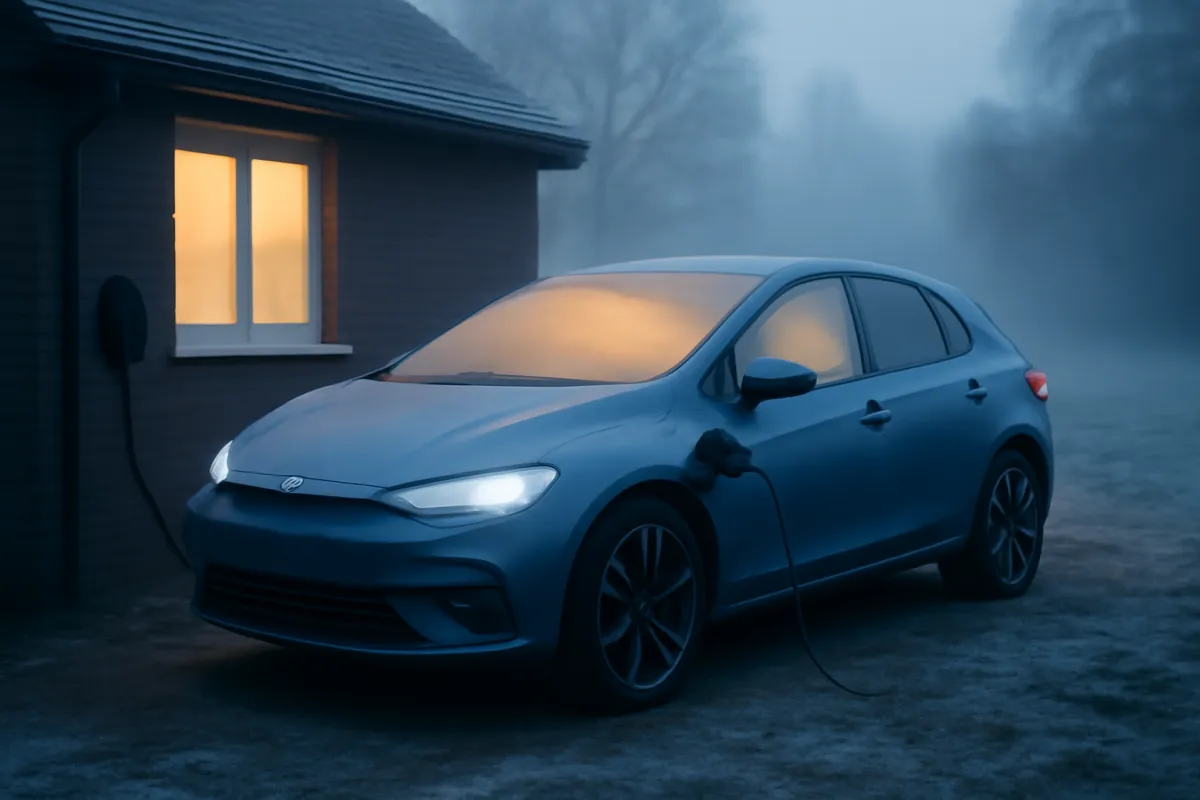
The countermeasure is preconditioning, which is the same habit that helps cold-weather charging speed. Warming the pack while the vehicle is still plugged in brings it to a temperature where it can accept regen normally, so you get your usual deceleration back from the first mile and recover more energy on the way. Our preconditioning walkthrough covers how to set it up, and our cold-weather range teardown covers the wider winter picture, of which reduced regen is one part. Until the pack warms, leave more braking distance than usual and use the pedal earlier.
Hard Stops, Emergencies, and Why the Friction Brakes Stay
Regen is an everyday braking tool, not an emergency one, and the distinction matters for safety. The braking force a motor can produce is bounded by the motor’s torque capability and by how much power the battery will accept, and it is generally well below the maximum stopping force the friction brakes can apply when you stand on the pedal. For a hard stop, a sudden hazard, or anything needing maximum deceleration, the friction brakes do the work, blending in instantly and automatically the moment you press the pedal firmly.
Use the brake pedal for anything urgent, exactly as you would in any other vehicle, and press it hard. Do not attempt to manage an emergency by lifting off and waiting for regen. Do not treat one-pedal driving as a reason to move your foot away from the brake pedal in dense traffic. And never look for a way to reduce or defeat the friction braking system; it is the safety-critical path and it is designed to work regardless of battery state, temperature or charge level.
This division of labour is deliberate and is a good thing. The friction brakes are proven, powerful and always available, so they cover every case regen cannot: emergencies, very low speeds near a standstill, a full or cold pack, and any fault in the electrical system. Regen handles the routine, friction handles the extreme, and the safety-critical function always has a mechanical path that does not depend on the battery being able to take charge. The upshot is that you get the efficiency and reduced wear of regen without giving up stopping power.
Where a Stop’s Energy Goes
It helps to picture where the energy of a single moderate braking event ends up, because it makes the recovery concrete. When you slow under blended braking, a share of the vehicle’s kinetic energy is captured by the motor and returned to the pack, while the rest is lost: some to the friction brakes when they assist, and some to the unavoidable inefficiency of converting motion into electricity and then into stored charge.
Illustrative split of the energy in one moderate stop
A gentle deceleration on a warm battery with room to accept charge. Illustrative only, not measured figures.
Illustrative only. On a gentle stop with a warm, not-full pack, most of the energy returns to the battery. A hard stop, a cold pack or a full one shifts far more of it into friction-brake heat.
The important reading of that chart is that the split is not fixed, and no vehicle has a single true version of it. A gentle stop on a warm, half-full pack sends most of the energy back. A hard stop, a cold pack or a nearly full one shifts the balance heavily toward friction-brake heat, because the battery cannot absorb regen fast enough to take the load. This is precisely why smooth, anticipatory driving recovers more than late, hard braking, and why the range benefit of regen is really a benefit of driving in a way that lets regen work.
Reading Regen on the Dashboard
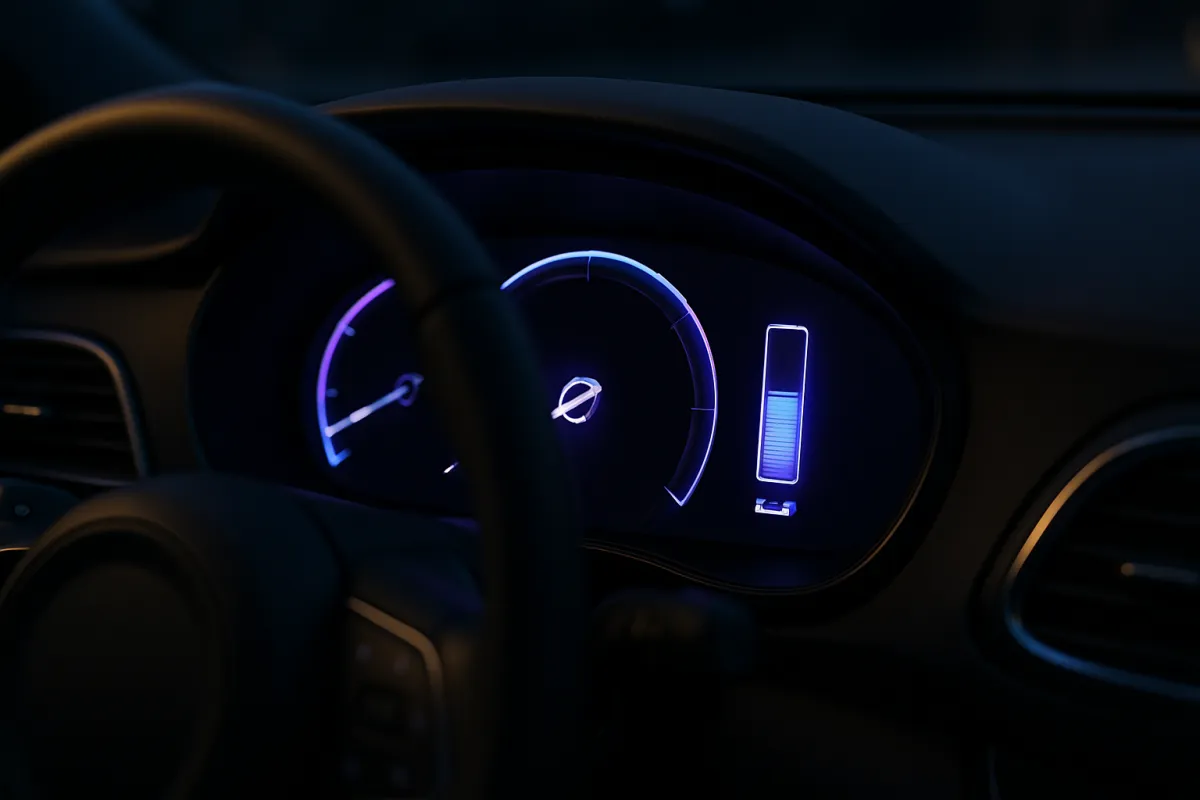
Most electric vehicles make regen visible, and learning to read the display turns an abstract mechanism into a driving feedback loop. The common design is a power gauge or an energy-flow animation. As you accelerate, the needle or bar swings toward power and energy flows from battery to wheels. As you lift off or brake, the flow reverses and the gauge swings toward charge or regen, often with a kilowatt figure showing what is flowing back. Some vehicles use a green zone or a plus sign for the recovery region.
Watching that display is the fastest way to develop an efficient style, because it rewards smoothness in real time and punishes lateness immediately. You quickly learn that easing off early keeps the gauge in the recovery zone all the way to a stop, while holding speed and braking late spikes the friction brakes and wastes energy you could have banked. Most people internalise the feedback within a few drives and stop needing to look at it.
The longer-term confirmation is the trip computer’s efficiency readout, in miles per kilowatt-hour or kilowatt-hours per hundred miles. Compare a week of deliberately smooth driving against a week of normal driving on the same commute and the difference is usually visible. That is the same instinct our range teardown encourages: using the vehicle’s own instruments to drive in the way that stretches a charge furthest.
Does Regen Work on Every EV and Hybrid?
Regeneration is present on essentially every modern electric vehicle and every hybrid, because it is inseparable from having a traction motor and a battery, but strength and feel vary widely. Battery-electric vehicles generally have the strongest regen, because a large pack can accept a lot of recovered power at once, which is what makes true one-pedal driving to a full stop possible. Hybrids and plug-in hybrids also use regen heavily, and it is a large part of why a hybrid is so much more efficient than a petrol-only car in town.
Hybrid regen usually feels gentler, and there are two reasons. A smaller pack accepts less power, so the peak regen torque is lower. And a hybrid has to blend regen with an engine and with a brake pedal tuned to feel conventional, so manufacturers often bias toward a familiar feel rather than a distinctive one. That does not mean a hybrid recovers little; it means the recovery is happening more through the brake pedal and less through lift-off.
Petrol-only cars have no regeneration at all, because there is no traction battery to store the recovered energy, so every braking event ends as heat. If you are cross-shopping, the feel of regen is worth testing on a drive, because it shapes the daily experience of a vehicle as much as acceleration does. Our electric drivetrain explainer covers the rest of what is different underneath.
How to Turn Regenerative Braking Off, or Down
This comes up constantly, usually from someone who has just switched and dislikes the vehicle slowing hard the moment they lift off. It is worth separating two different requests, because only one of them is generally possible.
Reducing regen, or switching off one-pedal driving, is normally available. Most electric and hybrid vehicles expose a setting. The names vary: a regen level, a low and standard choice, a creep or roll setting, a B position on the gear selector, or steering-wheel paddles that step through levels on the move. Turning it to the lowest setting makes the vehicle coast when you lift off, much like an automatic petrol car, and the friction brakes then do the work when you press the pedal.
Switching regeneration off entirely is usually not possible, and would not be desirable. On most electric vehicles the brake pedal itself is blended: pressing it recovers energy first and calls in friction as needed. That blending is not a driver setting, and it is where a large share of the total recovery happens. So even at the lowest regen level, the vehicle is still recovering energy every time you brake. What you have turned down is the lift-off deceleration, not regeneration as a whole.
Where the setting lives depends entirely on the vehicle, and menu layouts change between software versions, so the owner manual for your exact model year is the authority rather than any general instruction. As a rule it sits in the driving or pedal section of the vehicle settings, or on the gear selector for vehicles using a B position. Two practical notes. Reducing regen slightly reduces efficiency, though less than people assume because the pedal stays blended. And some vehicles remember the setting between drives while others reset to a default, which is worth checking once.
The Proper Technique for Using Regenerative Braking
There is a technique, it is learnable in a week, and it is where the efficiency actually comes from.
Lift early rather than braking hard. Anticipation is the single biggest gain. Seeing a red light four hundred metres out and easing off then recovers far more energy than arriving at speed and braking firmly. Hard deceleration exceeds what the motor can absorb and calls in the friction brakes, which turn that energy into heat and lose it.
Let the vehicle do the stopping where it can. Where strong one-pedal driving is available, modulating the accelerator to a smooth halt is both the most efficient method and, once learned, the most comfortable in traffic.
Use the brake pedal without guilt when you need it. The pedal is blended, so pressing it gently recovers energy too. The pattern to avoid is holding speed late and then braking hard, not the pedal itself. In anything urgent, press it firmly and without hesitation.
Keep it smooth for passengers. Aggressive lift-off deceleration is the most common complaint from people riding in an electric vehicle for the first time. Smoothness and efficiency point in the same direction here, which is convenient.
Adjust to conditions. Lower the regen level in low-grip conditions and in heavy motorway cruising. Expect weak regen for the first few miles on a freezing morning and leave extra braking distance until it returns.
Use the terrain. On a long descent, regen both recovers energy and holds speed without heating the brakes, which is where the system earns its keep most clearly.
The mistake worth naming is treating regen as a braking system to rely on in an emergency. It is not. For any sudden stop, press the brake pedal firmly, exactly as in any other vehicle. Our efficiency teardown covers where the rest of the range gains come from.
Regen on Long Descents and Mountain Roads
Descents are where regen is at its most useful and its most instructive. On a long grade, gravity is continuously adding kinetic energy that you have to keep removing, and in a petrol car that means either riding the brakes, which heats them toward fade, or holding a low gear so the engine absorbs it. In an electric vehicle a high regen level does the same job as engine braking, except that the energy goes into the pack instead of into heat, and the discs stay cold.
This is the situation where switching to the strongest regen level or the B position genuinely changes the outcome rather than just the feel. It holds speed on the grade with little or no pedal input, it keeps the friction brakes in reserve for a hard stop, and the state of charge visibly climbs. Long alpine descents are one of the few real-world cases where regen returns a large absolute amount of energy in a short time, because you are converting a large drop in altitude.
There is one predictable limit, and it is the full-battery case again. If you start a long descent with a nearly full pack, the vehicle will have very little room to regenerate and will hand more of the work to the friction brakes, sometimes with a warning that regen is limited. If you know a big descent is coming, arriving at the top with room in the pack rather than at 100 percent is the practical move, both for the recovered energy and to keep the brakes cool.
Regen and Efficient Driving Habits
Because regen rewards smoothness, it quietly teaches a more efficient style, and leaning into that is the closest thing to free extra range. The habits are simple: look well ahead, ease off early when you see a stop coming, and let regen bleed off speed gradually rather than holding speed and braking hard at the last moment. Each gentle deceleration banks energy, and over a day of driving the deposits add up. Late, hard braking does the opposite, dumping energy into the pads as heat that regen never gets to capture.
This is why two drivers in the same vehicle can see meaningfully different range from the same charge. The efficient driver anticipates, keeps steady moderate speeds and lets regen do the slowing. The aggressive driver accelerates hard, brakes late, and wastes both the extra energy of hard acceleration and the recoverable energy of hard braking. None of this requires driving slowly or timidly, only smoothly and with foresight.
The compounding effect is what makes it worth the habit. A few percent of efficiency, repeated across every commute for a year, is a real number of kilowatt-hours you did not buy. Our range teardown puts regen technique alongside speed management and climate use as the levers that cost nothing and add real miles, and the savings show up on the bill you can estimate in our cost calculator.
Regen, Traction, and Low-Grip Roads
Regen applies its braking torque through the driven wheels only, which is a meaningful difference from friction braking that acts at all four. On dry tarmac this is invisible. On ice, packed snow, wet leaves or loose gravel it can be noticeable, because a strong lift-off in a low-grip corner puts a decelerating force through two wheels and can make the vehicle feel like it is being tugged rather than settling.
Modern vehicles manage this actively. Stability and traction systems monitor wheel slip and will reduce regen torque, or shift braking effort to friction, if a driven wheel starts to lose grip. On many vehicles regen also reduces automatically when the systems detect slippery conditions. The intervention is fast and usually invisible, and it means the situation is handled rather than dangerous.
Even so, a lower regen level is often the more comfortable choice in genuine winter conditions, and it makes the vehicle behave more like what your reflexes expect. The wider point is the same one that governs winter driving in any vehicle: slow inputs, more distance, more anticipation. Our cold-weather range teardown covers what else changes when the temperature drops, and reduced regen on a cold pack often coincides with exactly these conditions.
Common Misconceptions About Regenerative Braking
A few myths cling to regen, and clearing them up sharpens the picture. The first is that regen recharges the vehicle for free, something like perpetual motion. It does not. It recovers a fraction of energy already spent, always less than was used to reach that speed, so it reduces consumption rather than eliminating it. If it returned more, you would have a machine that violates thermodynamics.
The second is that regen replaces the friction brakes. It does not. The friction brakes remain, they handle hard stops, and they are the backstop whenever regen is limited by a full or cold pack. The third is that regen wears out the battery. Everyday regeneration is gentle, brief and carefully managed, and it sits well down the list of what actually ages a pack, behind heat, calendar time and frequent high-power fast charging, as our battery-life teardown lays out.
A fourth is that one-pedal driving is unsafe because you rarely touch the brake pedal. In practice the brake lights still illuminate under strong regen, the pedal is always there and instantly effective, and the sensible habit of covering the brake in traffic applies exactly as it does in any vehicle. A fifth is that a weak-regen morning means something is broken; almost always it means the pack is cold, full, or both. Understanding regen as an efficiency and comfort feature with clear physical limits, rather than as magic or as a brake replacement, is the accurate mental model.
A Worked Example: A Week of City Driving
Numbers make the benefit concrete, so picture one driver, Mara, who commutes and runs errands mostly in town, covering an illustrative 250 miles a week in stop and go traffic. Her vehicle uses roughly 30 kilowatt-hours per 100 miles, so those 250 miles take about 75 kilowatt-hours of energy from the pack. In her stop and go pattern regen is doing a lot of work, recovering something on nearly every block, which is why her real consumption comes in lower than an equivalent vehicle without regen would show.
Take the chart’s city figure, an illustrative 25 percent gain, and run it backward. Without regen those same 250 miles would have needed about 100 kilowatt-hours, because 75 divided by 0.75 is 100, so regen saved her roughly 25 kilowatt-hours for the week. At an illustrative home rate of 15 cents per kilowatt-hour that is about $3.75 for the week, or on the order of $195 across a year, from energy she would otherwise have thrown away as brake heat. Every figure there is illustrative and yours will differ.
The energy is only half of it. Across the same year her friction brakes did a small fraction of the work they would have done in a petrol car, deferring a brake service she would otherwise have faced. Neither the energy nor the brake saving is dramatic on its own, but week after week they are a real part of why her electric miles are cheap. Price your own version, with your mileage, efficiency and electricity rate, in our cost calculator.
Common Mistakes and How to Think About Regen
A handful of avoidable errors shape how people experience regen, in both directions. Watch for these.
- Expecting full regen on a full battery. Charge to 100 percent and the first few miles will have weak regen, because the pack has no room. Leave headroom for daily driving and the vehicle behaves consistently.
- Treating cold-weather weakness as a fault. Reduced regen on a freezing morning is charge acceptance, not a defect. Precondition the pack and normal regen returns as it warms.
- Braking late and hard. Late stops dump energy into the pads as heat that regen never captures. Ease off early and let the vehicle slow to bank the energy.
- Thinking regen replaces the brakes. It handles the routine, not emergencies. The friction brakes are always there for hard stops and are the safety backstop.
- Never using the friction brakes at all. Rarely used brakes can surface-corrode and calipers can stick. An occasional firm stop from moderate speed on a clear road keeps the surfaces clean.
- Fighting the pedal instead of learning the neutral point. Most one-pedal lurchiness is a technique problem, and it resolves within a week of deliberate practice.
Each of those comes from treating regen as either magic or a malfunction when it is neither. It is a well-understood efficiency feature with predictable physical limits, and driving with those limits in mind is how you get the most from it.
The Bottom Line
Regenerative braking works by running the drive motor backward as a generator: the wheels spin the motor, the motor produces electricity, that electricity flows into the battery, and the torque required to produce it is the deceleration you feel. It is not magic and not free energy, it is the recovery of motion a petrol car wastes entirely as heat, and it pays off most in the stop and go driving where you brake the most, with an illustrative efficiency gain of roughly 5 to 10 percent on highway-heavy routes and roughly 20 to 25 percent in town. One-pedal driving is its most visible form, worth learning properly by finding the neutral point and easing through it rather than stepping across it. Set the regen level by comfort and situation rather than chasing efficiency, because the blended brake pedal recovers energy either way. Expect weak regen on a full or cold pack, since both mean the battery cannot accept the charge, and precondition in winter to get it back sooner. And keep the division of labour straight: regen for routine slowing, the brake pedal, pressed firmly, for anything urgent. See the running-cost side of that efficiency for your own driving in our cost calculator.
This teardown is educational and independent, written by people who like understanding how the machine works, and not on behalf of any vehicle maker or parts supplier. Every efficiency percentage, energy figure and dollar amount above is illustrative and will shift with your specific vehicle, its regen tuning and blending strategy, your driving style, the terrain and the temperature, so read them as ballparks rather than promises. Regen strength, one-pedal behaviour and cold and full-battery limits differ from vehicle to vehicle. The friction brakes remain the safety-critical system for hard stops and should never be relied on less because regen exists. Check your own owner manual for the settings your vehicle offers, and speak to a qualified technician about anything concerning your brakes or your battery.
Frequently asked questions
What is regenerative braking in simple terms?
Regenerative braking is slowing a vehicle by turning its motion back into stored electricity instead of throwing that motion away as heat. A moving car carries kinetic energy. In a car with only friction brakes, pads squeeze discs and all of that energy leaves as heat through the wheels. In an electric or hybrid vehicle, the drive motor can be run backward as a generator: the turning wheels spin it, it produces current, and that current flows into the battery. Producing the current takes effort, and that effort is felt at the wheels as braking. So the same action that slows you also recharges you, a little. It recovers waste rather than creating free energy, and it never returns as much as the vehicle spent getting up to speed.
How does regenerative braking work?
The motor that drives the wheels runs in two directions. Accelerating, the battery sends electricity through power electronics into the motor windings, and the motor turns the wheels. Slowing down, the flow reverses: the wheels turn the motor, the motor induces current in its windings, and the power electronics condition that current and push it into the battery. Inducing current requires torque, and that torque resists the wheels, which is the deceleration you feel when you lift off. A controller decides moment to moment how much of your requested braking comes from the motor and how much from the friction brakes, based on how hard you are slowing and how much charge the pack can accept. One machine, two jobs, switched by software in milliseconds.
Does regenerative braking charge the battery?
Yes, but as a partial refund rather than a substitute for plugging in. Every deceleration returns some share of the energy you spent reaching that speed, which is why the state of charge or the range estimate can tick upward on a long descent. It can never fully recharge the pack, for three reasons. You always lose energy to air resistance, rolling resistance and the conversion itself. Accelerating a heavy vehicle costs more than slowing it can return. And the battery only accepts charge when it has room and is at a workable temperature, so a full or very cold pack limits how much regen the vehicle will allow. Treat it as recovered waste, not as free driving.
How much range does regen actually recover?
There is no single honest number, because the answer depends almost entirely on how often you slow down. As an illustrative shape rather than a measured result, picture roughly 5 to 10 percent better overall efficiency in highway-heavy driving, where you rarely brake, and roughly 20 to 25 percent in dense stop and go city driving, where you decelerate constantly. Mixed driving lands somewhere between. Those figures move with vehicle design, terrain, ambient temperature, tire choice and driving style, so treat them as ballparks rather than specifications. The mechanism is the reliable part: the more decelerating your route contains, the more of it regen can capture, which is why many electric vehicles post better efficiency in town than on the motorway.
Is one-pedal driving bad for the car?
There is no mechanical reason to think so. The energy flowing back during regen is modest and brief compared with the sustained high power of DC fast charging, and the battery management system governs it, so it is not considered a meaningful driver of pack degradation. The motor and power electronics are designed for exactly this duty. The one genuine side effect is on the friction brakes, which get used far less and can therefore develop light surface corrosion on the discs if they sit unused, particularly in damp or salted conditions. The usual answer is an occasional firmer stop with the pedal to clean the surfaces. One-pedal driving also never removes the brake pedal, which stays fully available and is what you use for any hard stop.
Do hybrids use regenerative braking too?
Yes. Any vehicle with a traction motor and a battery can regenerate, so hybrids and plug-in hybrids use it heavily, and it is a large part of why a hybrid is so much more efficient than a petrol-only car in town. The difference is usually in strength and feel. A smaller battery accepts less power at once, and a hybrid also has an engine and a conventional-feeling brake pedal to blend with, so regen in a hybrid is often gentler and less obvious than the firm lift-off deceleration of a battery-electric vehicle. Petrol-only cars have no regeneration at all, because there is no traction battery to store the recovered energy, so every braking event ends as heat.
How do you turn off regenerative braking?
You can usually turn it down, but not off. Most electric and hybrid vehicles expose a regen level, a low and standard choice, a B position on the gear selector, or steering-wheel paddles, and the lowest setting makes the vehicle coast on lift-off much like an automatic petrol car. What is generally not switchable is regeneration through the brake pedal, because on most electric vehicles that pedal is blended: pressing it recovers energy first and calls in the friction brakes as needed. So even at the lowest setting the vehicle still recovers energy when you brake. Menu names and locations differ by model and software version, so the owner manual for your exact vehicle is the authority rather than any general instruction.
Does regenerative braking work in cold weather?
Less well until the battery warms, which catches new owners out on the first frosty morning. A cold pack accepts charge more slowly to protect its chemistry, and since regeneration is charging, the vehicle limits how much of it to allow. You feel weaker deceleration on lift-off, and the friction brakes quietly take up the difference, sometimes with a dashboard note that regen is reduced. It is a temperature condition rather than a fault, and it clears as the pack warms from driving or from preconditioning while plugged in. It is the same physics that slows fast charging in winter. Leave more braking distance for the first few miles of a cold morning until the usual lift-off deceleration returns.