
What's in this teardown
- What state of health actually means
- Why state of health is an estimate, not a measurement
- Usable capacity versus nominal capacity
- How the buffer hides the first few years of fade
- The four checks, ranked by how much they prove
- Check one: the manufacturer or dealer battery report
- Check two: a diagnostic scan through the data port
- Check three: reading the car’s own energy screens
- Why the dashboard range number is a prediction
- Check four: the controlled charge test
- A worked example: one five year old pack
- Range remaining at each state of health
- Where the kilowatt-hours actually sit
- What charging behavior reveals that capacity hides
- Reading the rapid-charge taper
- The warranty position is the most valuable single fact
- Capacity thresholds and what actually triggers a claim
- Whether the coverage transfers to you
- What the service record should show
- Red flags that should end the viewing
- Things that fake a bad result
- What a fair price adjustment looks like
- Questions to ask before you drive out to see the car
- A twenty minute check you can run at the viewing
- Mistakes buyers make with battery health
- The bottom line
The question that decides a used electric car purchase is almost never the one people ask at the viewing. Buyers ask about the tyres, the service history, whether the cables are all there, and then walk around the one component worth more than everything else on the car combined. The battery is somewhere between a third and half of what the vehicle is, and unlike an engine it will not tell you its condition by sounding rough at idle.
This teardown is about closing that gap: what battery health actually is, why every number you will be quoted is an estimate rather than a measurement, the four ways a buyer can assess a specific pack ranked by how much each one proves, how to read charging behavior for the wear that capacity numbers miss, and how to read the warranty position, which is often the single most valuable fact on the car. It sits alongside our work on how long EV batteries last and why used EVs are priced the way they are. If you want to put costs behind the decision as you read, our calculator is one tab away.
Key takeaways
- State of health is an estimate the car's own software infers, not a value any instrument reads directly, so two methods that agree are worth far more than one confident number.
- Usable capacity is not the same as nominal capacity, and the manufacturer's hidden reserve can hold your usable number flat while the cells quietly fade underneath it.
- Ranked by what they prove: a manufacturer battery report, then an independent diagnostic scan, then a controlled charge test you run yourself, then the dashboard range estimate a distant last.
- Charging behavior degrades before capacity visibly does, so how quickly the car accepts a rapid charge at a given state of charge is a leading indicator worth watching.
- The warranty position, its capacity threshold, its remaining term and whether it transfers, frequently moves the price more than the health percentage itself.
What state of health actually means
State of health is a single percentage meant to answer one question: how much of the pack’s original energy storage is still there. A pack described as 90 percent healthy holds roughly nine tenths of the energy it held when the car was new, which shows up in the only place an owner cares about, the distance a full charge covers. That is the whole concept, and its simplicity is exactly why it gets misused.
What it is not is a verdict on whether the battery is about to fail. Capacity fade and reliability are separate stories. A pack can lose a slice of its capacity over years of ordinary use and remain entirely sound, while a pack showing very little fade can still have a failing module or a temperamental cooling circuit. When you check battery health you are measuring how big the tank is now, not whether it leaks. Both questions deserve asking, and the checks in this teardown answer the first far better than the second, which is one reason a proper diagnostic scan earns its fee.
The other thing state of health is not is a comparison across cars from different manufacturers. Two makers can compute the number on different bases, against different reference capacities, with different amounts of smoothing applied. A percentage is only comparable against another percentage from the same source on the same car.
Why state of health is an estimate, not a measurement
There is no fuel gauge inside a battery. Nothing in the pack counts stored electrons and reports a total. What exists is a battery management system watching voltage, current and temperature thousands of times a second, and inferring capacity from how the pack responds. It knows how much charge went in, how much came out, and how the voltage curve behaved along the way, and from that it builds a model of how much the pack can hold.
That inference is good, and it gets better the more the car sees. It is also drifty in predictable ways. Models rely on seeing the pack near the top and bottom of its range, where the voltage curve has features worth reading, so a car that lives between 40 and 70 percent charge gives its own software less to work with. Some chemistries have famously flat voltage curves through the middle of their range, which makes the estimate harder still and is why some cars ask you to charge to full occasionally, not to help the cells but to recalibrate the estimate.
The practical consequence is worth internalizing before you go looking at cars. A reading of 90 percent and a reading of 92 percent on the same pack a week apart is not two different batteries, it is one estimate with a tolerance. Buyers who argue over a point and a half are arguing about noise. What deserves attention is a large gap between two independent methods, or a number that sits well away from where the car’s age and mileage suggest it should be.
Usable capacity versus nominal capacity
Every pack has two capacities, and mixing them up produces most of the confused arguments in used EV listings. Nominal capacity, sometimes called gross, is the total energy the cells contain. Usable capacity, sometimes called net, is the portion the car will let you spend. The difference is a deliberately withheld reserve, and it exists because lithium cells age fastest when held at the very top or driven to the very bottom of their voltage range.
So a pack described as a 64 kilowatt-hour battery may only ever hand over about 60 kilowatt-hours to the motor. The remaining 4 kilowatt-hours is not missing or defective; it is insurance the manufacturer bought on your behalf, keeping the cells inside the voltage window where they age slowly. That reserve is a large part of why modern packs outlive the phone-battery expectations people bring to them, a point covered at length in our battery lifespan teardown.
For a buyer the question is simply which number a quoted percentage refers to. A charge test measures usable capacity, because usable capacity is all the car will let you fill. A manufacturer’s internal report may work against a different reference. A warranty threshold may be written against a different basis again. None of that is dishonest, but comparing a percentage from one basis against a threshold from another produces a wrong answer with a confident face on it. Ask what the denominator is.
How the buffer hides the first few years of fade
Here is the part that surprises people, and it is the reason a used EV can look better than it is. Because the pack holds a reserve, a manufacturer has a choice about what to do when the cells begin to fade. It can shrink the usable window in step with the cells, so the driver sees range fall gradually from the first year. Or it can hold the usable window constant and let the reserve absorb the loss, so the driver sees no change at all until the reserve is spent.
Run the arithmetic on the example pack. If 4 of the 64 nominal kilowatt-hours are held back, that reserve represents 6.25 percent of the total pack. A manufacturer choosing to spend it can keep usable capacity pinned at 60 kilowatt-hours through the first 6.25 percent of cell-level fade, which on a typical fade curve is a few years of ordinary ownership. During those years the car reports full health honestly, by its own definition, while the cells underneath have genuinely aged.
You cannot tell from outside which strategy a given car uses, and neither approach is wrong. What it means practically is that a very high health figure on a car of a certain age is not automatically suspicious and not automatically reassuring. It is one input. The mileage, the climate the car lived in, the charging pattern and the warranty terms fill in the rest of the picture, and a diagnostic scan that exposes cell-level data tells you more than any headline percentage.
The four checks, ranked by how much they prove
Order matters here, because effort and evidentiary weight run in the same direction. The strongest check is a battery report produced with the manufacturer’s own tools, usually through a franchised dealer, because it is the number the manufacturer itself works from. Second is an independent diagnostic scan through the car’s data port, which reads the battery management system’s own figures and often exposes cell-level detail a summary report hides. Third is a controlled charge test you can run yourself with nothing more than a charger that reports energy delivered. Fourth, and a distant fourth, is reading the car’s own range and energy screens.

Very few buyers will do all four, and you do not need to. A sensible sequence is to run the free checks yourself at the viewing, use them to decide whether the car is worth further expense, then buy one paid check before money changes hands. What you should resist is the temptation to stop at the free checks because they produced a comfortable answer. The free checks are the ones most easily flattered by a warm day and a gentle week of driving.
Check one: the manufacturer or dealer battery report
The manufacturer’s own diagnostic tooling holds the richest picture of a pack: capacity estimates, cell balance, temperature history, fault codes, and any recorded battery-related work. A service visit that produces a battery health report gives you that picture in the form the manufacturer would use if you ever raised a warranty claim, which is exactly why it carries the most weight in a negotiation.
Getting one takes cooperation. If you are buying from a franchised dealer, ask whether the car has a recent battery report and request a copy. If you are buying privately, ask the seller to have one produced, or make the sale conditional on one. Some manufacturers offer a battery certificate as a standard service item, some produce a report only as part of a wider health check, and availability varies by market and by model year, so the honest instruction is to ask what exists for that specific car rather than to expect a particular document.
A seller’s response tells you something regardless of the outcome. A private seller who happily books the check is behaving like someone who expects a good result. A seller who resists, insists it is unnecessary, or offers a screenshot from an unnamed source instead is giving you data of a different kind. None of that is proof of a problem, but it changes how much the other checks need to carry.
Check two: a diagnostic scan through the data port
Every modern car exposes a standardized data port, and independent workshops and specialist EV technicians use it to read the battery management system directly. A good scan returns more than a single percentage. It can show the estimated capacity, the spread between the strongest and weakest cell groups, stored fault codes, and sometimes a record of how the pack has been treated in terms of temperature and rapid charging.
Cell balance is the detail worth paying for. A pack is a large series-parallel arrangement of cells, and the whole pack is limited by its weakest section, because charging stops when the first group reaches its ceiling and discharge stops when the first group hits its floor. A pack with tight balance is ageing evenly and predictably. A pack with one group drifting away from the others can lose capacity faster than the average suggests and is the sort of thing that eventually becomes a module repair, a subject covered in our replacement cost teardown.
Two practical cautions. First, the depth of data available varies enormously by manufacturer, so a scan that gives rich cell-level detail on one car may return little more than a capacity estimate on another. Second, choose the person, not the device. An experienced EV technician reading a modest tool will tell you more than an inexperienced one reading an expensive one, and interpretation is most of the value.
Check three: reading the car’s own energy screens
The car already knows a great deal and shows some of it. Most electric cars offer an energy or trip screen with consumption in miles per kilowatt-hour or the inverse, often over several averaging windows, and many show energy used since the last charge. These screens are useful in a way the range prediction is not, because consumption is a measurement of what happened rather than a forecast of what might.
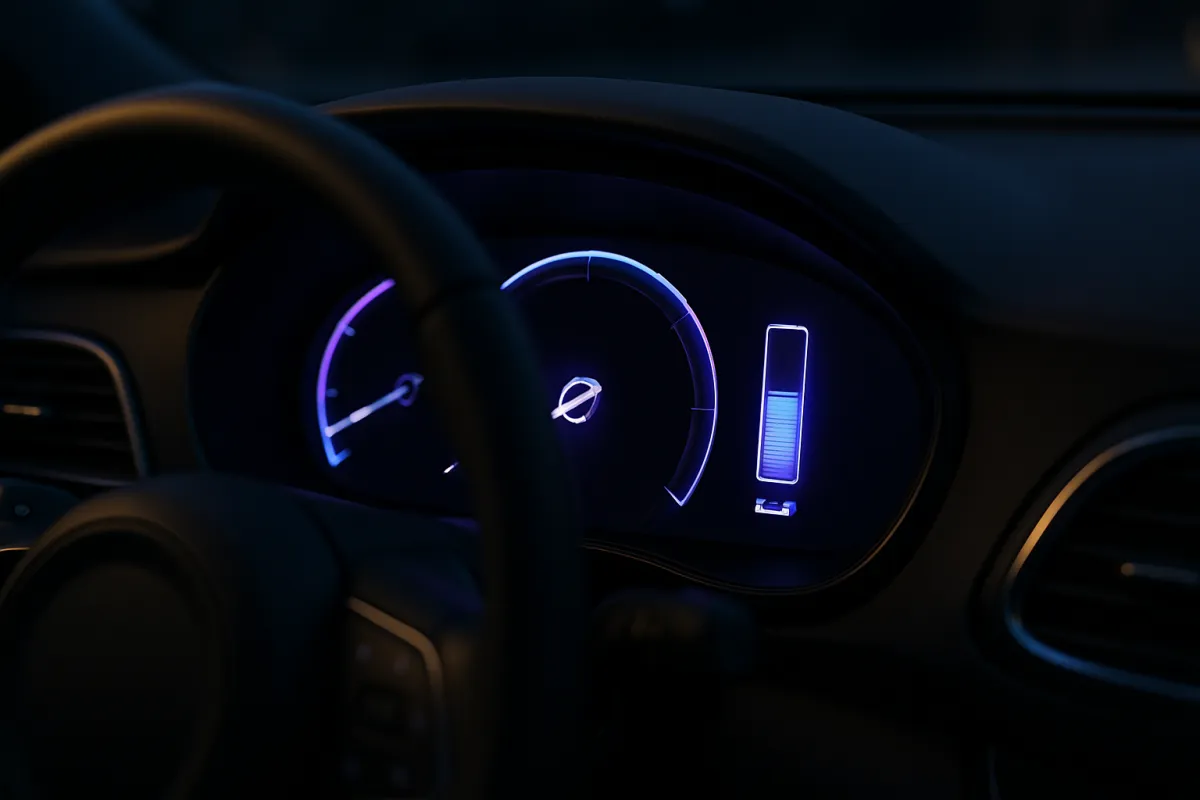
Here is how to use them on a test drive. Note the state of charge at the start, drive a reasonable distance including a mix of speeds, then note the state of charge and the energy consumed at the end. If the car reports energy used directly, you can compare the percentage of the battery spent against the kilowatt-hours it took to spend it, which gives you a rough usable capacity without any charging at all. Ten percent of the battery consumed for 5.4 kilowatt-hours implies a usable capacity near 54 kilowatt-hours, and that arithmetic is the seed of the controlled charge test in a later section.
The weaknesses are real. State of charge readings move in whole percent steps, so a short drive gives you a coarse denominator, and the car’s own energy accounting may or may not include what the climate system drew. Drive far enough to spend a meaningful chunk of the battery, and treat the result as a first approximation.
Why the dashboard range number is a prediction
The range figure deserves its own section because more buyers are misled by it than by anything else on the car. It is not a reading of the battery. It is the car’s estimate of remaining energy divided by an efficiency figure the car learned from recent driving, and that second term does most of the moving.
Picture two identical cars with identical packs. One has spent a fortnight on short warm-weather journeys at moderate speeds, the other has done a week of cold motorway miles with the heating on. The first car will predict substantially more range than the second, and the difference says nothing about either battery. Some cars average efficiency over a long window and move sluggishly, some react within a few dozen miles, and some let you choose. A buyer reading the number cold has no idea which they are looking at or what driving produced it.
Use it anyway, but use it correctly. Scale it: a car predicting 178 miles at 80 percent charge is implying about 222 miles at full, which against an original 240 mile rating suggests roughly 93 percent. Then hold that number loosely, because the same car on a cold morning after a motorway run might have implied 85 percent with no change whatsoever to the pack. It is a smoke test, and a smoke test is genuinely useful as long as nobody mistakes it for a measurement.
Check four: the controlled charge test
This is the check a determined buyer can run without special equipment, and it is the most satisfying because you are measuring energy rather than reading an inference. The logic is simple. If you charge a car from one known state of charge to another, the pack has accepted that fraction of its usable capacity. Divide the energy that actually went into the battery by that fraction and you have an estimate of usable capacity today.
The complication is the word “actually”. A charger reports the energy it delivered, and not all of that reaches the cells. Some is lost as heat in the onboard charger and the cables, some runs the car’s electronics and thermal management while it charges. Alternating-current home charging commonly lands somewhere around 90 percent efficient, worse in cold weather or at low charging currents, better on a warm day at full current. That assumption is the largest source of error in the method, which is why the result is an estimate with a couple of points of uncertainty rather than a laboratory figure.
Run it well and it is still the best free evidence you will get. Charge across a wide span rather than a narrow one, so the percentage denominator is large and the whole-percent steps matter less. Avoid the top few percent where charging slows and losses rise. Do it in mild conditions if you can, and if the car has been sitting cold, let it warm up. Then compare the answer to whatever the diagnostic scan said, because two methods agreeing is the strongest position a buyer without manufacturer tooling can reach.
A worked example: one five year old pack
Take a specific car, with every figure here illustrative and chosen to be arithmetically consistent rather than drawn from any particular model. The car is five years old with 62,000 miles. Its pack is 64 kilowatt-hours nominal, of which 60 were usable when new, and it was rated at 240 miles, implying an efficiency of 4.0 miles per kilowatt-hour on usable capacity.
You run the charge test. The car goes from 20 percent to 80 percent, a span of 60 percentage points, and the charger reports delivering 36.0 kilowatt-hours. Assume 90 percent charging efficiency and 32.4 kilowatt-hours reached the cells. Divide by 0.60 and usable capacity today comes out at 54.0 kilowatt-hours. Against 60 when new, that is a state of health of 90 percent, and 6.0 kilowatt-hours of capacity have gone.
Convert that into the currency that matters. At 4.0 miles per kilowatt-hour, 54 kilowatt-hours is 216 miles of realistic full-charge range against 240 when new, so the fade has cost 24 miles. Now cross-check against the dashboard: the car predicted 178 miles at 80 percent, implying 222 at full and about 93 percent health. The two methods disagree by three points, which is exactly the size of disagreement to expect, and the honest read is that this pack is somewhere around 90 percent with a tolerance either side. A buyer who reports “90.0 percent” to the seller as a fact has over-claimed their own evidence.
Range remaining at each state of health
Percentages are abstract. Miles are not, and converting one to the other is the step that turns a battery reading into a buying decision.
Full-charge range by state of health
Illustrative car rated at 240 miles when new. Range scales directly with usable capacity.
The worked example sits on the 90 percent row: 216 miles, 24 fewer than new. Whether that matters is a question about your longest regular journey, not about the battery.
Read the chart against your own driving rather than against the top row. The gap between 240 and 216 miles is invisible to a driver whose longest regular day is 60 miles and decisive for one who relies on a 200 mile run without stopping. This is the single most common framing error in used EV shopping: buyers treat fade as damage to be avoided, when for most journeys it is capability they were never going to use. Put your own mileage into the companion beside this article, and the cost side into our calculator, and the question usually answers itself.
Where the kilowatt-hours actually sit
The same pack, split into where its energy has gone, makes the usable-versus-nominal point concrete.
A 64 kWh nominal pack at five years, illustrative
Usable capacity today, the reserve the car never lets you spend, and the capacity lost to fade. Shares rounded to sum to 100.
Note the two different denominators: 6.0 kWh lost is 9.4 percent of the nominal pack but 10 percent of the 60 kWh you were ever able to use, which is why the car reports 90 percent health.
That last sentence is the whole usable-versus-nominal trap in one line, and it is why a percentage without a stated denominator is not yet information. Two honest people can look at this pack and say “9.4 percent gone” and “10 percent gone” and both be right. Before you compare a health figure against a warranty threshold, against another listing, or against what you paid last time, confirm that both numbers are measured from the same starting point.
What charging behavior reveals that capacity hides
Capacity is only half of what a battery does. The other half is power: how quickly it can accept and deliver energy. As cells age, internal resistance rises, and rising resistance shows up in how the pack behaves under load long before it shows up as missing miles. This is why a buyer who only checks capacity is checking the slower-moving of the two indicators.
The most accessible symptom is rapid-charging speed. A healthy pack at a low state of charge in mild conditions accepts a substantial charging rate and holds it for a while. A pack with elevated resistance reaches its temperature and voltage limits sooner, so the car’s own protection reduces the current earlier, and a session that used to take a certain time takes noticeably longer. Nothing has broken; the pack is simply less willing.
The other symptom is subtler and easy to misread: slightly softer peak acceleration when the battery is cold or low, and regenerative braking that backs off more readily. Both are normal behaviors that all electric cars show to some degree, so this is a matter of degree rather than presence. Treat these as things that make you look harder rather than as findings on their own, and pair them with the section below on rapid-charge taper, which turns the impression into something you can actually observe.
Reading the rapid-charge taper
Every electric car reduces its rapid-charging power as the battery fills. That reduction is called taper, and it is a protection feature, not a fault. What makes it useful to a buyer is that the taper curve is sensitive to pack condition, so a pack that has aged in the power dimension tapers earlier and more steeply than the same pack did when new.
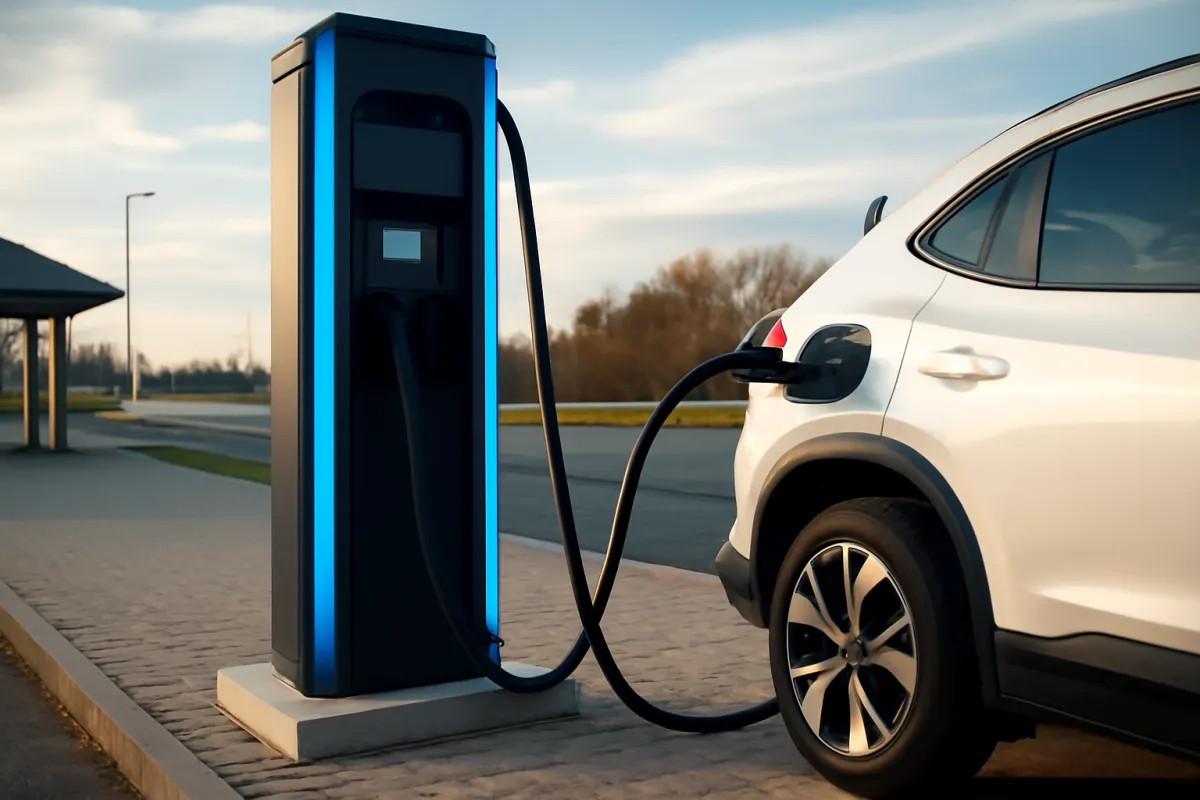
Here is how to observe it honestly. Arrive at a rapid charger with the battery reasonably low and the pack warmed by driving, because a cold pack charges slowly for entirely innocent reasons and is the single biggest false positive in this test. Note the power the car draws at the start, then watch what it does as the state of charge climbs. What you are looking for is the shape: whether power holds up through the low and middle part of the range or falls away early.
The caveats deserve equal billing. Charging speed is limited by the charger as well as the car, by the pack temperature, by ambient conditions, and by how busy a shared charging unit is. Any of those can produce a disappointing session on a perfectly good battery. Our reference on charging levels and connectors covers those limits in detail. Use the taper as a supporting observation, never as the finding that kills a deal on its own.
The warranty position is the most valuable single fact
If you take one thing from this teardown, take this: for many used electric cars, the remaining battery warranty moves the price more than the health percentage does. A pack with modest fade and years of transferable coverage left is a fundamentally different asset from an identical pack with the coverage expired, because in the first case the worst outcome is capped and in the second it is not.
That is what a battery warranty really sells. It does not promise no degradation. It promises that if the pack fails outright, or falls below a stated capacity threshold within a stated period, the manufacturer repairs or replaces it. The value of that promise is highest in exactly the years when an out-of-warranty pack problem would be most painful, and it is the reason the replacement-cost anxiety that dominates used EV conversations is misdirected for cars still inside their term.
So the warranty is not a footnote to check after agreeing a price. It is an input to the price. Establish it early, in writing, from a source that can look the car up by its identification number, and let it inform what you are willing to pay before you have fallen in love with the paint.
Capacity thresholds and what actually triggers a claim
The mechanism is worth understanding precisely, because this is where buyers most often assume something that is not true of their specific car. Battery warranties generally cover two different things. The first is defect and failure: the pack stops working properly and gets repaired or replaced. The second is capacity: if measured capacity falls below a stated percentage of original within the term, the pack qualifies for remedy even though it still works.
The second is the one to verify, because not every warranty includes it, and a warranty that covers failure but not fade will not help you with a pack that is merely tired. Where a capacity threshold exists, the number, the basis it is measured against, and the manufacturer’s chosen measurement procedure are all set by the specific warranty document. This teardown deliberately quotes no percentage as fact, because thresholds differ by manufacturer, model year and market, and a figure that is right for one car is wrong for another.
What you should do is concrete. Get the warranty document for that vehicle. Find whether a capacity threshold exists, what it is, what basis it is measured against, how a claim is assessed, and what the remedy is, since some warranties promise repair to just above the threshold rather than a new pack. Then compare your measured health figure against that threshold on the same basis, and you will know how much margin the car actually has.
Whether the coverage transfers to you
Transferability is the second half of the warranty question and it is asked far too late in most purchases. In many cases battery coverage attaches to the vehicle rather than the original purchaser, and simply continues for the remainder of its term. That is the common pattern, not a universal rule, and the exceptions are expensive.
Verify four things. Whether the remaining term transfers to a subsequent owner at all. Whether any registration or notification step is required, and by whom, and by when. Whether the term is measured in years from first registration, in mileage, or in whichever comes first, and where the car currently sits against each. And what voids it, since work carried out on the high-voltage system by an unauthorized party, damage, or modification can affect coverage on some cars.
A private seller’s belief about their own warranty is not evidence. Neither is a listing that says “warranty until” with a date. The evidence is the document, or a franchised dealer’s confirmation against the vehicle identification number, and asking for it is a normal request that a reasonable seller will not find offensive. Our used EV buying walkthrough puts this step in sequence with the rest of the purchase.
What the service record should show
Battery health has a paper trail, and reading it is free. Look for high-voltage system work of any kind: module replacements, battery management system software updates, coolant service on the pack circuit, and any recorded fault codes cleared during a service visit. None of these is automatically a red flag, and some are the opposite.

A replaced module, properly done and recorded, can mean the car has already had its weakest section addressed. A battery management software update may have changed how the car reports capacity, which matters if you are comparing a health figure from before the update against one from after. A pack that has had repeated attention for the same symptom is a different story, and that pattern is what you are reading the record for.
Also worth noting is where the car has lived and how it was charged, when either can be established. Sustained heat is the strongest driver of degradation, and a car that spent its life in a hot climate has aged differently from an identical one that did not. A car used almost exclusively on rapid chargers has had a harder time than one charged gently overnight, a distinction our battery care habits piece sets out in full.
Red flags that should end the viewing
Most viewings do not need to end early. A few do, and knowing which is worth more than any percentage. Treat the following as reasons to stop rather than reasons to negotiate.
- A warning light or message relating to the high-voltage system, propulsion, or charging, with an explanation about it being intermittent or needing a reset. Intermittent high-voltage faults are the expensive kind.
- A refusal to allow any diagnostic scan, particularly when the seller offers an alternative reason for the refusal each time you ask. There is no good version of this.
- A health figure the seller will not source. A number with no origin, no date and no method behind it is a claim, not a measurement.
- Charging that fails or aborts during the viewing, especially if the seller was already expecting it. A car that will not reliably accept a charge is not a car with a small problem.
- A pack that will not accept a meaningful rapid-charging rate when warm and low, with no charger-side explanation available.
- Visible damage to the underbody where the pack sits, or evidence of the car having been through standing water. Pack enclosures are not meant to be tested.
- A vehicle history or warranty position that will not reconcile, such as a claimed transferable warranty that a franchised dealer cannot confirm against the identification number.
Notice that most of these are about verification rather than about the battery itself. A pack at 85 percent that everybody can measure is a priceable known. A pack of unknown condition that resists being measured is the risk you cannot size, and unsizable risk is the thing to walk away from.
Things that fake a bad result
Symmetry matters, because a buyer who kills good deals on bad evidence is making the same error as one who buys bad cars on good faith. Several ordinary conditions produce readings that look like poor battery health and are not.
Cold is the biggest. A cold pack delivers less range, accepts rapid charge slowly, and may limit power until it warms, and every bit of that is temporary. Our cold weather range teardown covers the mechanism, but the short version is that winter borrows range and spring returns it. Test in mild conditions where possible, and if you cannot, discount what you see.
A car that has sat unused for a long time is the second. Battery management estimates drift when the pack is neither charged nor discharged, and a stored car can report pessimistically until it has been through a couple of full cycles. The third is the recent-driving effect on the range prediction discussed earlier: a fortnight of cold motorway miles can knock a large chunk off the predicted range with no change to the pack whatsoever. The fourth is mundane and often forgotten: under-inflated tyres, a roof rack, or a heavily loaded car all reduce efficiency, and the car will happily fold that into a range prediction you then misread as fade.
What a fair price adjustment looks like
Once you have a defensible health figure, the question becomes what it is worth in money, and the common answer is wrong. Buyers routinely translate 10 percent fade into 10 percent off the car, which treats the whole vehicle as if it were a battery. It is not. The seats, the motor, the suspension and the software are all unaffected by a slightly smaller pack.
A better frame is to price the capability you have lost against the capability you were buying. In the worked example, 10 percent fade cost 24 miles of a 240 mile car. If your longest regular journey is 90 miles, you have lost margin you were never going to spend, and the fair adjustment is small. If your use genuinely required 220 miles without stopping, you have lost the reason you were looking at this car, and the right adjustment is to look at a different one.
Where fade does carry a real cost is at resale, because the next buyer will run this same exercise and the fade will have grown. That is a legitimate line to raise, and on an illustrative $18,000 listing, opening at the arithmetic version of a 10 percent adjustment, $1,800, is a negotiating position rather than a valuation. Expect to settle well inside it, and expect to concede ground if the car comes with transferable coverage and a documented history, because both of those are worth money to whoever buys it next. Our depreciation teardown covers how that resale side actually behaves.
Questions to ask before you drive out to see the car
Half of these checks can be done by message, which saves the trip that was never going to end in a purchase. Ask them in a plain, unaccusing way and the answers arrive quickly.
Ask whether a battery health report exists, who produced it, and when. Ask for the vehicle identification number so a franchised dealer can confirm the warranty position, including the remaining term and whether it transfers. Ask what percentage the car is normally charged to and whether rapid charging was routine or occasional. Ask where the car has spent its life. Ask whether any high-voltage work has been done and whether the record is available. Ask whether all charging cables and adapters are present, which is a small thing that is annoying and expensive to replace.
Then ask the one that does the most work: whether the seller is comfortable with the car being independently inspected before purchase, including a battery scan, at your expense. That single question filters more effectively than the other six combined, because it asks about the seller’s confidence rather than about the car. Our used EV shortlist piece covers how to work out which cars are worth asking about in the first place.
A twenty minute check you can run at the viewing
Assume you have arrived, the seller is present, and you have limited time. Here is a sequence that extracts most of the available signal.
Start cold, before any driving. Photograph the odometer, the state of charge and the predicted range together in one frame, because the three numbers only mean something as a set. Scale the prediction against the original rating and note the implied percentage, holding it loosely. Open the energy or consumption screens and note the lifetime and recent efficiency figures, which tell you how the car has actually been driven.
Then drive it, ten to fifteen miles if you can, mixing town and faster roads. Watch for power that fades under sustained load, regenerative braking that behaves inconsistently, or any warning that appears and disappears. Note the state of charge and energy used at the end, and run the rough capacity arithmetic from the earlier section. If a rapid charger is nearby and the pack is warm, plug in for ten minutes and watch the power the car draws and how it holds.
Finish on paper. Read the service record for high-voltage entries. Confirm cables and adapters are present. Get the identification number for the warranty check. Then, unless something disqualified the car, make your offer conditional on an independent battery scan. Twenty minutes cannot prove a pack is healthy, but it reliably tells you whether the car deserves the paid check, which is exactly the job it needs to do.
Mistakes buyers make with battery health
The failure modes here are consistent enough to list, and every one of them is avoidable.
- Treating the dashboard range figure as a measurement. It is a prediction shaped by recent driving and weather. Scale it, then hold it loosely.
- Comparing percentages with different denominators. Usable and nominal bases produce different numbers for the same pack. Confirm the basis before comparing anything.
- Arguing over a point or two. State of health is an estimate with a tolerance. The difference between 90 and 92 percent is noise, not negotiation.
- Checking capacity and ignoring the warranty. Remaining transferable coverage frequently affects the price more than the health figure does.
- Testing on a cold day and concluding the pack is tired. Cold borrows range and returns it. Test in mild conditions or discount what you see.
- Skipping the paid scan because the free checks looked fine. The free checks are the ones most easily flattered by good conditions.
- Pricing fade as a percentage off the whole car. The battery is a large part of the car, not all of it. Price the capability lost against the capability you needed.
- Accepting a health figure with no source, method or date. An unsourced number is a claim. Ask who produced it, with what, and when.
- Forgetting to ask whether the car has had battery software updates. They can change how capacity is reported, which breaks comparisons across dates.
The bottom line
Checking EV battery health before buying is not one test, it is a short stack of imperfect readings that get strong when they agree. Start from the understanding that state of health is inferred rather than measured, that usable and nominal capacity are different denominators, and that a manufacturer’s reserve can hold a health figure flat while the cells quietly age underneath. Then work down the ladder: a manufacturer battery report if you can get one, an independent diagnostic scan if you cannot, a controlled charge test you run yourself, and the dashboard range figure last and loosest.
Convert whatever you find into miles, because miles are what you actually buy. In the illustrative example here, a five year old 60 kilowatt-hour usable pack reading 54 kilowatt-hours is 90 percent healthy, which is 216 miles instead of 240, which is either irrelevant or disqualifying depending entirely on your longest regular journey. Then check the warranty position, since remaining transferable coverage with a capacity threshold is frequently the most valuable fact on the car, and the one most often established too late. Walk away from packs that resist being measured rather than from packs that measure imperfectly. Run your own version of the numbers in the companion above, and take the ownership costs to our calculator, because a battery you have measured is a line item, and a battery you have not is a gamble.
AmpLoft writes this as independent educational analysis, not as a professional vehicle inspection, and certainly not as a substitute for one. Every figure in this teardown, the 64 kilowatt-hour nominal pack, the 60 kilowatt-hour usable capacity, the 240 mile rating, the 4.0 miles per kilowatt-hour efficiency, the 36.0 kilowatt-hours delivered, the 90 percent charging efficiency, the resulting 54 kilowatt-hour and 90 percent readings, the $18,000 listing and the $1,800 arithmetic beside it, is an illustrative construction chosen to be internally consistent within this article alone. None of it describes a real vehicle, a real listing, or any manufacturer’s specification, and no percentage here should be read as a fleet average or a study result. Battery warranty terms, capacity thresholds, measurement procedures, transfer rules and the conditions that void coverage are set by each manufacturer and differ by model year and market, so confirm them against the warranty document for the specific car and, where possible, with a franchised dealer working from its identification number. Diagnostic readings depend on the tool, the vehicle and the person interpreting them. Before committing money, commission a qualified independent inspection of the car and its high-voltage system.
Frequently asked questions
How do I check the battery health of a used EV?
Four checks cover almost everything, and they get more reliable as they get more effort. Ask the seller for a battery report produced by the manufacturer's own tools, usually through a dealer service visit, because that is the number the manufacturer would stand behind in a warranty conversation. Failing that, pay an independent workshop to run a diagnostic scan through the car's data port and read the battery management system's own capacity estimate. Then verify it yourself with a controlled charge test, charging between two known percentages and comparing the energy the charger delivered against what the pack should have accepted when new. Read the car's range and energy screens as a sanity check rather than as evidence, because the range prediction reflects recent driving as much as it reflects the battery.
What does state of health mean on an electric car battery?
State of health is the pack's current usable capacity expressed as a percentage of its usable capacity when new, so a pack reading 90 percent stores roughly nine tenths of the energy it once did. The important detail is that no instrument measures it directly. The battery management system infers it from voltage, current, temperature and its own charging history, then reports an estimate that can drift by a couple of points depending on how recently the pack has been charged to a high level and rested. Treat any single state of health figure as a reading with a tolerance around it rather than a precise fact, and give more weight to two methods that agree than to one that sounds confident.
What is a good state of health for a used EV?
There is no universal pass mark, because the honest answer depends on the car's age, mileage and what you are paying. As a way to think about it, a pack that has faded a few percent over several years and tens of thousands of miles is behaving normally, while a pack well below that for its age is worth a conversation about how the car has been charged and where it has lived. The number that matters most is not the percentage itself but the gap between it and what the warranty threshold would require, and how much range is left against your actual daily need. A car with modest fade and plenty of remaining coverage can be a better buy than a fresher car with none.
Can I check EV battery health without any tools?
Partly, and it is worth doing even though it proves less than a proper scan. Note the state of charge and the predicted range, scale that prediction up to a full charge, and compare it against the car's original rated range to get a rough percentage. Then check how the car behaves in the middle of a charging session, because a pack losing power capability accepts energy more slowly than it used to at the same state of charge. Both are crude and both can be skewed by weather, tyre pressure, and the last few hundred miles of driving, so use them to decide whether to pay for a real test rather than as the test itself.
Does the dashboard range estimate show battery health?
Only indirectly, and it misleads more buyers than any other number on the car. The range figure is a prediction, not a measurement: the car takes its estimate of remaining energy and divides it by an efficiency figure learned from recent driving, so a week of gentle warm-weather commuting inflates it and a cold week of motorway miles deflates it. Two identical cars with identical packs can show range predictions dozens of miles apart for that reason alone. It is a useful sanity check when you scale it against the original rating and treat the result as approximate, and it is a poor basis for a price negotiation.
How does a controlled charge test work?
You charge the car between two known states of charge and compare the energy that went in against the energy the pack should have accepted when it was new. If a car charges from 20 percent to 80 percent, it has accepted 60 percent of its usable capacity, so dividing the energy actually stored by 0.60 gives an estimate of usable capacity today. The wrinkle is that a charger reports what it delivered, not what the battery stored, so some of it went to heat and to running the car's own systems, and you have to assume a charging efficiency to bridge the gap. That assumption is why the method gives a good estimate rather than a laboratory result, and why it works best as a cross-check against a diagnostic reading.
What is the difference between usable and nominal battery capacity?
Nominal or gross capacity is the total energy in the cells, while usable or net capacity is the portion the car will actually let you use. The difference is a reserve the manufacturer holds back to protect the cells from being fully charged or fully drained, both of which age them quickly. This matters when checking health because your charge test measures usable capacity, while a warranty may be written against a different basis, and because a car can hold usable capacity steady for years by quietly drawing down that reserve as the cells fade. Confirm which basis a quoted percentage uses before you compare it against anything.
Does an EV battery warranty transfer to the second owner?
In many cases the remaining battery coverage does follow the car rather than the original buyer, which makes it one of the most valuable things you can verify before agreeing a price. But transfer rules, any registration steps, and the conditions that void coverage vary by manufacturer, model year and market, and some warranties treat gradual capacity loss differently from outright failure. The only reliable source is the warranty document for that specific vehicle, ideally confirmed with a franchised dealer using the car's identification number. Ask for that confirmation in writing before you buy, because a claim of transferable coverage that turns out to be wrong is expensive in exactly the years you would need it.