What's in this teardown
- The headline number: the scary figure in context
- The number most owners never pay
- What an EV battery replacement actually includes
- Battery size is the biggest cost lever
- Illustrative replacement cost by battery size
- Where the money goes: pack, labor, and the rest
- The 8-year, 100,000-mile federal warranty floor
- Degradation versus failure: two different events
- Pack, module, or cell: the repair that is not a replacement
- Refurbished and salvage packs
- The falling cost of a kilowatt-hour
- The out-of-warranty reality: who actually pays
- The other battery: the 12-volt you actually will replace
- How battery health shapes used-EV value
- Warranty transfer on a used EV
- How to extend battery life and push the cost further away
- Will I ever pay this? The honest answer
- A worked example: one EV, warranty timeline, and the illustrative bill
- Replacement-cost myths, retired
- How replacement cost compares to a gas engine or transmission
- What raises or lowers your own replacement odds
- The bottom line
Short answer: Replacing an EV battery out of warranty commonly costs an illustrative $5,000 for a small pack to $15,000 or more for a large premium one, with the battery itself the biggest line. That headline number is real but rarely paid: degradation is gradual rather than sudden failure, warranties commonly floor the risk for around eight years, and module repair can fix a fault without a full replacement. Battery size is the largest cost lever.
Ask a would-be EV buyer what stops them and the battery replacement bill arrives fast: I heard it costs as much as the car, you have to swap the whole thing at eight years, one big repair wipes out every fuel saving. It is the single most quoted number in EV skepticism, and it is quoted almost entirely without its context. The figure is real. The frequency with which anyone pays it is the part nobody mentions.
This teardown prices the question properly: the illustrative replacement range and why it looks scary, the far more important context that most packs outlast the car, what actually drives the cost, the falling price of a kilowatt-hour, the warranty floor underneath you, why degradation and failure are different events, the module repair that is not a full replacement, and the honest answer to whether you will ever pay any of this. It sits alongside our teardown on how long EV batteries actually last, which handles longevity, and our teardown on what an electric car costs, which handles the purchase. This one is strictly about the replacement bill. If you want your own numbers as you read, the companion beside this article and our calculator are one tab away.
Key takeaways
- Illustrative out-of-warranty replacement commonly runs from roughly $5,000 for a small pack to $15,000 or more for a large premium one, with the battery itself the biggest line.
- The headline number is real but rarely paid: gradual degradation, an eight-year warranty floor, and module repair mean most owners never write that check.
- Battery size in kilowatt-hours is the largest cost lever, and a falling per-kWh price is pulling future replacement bills down every year.
- Degradation, slow range loss everyone sees, is a different event from failure, an outright fault almost nobody experiences inside the warranty window.
- On a used EV, verified battery health and remaining transferable warranty turn replacement risk from a fear into a priced, checkable line item.
The headline number: the scary figure in context
Here is the number people mean when they ask, stated plainly before it gets defanged: an out-of-warranty full-pack replacement commonly runs an illustrative $5,000 to $15,000 or more, depending on how big the pack is and how premium the model. A small city-car battery sits near the bottom of that range; a large long-range luxury pack sits at the top and can exceed it. That is genuine money, and pretending otherwise would be dishonest, so this teardown will not wave it away.
But a cost only belongs in a decision weighted by the odds you actually incur it, and that is where the headline figure misleads. Quoted bare, it reads like a bill every owner receives on a schedule, the way a gas car needs a timing belt or a transmission service. It is nothing of the sort. It is the price tag on a rare event, largely fenced off by warranty, shrinking every year, and often replaced by a cheaper repair when it happens at all. The rest of this teardown is the context that turns a frightening sticker into a manageable, low-probability line item.
The number most owners never pay
The single most important sentence about EV battery replacement is that most owners never pay for one. Modern packs commonly last an illustrative 15 to 20 years, and in most realistic ownership stories the battery outlives the buyer’s interest in the car, as our longevity teardown lays out in detail. The pack does not die one morning; it slowly becomes a slightly shorter-range version of itself, which is a maintenance non-event, not a replacement.
Stack the reasons the check rarely comes due. Degradation is gradual, so there is no cliff that forces a swap. The warranty covers the first eight years or 100,000 miles, exactly the window when an early fault would hurt most. Many issues that do occur are module-level repairs at a fraction of a full pack. And falling cell prices mean that even when replacement happens, it costs less over time. Put those together and the population of owners who ever hand over five figures for a new pack is small. The replacement fear survives on an outdated picture and a badly weighted probability, not on how ownership actually plays out.
What an EV battery replacement actually includes
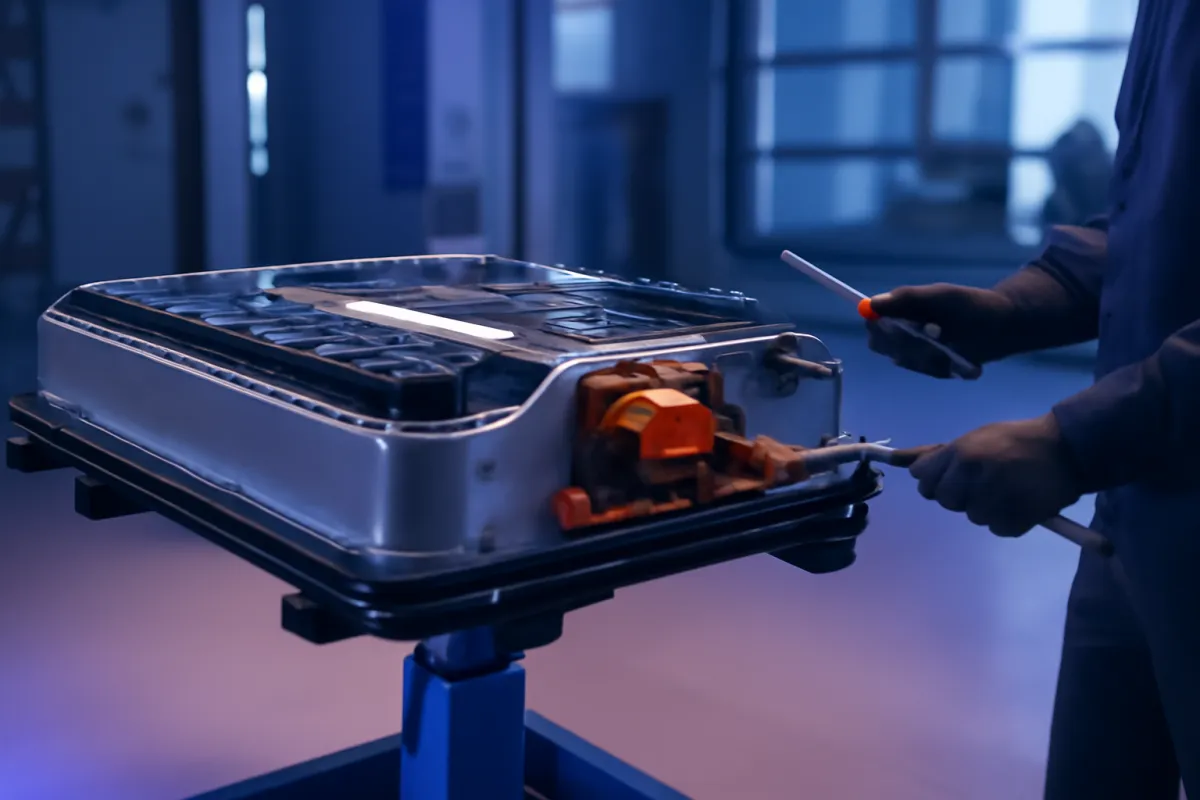
When people picture replacement they picture a single part, but the bill is a few things stacked together, and separating them explains both the size and the variability of the number. The largest piece is the pack itself: the cells, modules, wiring, cooling plumbing, and the battery management electronics that supervise all of it. This is where most of the money lives, and it scales almost directly with how many kilowatt-hours the pack holds.
On top of the pack sit the labor and the extras. Labor covers the hours to drop the old pack, which is a heavy, high-voltage component that sits under the floor and demands trained handling, and to install and commission the new one. The extras are the quiet line items: diagnostics to confirm the fault, fresh coolant, seals and fasteners, sometimes shipping a heavy pack, and safe disposal or recycling of the old one. None of these individually rivals the pack cost, but together they explain why two quotes for the same car can differ: the pack price is fairly fixed, and the surrounding work is where a shop’s rates and a model’s complexity move the total.

Battery size is the biggest cost lever
If you want to predict where a replacement quote lands, look first at the pack size in kilowatt-hours, because that number does more to set the price than the badge on the car. Cells are sold and manufactured by energy content, so a pack that stores more energy costs more to replace, almost linearly. A small commuter EV with a modest battery and a large long-range model with a big one are not in the same conversation, even before labor and brand enter.
This is the same lever that sets the purchase price, as our teardown on what an electric car costs explains: most of an EV’s price is battery and drivetrain, so the same kilowatt-hours you pay for at the dealer are the kilowatt-hours you would pay for again at replacement. The practical takeaway for a buyer worried about replacement is counterintuitive but useful: a smaller, right-sized battery is not only cheaper to buy, it is cheaper to replace in the unlikely event you ever do. Buying far more range than your life needs quietly enlarges every battery-related number, this one included. Size the pack to your actual driving and the worst-case bill shrinks with it.
Illustrative replacement cost by battery size
Because size is the dominant lever, the clearest way to see the cost is to plot illustrative full-replacement totals against common pack sizes. The bars below scale with the numbers: a larger pack means a larger bill, in rough proportion to the energy it holds.
Illustrative replacement total by battery size
Rough all-in figures including labor, for comparison only. Real quotes vary widely by model, region, and whether the fix is a repair or a full swap.
The bars scale almost directly with pack size, because cells are the largest line and are priced by energy content. A right-sized battery is the cheapest one to replace, if you ever do.
Read the chart for its shape, not its exact digits. The point is not that a 60 kWh pack costs precisely $9,000, since real quotes swing with model and shop and the year you ask. The point is the near-straight climb: double the usable energy and you roughly double the pack cost. That is why the same replacement conversation feels very different for a small commuter EV than for a big three-row SUV, and why the size you choose at purchase echoes into every later battery number, including this one. Run your own pack size through the companion beside this article to see where your row would land.
Where the money goes: pack, labor, and the rest
Zoom into a single replacement bill and the split explains why the pack size dominates and why labor, though real, is the smaller worry. The battery pack is the overwhelming majority of the cost; labor is a meaningful but secondary slice; and the remaining odds and ends round out the total.
Illustrative replacement cost split
Where a typical full-pack replacement dollar goes, framed illustratively. Not a quote for any specific vehicle.
Because the pack is roughly 70 percent of the bill, a falling per-kWh cell price pulls the whole number down over time, and a module repair that avoids buying a full pack saves the largest slice.
Two implications fall out of that split. First, because the pack dominates, anything that lowers the cost of cells, which is exactly what the industry trend is doing, moves the total more than any labor efficiency ever could. Second, the split is precisely why module-level repair is such a lever: if the fault lives in one module and a shop can replace that alone, you sidestep most of the 70 percent slice and pay mostly for labor and diagnostics. The stacked bar is, in effect, a map of where a repair saves you money versus where a full swap spends it.
The 8-year, 100,000-mile federal warranty floor
Underneath the whole replacement question sits a legal floor that battery worriers rarely price in. In major markets, battery coverage commonly runs along the lines of a federal-style minimum of eight years or 100,000 miles, whichever comes first, and many manufacturers add a capacity threshold, typically around 70 percent, below which the pack qualifies for repair or replacement. Some brands and regions go further; this is the generic shape, and the specific document for the specific car is the one that actually binds.
Read that floor for what it implies about the odds. An automaker writing an eight-year, 70-percent promise across millions of vehicles has actuaries, not optimists, signing it, and they sign it because the engineering margin is genuinely there, as the degradation curve in our longevity teardown shows. For an owner, the warranty converts the scary tail risk, a genuinely bad pack, into a covered event during exactly the years when a replacement would hurt most. The one discipline it asks of you is to read the terms: a years-and-miles warranty without a capacity floor covers outright failure but not gradual fade, and knowing which kind you have is worth the five minutes before you rely on it.

Degradation versus failure: two different events
Most of the replacement fear comes from quietly merging two very different events into one word. Degradation is gradual capacity loss: the pack slowly holds fewer kilowatt-hours, so a full charge covers fewer miles, commonly at an illustrative 1 to 2 percent per year. It is universal, expected, and engineered around. Failure is a genuine fault, a bad cell group or module, that stops the pack performing as it should. It is rare, and rarest during the warranty years that cover it.
The replacement quote applies to failure. The experience almost every owner actually has is degradation. Blurring the two is what makes people picture a $12,000 bill arriving on a schedule, when the reality is a few percent of range slipping away each year, invisible against a battery that was oversized for daily driving to begin with. A pack at 88 percent capacity after a decade has degraded; it has not failed, and nobody replaces it. Keeping these words separate is the single mental fix that shrinks the replacement fear to its real size: you will almost certainly see degradation, and you will very probably never see failure.
Pack, module, or cell: the repair that is not a replacement
The word replacement assumes the whole battery, but a pack is not one indivisible slab. It is built from modules, and modules from cells, arranged in a hierarchy that increasingly lets a shop fix a section rather than the entire unit. When a fault appears, it often lives in one module or a cluster of cells, not across the whole pack, and a growing independent repair ecosystem has learned to diagnose the failing part and swap only that.
The cost difference is exactly the stacked bar above: a module repair sidesteps most of the 70 percent pack slice and leaves you paying mainly for diagnostics and labor, which is why a real bill so often comes in far under the full-replacement headline. This capability is not universal, and it depends on the model, the nature of the fault, and whether a capable shop is within reach, so it is not a guarantee you can bank on for every car. But the direction is unmistakable: the industry is moving from replace toward repair, third-party specialists are multiplying, and the practical effect is that the scary full-pack number is increasingly the worst case rather than the expected one. When someone quotes you the price of a whole new battery, the honest follow-up question is whether the whole battery actually needs replacing.
Refurbished and salvage packs
Below the price of a brand-new pack sits a second tier that further softens the worst case: refurbished, remanufactured, and salvage batteries. When an EV is written off for body damage with a healthy pack, or when a pack is rebuilt with tested modules, that battery re-enters the market at a price well under new. For an owner of an older car facing a replacement, this tier can turn a five-figure quote into something markedly smaller, especially where new-pack availability for an out-of-production model is limited.
The honest caveats belong here too. A salvage or refurbished pack carries less certainty than a new one: its history, remaining capacity, and any warranty vary with the supplier, so verified state-of-health and a reputable source matter more than the headline discount. Availability depends on the model and the strength of the local specialist market, and a rare car may have few options while a popular one has many. Treat this tier as a genuine cost-reducer for out-of-warranty, older-car situations rather than a guaranteed backstop for every vehicle. Its existence is one more reason the replacement figure, quoted as a fixed new-pack price, overstates what many owners would actually spend. Where these packs come from, and where your old one goes, is its own story: our teardown on what happens to old EV batteries traces the reuse, second-life, and recycling chain end to end.
The falling cost of a kilowatt-hour
The most important trend in this entire teardown is that the thing driving the bill, the cost of a lithium-ion kilowatt-hour, has fallen dramatically over the past decade and continues to trend down. Manufacturing has scaled enormously, chemistry and pack design have improved, and the price of storing a kilowatt-hour of energy is a fraction of what it was a decade ago. Because cells are roughly 70 percent of a replacement bill, a falling per-kWh cost drags the whole number down with it.
The implication for replacement is genuinely reassuring, and it runs opposite to how most car costs behave. A part on a gas car tends to cost more to replace as the years pass; an EV pack tends to cost less in real terms the longer you wait, because the underlying cells keep getting cheaper. A replacement that looks like a $12,000 event today is plausibly a smaller event by the time an eight- or ten-year-old car might ever need it. So the correct mental model is not a fixed liability lurking in the future but a shrinking cost attached to a low-probability event. When you discount both the odds and the falling price, the replacement line in an ownership budget gets very small indeed.
The out-of-warranty reality: who actually pays
So who does write the check? The population is narrow and describable. It is overwhelmingly owners of older, higher-mileage cars, past the eight-year or 100,000-mile window, whose pack has developed a genuine fault rather than merely aged. It skews toward early model years with weaker thermal management, toward hard-used or hot-climate vehicles, and toward cases where a module repair or a refurbished pack was not available or not pursued. It is, in short, the tail of the distribution, not the middle.
For a typical buyer of a modern EV planning to keep it eight to twelve years, the honest expected out-of-pocket replacement cost is close to zero, because the warranty covers the early years and degradation, not failure, is what those years actually bring. That is the number the companion beside this article makes concrete: enter your car’s age and mileage and it flags whether you are inside the warranty window, and shows the illustrative out-of-pocket figure only when you are outside it. For most readers, running their own inputs produces a reassuringly empty column, which is the whole point.
The other battery: the 12-volt you actually will replace
There is a quiet twist in the replacement story worth naming, because it is the battery replacement most owners genuinely do pay for, and it is not the expensive one. Almost every EV carries two batteries: the large high-voltage traction pack that moves the car, and a small conventional 12-volt accessory battery that runs the lights, screens, locks, and control electronics and that wakes the main pack when you get in. That little 12-volt is the same humble part a gas car carries, it wears out on a similar timescale of a handful of years, and replacing it is ordinary, inexpensive work, an illustrative cost to replace of the low hundreds of dollars or less rather than the four- and five-figure pack numbers this teardown is built around.
The reason it matters is expectation. When someone hears that an electric car battery needs replacing, the mind jumps to the terrifying pack figure, when the far more common event is a dead 12-volt that leaves the car unable to start even though the traction battery is full. Treating the 12-volt as routine maintenance, checking it during service and replacing it before it strands you, keeps a minor part from feeling like a major failure. Confirm the correct battery type and cost for your specific model, since some EVs use a lithium 12-volt rather than a standard lead-acid one, and either way this is the cheap, expected battery replacement rather than the rare, dear one the rest of this teardown prices.
How battery health shapes used-EV value
Where the replacement question becomes financially real for most people is not a repair bill but a used-car price, because on a used EV the battery is effectively the engine and gearbox rolled into one line item. A buyer is really pricing the remaining life of the pack, and a seller is really being paid for it, which is why verified battery health belongs at the center of any used-EV transaction, as our teardown on what an electric car costs works through.
The good news is that battery health is measurable in a way engine wear never was. A state-of-health report shows remaining capacity as a percentage, and simple test-drive math, note the charge level and predicted range, scale the original rating, and compare, gives a coarse but honest cross-check. The pricing logic that follows is clean: a pack measured at 90 percent is not damaged goods, it is a 10 percent smaller battery, and it should be discounted for measured fade rather than feared fade. A used EV with a verified state-of-health report and remaining transferable warranty is a value play precisely because it converts the market’s vague battery anxiety into a number you can negotiate against. The replacement fear that depresses some used-EV prices is, for an informed buyer, an opportunity rather than a risk.
Warranty transfer on a used EV
One detail turns remaining battery coverage from a footnote into real money: it usually transfers with the car. Because the eight-year or 100,000-mile warranty attaches to the vehicle rather than the original owner, a used EV within that window generally carries the balance of its battery coverage to the next buyer, which is a tangible, priceable asset. A four-year-old car with strong health effectively comes with several more years of the exact protection that fences off the replacement risk.
Two habits make that value bankable. First, confirm the transfer terms for the specific model and market, since some coverage has conditions or requires a service record, and the general rule does not override a particular document. Second, price the remaining coverage into the negotiation: a car with four years of battery warranty left is worth more than an otherwise identical car just past the window, and the gap is roughly the value of the risk being carried. For a buyer, remaining warranty plus verified health is the combination that makes a used EV a checklist rather than a gamble. For a seller, keeping the paperwork that proves both is the cheapest way to defend the asking price. Either way, the transferable warranty is the quiet reason the replacement question rarely lands on a used buyer’s shoulders inside that window.
How to extend battery life and push the cost further away
Since the cheapest replacement is the one you never need, the habits that slow degradation are also the habits that keep the replacement question permanently over the horizon, and they cost nothing. The physics, covered in full in our longevity teardown, reduces to a short list: heat and a constantly full pack are what age cells fastest, so the levers are about how the battery sits and charges, not how the car drives.
The practical version fits in a paragraph. Keep daily charging in the comfortable middle, roughly 20 to 80 percent for a typical nickel-based pack, and save 100 percent for the mornings you leave on a trip, following your own manual first since chemistry changes the advice. Make gentle home charging the routine and DC fast charging the travel exception, because everyday fast charging is the pattern that shows up in wear data. Park in shade or a garage when heat is serious, and never leave the car sitting at a very high or very low charge for weeks. None of this is vigilance; it is a few defaults set once in the first week of ownership. Do them and the pack fades slowly, stays comfortably above any warranty floor, and makes replacement a question you never have to answer.
Will I ever pay this? The honest answer
Strip away the nuance and answer the question a nervous buyer is really asking: will I ever pay for a battery replacement? For most owners of a modern EV, the honest answer is probably not. The combination is decisive: gradual degradation instead of sudden failure, an eight-year warranty covering the risky early years, module repair and refurbished packs undercutting the full-pack price, and a per-kWh cost falling every year. Multiply the low probability of failure by a shrinking cost, largely inside warranty, and the expected out-of-pocket figure for a typical owner rounds close to zero.
That is not the same as never, and this teardown will not pretend certainty it does not have. Someone keeping an early, high-mileage, out-of-warranty car for fifteen years in a hot climate has a real, if still modest, chance of facing a bill, and a fraction of owners will. But the framing that treats replacement as an inevitability, a scheduled expense every EV owner meets, is simply wrong, and it talks people out of a good decision on the strength of a rare event. Compare it fairly against the certain, continuous engine and transmission maintenance a gas car carries over the same years, and the EV’s low-odds, falling-cost battery risk is at worst a wash. The right posture is calm budgeting, not dread.
A worked example: one EV, warranty timeline, and the illustrative bill
Numbers settle the argument better than reassurance, so follow one illustrative owner. She buys a mainstream EV with a 60 kWh pack, drives about 12,000 miles a year, and treats the battery well: a daily charge limit in the middle, home charging as the routine, fast charging saved for trips. Her warranty covers eight years or 100,000 miles with a roughly 70 percent capacity floor.
Trace the timeline. Through year eight, the pack is inside warranty on both time and mileage, so any genuine fault is a covered event and her out-of-pocket replacement cost is effectively zero. Around year eight she has driven roughly 96,000 miles, still under the 100,000 mile cap, and the pack sits comfortably in the high 80s percent of capacity, far above the floor, so the warranty expires unused, as most do. Now imagine the rare tail: in year ten, out of warranty, a module develops a fault. Best case, a shop repairs that module for a fraction of a full pack. Worst case, a full replacement of her 60 kWh battery runs an illustrative figure in the region the chart above shows for that size, softened by two more years of falling cell prices and the option of a refurbished pack. That worst case is the only scenario in a decade where she pays anything, and it is the unlikely branch, not the expected one. Enter your own pack size, cost per kWh, age, and mileage in the companion above, or take the wider picture to our calculator, and watch your own out-of-pocket column stay stubbornly empty.
Replacement-cost myths, retired
The recurring claims, each against the evidence above.
- “You will definitely pay five figures for a new pack.” Full-pack out-of-warranty replacement is rare; module repairs are common, refurbished packs exist, cell prices are falling, and the warranty covers the risky years.
- “The battery has to be replaced at eight years.” Eight years is where warranty coverage commonly ends, not where the pack does. Most packs run an illustrative 15 to 20 years, fading gradually the whole way.
- “Replacement gets more expensive as the car ages.” The opposite of most car parts: because cells keep getting cheaper, an EV pack tends to cost less in real terms the longer you wait.
- “Degradation means I will need a new battery.” Degradation is slow range loss everyone sees; it is not failure. A pack at 88 percent has aged, not broken, and nobody replaces it.
- “A used EV is a battery time bomb.” Health is measurable, warranty usually transfers, and a verified pack at 90 percent is a slightly smaller battery, priced accordingly.
- “It is a whole-pack swap or nothing.” Packs are modular, and repairing one failing module sidesteps most of the cost, when a capable shop is available.
Every myth shares one root: quoting the price of a rare event as if it were a scheduled certainty.
How replacement cost compares to a gas engine or transmission
The replacement figure only means something next to the alternative it is usually contrasted with, so set it beside the equivalent large repairs on a gas car. A gas vehicle carries its own five-figure risks: a failed engine, a blown transmission, or a major top-end repair can run into the thousands and, on an older car, approach the value of the vehicle, much as a battery can on an EV. The difference people forget is that the gas car also carries a long list of certain, recurring costs the EV never sees, oil changes, timing components, exhaust and emissions parts, fuel-system work, and the steady wear of a mechanically busier drivetrain.
So the fair comparison is not “EV battery risk versus nothing,” it is “a low-probability, falling-cost battery event versus a stack of certain gas-car maintenance plus its own low-probability big repairs.” Weighted honestly, the EV’s single scary line competes against many smaller certain lines, and the module repair, warranty, and refurbished-pack options covered above only tilt it further. Our maintenance teardown prices the routine side of that comparison in detail, and it is the routine side, not the rare battery swap, where most owners feel the difference month to month.
What raises or lowers your own replacement odds
The population that actually pays is describable, so it is worth naming the factors that move a given owner toward or away from it, without overstating any of them. Things that push the odds up: keeping an early-model, high-mileage car well past the warranty window; hard use in a consistently hot climate, since heat is the main accelerant of wear; and a habit of routine DC fast charging rather than gentle home charging. A pack that lived a hot, fast-charged, high-mileage life is simply more likely to develop a fault than one treated gently.
Things that push the odds down are the mirror image, and most cost nothing. Charging mostly at home at moderate rates, keeping the daily charge in the comfortable middle rather than at a constant full, parking out of extreme heat when you can, and staying inside the warranty window for the risky early years all shift you toward the empty out-of-pocket column that most owners end up in. The habits that slow degradation, laid out in our teardown on extending battery life, are the same habits that keep a genuine failure unlikely, which is why the cheapest replacement really is the one careful ownership keeps permanently over the horizon. Enter your own age, mileage, and pack size in the companion above to see which side of that line your car sits on.
The bottom line
How much does it cost to replace an EV battery? The illustrative sticker is real, roughly $5,000 for a small pack to $15,000 or more for a large one, driven mostly by size in kilowatt-hours, with the pack itself about 70 percent of the bill and labor the smaller rest. But the sticker is the wrong number to carry around, because the frequency is the story: degradation, not failure, is what almost every owner sees, the eight-year warranty floors the risky years, module repair and refurbished packs undercut the full price, and a falling per-kWh cost shrinks the bill over time. Weighted by its odds, the replacement line in a typical ownership budget rounds close to zero.
So price the low probability of a falling cost, not the certainty of a scary quote. Size your pack to your real driving so both the purchase and any distant replacement stay smaller, treat the battery well so degradation stays slow and the warranty expires unused, and on a used EV verify health and remaining coverage so the fear becomes a checklist. Run your own age, mileage, and pack size in the companion above, and take the wider ownership math to our calculator; the number that emerges is far calmer than the folklore, and calm is what good money decisions are made of.
This teardown is educational and independent, written by people who enjoy pricing hardware honestly rather than selling batteries, warranties, or cars. Every dollar figure, cost-per-kWh, pack size, cost split, warranty term, and worked example above is illustrative and general, and will move with the specific model you own, its pack size and chemistry, your mileage and climate, the year and market, whether a fault is repaired or the pack is fully replaced, and the shop and parts you use. Warranty coverage, capacity thresholds, transfer rules, module-repair availability, and refurbished-pack supply in particular vary by manufacturer, model, region, and situation and change over time, so before budgeting around a replacement, verify the actual warranty document and confirm current repair and replacement pricing and battery health with qualified service providers for the exact vehicle in question.
Frequently asked questions
How much does it cost to replace an EV battery?
Illustrative out-of-warranty figures commonly run from roughly $5,000 for a small pack to $15,000 or more for a large premium one, with the battery itself the largest line and labor a smaller share on top. That range sounds alarming until you weigh it by how rarely anyone actually pays it. Full-pack replacement outside warranty is uncommon because degradation is gradual, the first eight years or so are usually covered, and many faults are fixed at the module level for far less. Treat any single figure as illustrative, since it moves with pack size, model, and whether the fix is a repair or a full swap.
Do most EV owners ever pay to replace the battery?
Statistically, most do not. Modern packs commonly last an illustrative 15 to 20 years and often outlast the owner's interest in the car, so the pack quietly becomes a slightly shorter-range version of itself rather than failing outright. The federal-style warranty floor of eight years or 100,000 miles covers exactly the window when an early failure would sting most. When you combine gradual degradation, warranty coverage, and cheaper module-level repair, the number of owners who write a large out-of-pocket check for a new pack is small. Budgeting a guaranteed replacement into EV math is one of the most common mistakes buyers make.
What does the 8-year, 100,000-mile EV battery warranty cover?
In major markets, battery warranties commonly converge on a minimum along the lines of eight years or 100,000 miles, whichever comes first, and many add a capacity floor, often around 70 percent, below which the pack qualifies for repair or replacement. That capacity language matters: it means the manufacturer is contractually betting the pack holds well above 70 percent for eight years. Terms vary by brand, model, and region, so the specific warranty document is the one that binds, not any general description. On a used EV, remaining coverage is transferable value and part of what you are paying for.
Is degradation the same as battery failure?
No, and confusing the two is where most replacement fear comes from. Degradation is gradual capacity loss, commonly an illustrative 1 to 2 percent per year, so a full charge slowly covers fewer miles while the pack keeps working normally. Failure is a genuine fault, a bad module or cell group, that stops the pack performing, and it is rare, especially inside the warranty window. Almost every owner experiences slow degradation and almost none experience outright failure. The replacement quote applies to failure, an uncommon event, not to degradation, the normal one everyone sees.
Can you repair just part of an EV battery instead of replacing the whole pack?
Increasingly, yes. A pack is built from modules, and modules from cells, so a fault often lives in one section rather than the entire battery. A growing independent repair ecosystem can diagnose the failing module and swap it for a fraction of a full-pack price, which is why the scary headline figure often overstates the real bill. Module-level repair is not available everywhere and depends on the model, the fault, and the shop, so it is not guaranteed. But the direction of the market is toward fixing packs rather than replacing them wholesale.
Why is EV battery replacement getting cheaper over time?
The cost of a lithium-ion kilowatt-hour has fallen dramatically over the past decade and continues to trend down as manufacturing scales and chemistry improves. Because the cells are the largest part of a replacement bill, a falling per-kWh cost pulls the whole number down over time, so a replacement years from now is likely to cost less in real terms than the same job today. A growing supply of refurbished and salvage packs is also creating a price tier below new. The honest read is that this is a shrinking cost on a low-probability event, not a fixed liability.
How does battery health affect a used EV's value?
Battery condition is effectively the engine and gearbox of a used EV in one line item, so verified health is a real part of the price. A state-of-health report showing remaining capacity, plus simple test-drive range math, turns the biggest unknown into a number you can price. A pack measured at 90 percent is not damaged goods, it is a 10 percent smaller battery, and it should be discounted for measured fade rather than feared fade. Remaining transferable warranty adds value on top, since it fences off the replacement risk for the next owner. See our teardown on what an electric car actually costs for how this flows into the wider price.
Does an electric car have a 12-volt battery that needs replacing?
Yes, and this is the small battery replacement most EV owners will actually pay for, not the traction pack. Almost every EV carries a conventional 12-volt accessory battery that runs the electronics and wakes the main pack, and like the one in a gas car it wears out every handful of years and eventually needs replacing. The good news is that it is an ordinary, inexpensive part: an illustrative replacement commonly runs in the low hundreds of dollars or less, a world away from the high-voltage pack figures this teardown centers on. A dead 12-volt can leave the car unable to start even with a full traction battery, so it is worth treating as routine upkeep. Confirm the correct type and cost for your specific model, since some EVs use a lithium 12-volt rather than a standard lead-acid one.
Should I buy an extended battery warranty for peace of mind?
It depends on how you value certainty against expected cost, and there is no single right answer. Because out-of-warranty full-pack replacement is a low-probability event and repair costs are falling, the math on an extended battery warranty often favors self-insuring, meaning you keep the premium and accept the small risk. Some owners still prefer the fixed peace of mind, especially on an older, higher-mileage car nearing the edge of coverage. Read exactly what any extended plan covers, particularly whether it includes gradual capacity loss or only outright failure, since that distinction changes the value entirely. Treat it as a personal risk-tolerance decision, not a required purchase.