What's in this teardown
- What a Toyota hybrid battery actually is
- NiMH versus lithium-ion: which pack your Toyota carries
- The headline number: what a replacement quote actually says
- Why a hybrid pack costs so much less than an EV pack, and why the bill still stings
- What actually drives the price
- Illustrative cost by replacement route
- Where a hybrid battery replacement dollar goes
- New versus remanufactured versus independent module repair
- The federal and CARB-state warranty floor
- Degradation versus failure in a hybrid pack
- Warning signs your hybrid battery is failing
- How long a Toyota hybrid battery actually lasts
- Individual module repair: fixing one bad cell block instead of the whole pack
- The other battery: the 12-volt you’ll actually replace more often
- How mileage and driving pattern affect your odds
- Model-family differences: compact cars versus SUVs and trucks
- Used Toyota hybrid buying: checking the battery before you buy
- How hybrid battery health affects resale value
- A worked example: one replacement quote, priced three ways
- DIY, aftermarket, and the warranty trap
- Common myths about hybrid battery replacement, retired
- How this compares to a transmission or engine repair on a gas car
- What to do if you get a battery warning light
- The bottom line
Short answer: Toyota hybrid battery replacement cost commonly runs an illustrative $1,500 to $3,000 for a compact hybrid car at a dealer, higher for a larger hybrid SUV, with the pack itself the largest line. Remanufactured or exchange packs commonly cut that by roughly half, and independent module repair can cut it further still. Many packs are covered for eight years or 100,000 miles, sometimes longer in states that follow stricter emissions rules, and most packs fade gradually rather than failing outright.
Toyota hybrid battery replacement cost is the number that scares people away from a car with one of the best reliability reputations on the road. Someone mentions a battery, a forum post quotes a scary figure from a decade-old thread, and a genuinely sound used hybrid gets crossed off a shortlist for the wrong reason. The number people are afraid of is usually the price of a full-pack replacement at a dealer, quoted with none of the context that makes it a rare event rather than a routine one.
This teardown prices the question properly: what the pack actually is and how it differs from a full electric car battery, the illustrative replacement range and what drives it, the warranty floor sitting underneath most of these cars, the module repair option that often beats a full swap, how long these packs actually last, and what to check before you buy a used hybrid. It sits next to our teardown on EV battery replacement cost, which prices the full electric side of the same question, and our comparison of EV versus hybrid, which covers the wider ownership picture. If you want your own numbers as you read, the companion beside this article and our calculator are one tab away.
Key takeaways
- Illustrative dealer-new replacement commonly runs $1,500 to $3,000 for a compact hybrid, more for a larger hybrid SUV, with the pack itself the biggest line.
- A hybrid battery is a small fraction of the size of a full electric car battery, which is the main reason the replacement bill is so much smaller too.
- Remanufactured, exchange, and independent module repair routes commonly cut the dealer-new figure by half or more, when the fault lives in one module rather than the whole pack.
- Many hybrid batteries are covered by an emissions-related warranty commonly discussed as eight years or 100,000 miles, longer in states that follow stricter rules, so read your own booklet rather than a forum estimate.
- Most packs degrade slowly rather than fail outright, and a large share of Toyota hybrids on the road today are running well past that original coverage window with no replacement ever bought.
What a Toyota hybrid battery actually is
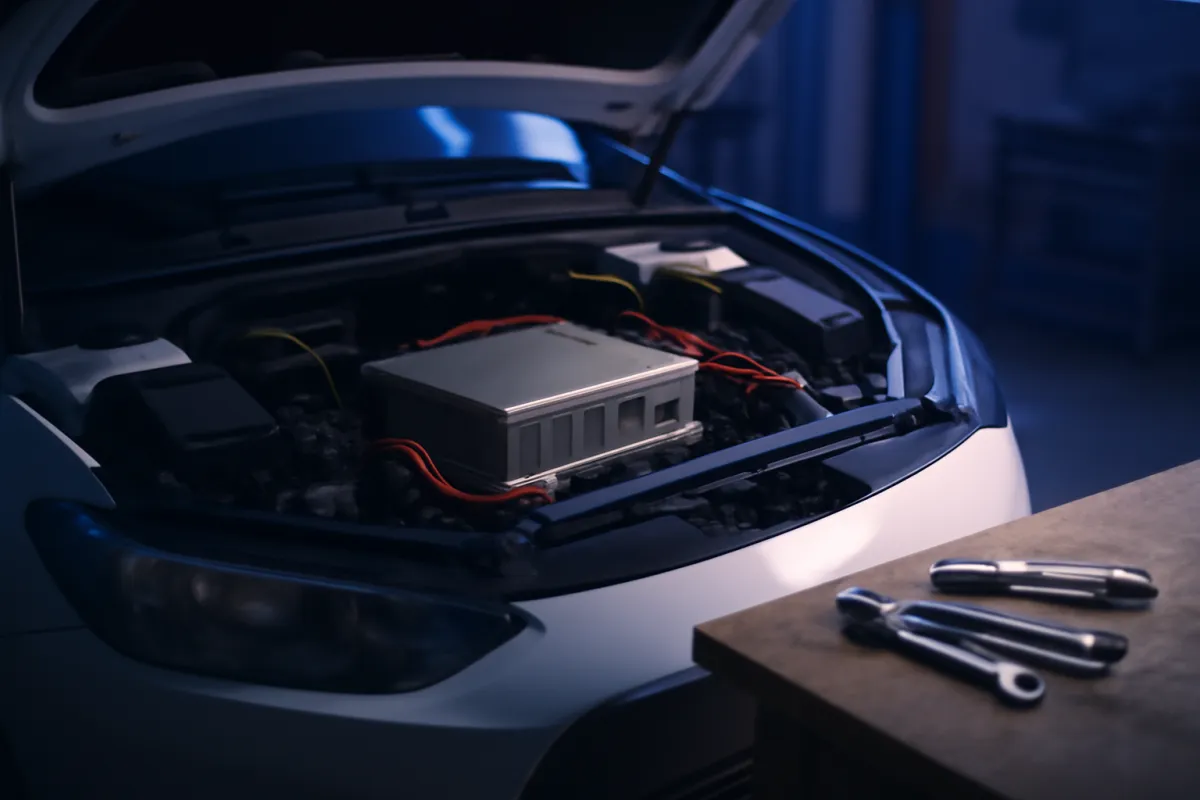
Start with the part itself, because most of the fear around it comes from picturing the wrong component. A conventional hybrid, the kind that never plugs in, carries a battery pack whose job is to smooth out the gap between the gas engine and the electric motor: storing braking energy for a moment, then handing it back for an acceleration boost or a few miles of low-speed electric driving. It is not sized to drive the car any real distance on electricity alone, and it was never meant to be.
That job description matters because it explains the size. Where a battery electric car needs enough energy to cover an entire trip, a hybrid pack only needs enough to cover the next few seconds of driving several times over. The result is a battery that is a small fraction of the size, in kilowatt-hours, of what sits under a full EV, which is the single biggest reason its replacement bill looks nothing like the EV number people have heard quoted.
NiMH versus lithium-ion: which pack your Toyota carries
Toyota has used more than one battery chemistry across its hybrid lineup over the years, and knowing which one applies to a given car changes what a repair conversation looks like. Older and many higher-volume hybrid models have long used nickel-metal hydride cells, a mature, well-understood chemistry that specialists have serviced for a long time, which is part of why the independent repair market around it is so developed. Newer and some higher-performance hybrid models use lithium-ion cells instead, generally offering a bit more energy in a smaller package.
Neither chemistry is inherently the cheaper one to service, and the honest position is that model, region, and shop availability matter more than chemistry alone. What is worth knowing is that the nickel-metal hydride packs on the road have accumulated a long service history, so the module-repair option discussed later in this teardown is especially well developed for them. Confirm which chemistry your specific model and model year carries in the owner’s documentation rather than assuming from the badge.
The headline number: what a replacement quote actually says
Here is the number people mean when they ask, stated plainly before it gets put in context. An illustrative dealer-new replacement for a compact hybrid car’s battery commonly runs somewhere in the region of $1,500 to $3,000, with a larger hybrid SUV or truck pack landing higher because it typically holds more energy. That is real money for most households, and this teardown will not pretend it is not.
But exactly as with a full EV pack, a cost only belongs in a decision weighted by how likely you are to actually pay it. Quoted bare, the figure reads like a scheduled maintenance item, the way a timing belt or a clutch eventually comes due. It is nothing of the sort. It is the price tag on an uncommon event, partly fenced off by warranty, and frequently replaced by a cheaper module repair when it does happen. The rest of this teardown is the context that turns the scary number into a manageable, low-probability line item.
Why a hybrid pack costs so much less than an EV pack, and why the bill still stings
Put the two side by side and the gap makes sense quickly. Our teardown on EV battery replacement cost prices an illustrative full electric car pack at roughly $5,000 to $15,000 or more, driven mostly by pack size in kilowatt-hours. A hybrid pack commonly holds a small fraction of that energy, so even at a similar or somewhat higher cost per kilowatt-hour, reflecting the smaller production runs and specialized labor involved, the total bill lands far lower.
That said, the hybrid figure still stings for a specific reason: labor and diagnostics do not shrink at the same rate the pack does. Dropping a compact battery, running diagnostics, and commissioning the replacement takes a fair amount of the same technician time regardless of how many kilowatt-hours are inside it, so labor is proportionally a bigger share of a hybrid replacement bill than it is of a full EV one. Knowing that split changes where the savings actually come from, which the chart later in this teardown makes concrete.
What actually drives the price
Four things move a real quote more than any other factor, and knowing them helps you read a quote rather than just flinch at it. Pack size in kilowatt-hours is the first: a larger hybrid SUV or truck pack costs more than a compact car’s smaller one, all else equal, for the same reason a bigger EV pack costs more than a smaller one. Chemistry and model-specific parts availability is the second, since a widely produced model with a large independent repair ecosystem tends to see more competition on price than a low-volume one.
Labor rate and shop type is the third, and it is the one buyers underweight most. A dealer’s hourly rate, a specialist hybrid shop’s rate, and a general independent mechanic’s rate can differ meaningfully, and not every shop is equally set up to test and diagnose a hybrid pack correctly. The fourth is the replacement route itself, new, remanufactured, or module repair, which the next two sections turn into numbers.
Illustrative cost by replacement route
Because the replacement route is the single biggest lever after pack size, the clearest way to see the cost is to plot the illustrative price of the same job across the routes available. Every bar below assumes the same illustrative compact-hybrid pack and scales as a share of the most expensive option.
Illustrative replacement cost by route, one compact hybrid pack
Rough all-in figures for comparison only. Real quotes vary by model, region, and shop, and not every route is available for every vehicle.
The bars are illustrative only, scaled from one example pack size and cost assumption, not a quote for any specific vehicle. Read the shape: the route you choose moves the bill as much as the fault itself does.
Read that chart for the pattern rather than the exact digits: a new dealer pack sits at one end, and each step toward a smaller, more targeted fix cuts the bill roughly in proportion. The used or salvage option at the far end carries the least certainty about remaining life, which the section on remanufactured packs below covers honestly. Run your own pack size and cost assumptions through the companion beside this article to see where your own row would land.
Where a hybrid battery replacement dollar goes
Zoom into a single new-pack quote and the split explains why labor matters more here than on a full EV replacement. The battery itself is still the largest piece, but labor and diagnostics take a noticeably bigger bite than they do on a full-size EV pack, because much of the labor is fixed regardless of pack size.
Illustrative new-pack replacement cost split
Where a typical compact-hybrid full-pack replacement dollar goes, framed illustratively. Not a quote for any specific vehicle.
Compare this with a full EV pack, where the battery itself is closer to 70 percent of the bill. On a hybrid, labor is proportionally bigger because a lot of the technician time does not shrink along with the smaller pack.
The practical lesson follows directly from the split. Because labor is a bigger relative share here than on a full EV, shopping the labor rate, comparing a dealer quote against a specialist hybrid shop, matters more on a hybrid battery job than people expect. And because the pack itself is still the majority of the bill, the module-repair route below is still the single biggest lever available when a fault is isolated to one section.
New versus remanufactured versus independent module repair
Three real paths exist to a working hybrid battery again, and they are not equally good for every situation, so it is worth understanding what each one actually buys you. A new pack from the dealer is the highest-certainty option: it typically carries the strongest warranty and the least ambiguity about remaining life, at the highest price. It is the right choice for an owner who wants to keep a car a long time and wants the least to think about afterward.
A remanufactured or exchange pack, whether sold through the dealer or a third party, sits in the middle. Reputable suppliers test incoming cores, replace the weak modules, and rebalance the pack before it goes back out, and a genuine remanufacturer stands behind the result with a written warranty. This route commonly lands meaningfully below new-pack pricing while still offering real assurance, provided the supplier is a real one rather than a bargain listing with no testing behind it.
Independent module repair is the most targeted option and often the cheapest, but it depends entirely on the fault matching the fix. A specialist tests each module in the pack, identifies the weak one, and swaps only that section, leaving the rest of the working pack untouched. When it applies, this route sidesteps most of the pack-cost slice in the chart above. It does not apply to every fault, since a pack with widespread degradation across most of its modules is not helped much by fixing one, which is exactly the diagnosis a good specialist should walk you through honestly before quoting the job.

The federal and CARB-state warranty floor
Underneath the whole replacement question sits a warranty floor that many owners never look up. In the United States, hybrid and electric vehicle batteries are commonly covered under a warranty tied to emissions-related components, and a federal-style minimum commonly discussed is eight years or 100,000 miles, whichever comes first. States that follow California’s stricter emissions program have often required a longer floor specifically on the battery, frequently discussed as ten years or 150,000 miles.
Treat both of those numbers as the shape of the rule rather than a guarantee for your specific car. The exact years, mileage, and what counts as a covered failure differ by model year, model, and region, and warranty rules of this kind can change over time, so the document that actually governs your car is the warranty booklet issued with it, not a general figure repeated online, including the ones in this teardown. If you are shopping a used hybrid, ask a dealer to confirm remaining coverage against the vehicle identification number rather than assuming from the car’s age alone.

Degradation versus failure in a hybrid pack
As with a full EV battery, most of the fear here comes from merging two different events into one word. Degradation is the slow, expected loss of capacity every battery experiences as it cycles and ages, and on a hybrid it shows up as slightly less assistance from the electric side rather than a shorter driving range, since the car was never running on the pack alone. It is normal, it happens to every pack, and it is not the kind of thing a warranty pays for.
Failure is different: a genuine fault, one weak module or a cell block that has drifted far out of balance, that produces a warning light or a real drop in performance. It is uncommon, and rarest during the years the warranty covers. The replacement quote applies to failure. What almost every owner actually experiences, if anything, is degradation, which is a maintenance non-event rather than a repair bill.
Warning signs your hybrid battery is failing
A short, practical list is more useful here than a long one. A hybrid system or check-engine warning light is the most obvious sign, and it should always trigger a proper diagnostic scan rather than a guess. A noticeably rougher handoff between electric and gas power, hesitation, or a jerkier transition than the car used to have is another. Fuel economy that drops in a way your driving does not explain is a third, since the electric side quietly assisting less shows up first at the pump.
A fourth is a state-of-charge display, where the car shows one, that swings unusually fast between full and empty, which can indicate one weak section dragging the whole pack’s apparent capacity down. And a fifth is the gas engine simply running more of the time at low speeds than it used to, since a healthy hybrid system leans on electric assistance there specifically. None of these five confirm a battery fault by themselves, since a sensor, the small 12-volt battery, or an unrelated issue can produce similar symptoms, which is exactly why a scan tool reading the actual pack data is the right next step rather than assuming the worst from a dashboard light.
How long a Toyota hybrid battery actually lasts
The honest answer runs counter to the reputation. Toyota’s hybrid system has been in mainstream, high-volume production for a long time, and the fleet-wide track record is genuinely strong: a large share of these packs are still running at very high mileages with no replacement ever bought, commonly discussed in the range of an illustrative 150,000 to well over 200,000 miles before a genuine fault appears, and plenty of well-documented examples run further than that. This is not a guarantee for any specific car, but it is a fair description of the pattern across a very large number of vehicles on the road.
The mechanism behind that longevity is the same gentle-use story that applies to any hybrid or EV pack: because the battery only ever handles brief bursts of energy rather than sustained high output, and because Toyota’s system is tuned to keep the pack within a comfortable middle band of charge rather than running it near empty or full, the cells see less of the stress that accelerates wear. Our teardown on how long EV batteries actually last covers the underlying degradation curve in more depth for the full-battery-electric case, and the same broad mechanism, gentler use meaning slower fade, applies here too.
Individual module repair: fixing one bad cell block instead of the whole pack
This deserves its own section because it is the single biggest cost lever available once a car is out of warranty, and it is underused simply because owners do not know to ask for it. A hybrid pack is not one indivisible unit. It is a stack of modules, each holding a handful of cells, wired together and managed as a group. When a fault develops, it very often traces to one weak module dragging down the whole pack’s apparent performance, rather than uniform failure across every cell.
A specialist equipped to test each module individually can identify the weak section, swap it for a tested healthy module, either new, reconditioned, or a good used unit, and rebalance the pack, restoring normal function without buying an entirely new battery. This is precisely the kind of work reflected in the lower bars of the replacement-route chart above, and it is why the real bill so often lands well under the full-replacement headline people quote. It is not available everywhere, since it depends on the shop having the right testing equipment and a supply of tested modules for your specific model, so ask directly whether a shop offers module-level diagnosis before assuming a full pack is the only option.
The other battery: the 12-volt you’ll actually replace more often
There is a detail worth naming plainly, because it is the battery replacement most hybrid owners genuinely do pay for, and it is not the expensive one. Every hybrid, alongside its high-voltage pack, carries a small conventional 12-volt battery that runs the accessories, the electronics, and the systems that wake the hybrid pack when you start the car. That little battery wears out on the same kind of timescale as the one in an ordinary gas car, a handful of years, and replacing it is routine, inexpensive work, an illustrative low hundreds of dollars or less rather than the four-figure hybrid-pack numbers this teardown centers on.
The reason it matters is expectation. A dead 12-volt battery can leave a hybrid unable to start or behaving strangely even though the expensive high-voltage pack is perfectly healthy, and an owner who has heard the scary hybrid-battery figure can jump straight to fearing the worst over what is actually routine maintenance. Treating the 12-volt as ordinary upkeep, checking it at service intervals and replacing it before it strands you, keeps a minor part from masquerading as a major failure.
How mileage and driving pattern affect your odds
The population that actually pays for a full hybrid battery replacement is describable, and knowing the shape of it helps you judge your own situation. Odds tilt upward for an older, very high-mileage car well past its warranty window, for a car that has spent its life in sustained extreme heat, since heat is the main accelerant of battery wear across every chemistry, and for a car with a documented history of ignored warning lights or deferred hybrid-system service.
Odds tilt downward for a car serviced on schedule, kept within a reasonable mileage for its age, and driven in a moderate climate, and for a buyer who simply keeps the car within the years most hybrid batteries comfortably outlast. None of this is a promise about any individual vehicle, since any pack can develop an early fault and any old pack can keep running fine, but the pattern across many cars is real and worth weighing when you are deciding how much replacement risk to price into a specific used hybrid.
Model-family differences: compact cars versus SUVs and trucks
Pack size scales with the vehicle it serves, which is the main reason a compact hybrid sedan and a larger hybrid SUV or truck do not share the same illustrative replacement figure. A smaller car needs a smaller boost from its electric side and correspondingly carries a smaller, cheaper-to-replace pack. A larger, heavier hybrid SUV or truck asks more of its electric assistance and commonly carries a bigger pack to match, which pushes the replacement bill higher for the same reasons a bigger EV battery costs more than a smaller one.
The practical takeaway mirrors the one in our EV battery replacement teardown: the size of the pack you are buying into is a real, ongoing number that follows the vehicle for its whole life, purchase price, running costs, and the unlikely replacement bill all included. A buyer cross-shopping a compact hybrid against a larger hybrid SUV should weigh that the larger vehicle’s every battery-related number, this one included, scales up with it.
Used Toyota hybrid buying: checking the battery before you buy
Everything above turns into a short, practical checklist when you are standing next to a used hybrid with your wallet out. Start with a proper diagnostic scan rather than a test drive alone, since a scan tool reading the actual hybrid system data will surface stored codes and battery-related history a short drive cannot. Ask for the service history and look specifically for any hybrid-system work, replaced modules, or warning-light visits, since a documented, well-maintained history is worth real money.
Get the in-service date and mileage, and check them against whatever warranty floor applies in your state, since remaining coverage on a still-covered car is transferable value in the same way it is on a full EV, as our teardown on buying a used electric car covers for the EV side of the same logic. Take a longer test drive than usual and pay attention to how smoothly the car hands off between electric and gas power, since a rough or hesitant transition is one of the more noticeable real-world symptoms. Then price what you found: a verified, healthy hybrid system is worth a premium over an identical car with an unclear history, and that gap belongs in your offer.
How hybrid battery health affects resale value
Battery condition functions on a used hybrid the same way it does on a used EV, just at a smaller financial scale: it is effectively part of the drivetrain’s health in one line item, and a buyer who cannot verify it is pricing in uncertainty whether they realize it or not. A car with a clean diagnostic history, no warning-light events, and a documented remaining warranty is worth more than an identical car without those things, even though the difference may never show up as a line item on a listing.
Our teardown on whether EVs hold their value works through the equivalent logic for full electric cars, and the short version carries over here: verified health converts a vague fear into a number, and a number is something a buyer and seller can actually negotiate around instead of arguing over. Sellers who keep the paperwork that proves a clean hybrid-system history are, in effect, defending their own asking price.
A worked example: one replacement quote, priced three ways
Numbers settle the argument better than reassurance, so follow one illustrative case. A compact hybrid, seven years old with 78,000 miles, develops a hybrid warning light. A dealer diagnostic finds one weak module dragging the pack’s performance down. The car’s battery is a 1.3 kWh pack, and the dealer’s all-in new-pack quote, based on an illustrative $1,600 per kilowatt-hour figure that reflects the smaller production runs and specialized labor behind these packs, comes to about $2,080.
Because the car is seven years old and under 100,000 miles, it sits inside the commonly cited federal-style eight-year, 100,000-mile floor, so a genuine defect of this kind would likely be a covered repair rather than an out-of-pocket one, pending the manufacturer’s own assessment. If the car were instead two years past that window, the same job priced three ways looks very different: about $2,080 new from the dealer, roughly $1,150 for a reputable remanufactured or exchange pack, or roughly $625 if a specialist can isolate and replace just the one weak module rather than the whole battery. Enter your own pack size, cost assumption, replacement route, age, and mileage into the companion beside this article to run your own version of this exact case.
DIY, aftermarket, and the warranty trap
A visible aftermarket exists around hybrid battery repair, and it is worth approaching with the same care that any high-voltage work deserves. Packs of this kind carry dangerous voltages, and opening one without the right training and protective equipment is a genuine safety risk, not a weekend-project inconvenience. That said, a real, competent independent hybrid-repair specialty has grown up around these systems precisely because the module-repair approach is so effective, and using one is not automatically a warranty problem.
The trap is timing rather than the aftermarket itself. If your car is still inside its emissions-related battery warranty window, using an unapproved shop for high-voltage work on that specific system can complicate or end a claim for that repair, so the sequence that protects you is to use the manufacturer’s network while coverage is live and valuable, and consider the independent route once that window has closed and there is nothing left to protect. Ask any shop directly what its work does to your remaining coverage before you commit, and keep the paperwork either way.
Common myths about hybrid battery replacement, retired
A handful of confident claims circulate widely and deserve dismantling. The battery always needs replacing around eight years or 100,000 miles: no, that is commonly where a warranty floor sits, not where the pack fails, and a large share of these packs run far past it. Replacing a hybrid battery costs as much as a whole new car: no, the illustrative range sits far below that, and it falls further with a remanufactured pack or a module repair.
Any fault means a full pack swap: no, packs are modular, and a fault very often lives in one section that a specialist can replace alone. A used hybrid with high mileage is a ticking time bomb: often false, since a well-maintained pack with a clean diagnostic history at high mileage is common rather than rare on these cars. And a warning light always means an expensive repair: not necessarily, since some of the same symptoms trace to the small 12-volt battery or a sensor rather than the high-voltage pack.
How this compares to a transmission or engine repair on a gas car
The replacement figure only means something set beside the alternative it gets compared to, so put it next to the equivalent big-ticket repairs on a conventional gas car. A failed transmission or a major engine repair on an aging gas vehicle can easily run into several thousand dollars and, on an older car, can approach or exceed the vehicle’s value, much the way a hybrid battery replacement can. The difference people tend to forget is that a gas car also carries a long list of certain, recurring costs a hybrid’s electric side never asks for on its own: more frequent fluid changes, exhaust and emissions parts, and the steady wear of a mechanically busier drivetrain doing more of the work by itself.
Our teardown on whether electric cars are cheaper to maintain prices the routine side of that comparison for the full-electric case, and the shape of the argument holds for a hybrid too: weigh a low-probability, shrinking-with-repair-options battery event against a stack of smaller, more certain maintenance costs elsewhere, rather than treating the battery figure as the only number that matters.
What to do if you get a battery warning light
Panic is the least useful response, and a short, calm sequence serves you better. Do not ignore the light, since continuing to drive on a genuinely failing pack can turn a cheap module fix into a bigger repair. Get a proper diagnostic scan booked, ideally somewhere that can read the actual hybrid battery data rather than just clearing a generic code, and ask directly whether the shop can test at the module level.
Ask for the fault explained in plain terms before agreeing to any quote: is this one weak module, a sensor issue, the 12-volt battery, or genuine widespread pack degradation, since those are very different jobs at very different prices. Check your warranty status before you authorize any high-voltage work, and get more than one quote if the first one is a full-pack replacement, since the module-repair and remanufactured routes covered in this teardown are worth asking about explicitly rather than assuming they are unavailable.
The bottom line
Toyota hybrid battery replacement cost is real money when it happens, an illustrative $1,500 to $3,000 for a compact hybrid at a dealer and more for a larger hybrid SUV, but the frequency is the part the scary number leaves out. The pack is a small fraction of the size of a full EV battery, which is most of why the bill is so much smaller too, a commonly cited eight-year, 100,000-mile floor covers many of the years an early fault would hurt most, module repair and remanufactured packs routinely cut the real bill well below the headline, and most of these packs simply fade gradually rather than fail outright.
Price the low probability of an uncommon event, not the sticker of a worst case. If you are buying used, get a real diagnostic scan and a service history rather than trusting a test drive alone, and if you already own the car, keep an eye on the symptoms in this teardown rather than the fear. Run your own pack size, replacement route, age, and mileage in the companion above, and take the wider ownership picture to our calculator; the number that comes out the other side is calmer than the folklore, and calm is what a good used-car decision is built on.
This teardown is educational and independent, written by people who enjoy pricing hardware honestly rather than selling batteries, warranties, or cars. Every dollar figure, cost-per-kilowatt-hour assumption, replacement-route split, warranty term, and worked example above is illustrative and general, and will move with the specific model and model year you own, its pack chemistry and size, your mileage and climate, the shop and parts you use, and whether a fault is repaired at the module level or the whole pack is replaced. Warranty coverage, capacity thresholds, and repair-network availability in particular vary by manufacturer, model, region, and situation and can change over time, so before budgeting around a replacement, verify the actual warranty document for the specific vehicle and confirm current diagnostic, repair, and replacement pricing with qualified service providers.
Gas vs electric, 5-year total
Fuel and electricity only, at 12,000 miles a year: a 30 mpg gas car at $3.50/gal against home charging at 0.3 kWh/mi and $0.15/kWh.
On incentives: this total is fuel vs. electricity cost only, with no purchase incentive netted in on either side. The federal EV tax credits, 30D for new vehicles, 25E for used, 45W for commercial, ended in 2025 and are no longer available to buyers at the time of writing. If you see a lower "after incentive" price quoted anywhere for a new purchase, that credit is gone; see how EV tax credits work now.
Frequently asked questions
How much does it cost to replace a Toyota hybrid battery?
Illustrative dealer-new figures commonly run from roughly $1,500 to $3,000 for a compact hybrid car and higher for a larger hybrid SUV, with the pack itself the largest line and labor and diagnostics a smaller share on top. Those figures fall a good deal if the job uses a remanufactured or exchange pack, and fall further still if a shop can repair the failing module rather than swap the whole battery. Treat any single number as illustrative: it moves with model, pack size, region, and whether the fix is a full pack or a module. Get a written quote for your specific vehicle and identification number rather than relying on a general figure, including this one.
Is a Toyota hybrid battery cheaper to replace than a full electric car battery?
Usually yes, and by a wide margin, because the two are different kinds of component doing different jobs. A conventional hybrid battery is sized to smooth out acceleration and regenerative braking for a few miles' worth of energy, not to drive the car on its own for long distances, so it commonly holds a small fraction of the energy a battery electric car's pack does. Our teardown on EV battery replacement cost prices the electric side of that comparison, and the gap between the two is mostly explained by that size difference, not by Toyota building a fundamentally different kind of part.
Does Toyota's hybrid battery warranty cover replacement?
Often, yes, inside the coverage window, because hybrid and electric vehicle batteries are commonly covered by a warranty tied to emissions-related componentry that runs longer than the basic new-car warranty in most markets. A commonly cited federal-style floor in the United States runs eight years or 100,000 miles, and vehicles registered in states that follow California's stricter emissions rules often carry a longer floor on the hybrid battery specifically, frequently discussed as ten years or 150,000 miles. Coverage details, exact years and mileage, and what counts as a covered failure differ by model year and region, so read the warranty booklet for your specific vehicle rather than any general description, including this one.
How long do Toyota hybrid batteries actually last?
Considerably longer than their reputation suggests. Toyota's hybrid system has been in mainstream production for a long time, and a large share of these packs are still running well past the original warranty window, commonly discussed in the range of an illustrative 150,000 to over 200,000 miles before a genuine fault shows up, with plenty of documented high-mileage examples beyond that. The pack fades gradually rather than failing on a schedule, so most owners see slightly reduced fuel-economy assistance from the electric side long before they see an outright failure, if they ever do.
Can a shop repair just one module instead of replacing the whole hybrid battery pack?
Increasingly, yes. A hybrid battery is built from smaller modules wired together, and a fault very often lives in one weak module or cell block rather than across the entire pack. A specialist who can test each module, identify the weak one, and swap it for a healthy used or reconditioned module can often resolve a fault for a fraction of a full-pack price. This is not available at every shop and depends on the model and the specific fault, so it is a real option to ask about rather than a guarantee, but it is a large part of why the real bill so often lands well under the full-replacement headline.
What are the warning signs of a failing Toyota hybrid battery?
Common reported signs include a hybrid system or check-engine warning light, a noticeably rougher or more frequent transition between electric and gas power, reduced fuel economy that does not match your driving, a battery state-of-charge display that swings unusually fast, or the gas engine running more than it used to at low speeds. None of these confirm a battery fault on their own, since several can also point to a sensor, the smaller 12-volt battery, or an unrelated issue, which is exactly why a proper diagnostic scan rather than a guess is the right first step.
Is a remanufactured or used Toyota hybrid battery a safe option?
It can be, and it is a large part of why real-world bills undercut the new-pack headline, but quality varies by supplier. A reputable remanufactured or exchange pack has typically been tested, had its weak modules replaced, and carries some form of warranty from the seller or installer, while a bargain used pack pulled from a salvage vehicle with no testing carries far less certainty about remaining life. Ask for the state-of-health testing behind any reconditioned pack, the specific warranty terms in writing, and who stands behind the part if it underperforms, before treating a lower price as automatically the better deal.
Does hybrid battery health affect the resale value of a used Toyota?
Yes, in the same way it does on a battery electric car, just at a smaller scale. A verified hybrid system that switches smoothly, holds a normal charge pattern, and shows no warning history is worth more than an identical car with a flagged or aging battery, and a car already outside its emissions warranty window carries more of that risk for the next owner. Our teardown on how to buy a used electric car covers the equivalent battery checks for a full EV, and most of the same logic, checking history, checking behavior, and pricing the remaining warranty, carries over to a used hybrid.