What's in this teardown
- The three kinds of electrified car
- How a battery electric car (BEV) works
- How a self-charging hybrid (HEV) works
- How a plug-in hybrid (PHEV) works
- BEV vs HEV vs PHEV at a glance
- Cost to buy: the upfront picture
- Cost to run: fuel and electricity
- Maintenance across the three
- Range, charging, and refueling
- Who a battery EV fits best
- Who a self-charging hybrid fits best
- Who a plug-in hybrid fits best
- The no-home-charging question
- Cold climates and how each copes
- Pros and cons of each powertrain
- Resale value and depreciation
- Tax credits and incentives
- Where the five-year cost gap comes from
- Common mistakes when choosing
- A worked example: three drivers
- How to choose in five questions
- The bottom line
The EV vs hybrid question is really three questions wearing one coat, because “hybrid” hides two very different machines and “EV” means something specific. Ask most people to choose between an electric car and a hybrid and they picture a clean two-way fight, when the honest picture is a three-way one: a battery electric vehicle that only ever plugs in, a self-charging hybrid that never does, and a plug-in hybrid that sits between them. Each solves a different problem, and the reason the debate feels unsettled is that people compare the wrong pair. The right answer is not a universal winner, it is a match between one of three powertrains and how you actually drive.
This teardown lays the three side by side and keeps every figure illustrative and brand neutral, so you can see the mechanism rather than a sales pitch. It explains how a battery EV, a self-charging hybrid, and a plug-in hybrid each work, what each costs to buy and to run, how far each goes and how you refuel it, and, above all, who each one fits. It deliberately stops short of re-running the full cost math against a gas car, which our EV versus gas cost teardown already prices in detail, and it does not re-argue the go or no-go verdict our is an electric car worth it note settles. Here the job is narrower and more useful: given that you are choosing between electric and hybrid, which one, and why. If you have already ruled out a battery EV and are deciding only between the two hybrid formats, our teardown on plug-in hybrid versus hybrid settles that narrower comparison on charging access and daily distance. Price your own version as you read with our cost calculator.
Key takeaways
- There are three powertrains, not two: a battery EV (BEV) that only plugs in, a self-charging hybrid (HEV) that never plugs in, and a plug-in hybrid (PHEV) that does both.
- Home charging is the deciding fact. It unlocks the EV's cheap mile and a plug-in hybrid's electric commute; without it, a self-charging hybrid is often the lower-friction pick.
- A battery EV usually runs cheapest and needs the least maintenance, but depends on charging access and asks for planning on long trips.
- A self-charging hybrid asks nothing new of you, refuels anywhere in minutes, and improves fuel economy, but never reaches an EV's running cost.
- A plug-in hybrid can behave like an EV locally and a hybrid on trips, but only if you actually charge it, and it carries the most hardware of the three.
The three kinds of electrified car
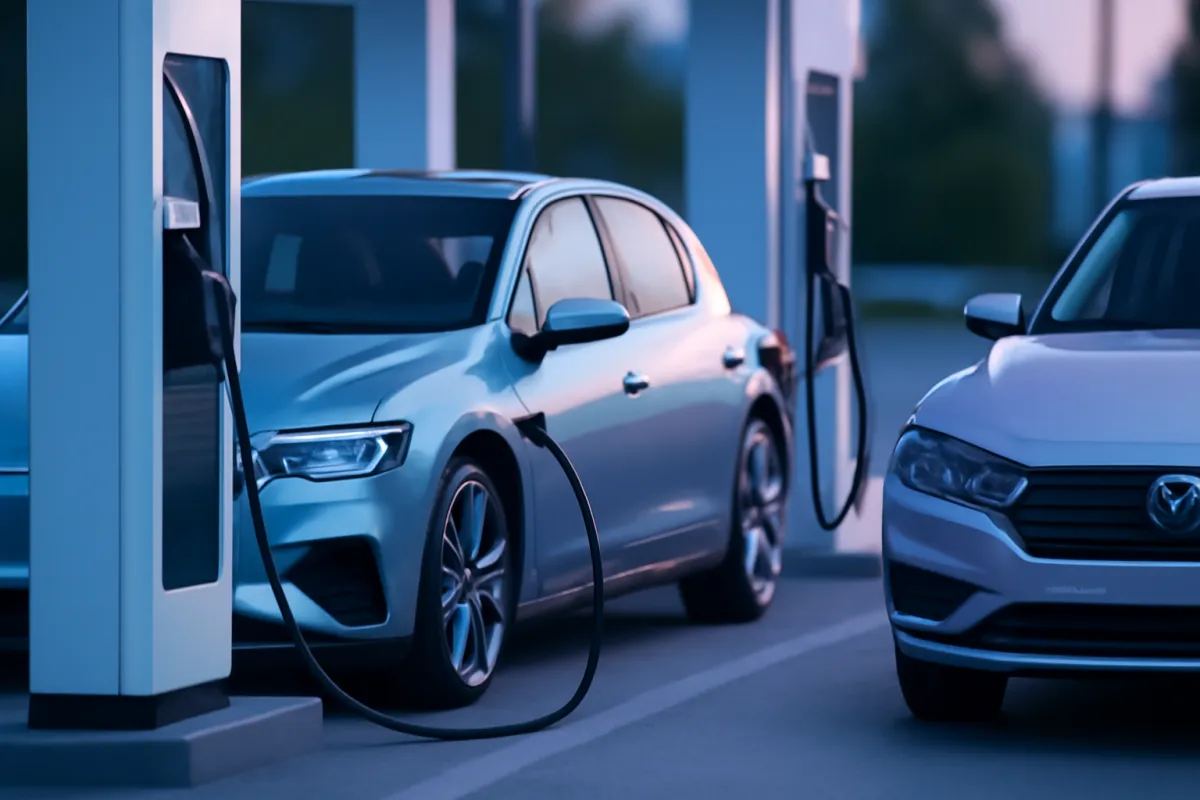
Before comparing anything, it helps to name the three machines precisely, because most confusion in the EV vs hybrid debate comes from blurring them. A battery electric vehicle, the BEV, carries a large battery and one or more electric motors and nothing else: no engine, no fuel tank, no tailpipe. You add energy by plugging it in. A self-charging hybrid, the HEV, is at heart a gasoline car with a small battery and motor bolted into the drivetrain to recover energy that would otherwise be wasted; it burns gasoline, and you never plug it in. A plug-in hybrid, the PHEV, is the middle child, with a battery big enough for a short electric range that you charge from a plug, plus a full gasoline engine for everything beyond that range.
The single most useful way to keep them straight is by how they take on energy. The BEV takes electricity only. The HEV takes gasoline only. The PHEV takes both, electricity for its first stretch of miles and gasoline after. Everything else in this teardown, the cost, the range, the charging, the fit, flows from that one distinction. When someone says an electric car is expensive to road trip or a hybrid is not really electric, they are usually right about one of these three and wrong to apply it to the others. Getting the categories clear is most of the battle, and our cost calculator is built to price all three at once against your own driving.
How a battery electric car (BEV) works
A battery electric car is the simplest of the three to describe because it does only one thing. A large battery pack stores energy, one or more electric motors turn that energy into motion, and a controller manages the flow between them. There is no engine, no transmission in the traditional sense, no oil, and no exhaust. When you press the accelerator, current flows from the pack to the motor almost instantly, which is why EVs feel so responsive from a standstill. When you lift off or brake, regenerative braking runs the motor backward as a generator, slowing the car and returning energy to the battery, a mechanism our note on regenerative braking walks through in full.
You refuel a BEV by plugging it in, and this is the fact that defines ownership. At home on a normal or dedicated circuit, the car charges slowly while it sits parked overnight, which for most drivers means it is full every morning without a thought. On the road, public DC fast chargers add a large chunk of range in tens of minutes rather than hours. The battery is also the most expensive single component, which sets the car’s price and its range, and it degrades gradually over years rather than failing suddenly, a curve our battery longevity teardown projects forward. Understood plainly, a BEV trades the gas station for the plug: cheaper and more convenient if you can charge at home, more of a planning exercise if you cannot.
How a self-charging hybrid (HEV) works
A self-charging hybrid is best understood as a gasoline car that wastes less. It keeps a conventional engine and fuel tank, then adds a small battery and one or two electric motors that capture energy the car would otherwise throw away, mainly the kinetic energy of braking and coasting. That recovered energy is stored briefly and fed back to help the car accelerate, run accessories, or creep at low speed on electricity alone. The result is meaningfully better fuel economy than an equivalent non-hybrid, especially in stop-and-go city driving where there is the most braking energy to recover. Crucially, the battery is small and is charged entirely by the car itself, so you never plug it in.
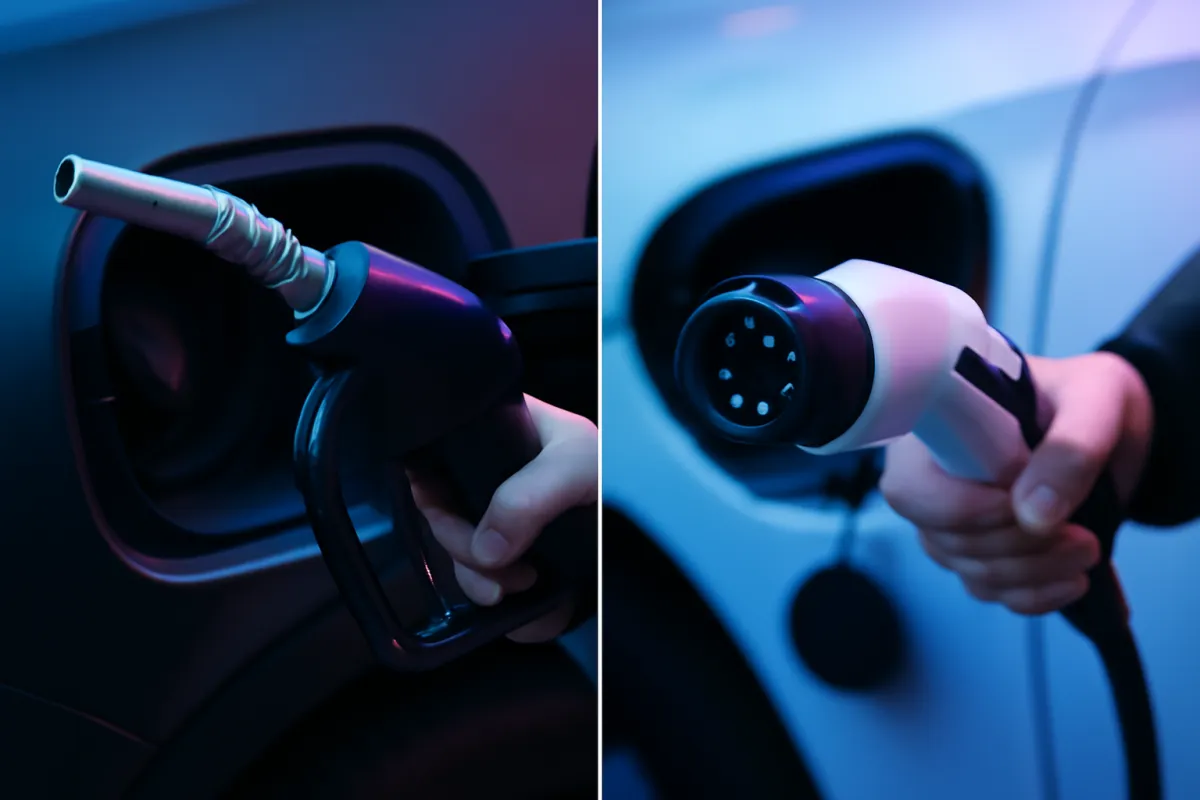
That self-contained design is the HEV’s whole appeal and its ceiling at once. Because it never needs charging, a hybrid asks nothing new of the driver: you fuel it at any gas station in a few minutes and drive it exactly like a conventional car, with no home charger to install and no public network to learn. It delivers a real fuel saving over a plain gasoline car and a lower entry price than most EVs. But it is still burning gasoline for every mile, so it can never reach the per-mile running cost of a home-charged EV, and it does not qualify for the plug-in incentives that a BEV or PHEV can. The hybrid is the low-commitment step up from gas, not the destination.
How a plug-in hybrid (PHEV) works
A plug-in hybrid combines the two designs above into one car. It has a battery large enough to deliver a short electric-only range, commonly a few dozen miles as an illustrative figure, which you charge from a plug like an EV. It also has a full gasoline engine and tank like a hybrid. Drive within the electric range and a PHEV behaves much like a battery EV, quiet and running on cheap electricity. Exceed that range and the gasoline engine takes over, and from there it behaves like a self-charging hybrid, refueling at any pump. In principle you get electric commuting and gasoline road trips in a single vehicle, with no range anxiety because the engine is always there as a backup.
The honesty required with a PHEV is about the word “if.” It delivers its promise only if you plug it in regularly, because the electric range is short and runs out quickly. An owner who charges every night and drives mostly local miles can run on electricity most of the time and touch gasoline only on longer trips, capturing much of the EV’s running-cost advantage with none of the range worry. An owner who never charges is carrying a heavier, more complex car, a battery plus a full engine, and getting little more than ordinary hybrid economy for the trouble. A PHEV rewards a specific habit rather than automatically beating both alternatives, which is why the fit sections below matter more for this powertrain than for either of the others.
BEV vs HEV vs PHEV at a glance
Before the details, here is the whole comparison compressed into one view. Every entry is illustrative and general, meant to show the shape of the choice rather than to pin exact numbers to any model.
| Factor | BEV (battery only) | HEV (self-charging) | PHEV (plug-in) |
|---|---|---|---|
| Electric range | The whole trip, commonly 200 to 300-plus miles illustrative | None on electricity alone | Short, commonly 20 to 50 miles illustrative, then gasoline |
| How you refuel | Plug in, at home or a public charger | Gas pump only, never plug in | Plug in for electric miles, gas pump beyond them |
| Charging needed | Yes, home charging strongly preferred | None, ever | Optional, but rewards nightly home charging |
| Running cost | Lowest if charged at home | Better than gas, above an EV | Near-EV if charged, near-hybrid if not |
| Best for | Home charger, mostly local or planned trips | No home charging, frequent long trips | Home charger plus regular long trips |
Read across the rows and the logic of the rest of this teardown appears. The BEV wins on running cost and simplicity but needs charging access. The HEV asks nothing new and refuels anywhere but never reaches the EV’s economy. The PHEV can straddle both worlds but only for a driver who charges it and who genuinely needs both electric commuting and gasoline range. None of these is a verdict; each is a match to a driver, which is the frame the rest of this article builds out and which our cost calculator lets you test against your own mileage.
Cost to buy: the upfront picture
On sticker price, the three tend to line up in a predictable order, though every figure here is illustrative and moves with the model and the market. A comparable self-charging hybrid usually carries the smallest premium over a plain gasoline car, because it adds only a small battery and motor to an otherwise conventional vehicle. A battery EV typically costs the most upfront among mainstream options, driven by the price of its large battery pack, which our purchase-price teardown breaks down in full. A plug-in hybrid often lands between the two, since it carries a mid-sized battery plus a full gasoline drivetrain, paying for some of both.

Two things complicate that tidy ranking, and both push in the EV’s favor. First, incentives apply to plug-in vehicles but generally not to self-charging hybrids, so a qualifying BEV or PHEV can see its effective price drop while the HEV’s does not, sometimes narrowing or closing the upfront gap at the point of sale. Second, the sticker is only the first of several costs; a higher purchase price can be repaid over time by lower running costs, which is the whole argument of our EV versus gas cost teardown. For this decision the practical takeaway is simpler: rank the three on upfront price if that is your binding constraint, but do not stop there, because the cheapest car to buy is frequently not the cheapest car to own.
Cost to run: fuel and electricity
Running cost is where the three separate most clearly, and it comes down to the price of a single mile repeated thousands of times a year. A gasoline mile is the pump price divided by the car’s miles per gallon. An electric mile is the car’s efficiency times your electricity rate, and charged at home that number is usually far lower. A self-charging hybrid improves the gasoline figure without ever reaching the electric one. A plug-in hybrid slides along a range: near the electric cost for miles you cover on a charge, back toward the hybrid cost for miles on the engine. The chart below sets illustrative per-mile costs side by side, each bar drawn directly from its value against the most expensive option at full width.
Illustrative fuel cost per mile, by powertrain
BEV at 30 kWh/100mi and 15 cents home; PHEV blended mostly-electric; HEV at 50 mpg; gas car at 30 mpg; gasoline at $3.50.
A home-charged BEV sits well below the gas mile, a self-charging hybrid roughly halves it, and a charged plug-in hybrid lands near the EV. The order shifts if the EV or PHEV cannot charge cheaply.
The chart carries the whole running-cost story on sight, and it hides one crucial condition. The BEV’s low bar assumes home charging; lean on public DC fast charging instead and its mile can climb toward or past the gas bar, a gap our home charging teardown prices in detail. The PHEV’s bar assumes you charge it; skip that and it drifts up to sit beside the hybrid. The self-charging hybrid’s bar is the most reliable of the three because it depends on nothing but the pump price, which is both its strength and its ceiling. Match these bars to your own rate and mpg in our cost calculator and the abstract order becomes your number.
Maintenance across the three
Maintenance is the quiet running cost, and here the order is fairly consistent even though the figures are illustrative. A battery EV generally needs the least routine service of the three: no oil changes, no spark plugs, no timing belt, no exhaust or emissions system, and a drivetrain with far fewer moving parts, plus regenerative braking that eases brake wear. A self-charging hybrid still has a full gasoline engine and its associated maintenance, though the engine and brakes often work less hard than in a conventional car, which can extend service intervals. A plug-in hybrid carries both an electric drivetrain and a complete gasoline engine, so it has the most systems that can eventually need attention.
That said, none of the three is maintenance free, and the differences are smaller in practice than the headline order suggests. All three need tires, and an EV’s extra weight and instant torque can wear them faster, which narrows its advantage. All three need brake fluid, cabin filters, coolant service in some designs, and occasional repairs, and a rare fault in a battery or power electronics can be expensive on any of them. Netted out over the years you own the car, the routine-service ranking tends to run EV cheapest, hybrid in the middle, and plug-in hybrid carrying the broadest set of components, but the gaps are modest and swamped by fuel differences for most drivers. Treat maintenance as a tiebreaker rather than the deciding factor.
Range, charging, and refueling
How far each car goes, and how you top it up, is where day-to-day life with the three feels most different. A battery EV covers its entire range on electricity, commonly a couple hundred miles or more as an illustrative figure, then needs charging: slow and cheap at home overnight, faster and pricier at a public DC station on a trip. A self-charging hybrid has the total range of a gasoline car and refuels in minutes at any pump, with the electric side working invisibly in the background. A plug-in hybrid gives you a short electric range for local trips, then the gasoline engine extends total range to gas-car levels, so you charge for the cheap local miles and pump for the long ones.
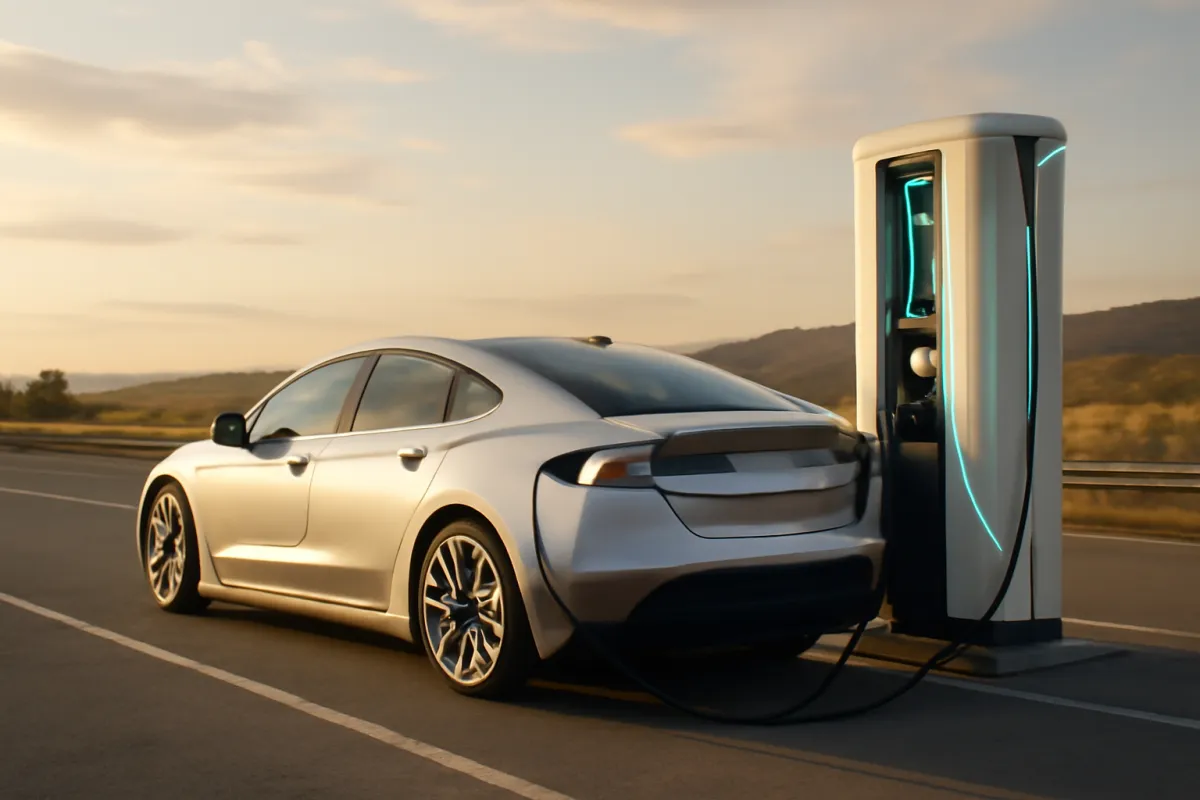
The refueling difference is the source of most real friction, and it cuts cleanly by use case. For daily local driving, the BEV is the most convenient of the three because it charges at home while parked and you never visit a station at all. For frequent long-distance driving, the hybrids are more convenient because they refuel anywhere in minutes with no planning, while the EV depends on the density, speed, and availability of public chargers, which our road-trip planning note addresses head on. A PHEV tries to have both: home charging for the commute and a gas tank for the highway. Which pattern matches your life is the question the fit sections below answer directly.
Who a battery EV fits best
A battery EV fits best the driver who can charge at home and does mostly local or predictable driving. Home charging is the whole case, because it delivers the cheap mile on the chart above and turns refueling into something that happens automatically overnight. Layer on mostly local driving, a daily commute and errands well inside the car’s range, and the EV rarely if ever needs a public charger, which removes its main inconvenience. Such a driver gets the lowest running cost, the least maintenance, the quietest and most responsive drive, and the plug-in incentives, all with essentially none of the downsides that make people hesitate. This is the powertrain’s sweet spot, and it is a large slice of ordinary drivers.
The EV still fits drivers who take occasional long trips, provided they are willing to plan around fast charging a handful of times a year rather than treating the worst-case trip as the everyday case. Where the fit weakens is the mirror image of its strengths: no home charging turns the cheap mile into an expensive, slower public one, and very frequent long-distance driving turns charging stops into a recurring tax on time. If either of those describes you, one of the hybrids is likely the better match. For everyone in the broad middle, a home charger plus a normal driving pattern, the battery EV is usually the strongest choice, and our is an electric car worth it note tests that verdict against the numbers.
Who a self-charging hybrid fits best
A self-charging hybrid fits best the driver who wants better fuel economy without changing anything about how they refuel or where they park. Because it never plugs in, it is the natural choice for anyone who cannot charge at home and does not want to depend on public charging: an apartment dweller, a street parker, or anyone whose driving is too unpredictable to plan around a charger. It is also a strong fit for frequent long-distance drivers, since it refuels at any station in minutes and carries no range anxiety, and for buyers who want the lowest upfront premium over a conventional car. In short, the HEV is the low-commitment, low-friction step up from gasoline.
The trade the hybrid asks you to accept is a ceiling on savings. It improves on a gasoline car’s fuel bill but never reaches a home-charged EV’s running cost, because every mile still burns gasoline, and it does not qualify for the plug-in incentives that lower an EV’s or PHEV’s effective price. For a driver who could charge at home and does mostly local miles, the hybrid leaves money on the table that a BEV would have saved. But for the driver it fits, someone who values refueling convenience, a low entry price, and zero change to their routine over the last increment of running-cost savings, the self-charging hybrid is not a compromise, it is the correct answer.
Who a plug-in hybrid fits best
A plug-in hybrid fits best the driver who has home charging and both a short daily commute and regular long trips. That specific combination is where the PHEV shines: charge it overnight, cover the commute and errands on electricity at near-EV cost, and when a long trip comes, the gasoline engine takes over with no charging stops and no range anxiety. For this driver the PHEV genuinely does blend the two worlds, delivering most of the EV’s day-to-day economy with the hybrid’s road-trip freedom in one car. It also suits someone who wants to drive electrically most of the time but is not yet comfortable relying on public charging for the occasional long haul.
The PHEV fits poorly the driver who will not plug it in, and this is the single most important caveat for the powertrain. Its electric range is short, so its advantage over a self-charging hybrid exists only for miles you actually cover on a charge; an owner who never charges is paying for and hauling a battery that does nothing useful. It also carries the most hardware of the three, an electric drivetrain plus a full gasoline engine, which means the most components to maintain and often a middling price. So a PHEV is an excellent match for a charging, trip-taking household and a poor one for a non-charger, which makes honest self-assessment about your habits more important here than with either alternative.
The no-home-charging question
No single fact reshapes this decision more than whether you can charge at home, so it deserves its own section. With a home charger, the whole board tilts toward electric: the BEV delivers its cheap overnight mile, the PHEV can run its commute on electricity, and both become genuinely convenient because refueling happens while you sleep. Without one, the calculus flips. A battery EV then depends on public charging for everything, which is slower and can cost close to gasoline per mile at DC fast rates, eroding the main reason to go electric. A plug-in hybrid loses most of its point, since its short electric range needs regular charging to matter and it falls back to hybrid economy without it.
That is why, for a driver with no reliable home charging and no dependable alternative such as charging at work, a self-charging hybrid is so often the sensible pick. It sidesteps the charging question entirely, never asking for a plug while still improving fuel economy over a conventional car. The exception is the driver who has consistent, convenient charging somewhere other than home, a workplace charger used daily, for instance, who can sometimes make a BEV or PHEV work well. But treating public fast charging as a substitute for home charging in daily life is usually a mistake that quietly cancels the electric advantage. Be ruthlessly honest about your charging reality before anything else, because it decides more than the badge does.
Cold climates and how each copes
Climate belongs in this decision because temperature affects the three powertrains differently. Cold weather reduces a battery’s usable capacity and range temporarily while it is cold, and cabin heating draws from the same battery, so a battery EV can show a meaningful winter range dip until the pack warms, illustratively on the order of a fair fraction in severe cold. That is manageable for a driver whose daily miles sit comfortably inside even the reduced range, especially with home charging to start each day full and preconditioning to warm the car on grid power before departure. It is more of a factor for someone already near the edge of their range or reliant on public charging in the cold.
A self-charging hybrid and a plug-in hybrid are less exposed to cold on range, because the gasoline engine is unaffected by battery temperature and produces waste heat that warms the cabin without draining the traction battery. A PHEV will still see its short electric range shrink in the cold, but the engine backstops it, so total range holds up. Hot climates matter too, mainly for long-term battery health, since sustained high temperatures are among the harder conditions on a pack over the years, a factor our battery longevity teardown covers. None of this rules out an EV in a cold or hot region, where they are driven successfully every day, but a driver at the extremes should size the range with a margin and weigh how much the winter dip or summer heat touches their specific routine.
Pros and cons of each powertrain
It helps to see each powertrain’s trade-offs stated plainly rather than buried across sections, so here they are in brief.
- Battery EV (BEV), pros: lowest running cost when charged at home, least routine maintenance, quiet and responsive drive, no tailpipe emissions, eligible for plug-in incentives, and refueling that happens automatically overnight.
- Battery EV (BEV), cons: highest upfront price of the three for many models, depends on charging access, slower and pricier refueling on long trips via public charging, and a temporary winter range dip in cold climates.
- Self-charging hybrid (HEV), pros: no charging ever needed, refuels anywhere in minutes, lowest upfront premium over a gas car, improved fuel economy especially in city driving, and no change to your routine.
- Self-charging hybrid (HEV), cons: still burns gasoline every mile so never reaches an EV’s running cost, does not qualify for plug-in incentives, and carries a gasoline engine’s maintenance.
- Plug-in hybrid (PHEV), pros: electric running for local miles plus gasoline range for trips, no range anxiety, and near-EV economy if charged nightly.
- Plug-in hybrid (PHEV), cons: short electric range, the most hardware and maintenance of the three, a middling price, and it only pays off if you actually plug it in.
Laid out this way, the pattern is clear: the BEV maximizes running savings at the cost of charging dependence, the HEV maximizes convenience at the cost of savings, and the PHEV attempts a middle path that rewards a specific habit. Your own weighting of savings against convenience, filtered through your charging access, is what turns this list into a decision.
Resale value and depreciation
Depreciation is usually the largest cost of owning any car, and it adds a wrinkle to this comparison worth understanding, with the caveat that resale trends are model-specific and shift over time. Battery EVs have tended to depreciate quickly in their early years, faster than many comparable gas or hybrid models, driven by rapid technology improvement, changing incentives, and buyer caution about older batteries. Self-charging hybrids have generally depreciated more like conventional cars, with strong demand for fuel-efficient used vehicles often supporting their values. Plug-in hybrids have sat somewhere in between, sometimes softer as a niche used product, sometimes supported by their flexibility.
The practical implications run two ways. For a buyer purchasing new and selling after a few years, an EV’s faster early depreciation is a real cost and a reason leasing is popular, since it hands that risk to someone else. For a buyer shopping used, the same fast depreciation is an opportunity: a used EV with a verified healthy battery can capture most of the car for a large discount and still deliver the cheap running costs, which our best used EVs guide explores. Because the numbers vary so much by model and move with the market, the honest posture is to look up recent resale trends for the specific vehicles you are weighing rather than assume any one powertrain holds value best. Depreciation is too large a cost to guess at.
Tax credits and incentives
Incentives can meaningfully change the upfront math, and they treat the three powertrains differently, so it is worth understanding the shape of the rules even though the specifics change and vary by situation. In general, battery EVs and qualifying plug-in hybrids can be eligible for purchase incentives because they can be charged from the grid, while conventional self-charging hybrids that never plug in have generally not qualified for the same credit. Where an incentive applies, it can reduce the effective price of a BEV or PHEV, sometimes narrowing or closing the upfront gap that made the EV look expensive next to a hybrid.
The reason to stay careful is that eligibility depends on the vehicle, the buyer, and other conditions set by the IRS, and the rules shift over time, with separate provisions sometimes applying to used vehicles. A credit that applies to one model or one buyer may not apply to another, and the amounts and qualifying conditions can change between reading this and buying. Our EV tax credit note walks through how these incentives are structured in general terms. For this decision, treat any incentive figure as illustrative and attribute the authority to the IRS: confirm current federal eligibility, plus any local or state programs, for the exact vehicle and your own situation before you count a credit as money in hand. Treated as a conditional discount it is a genuine help; treated as a guarantee it is a way to be disappointed at the counter.
Where the five-year cost gap comes from
When a battery EV does come out cheaper to own than a hybrid over several years, it helps to see where that advantage is concentrated, because the split explains why the levers in this teardown matter as much as they do. The advantage is not spread evenly; it clusters in a couple of lines. The bar below is an illustrative breakdown of where a home-charged BEV’s total running-cost advantage over a self-charging hybrid comes from across a typical ownership period, and its segments sum to 100 percent.
Where a BEV's running-cost edge over a hybrid comes from
Illustrative split of the total advantage over a typical ownership period. Actual shares vary by driver and model.
Fuel leads, but by a narrower margin than in an EV-versus-gas comparison, because a hybrid already trims the gasoline bill. Maintenance carries a larger relative share of the gap.
The split makes the strategy clear and, notably, different from an EV-versus-gas comparison. Fuel still leads, but by less, because a self-charging hybrid has already cut the gasoline bill that a plain gas car pays in full, so the electric mile is being measured against an efficient hybrid rather than a thirsty conventional car. That narrower fuel gap lets maintenance, where the EV deletes an entire engine’s worth of routine service the hybrid still needs, carry a larger relative share of the advantage. The “other” slice nets incentives and small savings against any higher insurance. Read together, the chart says that against a hybrid specifically, the EV’s case leans more on its mechanical simplicity and less purely on fuel than the headline EV-versus-gas story suggests. Set your own rate and mileage in our cost calculator to see how the gap moves.
Common mistakes when choosing
A handful of recurring errors push people toward the wrong powertrain, in every direction.
- Treating “hybrid” as one thing. A self-charging hybrid and a plug-in hybrid are very different cars with different needs and economics; lumping them together hides the choice that actually matters.
- Assuming home-charging economics without home charging. The EV’s and PHEV’s low running costs depend on charging cheaply at home; a driver who will rely on public fast charging should not expect the numbers the chart shows.
- Buying a plug-in hybrid you will not plug in. A PHEV that is never charged is a heavy, complex hybrid; if you will not charge nightly, a self-charging hybrid is usually the better and cheaper choice.
- Letting a few road trips a year veto an EV. Frequent long hauls are a real reason to lean hybrid, but a handful of trips against mostly local driving should not decide the other three hundred days.
- Comparing only the sticker price. The cheapest car to buy is often not the cheapest to own; upfront price is one of several costs, as our EV-versus-gas teardown lays out.
Each mistake isolates one fact and treats it as the whole answer. The fix is the same in every case: match the powertrain to your charging access, your trip mix, and how long you will keep the car, rather than to a slogan.
A worked example: three drivers
Numbers land harder as stories, so here are three drivers weighing the same choice, every figure illustrative. The first has a driveway with a home charger and a short commute with errands, almost all local, and takes two road trips a year. For her the battery EV is the clear match: she charges overnight for a few cents a mile, rarely touches a public charger, and plans around fast charging just twice a year. The self-charging hybrid would leave real running-cost savings on the table she is perfectly placed to capture.
The second driver parks on the street in an apartment building with no charging and drives long distances for work most weeks. For him the self-charging hybrid is the sensible pick: it never asks for a plug he does not have, refuels at any station in minutes on his frequent long hauls, and still improves his fuel economy over a conventional car. A battery EV would force him onto slow, pricey public charging for everything, and a plug-in hybrid’s electric range would mostly go unused. The third driver has a home charger but also a genuinely mixed life: a daily commute inside a short electric range, plus regular long family trips. For her the plug-in hybrid fits best, running the commute on electricity and the trips on gasoline, provided she charges nightly, which she will. Change any of these facts, the charging access, the trip mix, and a different powertrain wins, which is exactly what our cost calculator is built to test on your own inputs.
How to choose in five questions
If you want the decision compressed into a short checklist, work through these five questions in order.
- Can you charge at home? A yes opens the door to a BEV or PHEV and their cheap electric miles; a no points strongly toward a self-charging hybrid, unless you have dependable charging elsewhere such as at work.
- How much of your driving is long-distance? Mostly local favors a BEV; frequent long hauls favor a hybrid for refueling convenience; a mix of short commutes and regular trips is the classic PHEV case.
- How long will you keep the car? Longer ownership lets an EV’s running savings overtake its higher price, while a short hold makes depreciation and upfront cost weigh heavier.
- What is your upfront budget? If the lowest sticker is a hard constraint, a self-charging hybrid usually asks the smallest premium, though incentives can reorder this for plug-in models.
- Does your climate run to extremes? Severe cold trims an EV’s range temporarily and sustained heat is harder on a battery over years, so size the range with a margin if you live at either edge.
Your answers will usually point to one powertrain clearly, and where two are close, price both against your own mileage and rates in our cost calculator and let your numbers break the tie.
The bottom line
EV versus hybrid is not one choice but a match between three powertrains and how you drive. A battery EV usually runs cheapest and needs the least maintenance, and it is the strongest pick for a driver who can charge at home and drives mostly local miles. A self-charging hybrid asks nothing new, refuels anywhere in minutes, and improves fuel economy, which makes it the sensible choice for anyone without home charging or with frequent long trips, at the cost of never reaching an EV’s running economy. A plug-in hybrid can behave like both, electric for the commute and gasoline for the highway, but only for a driver who charges it nightly and genuinely needs both, and it carries the most hardware of the three.
So the honest answer is the one you can only give yourself. Can you charge at home, how far and how often do you drive, and how long will you keep the car: those three facts decide it more than any average or any badge. Home charging plus local driving points to a BEV, no home charging plus long trips points to a hybrid, and home charging plus a mixed life points to a plug-in hybrid. Lean on our EV versus gas cost teardown for the deeper money math and our is an electric car worth it note for the go or no-go verdict, then price your own three-way comparison with our cost calculator and let your numbers, not a slogan, make the call.
This teardown is educational and independent, written by people who like comparing these machines rather than selling any of them. Every price, cost-per-mile, range, maintenance, depreciation, and incentive figure above is illustrative and general, and will shift with the specific models you compare, their battery size and efficiency, your annual mileage and trip mix, your local electricity and gasoline prices, where and how you charge, your climate, and the year and market you buy in. Tax credit eligibility in particular is set by the IRS, depends on the vehicle and the buyer, and changes over time, so confirm current federal, state, and local incentives, along with real prices and insurance quotes, for the exact vehicles you are weighing before making a purchase decision.
Frequently asked questions
What is the difference between an EV and a hybrid?
An EV, more precisely a battery electric vehicle or BEV, runs only on a battery you charge from a plug, with no engine and no gasoline at all. A hybrid comes in two forms. A self-charging hybrid, or HEV, is fundamentally a gasoline car with a small battery and motor that recover energy and never needs plugging in. A plug-in hybrid, or PHEV, sits between them, with a larger battery you charge for a short run of electric miles and a gasoline engine for everything beyond that. So the real question is not EV versus hybrid but which of three powertrains fits how you drive and where you can charge.
Is an EV or a hybrid cheaper to run?
Charged at home, a battery EV usually has the lowest running cost of the three, because electricity bought at a residential rate is a cheaper way to buy a mile than gasoline, and there is no engine to service. Illustratively, a home-charged EV mile can cost a few cents against roughly eleven to fourteen cents for a gas mile, with a self-charging hybrid landing in between on fuel. A plug-in hybrid can nearly match the EV for local driving if you charge it, and falls back toward hybrid economy on longer trips. The catch is charging access: an EV that relies on public fast charging loses much of that advantage, which is why the running-cost winner depends on where you plug in rather than on the badge.
Should I buy an EV or a hybrid if I cannot charge at home?
Without reliable home charging, a self-charging hybrid is often the lower-friction choice, because it never needs a plug and still improves on a conventional car's fuel economy. A battery EV is still possible if you have dependable charging at work or nearby, but leaning on public fast charging for daily driving is slower and can cost close to gasoline per mile, which erodes the main reason to go electric. A plug-in hybrid can work too, though its electric miles depend on finding somewhere to charge and its efficiency drops toward a normal hybrid if you never do. Home charging is the single fact that reshapes this decision more than any other, so be honest about your access before choosing.
Which lasts longer on a road trip, an EV or a hybrid?
For long-distance driving with minimal planning, a hybrid or plug-in hybrid is the lower-friction option, because it refuels at any gas station in a few minutes and carries no range anxiety. A battery EV can absolutely road trip, but it depends on public DC fast charging, which is slower than pumping gas and needs planning around charger locations and availability. For a driver whose life includes frequent long hauls, that difference is a genuine mark in the hybrid's favor. For someone who road trips only a few times a year against a background of local driving, it matters far less, and our note on planning an EV road trip walks through how to make those occasional trips smooth.
Do plug-in hybrids get the best of both worlds?
In theory a plug-in hybrid gives you electric commuting plus gasoline range, and for the right driver that is exactly what happens. The honest caveat is that a PHEV only delivers its promise if you actually plug it in, since its electric range is short and it carries both a battery and a full gasoline drivetrain. An owner who charges nightly and drives mostly local miles gets near-EV running costs with a gas backup for trips. An owner who never charges is hauling a heavier, more complex car around and getting little more than ordinary hybrid economy. So a PHEV rewards a specific habit rather than automatically outperforming both a hybrid and an EV.
Are EVs or hybrids cheaper to maintain?
A battery EV generally has the lowest routine maintenance of the three, with no oil changes, no spark plugs, no exhaust system, and fewer moving parts, plus regenerative braking that reduces brake wear. A self-charging hybrid still has a gasoline engine and its associated service, though its brakes and engine often see lighter duty than a conventional car. A plug-in hybrid carries both systems, an electric drivetrain and a full gasoline engine, so it has the most components that can eventually need attention. All three still need tires, brake fluid, and cabin filters, and figures are illustrative, but the general order from least to most routine maintenance tends to run EV, then hybrid, then plug-in hybrid.
Do EVs and hybrids qualify for the same tax credits?
Not necessarily, and the rules differ by powertrain and change over time. Battery EVs and qualifying plug-in hybrids have commonly been eligible for purchase incentives because they can be charged from the grid, while conventional self-charging hybrids that never plug in have generally not qualified for the same credit. The IRS sets the federal rules, and eligibility can depend on the vehicle, the buyer, and other conditions, with separate provisions sometimes applying to used vehicles. Because the specifics shift and vary by situation, treat any incentive figure as illustrative and confirm current eligibility with the IRS and your own circumstances for the exact vehicle before counting on it.
How do I decide between an EV, a hybrid, and a plug-in hybrid?
Start with three questions: can you charge at home, how much of your driving is long-distance, and how long will you keep the car. Home charging plus mostly local driving points strongly toward a battery EV, which then delivers its lowest running costs. No home charging plus frequent long trips points toward a self-charging hybrid, which asks nothing of you beyond fuel. Home charging combined with regular long trips is the classic plug-in hybrid case, electric for the commute and gasoline for the highway. Our cost calculator lets you price all three against your own mileage and rates so the decision rests on your numbers rather than on an average.