
What's in this teardown
- Before you start: what a lease really asks of you
- Step 1: Set your budget and mileage needs
- Step 2: Understand the core lease terms
- Step 3: Research EV incentives and the lease credit path
- Step 4: Get quotes from multiple dealers
- Step 5: Negotiate the capitalized cost
- Step 6: Review the contract and its fees
- Step 7: Take delivery and plan your charging
- Illustrative monthly lease payment by negotiated cap cost
- Where a monthly lease payment goes
- A worked example: leasing one EV
- Leasing versus buying an electric car
- Common mistakes to avoid
- Troubleshooting: tricky lease situations
- The EV lease checklist
- The bottom line
Short answer: To lease an electric car well, set a budget and an honest mileage count first, understand that a lease charges you for the depreciation you use plus a finance charge, then negotiate the capitalized cost in dollars before discussing the monthly payment. Three numbers decide the payment: the negotiable cap cost, the lender-set residual value, and the money factor. There is no federal credit left on a lease, so get any discount written in.
An electric car lease can be the cleanest way into an EV: a lower monthly payment than a loan, a car under warranty for the whole term, and a tidy exit that hands back any worry about battery aging or resale value. It can also be the easiest place to overpay, because a lease has more moving parts than a purchase, and a dealer who quotes only the monthly number can bury a marked up price, an inflated finance rate, and soft fees inside it. This teardown is the operating manual for doing it well: seven ordered steps that take you from “should I even lease” to a signed contract you understand line by line, with the one EV specific wrinkle, incentives, handled honestly.
Read it as the whole leasing practice, not just a showroom visit. The decision starts at your kitchen table, with a budget and an honest mileage count, long before any dealer is involved, and the money is won or lost in the negotiation over one number, the capitalized cost. For the wider question of whether an EV pencils out at all, see our EV ownership math; for where a lease payment sits in the full budget, our monthly cost teardown; and if leasing turns out not to fit, our used EV buying walkthrough covers the other end of the market. Price your own lease as you read with our calculator.
Key takeaways
- A lease charges you for the depreciation you use plus a finance charge, so a lease payment is usually lower than a loan payment on the same EV, but you own nothing at the end.
- Three numbers decide the payment: the capitalized cost (negotiable), the residual value (set by the lender), and the money factor (the interest rate, often negotiable for strong credit).
- There is no federal EV credit left to claim on a lease: the commercial credit behind the lease pass-through ended for vehicles acquired after September 30, 2025, so treat any discount offered as a lessor or state offer and get it written in as a specific cap cost reduction.
- Negotiate the cap cost first, in dollars, before you ever discuss the monthly payment, because a low payment can be rebuilt out of a high price and a long term.
- Match the mileage allowance to your real driving, read every fee on the worksheet, and plan your home charging before delivery so the car earns its keep from day one.
Before you start: what a lease really asks of you
Leasing asks for a little homework and a lot of discipline at the table, and the homework is what protects you from the table. Gather four things before you contact a dealer. First, a realistic monthly budget for the payment plus insurance plus charging, not the payment alone, since a lease that looks affordable in isolation can crowd out the running costs. Second, an honest annual mileage count, ideally from a two or three week log annualized rather than a hopeful guess, because the mileage allowance you pick is expensive to get wrong. Third, your credit standing, because it directly moves the money factor you will be offered. Fourth, a shortlist of two or three EV models you would actually be happy with, so you can pit their lease programs against each other.

Two more inputs sharpen everything. Skim each candidate model’s typical residual and any advertised lease offer, because a car that holds its value well quietly lowers your payment, and manufacturer lease specials sometimes beat anything you could negotiate from scratch. And decide your walk away line before you go in, the total monthly and upfront figure above which you simply leave, because the single most powerful move in any car negotiation is a credible willingness to not sign today. Difficulty here is low but the stakes are real: this is paperwork and arithmetic, not mechanical skill, and every hour spent on it at home is worth more than any charm deployed at the dealership. Run the figures as you read with our calculator.
Step 1: Set your budget and mileage needs
Start with the two numbers only you can supply, because every later step is measured against them. The budget number is not the monthly payment in isolation; it is the payment plus insurance plus charging plus fees, the true monthly cost of keeping the car on the road. Build it from the top down: take the amount you can comfortably commit each month, subtract an illustrative insurance estimate and a charging estimate from our monthly cost teardown, and what remains is the payment you can actually afford. A common rule of thumb keeps all car costs well under a fifth of take home pay, but your own ceiling is the one that matters, so set it in dollars and write it down.
The mileage number is the one people fumble, and it is expensive. A lease sets an annual mileage allowance, often around 10,000, 12,000, or 15,000 miles, and every mile over it at lease end costs an illustrative 15 to 30 cents. Guess low to shave the payment and you can hand back a bill for hundreds or thousands; guess high and you pay up front for miles you never drive. The fix is data, not optimism: log two or three weeks of real driving, annualize it, and add a modest cushion rather than a generous one. If your honest number runs high, a lease may be the wrong tool, and buying, which has no mileage cap, could cost less over the same years.
The watch out here is anchoring on the monthly payment too early. A payment is an output of the price, the term, the rate, the residual, and the mileage, and a dealer can hit almost any monthly target by stretching one of those levers in a direction that costs you. Fix your budget and your mileage first, as inputs you control, and treat the payment as something the honest math produces, not the number you negotiate toward. See our EV ownership math for how these inputs ripple through the whole cost picture.
Step 2: Understand the core lease terms
Before you can negotiate, learn the five words the whole contract turns on, because a lease is only confusing until this vocabulary clicks. The capitalized cost, or cap cost, is the price of the car the lease is built on, and like any price it is negotiable. The residual value is the percentage of the sticker price the lender predicts the car will be worth at lease end, an illustrative 50 to 60 percent on a common 36 month term, and you are financing the gap between the cap cost and that residual. The money factor is the interest rate in disguise, a small decimal such as an illustrative 0.00125 that you multiply by 2,400 to get a rough annual percentage rate, here about 3 percent.

Two more finish the set. The term is the length in months, commonly 24, 36, or 48, and it trades payment size against how long you are committed. The mileage allowance you set in step one lives here too. Now the arithmetic, which is worth seeing once so no worksheet can bluff you. Your monthly payment has two parts: a depreciation charge, the cap cost minus the residual divided by the term, and a finance charge, the cap cost plus the residual multiplied by the money factor. Illustratively, an adjusted cap cost of $39,000, a residual of $24,750, a money factor of 0.00125, and a 36 month term give a depreciation charge near $396 and a finance charge near $80, a pre tax payment around $476.
The watch out: understand that only some of these are yours to move. The cap cost and often the money factor are negotiable; the residual and the lender’s acquisition fee generally are not. Knowing which is which is what keeps a negotiation on the levers that actually help you, a theme we return to in step five.
Step 3: Research EV incentives and the lease credit path
This is the EV specific step, and it is the one to handle with the most care, because incentives are both the biggest potential saving and the easiest place to be told something stale or wrong. Here is the honest state of it: there is no federal figure to confirm. Public Law 119-21 ended the federal clean vehicle credits, including the commercial credit that made the lease pass-through possible, for vehicles acquired after September 30, 2025, where acquired means a written binding contract plus a payment and a nominal deposit or trade-in counts as that payment. So on a lease you sign now there is no federal amount to look up, to ask about, or to build into your budget. If a dealer quotes you a federal credit on this deal, they are working from superseded rules, and that is a reason to check the rest of their numbers too.

With that caution set, understand the mechanism people mean by the lease credit path. Because the leasing company, not you, owned the vehicle during a lease, leasing used to qualify for the federal commercial credit even when the same car or the same buyer would not have qualified on a retail purchase, and the lessor could pass some or all of that benefit to you as a capitalized cost reduction, a dollar amount subtracted from the cap cost before your payment is calculated. That is the mechanism people still describe as the lease credit path, and it is worth knowing because you will hear it repeated. It no longer runs, on the same acquisition cutoff, so understand it as history rather than as something to chase.
What can still exist is a lessor or manufacturer lease discount, or a state or utility programme, none of which is a federal credit and all of which vary by lender and by where you live. Ask your own utility and your state energy office or revenue agency what they run, and take any tax question to a qualified tax professional. The watch out is verbal promises. Any such discount only helps you if it lands as a written, specific cap cost reduction on the lease worksheet, reducing the number your payment is computed from. A promise to “take care of the credit” that never appears as a line item is worth nothing. Ask to see the incentive as a dollar figure on the cap cost line, confirm the source, and keep a copy. Get this step right and it can be the largest single saving in the whole deal; get it wrong and it is the easiest place to be quietly overcharged.
Step 4: Get quotes from multiple dealers
Competition is your leverage, and a lease rewards it even more than a purchase, because there are more numbers to shop. Contact three or four dealers, ideally by email so you have everything in writing, and ask each for the same structured quote on the same model, trim, and term: the selling price or cap cost in dollars, the money factor, the residual, the mileage allowance, every fee itemized, and the resulting monthly payment. Insisting on the cap cost as a dollar figure is the key move, because a quote that gives you only a monthly payment is unshoppable by design. Ask them to compete on the price of the car, not on a payment.
Cast the net a little wider than one brand. If two or three models made your shortlist in step one, quote all of them, since a manufacturer running a lease special, a subsidized money factor or an inflated residual to move metal, can beat a car you thought you preferred. Manufacturer lease offers are sometimes genuinely better than anything you could negotiate from scratch, and sometimes they are marketing wrapped around ordinary terms, which is exactly why you gather several and compare the underlying numbers rather than the advertised payment. Keep every quote, because the next dealer’s number is your evidence with this one.
The watch out is the apples to oranges trap. A lower payment on one quote can hide a longer term, a lower mileage allowance, more money down, or fees folded into the cap cost, so normalize before you compare: same term, same mileage, same money down, then look at the cap cost and money factor side by side. Our used EV buying walkthrough makes the same point about total price over monthly payment, because the discipline is identical. Do the normalizing in a simple table, and let the numbers, not the sales pitch, tell you which dealer is actually cheapest.
Step 5: Negotiate the capitalized cost
This is where the money is won, and the whole game is to negotiate the price of the car, the cap cost, in dollars, before anyone says the word payment. The cap cost is negotiable exactly like a purchase price, and because your payment is largely the cap cost minus the residual spread over the term, every dollar you shave off the cap cost lowers every payment for the life of the lease. Open on the cap cost using your best competing quote as the anchor, keep the conversation in total dollars, and do not let it drift to “what monthly payment are you looking for,” which is the pivot that hands the dealer control of all the other levers.
Illustratively, the leverage is real: on the numbers from step two, moving the cap cost from $45,000 to $41,000, a $4,000 negotiation, drops the illustrative pre tax payment from around $563 to around $447 on the same residual, money factor, and term. That is more than a hundred dollars a month, or over $4,000 across a 36 month lease, won at the price line alone. The chart below traces that relationship across a range of cap costs so you can see how directly the payment follows the price. Nudge the same figures in our calculator to price your own version.

Once the cap cost is settled, turn to the money factor, which is often negotiable for strong credit and which a dealer can quietly mark up above the lender’s base rate. Ask for the money factor as a number, compare it to your competing quotes, and push back if it looks inflated relative to your credit. The watch out is the payment reassembly trick: after you win a low cap cost, a longer term or a smaller mileage allowance can rebuild a comfortable looking payment on worse terms. Hold the term and mileage you set in step one fixed while you negotiate the price, and confirm all four numbers, cap cost, money factor, term, mileage, before you nod at any payment.
Step 6: Review the contract and its fees
You have negotiated a good deal; now make sure the contract is the deal you negotiated, because the paperwork is where a clean number can pick up barnacles. Read the lease agreement line by line against the worksheet you agreed to, and check the four negotiated numbers first: the capitalized cost, the money factor, the residual, and the term should match exactly what you settled on. Confirm any incentive appears as the specific cap cost reduction you were promised in step three. If a number on the contract does not match the worksheet, stop and reconcile it before signing, since “we will fix it later” almost never favors you.
Then work the fees, which are where soft charges hide. Expect an acquisition fee from the lender to start the lease and a disposition fee if you return the car at the end rather than buy it, both illustratively a few hundred dollars and both printed on the contract. Around them can sit dealer add ons: paint protection, fabric coating, nitrogen in the tires, a marked up documentation fee, and similar items that pad the total. Ask for a full itemized list of every upfront and end of term charge, question each add on, and decline the ones you do not want. Lender set fees are usually fixed, but dealer add ons are frequently negotiable or removable.
The watch out is the mileage and wear terms at the back of the document, which you will not think about for years and then suddenly will. Confirm the mileage allowance and the exact overage rate per mile, and read the wear and tear standard so you know at signing what counts as normal versus chargeable damage. Note whether the lease is a closed end lease, where you simply return the car, or the riskier open end type, and confirm the purchase option price if you might buy at the end. The disclaimer at the foot of this teardown applies with full force here: this is general education, and a lease is a binding contract, so read every line yourself.
Step 7: Take delivery and plan your charging
The paperwork is done; the last step turns a signed lease into a car that actually earns its lower payment, and for an EV that means charging. Before or on delivery day, inspect the car thoroughly and document its condition, because the wear and tear clock starts now and photographs taken today are your evidence at lease end. Walk the exterior and interior, confirm the trim, options, and mileage match the contract, test that charging works on the car’s included equipment, and take dated photos of every panel and the odometer. A closed end lease judges the car’s condition when you hand it back, so a clear record of how it arrived is worth keeping for the whole term.
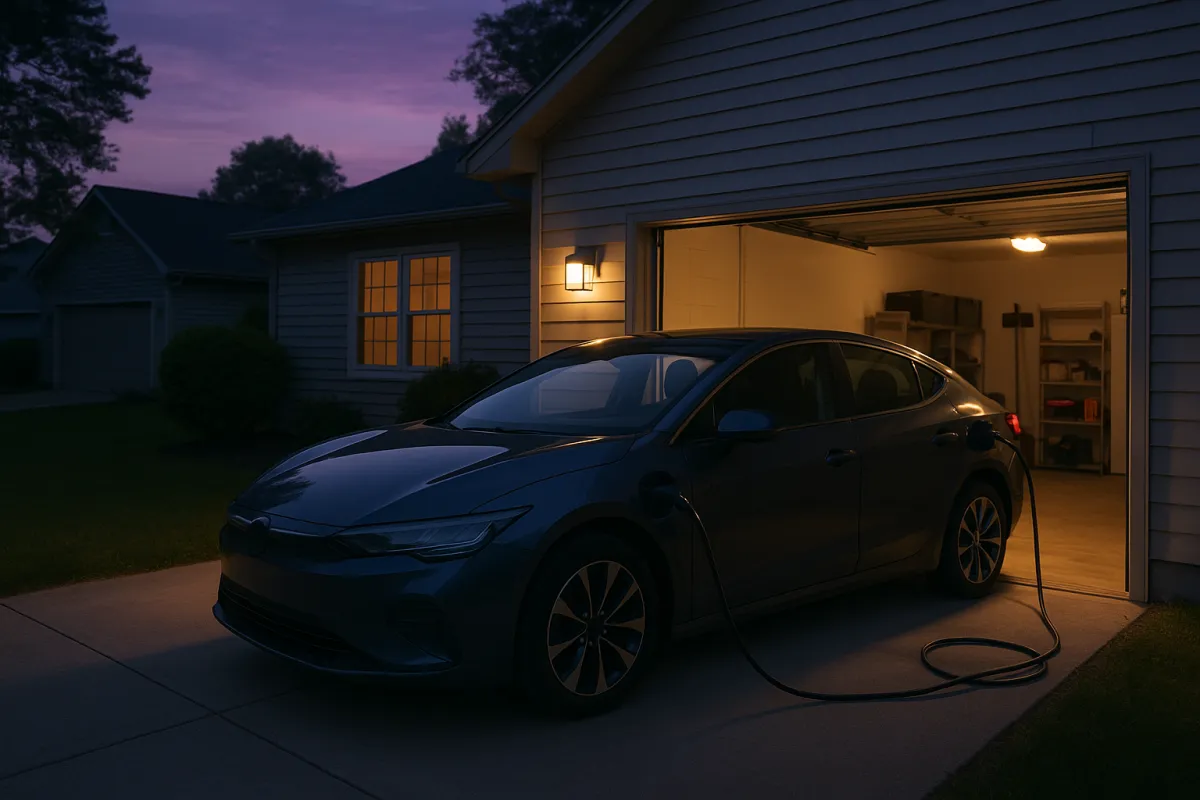
Now plan the charging, because a leased EV lives or dies economically on where it gets its electricity, exactly as an owned one does. If you can charge at home, our home charging walkthrough covers setting it up so the car refills cheaply overnight on an off peak rate, which is the single biggest running cost lever you control. If you cannot charge at home yet, sort out a reliable alternative before you rely on the car for daily driving, and price it honestly, since leaning on public fast charging can erase the savings a lease payment was supposed to deliver. A lease does not change the charging math, it just puts a clock on getting it right.
The watch out is treating delivery as the finish line. Two habits protect the deal you negotiated: keep the car within its mileage allowance by tracking your pace against the annual cap a few times a year, and maintain it to the lease’s wear standard so nothing at turn in comes as a surprise charge. The lease you signed rewards attention across the term, not just a good day at the table, so set a calendar reminder to check your mileage pace and you will hand the car back cleanly, or into a new lease, with no end of term shocks.
Illustrative monthly lease payment by negotiated cap cost
Everything in step five reduces to one relationship: the price of the car drives the payment almost in a straight line, because the payment is largely the cap cost minus the residual spread across the term. The chart below holds the residual at an illustrative $24,750, the money factor at 0.00125, the term at 36 months, and $3,000 down, then varies only the negotiated cap cost, so you can see how directly every dollar shaved at the price line shows up in the monthly number.
Illustrative monthly lease payment by negotiated cap cost
Residual $24,750, money factor 0.00125, 36 month term, $3,000 down; pre tax.
Each bar is the depreciation charge (adjusted cap minus residual, divided by 36) plus the finance charge (adjusted cap plus residual, times the money factor). A $4,000 swing at the price line moves the illustrative payment by more than $100 a month, which is why the negotiation lives on the cap cost.
The lesson is not the exact dollars, which depend on your car and your credit, but the slope: the payment tracks the price you negotiate, so the cap cost line is where an hour of firmness pays back for the whole term. Read your own numbers into the calculator to find your row on this chart.
Where a monthly lease payment goes
It helps to see what a lease payment is actually buying, because the split explains why the finance charge is worth negotiating and why depreciation is the bulk of the bill. The illustrative breakdown below splits the roughly $476 pre tax payment from our worked example into its parts, then adds an illustrative sales tax slice, since tax on a lease payment varies widely by state and is worth confirming for your own location.
Where an illustrative monthly lease payment goes
Depreciation, finance charge, and an illustrative tax slice on a ~$476 pre tax payment.
Illustrative shares summing to 100 percent, on a payment near $513 with tax. Depreciation, the value you use up, is the bulk; the finance charge is the money factor's slice and the negotiable one; the tax share varies by state, so confirm your own rate.
The takeaway is the shape, not the exact percentages. Depreciation dominates, which is why a car with a strong residual and a keen cap cost matters most, while the finance charge is the smaller slice you can trim with a lower money factor. Tax sits on top and is set by your state, not the dealer, so treat the pre tax payment as the number you negotiate and the tax as a known add on.
A worked example: leasing one EV
Walk one illustrative household through all seven steps with numbers. Priya wants an EV, likes the idea of a warranty covering the whole term, and is not sure she wants to bet on battery resale value in a fast moving market, so a lease fits. Step one: she logs three weeks of driving, annualizes to about 11,000 miles, and picks a 12,000 mile allowance with a small cushion, then sets a firm ceiling on the total monthly cost of the car. Step two: she learns the vocabulary, so no worksheet can bluff her, and settles on a 36 month term.
Step three: she takes the federal credit off the table, since none applies to a lease signed now, and asks the lender only about its own lease discounts and her state programme, insisting any amount appear as a written cap cost reduction. Step four: she emails four dealers across her two shortlisted models for structured quotes, cap cost in dollars, money factor, residual, mileage, and fees itemized, and normalizes them to the same term and mileage. Step five is where the money shows up. On a car with a $45,000 sticker, an illustrative $24,750 residual, and a 0.00125 money factor, she negotiates the cap cost down and puts $3,000 down, landing an adjusted cap near $39,000, which computes to a depreciation charge around $396 and a finance charge around $80, a pre tax payment near $476.
Step six: she reads the contract line by line, confirms the four numbers match her worksheet and the incentive appears as a specific cap cost reduction, questions two dealer add on fees and has them removed, and checks the overage rate and wear standard at the back. Step seven: on delivery she photographs the car and the odometer, confirms the trim and mileage, and sets up home charging on an off peak schedule from our home charging walkthrough so the car refills cheaply overnight. Illustratively her payment lands near $476 before tax, roughly $513 with an illustrative tax slice, and across 36 months plus her $3,000 down that is about $20,100 of total lease cost. The lesson: the vocabulary and the quotes set her up, but step five, the cap cost, is where the dollars were actually won.
Leasing versus buying an electric car
The step by step above assumes a lease is right for you, but the honest first question is whether to lease or buy at all, and the answer is genuinely personal. Over a single term a lease usually wins on monthly payment, because you pay only for the depreciation you use plus a finance charge, not for the whole car. That is why a lease payment on a given EV is typically lower than a loan payment on the same car, and why leasing lets you drive a newer, better equipped vehicle for the same monthly outlay. A lease also hands back every worry about battery aging and resale value at term end, which some buyers value highly on a fast moving technology.
Buying wins over the long run and on flexibility. Once a loan is paid off you drive for years with no payment at all, which is why total cost per mile over a long ownership usually favors buying and keeping the car, a point our cost per mile teardown and ownership math both make. Buying has no mileage cap, so high mile drivers avoid overage charges entirely, and you can modify or sell the car whenever you like. The trade is that you carry the depreciation and resale risk yourself, and on an EV specifically that includes uncertainty about how the used market values an older battery, a concern our battery longevity teardown helps you weigh.
For EVs in particular, three things tilt toward leasing when they apply: fast changing technology you would rather not be locked into, a written lessor lease discount worth more than anything on offer for a purchase, and a preference for handing back resale uncertainty. Three things tilt toward buying: high annual mileage, an intent to keep the car many years, and a wish to own an asset at the end. There is no universal answer, only your driving, your horizon, and the written numbers in front of you, so run both paths through the calculator before you commit.
Common mistakes to avoid
The failure modes in leasing are almost never the car; they are numbers agreed to out of order or fees skimmed past for haste. These are the ones that cost real money.
- Negotiating the monthly payment instead of the cap cost. The payment is an output of the price, term, rate, and residual, so a dealer can hit any payment by stretching a lever that costs you. Negotiate the cap cost in dollars first, and let the payment follow.
- Guessing the mileage allowance. Too low and you pay an illustrative 15 to 30 cents for every mile over at lease end; too high and you prepay for miles you never drive. Log real driving, annualize it, and add a small cushion, not a large one.
- Taking a federal lease credit on faith. There is no longer one to take, since the credits ended for vehicles acquired after September 30, 2025. A verbal promise of any other discount is worth nothing until it is written in as a specific cap cost reduction.
- Ignoring the money factor. Quoted only a monthly payment, you cannot see a marked up finance rate hiding inside it. Ask for the money factor as a number, multiply by 2,400 for the rough rate, and compare it across quotes.
- Skipping the fee itemization. Acquisition and disposition fees are expected, but dealer add ons like paint protection and marked up documentation charges pad the total. Get every upfront and end of term charge itemized and decline the ones you do not want.
- Forgetting the charging plan. A leased EV that leans on public fast charging can cost as much to run as the gas car it replaced. Line up cheap home or reliable alternative charging before delivery, so the lower payment is not eaten by fuel.
Troubleshooting: tricky lease situations
What if the dealer will only quote a monthly payment? Treat that as a red flag and insist, in writing, on the cap cost in dollars, the money factor, and the residual, because a payment only quote is unshoppable by design. A dealer genuinely competing for your business will give you the underlying numbers; one that refuses is protecting a margin you cannot see, and the fix is to take your structured quote request to the next dealer on your list.
What if your credit is not strong? The money factor you are offered rises with credit risk, which raises the finance charge in every payment, so the honest move is to know your standing before you shop, get quotes from more than one lender through more than one dealer, and consider whether a larger cap cost reduction, waiting to improve your credit, or buying instead serves you better. Do not let a weak money factor be buried inside a payment you never inspect.
What if you drive more than you expected mid lease? Track your mileage pace against the annual allowance a few times a year rather than discovering an overage at turn in. If you are trending over, some lessors let you buy additional miles up front at a lower rate than the end of term overage charge, which is worth asking about early. And what if your needs change entirely? A lease is a binding contract, so ending one early can be costly through early termination fees or a lease transfer, which is exactly why steps one and five, an honest budget and a deal you understand, matter so much before you sign.
The EV lease checklist
The whole practice, in the order it should happen.
- Set a total monthly budget and log your real mileage. Payment plus insurance plus charging, and an annualized mileage count with a small cushion, before any dealer.
- Learn the five terms. Cap cost, residual, money factor, term, and mileage allowance, and which of them you can actually move.
- Do not budget for a federal credit. There is none on a lease signed now, so build the payment on the full cap cost and subtract only a lessor or state offer you have in writing as a cap cost reduction.
- Get structured quotes from three or four dealers. Cap cost in dollars, money factor, residual, mileage, and every fee itemized, then normalize to the same term and mileage.
- Negotiate the cap cost first, in dollars. Settle the price and the money factor before you ever discuss a monthly payment.
- Read the contract line by line. Match the four numbers to your worksheet, itemize every fee, and check the overage rate and wear standard.
- Inspect and document the car at delivery. Photograph every panel and the odometer, and confirm the trim and mileage match the contract.
- Set up cheap charging before you rely on the car. Home off peak charging where possible, a reliable alternative where not, so the lower payment is not eaten by fuel.
An evening of honest homework, a few emails, and one firm hour at the price line, and a lease becomes the clean, low payment path into an EV it is supposed to be.
The bottom line
Leasing an electric car is less about the showroom than about the seven steps that surround it: set an honest budget and mileage need, learn the five terms the contract turns on, drop the federal credit from your budget because there is not one left to claim, gather structured quotes, negotiate the cap cost in dollars, read every line and fee before signing, and plan your charging so the car earns its lower payment. The money is won at one line, the capitalized cost, and lost most often to a payment negotiated in isolation, a guessed mileage allowance, or a discount taken on faith. Do the homework at your kitchen table, hold your walk away line at the dealership, and put every promised dollar on the worksheet in writing, because a discount you cannot point to on the page is not a discount. Price your own version with our calculator, and if a lease turns out not to fit your mileage or your horizon, our ownership math will point you at the path that does.
We love this stuff, but we are enthusiasts, not your dealer, lender, tax adviser, or attorney. Treat everything above as educational and general: the cap costs, residuals, money factors, payments, fees, and savings are illustrative figures that shift with your car, your credit, your state, and the lender’s program. A lease is a binding contract, so read every line yourself and have a qualified professional review anything you are unsure of. The federal clean vehicle credits ended for vehicles acquired after September 30, 2025, so there is no federal figure here to rely on; any state or utility programme is separate and local, so ask your own utility and state agency, and take tax questions to a qualified tax professional.
Frequently asked questions
How does leasing an electric car work?
A lease is a long-term rental with a purchase option, not a loan. You pay for the portion of the car's value you use up during the term plus a finance charge, rather than buying the whole car. Illustratively, if a $45,000 EV is expected to be worth $24,750 when a 36 month lease ends, you are financing roughly the $20,000 of value in between, spread across the monthly payments, which is why a lease payment is usually lower than a loan payment on the same car. At the end you hand the car back, buy it for the agreed residual, or start a new lease.
Is it cheaper to lease or buy an electric car?
Over a single term a lease usually has the lower monthly payment, because you are only paying for the depreciation you use, not the whole car. Over many years buying and keeping a car is typically cheaper per mile, because after the loan is paid off you drive for years with no payment at all. Leasing tends to make the most sense for EVs specifically when the technology is changing fast, when a lessor offers a lease discount worth having in writing, or when you value handing back any battery or resale uncertainty. Run your own numbers against our EV ownership math before deciding, since the answer is personal, not universal.
What is a money factor on an EV lease?
The money factor is the lease version of an interest rate, written as a small decimal such as an illustrative 0.00125. To see the rough annual percentage rate it implies, multiply it by 2,400, so 0.00125 works out to about 3 percent. A lower money factor means a smaller finance charge every month, and it is one of the few lease numbers that is genuinely negotiable, especially for buyers with strong credit. Always ask for the money factor as a number, since a dealer quoting only the monthly payment can hide a marked-up rate inside it.
Do EV lease deals include the federal tax credit?
No. The lease pass-through worked because the leasing company owned the car and claimed the federal commercial clean vehicle credit, then handed some or all of it back to you as a capitalized cost reduction. That credit is gone: the federal clean vehicle credits are not available for vehicles acquired after September 30, 2025, where acquired means a written binding contract plus a payment, and a nominal deposit or a trade-in counts. So there is no federal figure to confirm on a lease signed now. A lessor, manufacturer, or state programme may still offer you something of its own, but that is not a federal credit, and it only counts if it appears on the worksheet as a specific written cap cost reduction. If a dealer quotes you a federal lease credit today, they are working from superseded rules.
What is a good residual value for an EV lease?
Residual value is the percentage of the sticker price the leasing company predicts the car will be worth at lease end, and a higher residual generally lowers your payment because you are financing less depreciation. Illustrative residuals often land somewhere in the 50 to 60 percent range for a popular 36 month lease, though the real number varies widely by model, term, and mileage allowance. A model that holds value well is a quiet advantage in a lease even if its sticker price is higher. You cannot really negotiate the residual, since the lender sets it, but you can shop for the car whose residual makes the math work.
How many miles should I put on an EV lease?
Choose an annual mileage allowance that matches how you actually drive, because going over it triggers a per mile charge at lease end that adds up fast, while buying miles you never use wastes money up front. Common allowances run around 10,000, 12,000, or 15,000 miles per year, and overage fees are often an illustrative 15 to 30 cents per mile. Log two or three weeks of real driving and annualize it honestly before you sign, adding a small cushion rather than a large one. If you routinely drive far, a higher allowance or buying rather than leasing usually costs less than paying overage later.
What fees should I expect on an EV lease?
The common ones are an acquisition fee charged by the lender to start the lease, a disposition fee charged at the end if you return the car rather than buy it, and the usual registration, title, and documentation charges. Illustratively an acquisition fee might run a few hundred dollars and a disposition fee a similar amount, but the exact figures are printed on the worksheet, so read them rather than guessing. Some fees are fixed by the lender and some are dealer add ons that can be questioned or removed. Ask for a full itemized breakdown of every upfront and end of term charge before you sign anything.
Can you negotiate an EV lease?
Yes, more of a lease is negotiable than most people realize. The capitalized cost, which is the price of the car the lease is built on, is negotiable just like a purchase price, and lowering it lowers every payment. The money factor can often be reduced for strong credit, and dealer add on fees can be questioned. What you generally cannot move are the residual value and the lender set acquisition fee. Negotiate the cap cost first and in dollars, then confirm the money factor and fees, and only then look at the monthly payment, so a low payment cannot be rebuilt out of a high price and a long term.