What's in this teardown
- How charging an EV with solar actually works
- The path the electrons take: panels, home, EV
- Daytime charging: sipping straight from the roof
- Night charging and the battery-buffer question
- How much solar an EV adds to your system
- The sizing formula: miles to kWh to panels
- Extra panels an EV adds, by how far you drive
- Net metering: the feature that makes it work
- Do you need a home battery to charge with solar
- The Level 2 charger and solar setup
- Solar-aware charging: chasing the surplus
- What a solar-charged mile actually costs
- The cost of adding solar for EV charging
- Payback: the solar-for-EV math
- Where a solar EV year’s energy comes from
- Roof orientation and real solar output
- Time-of-use rates and your charging schedule
- Solar plus an EV in an apartment or rental
- Who solar EV charging is worth it for
- A worked example: one commuter, one roof, one year
- Common solar-EV charging mistakes
- Is charging an EV with solar worth it
- The bottom line
Short answer: EV charging with solar works indirectly for most owners: the panels feed the home, the charger draws from the home, and net metering bridges the gap between daytime sun and overnight charging. A typical 40-mile-a-day driver adds an illustrative 3 to 4 kilowatts of solar, roughly 8 to 10 panels. The solar-charged mile trends toward low single digit cents once the array is paid off, but payback runs illustratively into the teens of years.
Charging an EV with solar is the version of electric-car ownership that finally closes the loop: the fuel falls out of the sky, lands on your roof, and moves your car for a marginal cost that trends toward nothing once the panels are paid off. Our home charging cost teardown priced what grid electricity costs per mile, and our charger-install teardown covered building the pump in your garage. This article adds the piece both of those set aside: what happens when the electricity comes from your own panels instead of the utility, how many panels that actually takes, and whether the numbers justify the roof.
The appeal is obvious and the mechanics are more subtle than the marketing image suggests. A car does not usually drink straight from the roof, because most commuters are out driving during the sunniest hours and come home to charge after dark. So the real system is a partnership between your panels, your home, your utility’s net metering rules, and the timing of when you plug in. This teardown walks the whole chain: how the electrons actually get from panel to car, how to size the extra solar an EV needs from your own driving, what it costs and how it pays back illustratively, whether you need a home battery, and who the setup genuinely suits. You can run your own version of the numbers in about a minute with our cost calculator.
Key takeaways
- Solar does not usually charge a car directly: panels feed your home, the charger draws from the home, and net metering bridges the gap between daytime sun and overnight charging for most commuters.
- An EV adds illustratively 3 to 4 kilowatts of solar for a typical 40-mile-a-day driver, roughly 8 to 10 standard panels, sized straight from your miles and your local sun.
- A home battery is a comfort and resilience purchase, not a charging necessity: with fair net metering, the grid banks your daytime sun as credit you spend charging at night.
- The solar-charged mile trends toward the low single digits of cents once the array is paid off, illustratively below even an off-peak grid rate, but the payback is a slow, long-horizon one.
- It is an easy yes for a household already going solar and a softer case as a standalone reason to install, driven by your rate, your sun, your net metering terms, and how long you stay.
How charging an EV with solar actually works
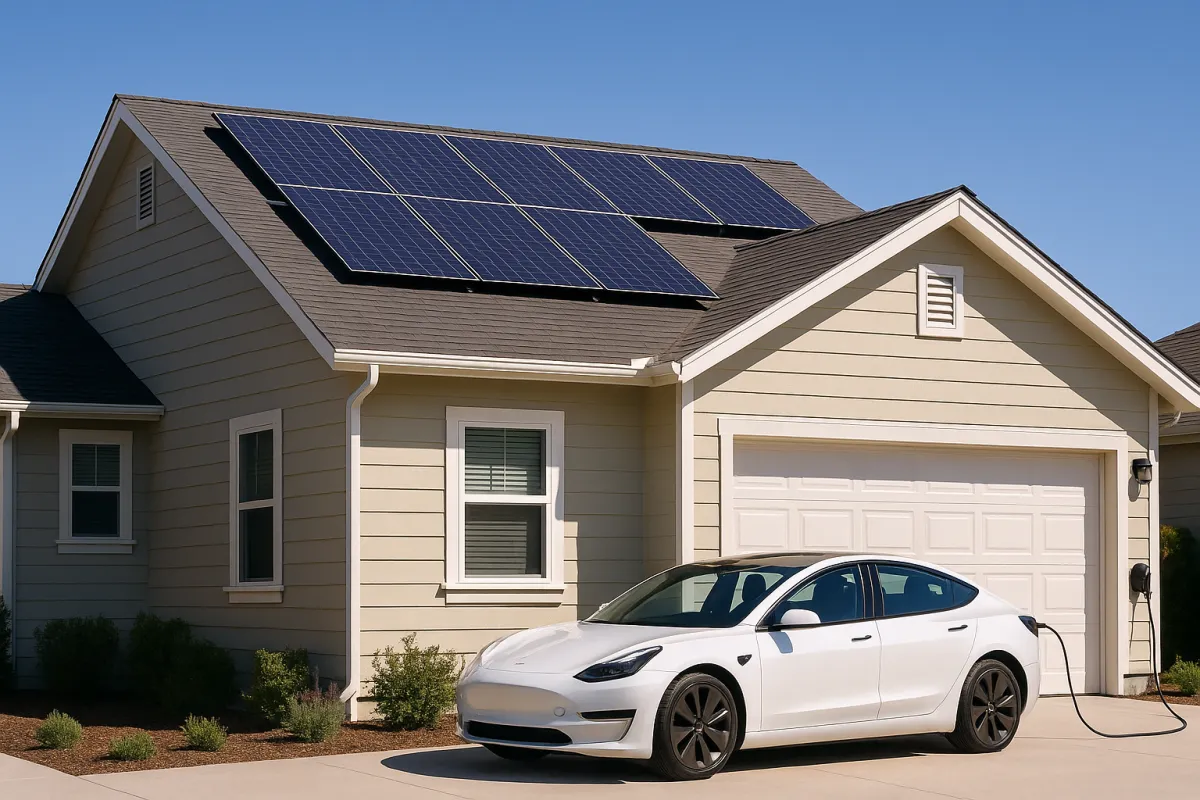
Start by dismantling the picture most people carry, which is a car plugged into a panel like a phone into a charger. That is not how it works, and understanding why is the whole foundation. Solar panels do not connect to your car. They connect to your home’s electrical system through an inverter that turns their direct current into the alternating current your house uses. Your EV charger is just another appliance on that same system, so when the panels are producing, the car can draw from them exactly the way your refrigerator or air conditioner does, without any special link between the two.
That reframing matters because it explains both the promise and the catch. The promise is that any solar you own reduces the grid electricity your charger pulls, whether or not the sun and the car are ever in the same place at the same time. The catch is timing: solar produces at midday, and a commuter’s car is usually gone by then. So charging an EV with solar is less about a direct cable and more about balancing production and consumption across a day, which is exactly the job net metering and, optionally, a home battery exist to do. The rest of this teardown is really about managing that timing gap, because the panels themselves are the easy part.
The path the electrons take: panels, home, EV
Trace one sunny afternoon to see the flow. Light hits the panels, which produce direct current. The inverter converts it to household alternating current and feeds it to your main electrical panel, the same box our charger-install teardown spent so long on. From there the power serves whatever the house is using right now: the fridge, the standby loads, and, if it is plugged in and charging, the EV. Only the surplus your home cannot use in the moment flows backward through the meter to the grid, where net metering records it as a credit.
At night the flow reverses. The panels are dark, so the car charges from the grid, drawing down the credit the roof banked earlier. Over a billing cycle the utility nets the two: the daytime kilowatt-hours you sent out against the nighttime kilowatt-hours you pulled in. If your panels produced as much as your car and home consumed, your net energy charge for that slice approaches zero, even though the actual electrons that moved your car came from the grid at midnight. This is the mental model to keep: the panels and the car rarely touch directly, but across a day the roof still pays for the miles, either in real time or through the meter’s bookkeeping.

Daytime charging: sipping straight from the roof
There is one setup where the tidy image is real, and it is worth naming because it is the cheapest way to charge a car that exists. If the car is home while the sun is up, and the panels are producing more than the rest of the house is using, that surplus can flow directly into the charger. No export, no credit, no round trip through the utility, just sunshine into the battery. For the illustrative 40-mile-a-day driver, that is around 12 kWh of driving energy the roof can cover on a good day without the grid touching it at all.
The people this fits are specific and growing: retirees, remote workers, shift workers home during daylight, weekend-heavy drivers, and above all second cars that stay parked at the house. For them, a solar-aware charger that ramps its speed up and down to match the panels’ surplus can push most of their charging into direct daytime solar, which is as close to free fuel as a car gets. The honest limit is that a standard nine-to-five commuter rarely qualifies, because the car is out earning its miles during the exact hours the roof is most productive. That mismatch is not a flaw in solar; it is a scheduling reality that the next several sections exist to solve.
Night charging and the battery-buffer question
Most drivers charge overnight, which is the sensible default for reasons that have nothing to do with solar: the car sits parked anyway, and off-peak rates are cheapest, a point our home charging cost teardown crowned as the biggest lever available. The question solar adds is how the daytime sun reaches a car that only charges after dark, and there are exactly two answers. The first is net metering, covered in its own section below, where the grid does the buffering for you at no hardware cost. The second is a physical home battery that stores the day’s surplus and discharges it into the car at night.
The instinct that you need a battery to charge a car from solar is the single most common and most expensive misconception in this whole topic. In a grid-connected home with fair net metering, you do not: the grid is a near-perfect, zero-cost battery that accepts your daytime export and returns it at night. A physical battery becomes worth discussing only when net metering pays poorly, when you want backup power through outages, or when you specifically want to run the car on stored sunshine rather than grid electrons at 2 a.m. Those are real motivations for some households, but none of them is a requirement to charge with solar, and treating a battery as mandatory is how a sensible solar decision balloons into an oversized one.
How much solar an EV adds to your system
The practical question for anyone sizing a system is how much bigger the array needs to be because of the car. The answer is smaller than most people fear, because an EV, for all its appetite compared to a phone, is a modest annual load compared to a whole house. Illustratively, a typical driver adds somewhere around 3 to 4 kilowatts of solar to cover the car, roughly 8 to 10 standard panels, on top of whatever the home itself needs. That is a meaningful but not overwhelming addition to a residential roof, and it scales cleanly with how far you drive.
The reason it stays manageable is arithmetic you can do yourself, which the next section lays out in full. The car’s annual energy need comes straight from your mileage, and solar’s annual output per kilowatt comes straight from your local sun, so the extra array is just one divided by the other. Run your own driving through our cost calculator and you get your specific number rather than this illustrative middle. The takeaway to hold here is that the EV rarely doubles a home’s solar needs; it adds a wing to the array rather than a second house, which is part of why pairing the two has become such a natural fit.
The sizing formula: miles to kWh to panels
Every panel-count figure in this teardown comes from one short chain, and it is worth learning because it lets you sanity-check any installer’s proposal on the back of an envelope. Step one, turn miles into energy: your daily miles times your car’s efficiency in kWh per 100 miles gives daily kilowatt-hours. At the illustrative 40 miles a day and 30 kWh per 100 miles, that is 40 times 0.30, about 12 kWh a day, or roughly 4,400 kWh a year. This is the same efficiency figure our home charging cost teardown built its per-mile math on, now pointed at the roof instead of the bill.
Step two, turn energy into panels. Solar output depends on sun: in an average-sun region, one kilowatt of panels produces roughly 1,300 kWh a year after real-world losses, more in sunny states and less under cloudier skies. Divide your annual driving energy by that figure and you get the kilowatts of solar the car needs: 4,400 divided by 1,300 is about 3.4 kilowatts. Step three, divide by your panel wattage for the count: 3.4 kilowatts is 3,400 watts, which at 400-watt panels is roughly 8 to 9 panels. Three steps, three inputs you can find in an afternoon, and you have sized the car’s share of a roof. Our cost calculator runs the whole chain live if you would rather not.
Extra panels an EV adds, by how far you drive
Because the whole chain scales with mileage, it helps to see the range laid out rather than anchoring on one illustrative driver. The table below runs the formula across daily-mileage profiles, at the illustrative 30 kWh per 100 miles, average-sun output near 1,300 kWh per kilowatt a year, and 400-watt panels. Every figure is illustrative and rounded, and your own sun and efficiency will shift it, but the shape holds: the panel count climbs steadily and predictably with the miles.
| Daily miles | Annual miles | Extra kWh/year | Extra solar (kW) | Extra panels (~400 W) |
|---|---|---|---|---|
| 20 | ~7,300 | ~2,200 | ~1.7 | ~4 to 5 |
| 30 | ~10,950 | ~3,300 | ~2.5 | ~6 to 7 |
| 40 | ~14,600 | ~4,400 | ~3.3 | ~8 to 9 |
| 50 | ~18,250 | ~5,500 | ~4.2 | ~10 to 11 |
| 60 | ~21,900 | ~6,600 | ~5.0 | ~12 to 13 |
Two things stand out. First, even a heavy 60-mile-a-day driver adds only around a dozen panels, a large but ordinary residential array wing, not a solar farm. Second, the low-mileage rows are strikingly light: a 20-mile-a-day second car needs just four or five panels, which is why pairing solar with a lightly driven car is such an easy call. Find your exact row by entering your real daily miles, efficiency, sun, and panel size in our cost calculator, which does the rounding and the arithmetic for you.
Net metering: the feature that makes it work
Net metering is the policy that turns a daytime resource into an overnight fuel, and it is the single most important variable in whether solar EV charging works for a commuter. Under it, the surplus your panels export during the day earns a credit, and the energy you pull at night draws that credit down, with the utility billing you on the net. When the credit pays close to the retail rate you would otherwise pay, the grid becomes a free, lossless battery: every kilowatt-hour of afternoon sun is a kilowatt-hour of midnight charging, no hardware and no storage losses in between.

The complication is that net metering terms are changing in many places, and not always in the customer’s favor. Some utilities have shifted to crediting exported power below retail, or to time-varying credits that pay less for midday export than the evening power you buy back. Where that happens, the tidy one-to-one bookkeeping weakens, and the case for either shifting more charging into direct daytime solar or adding a home battery strengthens. None of this stops solar EV charging from working; it changes the economics and the ideal setup. The honest homework is to read your utility’s current net metering or successor tariff before you size a system around the car, because that single document decides whether the grid buffers your sun for free or takes a cut for the service.
Do you need a home battery to charge with solar
This deserves its own verdict because so much money rides on it. For a grid-connected home with reasonable net metering, the answer is no: a battery is optional, and often the least cost-effective way to spend the next chunk of your solar budget. The grid already does the storage job for free through net metering, so a battery bought purely to charge the car at night is usually paying, illustratively, five figures to replace a service the meter provides at no cost.
Where a battery does earn its place is on other merits. If your net metering credit is poor, storing your own daytime surplus and using it yourself can beat exporting it cheaply and buying it back dear. If you want backup power that keeps the lights, and possibly the car charger, running through an outage, a battery delivers resilience that net metering cannot. And if you simply prefer, for independence or principle, to charge on stored sunshine rather than grid power after dark, that is a valid choice with a known price. The discipline is to name which of these you are buying, price it on its own, and not fold a big-ticket resilience purchase into the charging decision where it quietly wrecks the payback. A battery is a fine thing to want; it is rarely a thing you need to charge a car with solar.
The Level 2 charger and solar setup
On the hardware side, good news: charging an EV with solar needs no exotic equipment beyond the solar system itself. The charger is an ordinary Level 2 unit, the same 240-volt wall box our charger-install teardown walks through installing, on a circuit sized and permitted the same way. Solar changes what feeds the panel, not what hangs on the garage wall. So the sequence for a solar-plus-EV home is simply the two projects done well: a correctly sized array with a compliant inverter, and a licensed-electrician Level 2 install, both landing at the same main panel.
The one upgrade worth considering is a solar-aware, or solar-diverting, charger. These units read your home’s real-time solar surplus and modulate the car’s charging speed to soak up excess production rather than exporting it, which matters most where net metering pays poorly and self-consumption is more valuable than export credit. For a commuter charging overnight against fair net metering, the feature earns little, because the car is not home during peak sun anyway. For a daytime charger, or a household on a stingy export tariff, it can meaningfully raise how much of the array’s output goes straight into the car. As with the charger-install decision, the rule is to pay for the smart features that touch your actual rate and timing and shrug at the ones that do not.
Solar-aware charging: chasing the surplus
It is worth going one level deeper on solar-aware charging, because it is where the direct-from-roof dream gets closest to real for the households that can use it. A solar-diverting charger continuously watches the difference between what the panels are making and what the house is using, and it feeds only that surplus into the car, ramping the charge rate up as a cloud passes and down as the oven switches on. Done well, it means the car exports almost nothing and imports almost nothing during daylight; it just absorbs whatever the roof has spare, minute by minute.
The value of this depends entirely on timing and tariff. If your car is home during the day and your utility pays you little for exported power, chasing the surplus is genuinely valuable, because every self-consumed kilowatt-hour is worth the full retail rate you avoid paying, while an exported one might be worth far less. If, instead, you have generous net metering and an overnight-charging commuter car, the fancy charger changes little, since the meter already gives you retail value for exported sun and the car was going to charge at night regardless. So this feature is not universally worth it; it is a targeted tool that pays off precisely for daytime-home drivers on weak export tariffs, and it is close to decorative for the net-metered overnight commuter.
What a solar-charged mile actually costs
The reason to do any of this is the cost per mile, so line solar up against the alternatives our other teardowns priced. Every bar below is an illustrative cost per mile at the same 30 kWh per 100 miles. The solar figure is the amortized cost: the system’s price spread across the many years and hundreds of thousands of miles of energy it produces, which is why it lands so low once the panels are working.
Illustrative cost per mile, by how you power the miles
30 kWh per 100 miles; solar amortized over the array's life, home grid 15 cents, gas 30 mpg at $3.50, public DC fast at 45 cents per kWh.
Amortized solar sits below even a standard home grid mile and far under gasoline, which is the whole economic case. The figure assumes the panels are paid off across their long life; before payback you are trading upfront cost for these cheap miles later.
The chart settles the direction of the argument on sight: a solar-charged mile is the cheapest fuel a car can run on, illustratively below a standard grid mile and a fraction of gasoline or public fast charging. The honesty check is in the note. That low number is an amortized figure, meaning it assumes you have spread the system’s upfront cost across its full productive life. The panels do not make the mile cheap on day one; they make it cheap over decades, which is why the payback section matters as much as this chart. Solar does not beat the grid because sunshine is magic; it beats it because, once the hardware is bought, the marginal fuel is genuinely close to free.
The cost of adding solar for EV charging
Now the upfront number the chart deliberately set aside. Adding the solar to cover a car is not free; it is a capital cost you trade for those cheap miles later. Illustratively, the 3 to 4 kilowatts the typical commuter needs might add somewhere in the low five figures to a system at a common installed cost per watt, before incentives. That is a real sum, and it is the honest counterweight to the near-free mile: you are prepaying years of fuel in one lump on the roof.
Two factors soften it. First, incentives: solar routinely qualifies for tax credits and local rebates that commonly cut a meaningful share of the gross cost, though these programs change and vary by region, so confirm the current terms rather than trusting any figure here. Second, and often missed, the panels you add for the car do not only charge the car. On days you drive little, that same array offsets your dishwasher, your air conditioner, and every other household load, so the cost you mentally assign to the car overstates what the panels actually earn. The practical move is the same as the charger-install one: get two or three quotes on a clear scope, ask each installer to break out the incremental cost of sizing up for the EV, and confirm every incentive with the actual authority before you count on it. Model your own figures in our cost calculator.
Payback: the solar-for-EV math
Payback is where enthusiasm meets a spreadsheet, and honesty demands the slow answer. Take the illustrative commuter: roughly 3.3 kilowatts of added solar at a common installed cost lands in the low five figures gross, and the electricity it saves the car is about 4,400 kWh a year, worth maybe several hundred dollars at a typical rate. Divide the cost by that annual saving and the simple payback on the EV slice alone runs, illustratively, into the low-to-mid teens of years before incentives. That is a long horizon, and pretending otherwise would be the kind of fabricated optimism this teardown refuses.
Three things shorten it, and all three are real. Incentives cut the upfront cost, often by a large fraction, pulling the payback in proportionally. A higher electricity rate, or a rate that climbs over the years as utility prices tend to, raises the annual saving and shortens the wait. And the framing itself understates the truth, because the same panels offset your whole home’s power, not just the car, so their real payback is faster than the EV-only slice suggests, and because against gasoline rather than grid electricity the saving is far larger. The fair summary: as a standalone investment judged only on the car and only on grid offset, solar-for-EV is a long-horizon play; judged on the whole array, incentives, rising rates, and the gasoline it replaces, it is a sound one for owners who stay put. Run your own payback with your real rate and cost in our cost calculator.
Where a solar EV year’s energy comes from
It helps to see how a realistic solar-charging year actually splits, because the direct-from-roof fraction is smaller than the brochures imply and the net-metered fraction does most of the work. The bar below is an illustrative breakdown for a net-metered commuter whose car charges mostly overnight, showing where the energy that moves the car ultimately originates across a full year.
A solar EV year: where the charging energy comes from
Illustrative split for a net-metered household whose EV charges mainly overnight against daytime solar credit.
Only a minority of the energy flows straight from roof to car; the larger share is daytime sun banked as net metering credit and spent charging overnight. The grid top-up covers cloudy stretches and winter, when the roof produces less than the car needs.
The split explains why net metering, not a direct cable, is the real engine. Even for a household that captures some direct daytime charging, the majority of the car’s annual energy is daytime sun routed through the meter and spent at night, with a grid top-up filling the seasonal gaps. This is also why the setup’s economics live or die on the export credit: that big middle segment is only as valuable as your net metering terms make it. A household on generous net metering runs most of the year on effectively solar power; one on a poor tariff sees that middle slice lose value and leans harder on either direct daytime charging or a battery to hold onto its own production.
Roof orientation and real solar output
The illustrative output figure of roughly 1,300 kWh per kilowatt a year assumes a reasonably sited array, and real roofs vary enough that this deserves a caveat. Orientation matters: a south-facing roof in the northern hemisphere captures the most annual sun, while east or west faces give up a portion, and a north face gives up a lot. Tilt, shading from trees or neighboring buildings, and simple geography all move the number, so two identical arrays can produce meaningfully different amounts depending only on where and how they are mounted.
This feeds back into sizing. If your roof underperforms the average, you need a few more panels to cover the same miles, and if it is a sunny, unshaded, well-oriented plane, a few fewer. There is also a timing wrinkle worth knowing: an east-west split array spreads production across the morning and afternoon rather than concentrating it at noon, which can actually suit a home that wants some direct charging in the early morning or evening shoulders. None of this changes the method, only the inputs. The honest step is to have an installer model your specific roof’s production rather than applying a national average, then feed that real output figure into the sizing formula so your panel count reflects your roof, not a brochure’s.
Time-of-use rates and your charging schedule
Solar and time-of-use rates interact in ways that reward a little planning. Many utilities now price grid electricity by time of day, and increasingly they also value your solar export by time of day, paying less for midday power when solar is abundant and more for evening power when it is scarce. For a solar EV household, this changes the optimal charging schedule: the old advice to simply charge overnight at the cheapest off-peak window still usually holds, but the interplay with your export credits can tilt it.
The practical moves are straightforward. Where you have a car home during the day and a tariff that pays little for export, shifting charging into the midday solar peak to self-consume your own production beats exporting it cheaply. Where you are a net-metered overnight commuter, keep charging in the cheap late-night window and let the meter reconcile your daytime export against it. And in all cases, schedule the charging once, in the car or the charger, so it happens automatically at the right hour rather than depending on you to remember. This is the same set-it-once discipline our home charging cost teardown applied to off-peak rates, now with the solar export side of the ledger added to the decision.
Solar plus an EV in an apartment or rental
The whole solar-charging proposition assumes a roof you control, which quietly excludes a large share of drivers, so it is worth being straight about the harder cases. If you rent, or live in an apartment or condo, you usually cannot install panels on a roof you do not own, and the direct solar-charging path is closed for now. That does not mean the clean-energy goal is unreachable, only that it runs through different routes: choosing a utility green-power plan, joining a community solar program where your region offers one, or charging at workplaces or public stations that are themselves solar-supplied.
Community solar deserves a specific mention, because it is the nearest equivalent for the roofless. In these programs you subscribe to a share of a shared solar installation elsewhere and receive credits on your bill for its production, which can offset the grid electricity your EV charging consumes without a single panel on your own building. The economics and availability vary widely by region, and it is not identical to owning your own array, but it lets an apartment dweller point their charging at solar generation in spirit and, through the credits, partly in fact. The essential move is the same one our charger-install teardown urged on renters: solve the charging access question first, then layer the solar sourcing on through whichever program your situation actually allows.
Who solar EV charging is worth it for
Pulling the threads together, the setup suits some households far better than others, and matching yourself to the profile matters more than any single number. It is strongest for owners who plan to stay in their home for many years, because the long payback rewards patience and punishes a near-term move. It is strong for drivers with the miles to use the panels, since a well-driven car turns more of the array into avoided fuel cost. And it is strongest of all for a household already installing solar for the home, where adding the car’s slice is a small incremental decision on a roof that was going up regardless.
It is a weaker fit for the opposite cases, and honesty means saying so. A driver who expects to move within a few years may not hold the system long enough to reach payback, though a well-installed array can add to a home’s sale value to offset that. A very-low-mileage driver uses so little of the car-attributed panels that the standalone case thins, even as the panels still earn their keep offsetting the house. And a household on a poor net metering tariff faces weaker economics that may push toward a battery or daytime charging to recover value. Run your profile through our cost calculator with your real miles, rate, sun, and cost, and let your own payback, rather than a brochure’s, decide where you land.
A worked example: one commuter, one roof, one year
Numbers land harder as a story, so walk one illustrative household through the whole chain. Maya drives about 40 miles on a typical day in an EV that uses roughly 30 kWh per 100 miles, she owns her home and plans to stay a long while, her roof faces mostly south in an average-sun region, and her utility offers reasonable net metering. Step one, her energy: 40 miles at 0.30 kWh a mile is about 12 kWh a day, roughly 4,400 kWh across the year. Step two, her panels: at average output near 1,300 kWh per kilowatt, that is about 3.4 kilowatts of solar, or roughly 8 to 9 standard 400-watt panels added to her array for the car.
Step three, her setup and cost: she already has a permitted Level 2 charger from a prior install, so solar changes nothing on the garage wall, and the added panels land, illustratively, in the low five figures before the incentives she will confirm with her installer and tax authority. Step four, her timing: as a daytime commuter, Maya charges overnight, so most of her car’s energy is daytime sun banked as net metering credit and spent after dark, with a grid top-up covering cloudy winter weeks. Step five, her payback: on grid offset alone the car’s slice is a long, low-teens-of-years horizon, but with incentives, the panels also cutting her household bill, and the gasoline she is no longer buying, the real recovery is meaningfully faster. Her honest conclusion is the one this teardown keeps reaching: as a standalone car investment it is patient money, but as part of a solar home she intends to keep, it locks in years of very cheap, very stable miles. Run your own version of Maya’s year in our cost calculator.
Common solar-EV charging mistakes
A handful of recurring errors distort people’s expectations and budgets, in both directions.
- Assuming you need a home battery. With fair net metering, the grid buffers your daytime sun for free; buying a five-figure battery purely to charge the car at night usually replaces a service the meter already provides at no cost.
- Expecting the car to charge straight from the roof. For a daytime-away commuter, the panels and the car rarely meet directly. Most of the energy flows through net metering, which works, but is not the tidy direct-cable image.
- Ignoring the net metering terms. The export credit is the whole economic engine for an overnight charger. Sizing a system around the car without reading your utility’s current tariff is how the math quietly disappoints.
- Assigning the whole panel cost to the car. The array also offsets your house, so the cost attributed purely to the EV overstates its true payback and makes the setup look worse than it is.
- Believing the day-one cost-per-mile. The near-free solar mile is an amortized figure earned over decades, not a day-one price. The upfront system cost is the real counterweight, and the payback is a slow one.
- Skipping the incentive homework. Solar incentives change and vary by region; counting on a stale figure, or missing one you qualify for, can swing the payback by years.
Is charging an EV with solar worth it
The verdict resists a single yes or no, because it genuinely depends on which household is asking. For a family already going solar for the home, adding the car’s few kilowatts is close to a free decision and an easy yes: the incremental panels lock in years of very cheap miles on a roof that was being built anyway. For a household already living on paid-off solar, plugging in an EV is arguably the highest-value new load they can add, because those miles cost a fraction of grid or gasoline power for as long as the panels last.
As a standalone reason to install solar entirely from scratch, the case is softer and more conditional, and pretending otherwise would fail the honesty test this whole teardown is built on. It rests on your electricity rate, your local sun, your net metering terms, your mileage, and above all how long you will stay in the home to reach the payback. For an owner who stays put, drives enough to use the panels, and values locking in a fuel rate no utility can raise, it is a sound long-horizon investment in cheap, stable energy. For a mover, a very light driver, or a household on a poor export tariff, the numbers thin and the decision deserves a hard look at your own figures rather than a brochure’s enthusiasm. The tool for that look is the same one this article keeps pointing at: your real numbers in our cost calculator.
The bottom line
Charging an EV with solar is the closest thing to owning your own fuel supply, but it works through the meter far more than through a direct cable: panels feed your home, net metering banks the daytime sun, and the car spends that credit charging overnight. Sizing it is simple arithmetic from your miles, illustratively 3 to 4 kilowatts and 8 to 10 panels for a typical commuter, and the resulting mile is the cheapest a car can run on once the array is paid off. The honest caveats are that you rarely need a home battery, that the whole-array cost is the real counterweight to the cheap mile, and that the payback is a long, patient one best suited to owners who stay put. Run your own miles, rate, sun, and cost through our cost calculator, read your utility’s net metering terms before you size anything, and treat the roof as what it is: a long-horizon investment in fuel the sky delivers for free.
This teardown is educational and independent, written by people who enjoy the arithmetic of sunshine and cars, not by a solar installer or your utility. Every kilowatt-hour, panel count, cost, and payback figure above is illustrative and will move with your roof, your local sun, your car’s real efficiency, your electricity rate, and the solar prices where you live. Net metering rules, export credits, tax incentives, and rebate programs differ by region and change over time, and all solar and 240-volt electrical work must be designed and installed by licensed professionals under the proper permits. Confirm your own utility’s current tariff, your roof’s modeled production, and every incentive with the actual authorities before you budget or build on any number here.
Frequently asked questions
Can you charge an EV with solar panels?
Yes, and it is one of the cleanest ways to fuel a car, though the mechanics are less direct than the tidy image of a car sipping straight from the roof. Solar panels feed your home's electrical system, and your EV charger draws from that same system, so on a sunny day the panels can power the charger directly while the car is home. Most commuters, though, are away with the car during peak sun, so the practical setup relies on net metering: the roof exports daytime power for a credit, and the car charges overnight against that credit. Either way, the panels are covering the miles, just sometimes through the meter rather than through a direct cable.
How many solar panels does it take to charge an EV?
Illustratively, a typical driver covering about 40 miles a day needs somewhere around 8 to 10 standard panels dedicated to the car, which is roughly 3 to 4 kilowatts of extra solar. The math starts from miles: 40 miles at about 30 kWh per 100 miles is roughly 12 kWh a day, or about 4,400 kWh a year, and in an average-sun region one kilowatt of panels produces roughly 1,300 kWh a year. Divide and you land near 3.3 kilowatts, then divide by your panel wattage for the count. Drive less and you need fewer; drive a lot, or live under cloudier skies, and the number climbs.
Do you need a home battery to charge an EV with solar?
No, and for most grid-connected homes a battery is the expensive option, not the necessary one. Where net metering credits your daytime solar export at a fair rate, the grid itself acts as your battery: you bank sunshine as credit by day and spend it charging overnight, no hardware required. A home battery earns its keep mainly where export credits are poor, where you want backup power during outages, or where you genuinely want to charge from stored sunshine at night rather than from the grid. It is a comfort and resilience purchase far more than a charging necessity, and it deserves its own payback math rather than being bundled in by enthusiasm.
Is it cheaper to charge an EV with solar than from the grid?
Over the life of the panels, usually yes, though the saving is a slow one rather than a dramatic one. Once a solar array is paid off, the electricity it makes is close to free, so the solar-charged mile can fall toward the low single digits of cents illustratively, below even an off-peak grid rate. Before payback, you are trading an upfront system cost for years of cheap miles, so the comparison that matters is the amortized cost over the system's long life, not the price on day one. The array also offsets your other household loads, so the true value is larger than the EV slice alone suggests.
How much does it cost to add solar for EV charging?
Illustratively, the extra solar to cover a typical commuter's driving, roughly 3 to 4 kilowatts, might add somewhere in the low five figures to a system at a common installed cost per watt, before any incentives. Incentives commonly cut a meaningful share of that, and the exact figure swings with your roof, your installer, and your region, so treat any single number as a placeholder until you have real quotes. Because the same panels also offset your other home electricity, the cost attributed purely to the car overstates what the panels actually earn. Get two or three quotes and confirm current incentives before budgeting on any figure.
Does net metering matter for solar EV charging?
It matters enormously, because it is what bridges the gap between when the sun shines and when a commuter's car is home to charge. Net metering credits the daytime power your roof exports and lets you draw it back later, so a car that charges overnight is effectively running on the sunshine banked that afternoon. Where the credit pays close to retail, solar EV charging works cleanly for even a nine-to-five commuter. Where export pays poorly, the economics weaken and a home battery or a solar-aware charger that chases midday surplus becomes more attractive, so confirm your utility's net metering terms before you size the system around the car.
Can I charge my EV directly from solar during the day?
Yes, if the car is home while the sun is up, which fits retirees, remote workers, weekend drivers, and second cars far better than a daily commuter. When solar output exceeds the rest of the home's draw, that surplus can flow straight into the charger, and a solar-aware charger can modulate its speed to soak up only the excess so you export as little as possible. The catch is timing: a commuter's car is usually away earning its miles during peak sun and comes home to an empty roof after dark. For that pattern, overnight charging against net-metered daytime credit does the same job through the meter.
Is charging an EV with solar worth it?
For a household already going solar, or already living on it, adding the car to the array is usually an easy yes, because the incremental panels lock in years of very cheap miles and the roof was going up anyway. As a reason to install solar entirely on its own, the case is softer and rests on your electricity rate, your sun, your net metering terms, and how long you will stay in the home. The honest framing is that solar EV charging is a long-horizon investment in cheap, stable fuel rather than a quick win, most compelling for owners who stay put, drive enough to use the panels, and value locking in a rate the utility cannot raise.