What's in this teardown
- The short answer: cost per charge and per mile
- Why a Tesla is the example, and why the math is brand neutral
- The core formula: battery size, efficiency, and your rate
- What a full charge costs at home
- Cost per mile and cost per 100 miles
- Cost per charge by method, on one chart
- Home charging versus Supercharging
- Why Supercharging costs more per kWh
- Monthly and annual charging cost by mileage
- What moves your charging number
- Charging losses: paying for what never reaches the battery
- Time of use and off-peak: the biggest home lever
- Battery size versus efficiency
- Annual charging cost versus gasoline
- A typical year of charging, by source
- How to charge cheaper: off-peak, home, and solar
- Charging on a road trip
- Free and destination charging
- A worked example: one owner for a year
- Common cost-to-charge mistakes
- The bottom line
The cost to charge a Tesla, or any comparable electric car, comes down to three numbers you can look up in an afternoon: your battery size, your car’s efficiency, and the rate you pay for electricity. Tesla is the name most people search for because it is the popular example, but nothing in the math is brand-specific. The same formula prices a full charge, a single mile, and a full year for any EV, and it produces figures that are almost always far smaller than people expect for home charging and noticeably larger for public fast charging like Supercharging.
That home-versus-public split is the whole story, and it gets mixed up constantly. Charging in your own driveway means paying an ordinary residential electricity rate for power you were already connected to. Charging at a Supercharger or other DC fast station means paying a premium for expensive hardware and convenience on the road. This teardown prices both directly: the cost per full charge, the illustrative cents per mile, the cost per 100 miles, the monthly and annual bill by how much you drive, the gap between home and Supercharger rates, and the levers that make charging cheaper. You can run your own version in about a minute with our cost calculator.
Key takeaways
- The whole cost reduces to a short formula: battery size times your rate for a full charge, and efficiency in kWh per 100 miles times your rate for cost per mile. A 75 kWh pack at a 15 cent home rate is an illustrative $11 to fill.
- Home charging costs an illustrative 4 to 5 cents per mile, about $4 to $5 per 100 miles, and roughly half that on an off-peak overnight rate.
- Supercharging and other public DC fast charging commonly cost two to four times more per kWh, pushing a full charge toward $30 to $35 and the per-mile cost near or above gasoline.
- Battery size sets your single-charge bill and your range, but it does not change the cost per mile: efficiency and your rate do.
- Against a 30 mpg gas car at $3.50 a gallon, home charging commonly saves a several-hundred-dollar to four-figure sum every year, decided by your miles, your rate, and where you plug in.
The short answer: cost per charge and per mile
Before any nuance, here are the numbers people actually came for. Charging an EV like a Tesla at home costs an illustrative 4 to 5 cents per mile at a common residential electricity rate, and a full charge of a typical mid-size pack of about 75 kWh runs somewhere near $11 at that rate. Charge overnight on an off-peak plan and the per-mile figure can fall closer to 2 to 3 cents, with the full charge nearer $6. Take that same car to a Supercharger and the full charge can cost $30 to $35, with the per-mile cost climbing toward gasoline territory. That is the entire headline, and everything below is showing the work and the variations.
To put it in a frame most people carry from gas cars: a mile that costs 4.2 cents in home electricity would cost roughly 11 to 14 cents in gasoline for a comparable trip in an average car. So a commute that quietly drains $150 a month from a gas tank often costs $40 to $50 charged at home. The reason the number feels too good is that gasoline has trained everyone to expect fuel to be a large, visible expense, while home charging turns it into a small line item buried in an electric bill you were already paying. The rest of this teardown makes those numbers yours instead of an average, and it keeps returning to the single fact that decides them: where and when you charge.
Why a Tesla is the example, and why the math is brand neutral
Tesla is the car people name when they search for charging costs, so it is the natural example, but there is nothing proprietary about the arithmetic. Every EV, whatever the badge, charges on the same physics: it stores energy in a battery measured in kilowatt-hours, uses a certain number of those kWh to cover 100 miles, and buys them at whatever your electricity rate happens to be. Swap in a different brand’s battery size and efficiency and the formula spits out that car’s number instead. The reason to keep it brand-neutral is that it makes the method portable, so the same page that prices a popular sedan also prices a rival hatchback or a large electric SUV.
Where the popular example does carry useful specifics is charging access. The best-known EV brand runs its own fast-charging network with its own pricing, and other networks price differently, sometimes by the kWh, sometimes by the minute, sometimes with a membership that lowers the rate. Those pricing structures matter for the public side of the math, which we take on in detail below and in our companion teardown on the cost of charging at a public station. But for home charging, which is where most owners do most of their miles, the network is irrelevant. You plug into your own outlet at your own rate, and the badge on the car changes only the battery size and efficiency you feed the formula.
The core formula: battery size, efficiency, and your rate
Every cost figure in this article comes from a short calculation with two halves, and both are genuinely simple. To price a full charge, multiply the battery size in kWh by your rate per kWh: a 75 kWh pack at 15 cents is 75 times $0.15, about $11.25. To price a mile, use efficiency instead of pack size. An EV’s energy use is measured in kilowatt-hours per 100 miles, much like a gas car’s miles per gallon, and a common figure for a typical EV is around 28 kWh per 100 miles. Multiply that by your rate to get the cost of 100 miles, 28 times $0.15 is $4.20, then divide by 100 for the cost per mile, about 4.2 cents.
That is the whole engine. Cost per full charge equals battery size times rate. Cost per mile equals efficiency in kWh per 100 miles, divided by 100, times your rate. Cost per month is the per-mile figure times your monthly miles, and cost per year is the per-mile figure times your annual miles. Three inputs you can find in an afternoon, your pack size, your car’s efficiency, and your utility’s rate, produce every number that follows, and our cost calculator runs the arithmetic live if you would rather not do it by hand. Because the formula is so short, it is worth memorizing: it lets you sanity-check any charging cost claim, yours or a salesperson’s, on the back of a receipt.

What a full charge costs at home
The number people picture first is the cost of filling the tank, so start there. A full charge is simply the usable battery size times your rate, and the spread across common pack sizes is easy to lay out. At a 15 cent home rate, a smaller 60 kWh pack costs about $9 to fill, a mid-size 75 kWh pack about $11, and a large 100 kWh pack about $15. Move to a low 10 cent rate and those drop to roughly $6, $8, and $10; push to a high 25 cent rate and they climb to about $15, $19, and $25. The rate is doing most of the work, which is why the single most valuable thing you can look up is your own per-kWh price rather than trusting any national average.
Two honest caveats keep that full-charge figure grounded. First, you rarely charge from truly empty to truly full, and it is common practice to charge daily to something like 80 percent for battery health, so a real session usually costs less than the empty-to-full figure. Second, charging is not perfectly efficient: roughly 10 percent of the energy drawn from the wall is lost as heat before it reaches the battery, so your meter counts a little more than the pack stores. That means the wall draws closer to 83 kWh to store 75, nudging the real cost of a full 75 kWh charge from about $11.25 toward $12.50 at a 15 cent rate. Treat the battery-times-rate figure as a close floor rather than an exact ceiling, and the estimate stays honest.
Cost per mile and cost per 100 miles
The per-mile figure is the one that actually matters for budgeting, because it is the unit both an EV and a gas car share. Run the formula and the home-charged mile comes out cheap in a way that rewards a second look. At the illustrative 28 kWh per 100 miles and a 15 cent rate, a mile costs 4.2 cents and 100 miles costs $4.20. Nudge the rate to a low 10 cents and the mile drops to 2.8 cents; push it to a high 25 cent rate and it climbs to 7 cents, still comfortably under most gas cars. The rate is the lever here, which is why knowing your own per-kWh price beats any remembered rule of thumb.
Efficiency is the other dial, and it varies more than people expect between vehicles. A small, aerodynamic EV might use 25 kWh per 100 miles, dropping the 15 cent mile to under 4 cents, while a large electric truck or SUV might use 40 or more, pushing the same mile past 6 cents. The cost per 100 miles is the same figure written at a friendlier scale: efficiency times rate, so 28 times $0.15 is $4.20 for 100 miles, or $2.24 off-peak, or about $12.60 at a Supercharger. Our teardown on electric car cost per mile runs this comparison against gas in full, and the practical move is the same one every section keeps recommending: read your car’s real lifetime efficiency from its own display, then plug your real efficiency and real rate into the formula.
Cost per charge by method, on one chart
The cleanest way to see where charging sits is to line up the realistic ways to power 100 miles and let the widths speak. Every bar below is an illustrative cost per 100 miles from the same formula, efficiency times rate, with public charging and gasoline priced at common figures.
Illustrative cost per 100 miles, by charging method
28 kWh per 100 miles; home 15 cents, off-peak 8 cents, Supercharger 45 cents per kWh; gas 30 mpg at $3.50.
The two home rows sit far below the fuel most drivers are used to, while Supercharging lands beside or above gasoline. The whole EV cost advantage is really the distance between the top two bars and the bottom two.
The chart settles most of the debate on sight. Home charging, at either rate, is a fraction of the cost of the gasoline most drivers have paid their whole lives. Supercharging, by contrast, sits right beside gas and can pass it, which is the single most misunderstood fact about EV running costs. An owner who charges at home lives on the bottom two bars and saves accordingly; an owner who defaults to fast charging lives near the top and wonders where the savings went. The car is identical in both stories. Only the plug changed. The table below turns the same comparison into a per-charge and per-mile view you can scan by method.
| Charging method | Illustrative rate | Cost per full charge (75 kWh) | Cost per mile |
|---|---|---|---|
| Home, off-peak | ~$0.08/kWh | ~$6 | ~2.2 cents |
| Home, standard | ~$0.15/kWh | ~$11 | ~4.2 cents |
| Public Level 2 | ~$0.30/kWh | ~$23 | ~8.4 cents |
| Supercharger, DC fast | ~$0.45/kWh | ~$34 | ~12.6 cents |
| Gasoline, 30 mpg | $3.50/gal | not applicable | ~11.7 cents |
Home charging versus Supercharging
The gap between home and Supercharging is large enough to change the entire ownership math, so it deserves a clear-eyed look. Public DC fast charging commonly costs an illustrative two to four times more per unit of energy than home charging, and at busy or premium stations the multiple can be higher. Where a full home charge of a 75 kWh pack costs about $11, the same fill at a Supercharger can cost $30 to $35, and where a home mile costs 4.2 cents, a Supercharged mile can cost 12 to 15 cents or more. That is why the chart above puts fast charging beside gasoline rather than beside the home bars.
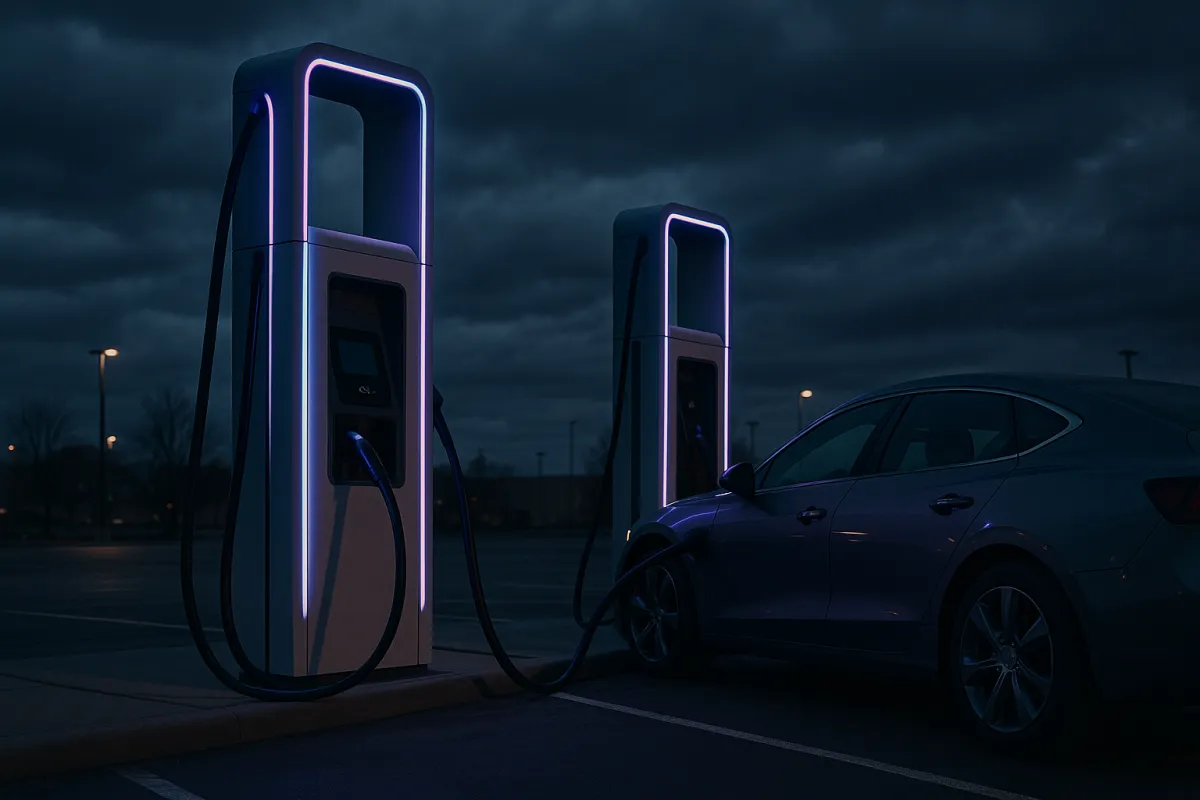
The practical takeaway is not that fast charging is bad, it is genuinely useful on road trips, but that its price is built for occasional convenience rather than daily fuel. An owner who can charge at home and reserves Supercharging for travel captures the low-cost story in full; one who Superchargers by default has, in cost terms, bought an expensive gas car. This is the same conclusion our teardown on home charging cost reaches from the home side, and it is worth internalizing before buying: the EV’s fuel advantage is real, but it is a property of the plug, not the badge. Confirm you have a realistic path to home or workplace charging before you count on the cheap numbers.
Why Supercharging costs more per kWh
The premium on fast charging is not gouging so much as economics, and understanding why makes the price predictable. A DC fast charger is expensive hardware pulling enormous power, sited on real estate, often hit with utility demand charges for its peak draw, and run at a margin. All of that loads onto the per-kWh or per-minute price you see at the stall. Home charging carries none of it: you pay your ordinary residential rate for electricity you were already connected to, with no hardware to amortize beyond a one-time charger install and no real estate to rent.
Three features of fast-charging pricing follow from this. First, prices vary by station, network, and time of day, because demand charges and local electricity costs vary, so the same network can cost noticeably more at a busy urban site than a quiet rural one. Second, some networks price by the minute rather than the kWh, which penalizes cars that charge slowly or that are already near a full battery, since fast charging deliberately slows down above roughly 80 percent to protect the pack. Third, memberships or subscriptions can lower the per-kWh rate for frequent users, trading a monthly fee for cheaper electrons. None of these change the core lesson: fast charging is priced for convenience, and the way to keep its premium small is to use it deliberately rather than by default.
Monthly and annual charging cost by mileage
Because charging cost is purely miles times cost-per-mile, the monthly bill is one of the most predictable expenses in car ownership. Once you know your per-mile figure, your monthly cost is just your monthly mileage scaled against it, and that scaling is worth seeing laid out, because it reframes charging from a mystery into a line item you can plan around.
At the illustrative 4.2 cents per mile from a 28 kWh per 100 miles car on a 15 cent rate, here is roughly how the monthly bill grows with driving:
- 500 miles a month: about $21, the profile of a low-mileage second car or a short commute.
- 750 miles a month: about $32, a light-to-moderate driver.
- 1,000 miles a month: about $42, close to the average driver’s mileage.
- 1,250 miles a month: about $53, a longer commute or an active household.
- 1,500 miles a month: about $63, a high-mileage driver or a car doing a lot of family duty.
Two things stand out. First, even the high-mileage row is a modest number against a comparable gas fuel bill, which for 1,500 miles in an average car could easily run $170 to $200 a month. Second, every figure roughly halves if you charge off-peak, the lever the next few sections keep coming back to. Scaled to a year, the 1,000-mile-a-month driver spends about $500 charging at home, against roughly $1,400 of gasoline for the same 12,000 miles. Find your own row with our cost calculator, which lets you set your exact rate, efficiency, battery size, and charging mix rather than reading off an illustrative table.
What moves your charging number
The illustrative figures assume a typical car and typical conditions, so it helps to know which dials actually change your result and which do not. Three genuinely matter. Your electricity rate is the largest and most controllable, ranging widely by region and, crucially, by time of day. Efficiency is the co-star: a car using 25 kWh per 100 miles costs a third less per mile than one using 33, before you touch the rate. And your charging mix, how much of your energy comes from cheap home charging versus expensive Supercharging, can swing the blended cost per mile by more than either of the first two.

Two things move the number less than people assume. Charging losses are real but small and already counted in a from-the-wall efficiency figure, a point the next section takes on its own. And battery size, despite intuition, does not change cost per mile at all. A bigger pack costs more to fill in one session because you are buying more kWh, but it also drives farther on that fill, so the per-mile cost is untouched. Keeping those straight prevents the most common mistakes in charging math, and it explains why two owners of very different EVs can pay nearly the same per mile while paying very different amounts to fill up.
Charging losses: paying for what never reaches the battery
Charging is not perfectly efficient, and the gap between what your meter counts and what your battery stores is a small cost that confuses a lot of first-time calculations. When you charge, roughly 10 percent of the energy pulled from the wall is lost as heat in the charger, the cables, and the battery’s own conditioning, so filling a 75 kWh pack draws closer to 83 kWh at the meter. At a 15 cent rate that is a difference of about a dollar per full charge, real but modest, and it is the reason a careful bill-based estimate runs slightly higher than a naive battery-times-rate figure.
The good news is that the common efficiency figure of around 28 kWh per 100 miles is usually already a from-the-wall number, measured at the plug rather than at the battery, which means the loss is already baked into the per-mile and per-100-mile costs this teardown quotes. Where the loss bites as a surprise is when you calculate from the car’s own consumption display, which typically reports what the battery delivered to the wheels, not what the wall supplied. If you do your math that way, add about 10 percent to reflect what the meter sees. Cold weather widens the loss slightly, since a cold battery spends energy warming itself before it can accept a charge efficiently, which is one more reason winter charging costs a little more per mile than summer charging.
Time of use and off-peak: the biggest home lever
If there is one setting that most changes your charging cost, it is when the electrons flow. Many utilities now price electricity by time of day, and the gap between peak and off-peak rates is large: overnight off-peak rates commonly run a third to half of peak rates, and some utilities offer EV-specific plans with even deeper overnight discounts. Because an EV sits parked all night anyway, shifting its charging into the cheap window is close to free money, the car neither notices nor minds finishing at 4 a.m. instead of 8 p.m.
The size of the lever is easy to state. Take the 1,000-mile-a-month driver paying about $42 on a 15 cent standard rate. Move that same charging to an 8 cent off-peak rate and the bill falls to roughly $22, a saving near $240 a year for a schedule you set exactly once. Every modern EV can schedule its own charging window, and most smart home chargers duplicate the feature, so the one-time setup is to check your utility for a time-of-use or EV rate, enroll if the overnight math wins, and set the schedule in the car or charger. After that, years of savings accrue with no further attention. The one caution is that time-of-use plans also price peak power higher, so the move only pays if your charging, and ideally your other big loads, genuinely shift off-peak, which for an EV household that charges overnight it usually does.
Battery size versus efficiency
The single most common confusion in charging cost is the belief that a bigger battery costs more per mile, so it is worth settling directly. Battery size sets two things: your range and your maximum single-charge bill. A 100 kWh pack costs about $15 to fill at a 15 cent rate against about $9 for a 60 kWh pack, precisely because you are buying more kWh in one session. But that larger pack also carries you farther on the fill, so when you divide the cost by the miles it delivers, the per-mile figure lands in the same place. What each mile costs is set by efficiency and your rate, full stop.
Efficiency, meanwhile, is where real per-mile differences live, and it is easy to overlook because it does not appear on a spec sheet as prominently as range. A lean sedan sipping 25 kWh per 100 miles and a heavy electric truck drinking 45 can both cost the same $15 to top off if their packs happen to match, yet the truck costs nearly twice as much per mile to drive, because it burns more energy covering the same distance. When you compare two EVs on running cost, then, the question is not how big the battery is but how many kWh the car needs per 100 miles. That number, times your rate, is the honest cost of a mile, and it is the figure our companion teardowns on home charging cost and cost per mile both build their comparisons on.
Annual charging cost versus gasoline
Stacking a year of charging against a year of gasoline is where the small per-mile gap turns into a number worth caring about. Take a driver covering 12,000 miles a year. At the illustrative home rate, that is about $470 of electricity; charged off-peak, closer to $250. The same 12,000 miles in a 30 mpg gas car at $3.50 a gallon is 400 gallons, about $1,400. So the annual fuel saving is roughly $930 charging at the standard home rate, and over $1,100 charging off-peak, every year the driver keeps driving.
Those savings are the recurring engine behind the break-even math in our teardown on electric car versus gas cost, where the higher purchase price of an EV is slowly repaid by exactly this fuel gap. Scale it to a higher-mileage driver and the yearly saving grows past a thousand dollars easily; scale it to a thirstier gas car being replaced, and it grows again. The one scenario that erases it is the one this teardown keeps flagging: a driver who relies on Supercharging can spend as much as or more than the gas car they left, turning a $930 saving into roughly nothing. The saving, in other words, is not a property of the car. It is a property of the plug, the rate, and the miles, all three of which you control and can price in advance with our cost calculator.
A typical year of charging, by source
Most real owners do not charge exclusively one way; they charge mostly at home, sometimes on peak when they forget the schedule, and occasionally at a Supercharger on trips. Seeing a realistic annual mix as one bar helps explain why a typical owner’s bill lands where it does, and where the money leaks.
A typical owner's year of charging, by source
Illustrative share of annual charging energy for a home-charging owner who travels occasionally.
Most of the year runs on the cheapest electrons, which is why a typical owner's bill stays low. The small Supercharger slice costs far more per mile than its share of energy suggests, and the peak-home slice is the one a charging schedule quietly recovers.
The mix explains the whole story. Because the large majority of energy comes from cheap home charging, the owner’s blended cost stays close to the home figure, not the Supercharger one. But notice that the small 18 percent Supercharger slice, priced at three or four times the home rate, costs far more than its share of energy implies, and the 22 percent home-peak slice is money left on the table by charging at the wrong hour. Both are recoverable: shifting the peak slice off-peak is a schedule setting, and trimming unnecessary Supercharging is a habit. An owner who pushes their mix toward the leftmost segment is charging at the cheapest cost per mile a car can achieve, which is the practical goal every earlier section has been building toward.
How to charge cheaper: off-peak, home, and solar
Pulling the levers together, there is a clear hierarchy for cutting your charging cost, and none of it requires a different car. The first and biggest move is to charge at home overnight on an off-peak or EV-specific rate, which for most owners is the difference between paying 4 cents a mile and paying 2. The second is to keep Supercharging to genuine road-trip need rather than daily convenience, since every fast-charging session trades a large price premium for time saved you often did not need. The third is to make sure you are actually enrolled in the cheapest rate plan your utility offers, because many households pay a standard flat rate simply because no one ever asked about a time-of-use option.
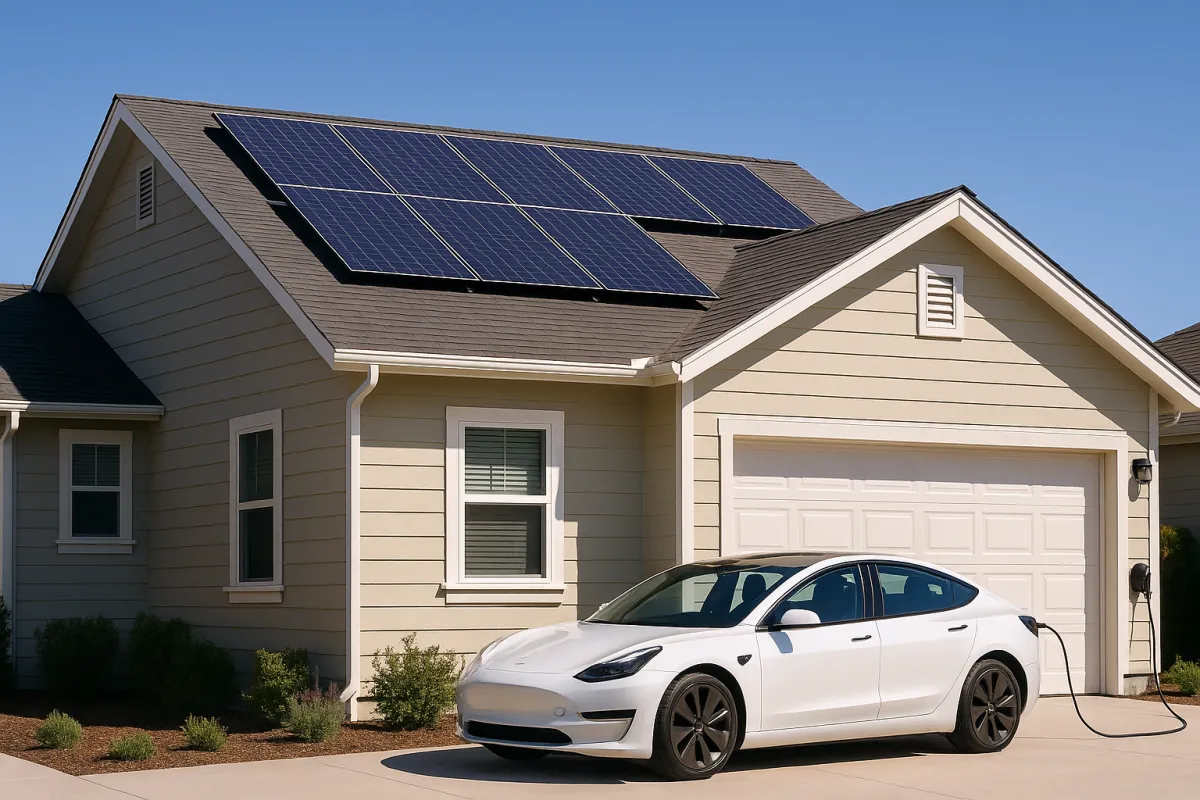
For households with rooftop solar, or plans for it, there is a fourth lever that can be the cheapest of all. Electricity you generate and use yourself displaces power you would have bought at retail, so charging from your own panels can drop the effective cost per mile toward the low single digits or even near zero for the self-consumed portion. The catch is timing: solar output peaks at midday, precisely when many commuter cars are away earning their miles elsewhere, so the tidy image of a car sipping directly from the roof fits retirees, remote workers, and second cars better than a nine-to-five commuter. Our teardown on charging with solar works through when the overlap pays and when net metering has to bridge it. The honest summary is that solar can make charging nearly free, but only when the timing lines up or the utility’s rules do it for you.
Charging on a road trip
The one place the cheap home numbers do not apply is the road trip, where you are away from your own outlet and leaning on the fast-charging network by necessity. On a long drive you charge at Superchargers or other DC fast stations at their premium rate, so a trip’s fuel cost looks more like the top bars of the chart than the bottom ones. This is not a flaw in the car; it is the price of covering long distances quickly, and it is still frequently competitive with gasoline for the same trip, especially against a thirstier vehicle.
The practical way to hold road-trip costs down is to charge smart rather than charge full. Fast charging deliberately slows above roughly 80 percent to protect the battery, so the last stretch to a full battery is both the slowest and, on per-minute networks, the most expensive kWh you will buy. Planning stops around the 10-to-80-percent window keeps you in the fast, cheaper part of the curve and gets you back on the road sooner, a rhythm our teardown on planning an EV road trip lays out in full. It also helps to know your network’s pricing before you leave, since a membership can pay for itself on a single long trip, and to precondition the battery before a fast-charging stop so it accepts power at full speed rather than warming up on your dime.
Free and destination charging
Some of the cheapest charging is the kind you do not pay for at all, and it changes the math enough to be worth planning around. Workplace charging, where an employer offers it, can cover a large share of a commuter’s miles at zero personal cost, which for a daily driver can mean the bulk of the year’s charging is simply free. Destination charging at hotels, restaurants, and shopping centers, often slower Level 2, is increasingly common as a draw for customers, and while it will not fill a big pack quickly, it is genuinely free energy accumulated while you were parked anyway.
The practical way to think about free charging is as a rate of zero in the same formula. A driver who gets, say, half their miles from free workplace charging effectively halves their already-low home-charging bill, pushing their blended cost per mile toward 2 cents or below. That is not a reason to build your life around chasing free plugs, since the time cost of hunting them usually outweighs the small savings, but where free charging lands naturally in your routine, it is worth taking. Our teardown on finding free EV charging maps out where it tends to appear. The one caution is not to let occasional free charging talk you into skipping a home setup: the free plug is a bonus on top of home charging, not a replacement for it, because its availability is never guaranteed.
A worked example: one owner for a year
Numbers land harder as a story, so here is one owner run through three scenarios for a single year. He drives 12,000 miles, his EV has a 75 kWh pack and uses 28 kWh per 100 miles, his home rate is 15 cents standard and 8 cents off-peak, and his old car was a 30 mpg sedan he fueled at $3.50 a gallon. The formula does the rest, and the three outcomes are strikingly far apart despite being the same car and the same miles.
Charging entirely at home on the standard rate, his year costs about $470, and a full charge of his pack runs about $11 whenever he tops up. Setting an overnight schedule to catch the off-peak rate, the same year costs about $250, with a full charge nearer $6, saving him roughly $220 for one evening of setup. Now run the pessimistic version: if he had no home charging and leaned on Supercharging at 45 cents per kWh, that same 12,000 miles would cost about $1,510, more than the gas car he replaced, with each full charge near $34. Against the gas car’s $1,400 fuel year, home charging saves him about $930 on the standard rate and over $1,100 off-peak, while Supercharging-only would have cost him more than staying with gas. One owner, one car, one year, and a spread of well over a thousand dollars decided entirely by where and when he plugs in. Run your own version in our cost calculator, and the abstract cents per mile become your actual annual number.
Common cost-to-charge mistakes
A few recurring errors distort people’s sense of what charging an EV like a Tesla costs, in both directions.
- Quoting Supercharger prices as if they were the norm. Fast charging is the expensive exception. Home charging, where most miles happen, costs a fraction of it, and conflating the two makes EVs look pricier to run than they are.
- Ignoring the off-peak rate. Charging on peak by default can nearly double the bill against an off-peak schedule you set once. It is the biggest home lever and the easiest one to miss.
- Blaming battery size for a big charge cost. A large pack costs more to fill in one session but not more per mile. Cost per mile is efficiency times rate, full stop.
- Calculating from the battery instead of the wall. The car’s own consumption display omits the roughly 10 percent charging loss the meter sees, so bill-based math should use from-the-wall figures.
- Assuming the badge sets the cost. The brand changes the battery size and efficiency you feed the formula, not the formula itself. A cheaper-to-charge car is simply a more efficient one on a better rate.
Each mistake pushes the estimate toward a wrong conclusion, which is why the simple formula, run on your own pack size, efficiency, and rate, beats any remembered rule of thumb.
The bottom line
Charging an EV like a Tesla is one of the cheapest ways to fuel a car when you do it at home, an illustrative 4 to 5 cents a mile and about $11 for a full 75 kWh charge at a common rate, often half that overnight. The whole thing reduces to a short formula, battery size times rate for a full charge and efficiency times rate for a mile, and the biggest savings come from levers you fully control: charging off-peak, keeping Supercharging to trips, and knowing your car’s real efficiency. Supercharging is genuinely useful on the road but priced for convenience, so leaning on it daily quietly erases the savings. Against a typical gas car, home charging adds up to a several-hundred-dollar to four-figure saving every year. Price your own pack, rate, and charging mix in our cost calculator, set the overnight schedule once, and the cheapest fuel station in town stays the one in your own garage.
This teardown is educational and independent, written by people who enjoy the arithmetic, not by any carmaker, charging network, or your utility. Every cost-per-charge, per-mile, per-100-mile, monthly, and annual figure above is illustrative and will move with your battery size, your car’s real efficiency, your electricity rate, the season, and the prices of gasoline and public charging where you live. Charging network pricing, time-of-use windows, demand charges, membership rates, and any charging incentives differ by provider and region and change over time, so confirm your own tariff, your car’s consumption, and current fuel and station prices with the actual sources before you budget on any number here.
Frequently asked questions
How much does it cost to charge a Tesla at home?
Illustratively, a full charge of a mid-size pack of roughly 75 kWh at a common home rate near 15 cents per kWh costs about $11, before the small charging loss the meter also counts. On a per-mile basis that works out to roughly 4 to 5 cents, or about $4 to $5 per 100 miles. Charge overnight on an off-peak rate near 8 cents and the same full charge falls closer to $6, and the per-mile cost drops toward 2 to 3 cents. The exact figure moves with your battery size, your car's efficiency, and your electricity rate, but home charging is almost always the cheapest way to power an EV like a Tesla.
How much does it cost to charge a Tesla at a Supercharger?
Public DC fast charging, including Supercharging, commonly costs an illustrative two to four times more per kWh than home charging, often somewhere near 40 to 50 cents per kWh depending on the station, the time, and local demand. At those rates a full charge of a 75 kWh pack can run an illustrative $30 to $35, and the cost per mile climbs to around 12 to 15 cents, close to or above what gasoline costs. That premium pays for expensive high-power hardware, real estate, and grid demand charges. It is priced for convenience on a road trip, not for daily fuel, which is why owners who can charge at home reserve fast charging for travel.
What is the cost to charge a Tesla per mile?
Cost per mile equals your car's efficiency in kWh per 100 miles, divided by 100, times your electricity rate. At an illustrative 28 kWh per 100 miles and a 15 cent home rate, that is about 4.2 cents per mile. Off-peak overnight charging can push it toward 2 to 3 cents, while Supercharging can raise it to 12 to 15 cents or more. For comparison, a 30 mpg gas car at $3.50 a gallon costs about 11.7 cents per mile to fuel, so home charging is usually a fraction of the gasoline cost for the same distance.
How much does it cost to charge a Tesla per 100 miles?
Multiply your efficiency in kWh per 100 miles by your rate per kWh. At an illustrative 28 kWh per 100 miles and a 15 cent home rate, 100 miles of driving costs about $4.20, an illustrative figure. Off-peak that falls near $2.24, and at a Supercharger rate close to 45 cents it climbs to roughly $12.60. Battery size does not change this number, because a bigger pack drives farther on its larger charge, leaving the cost per 100 miles set by efficiency and your rate alone.
Is it cheaper to charge a Tesla or buy gas?
For home charging, almost always cheaper, and often dramatically so. An illustrative home-charged mile near 4 to 5 cents sits well under a typical gas mile of 11 to 14 cents, which over a year of average driving is commonly a several-hundred-dollar to four-figure gap in the EV's favor. The comparison narrows sharply if you rely on Supercharging or other public DC fast charging, which can cost as much as or more than gasoline per mile. So the honest answer depends less on the car than on where and when you plug it in.
How much does it cost to fully charge a Tesla?
It depends mostly on battery size and your rate. An illustrative full charge is battery size in kWh times your rate per kWh, so a 75 kWh pack at a 15 cent home rate costs about $11, while a smaller 60 kWh pack costs about $9 and a larger 100 kWh pack about $15. At an off-peak rate near 8 cents those figures roughly halve, and at a Supercharger near 45 cents they roughly triple. Because charging is not perfectly efficient, the wall draws about 10 percent more energy than the pack stores, so treat the full-charge cost as a close floor rather than an exact ceiling.
Does a bigger Tesla battery cost more to charge per mile?
No, and this is a common source of confusion. Cost per mile depends on efficiency, how many kWh the car uses to cover 100 miles, and your electricity rate, not on how big the battery is. A larger pack costs more to fill from empty to full, because you are buying more kWh in one session, but it also drives farther on that fill, so the cost per mile is unchanged. Battery size sets your range and your maximum single-charge bill; efficiency and your rate set what each mile actually costs.
How can I charge a Tesla for less?
The biggest lever is charging at home overnight on an off-peak or EV-specific rate, which commonly runs a third to half of the standard rate and can nearly halve your charging bill for a schedule you set once. Keeping Supercharging to genuine road-trip need, rather than daily use, avoids the most expensive electrons. Where you have rooftop solar, charging from self-generated power can push the effective cost per mile toward the low single digits, though timing matters because solar peaks at midday. Free workplace or destination charging, where it lands naturally in your routine, is simply a rate of zero in the same formula.