
What's in this teardown
- How do electric cars work? The short version
- The main parts of an electric car
- The battery pack: where the energy lives
- The electric motor: what turns the wheels
- The inverter: the brain between battery and motor
- The onboard charger and how AC becomes DC
- How energy flows from battery to wheels
- Why electric cars have instant torque
- The single-speed transmission explained
- Regenerative braking in brief
- How electric cars charge: AC vs DC
- Charging levels: 1, 2, and DC fast
- Battery basics: kWh, range, and efficiency
- How far a charge takes you
- Where a charge’s energy goes
- BEV vs hybrid: two different drivetrains
- What an electric car does not have
- The thermal system: keeping the battery happy
- The 12-volt battery still matters
- A day in the life of an EV’s energy
- Common misconceptions about how EVs work
- The component-by-component summary
- The bottom line
Lift the floor of an electric car and you will not find an engine, a fuel tank, or a gearbox full of gears. So how do electric cars work? In the plainest terms, an EV stores electricity in a large battery, uses that electricity to spin an electric motor, and the motor turns the wheels. Everything else is detail hung on that one idea. There is no combustion, no fuel to burn, and almost nothing to shift, which is why an electric car feels so different to drive and so different to own. Once you see the handful of parts involved, the whole machine stops being mysterious.
This teardown walks through how an electric car works from the battery to the road, one component at a time, in language that assumes no engineering background. It covers the four parts that define an EV, the battery pack, the electric motor, the inverter, and the onboard charger, then follows the energy as it flows from the pack to the wheels. It explains why EVs have instant torque and only one gear, how they charge on AC and DC, what kilowatt-hours mean for range, and how a battery EV differs from a hybrid. You can put your own driving into our project cost calculator to see the running-cost side of all this as you read.
Key takeaways
- An electric car stores energy in a battery pack, an inverter shapes that energy, an electric motor turns it into rotation, and a single gear sends that rotation to the wheels: stored electricity in, motion out.
- The four defining parts are the battery pack (stores energy in kWh), the motor (makes rotation), the inverter (controls the flow and converts DC to AC), and the onboard charger (converts wall AC back to DC).
- EVs have instant torque because the motor makes full turning force from a standstill, and only one gear because the motor works across a very wide speed range.
- Charging depends on AC versus DC: home and Level 2 charging feed AC through the onboard charger and are slower, while DC fast charging sends direct current straight to the pack and is much faster.
- Range is set by the battery's energy in kilowatt-hours and the car's efficiency in miles per kWh, so a bigger pack and a more efficient car both travel farther on a charge.
How do electric cars work? The short version
Here is the whole machine in four sentences. A large battery pack stores energy as electricity, rated in kilowatt-hours, the way a tank is rated in gallons. When you press the accelerator, the inverter draws electricity from the pack and shapes it into the precise, rapidly alternating form an electric motor needs. The motor turns that electricity into rotation, and a single fixed gear passes the rotation to the wheels. To refuel, you plug in and refill the battery instead of stopping for gas.
That is genuinely most of it. An electric car has no engine burning fuel, no multi-speed transmission juggling gears, no fuel pump, exhaust, or emissions plumbing. In their place sits a battery, a motor, and the power electronics that manage the current between them, plus a charger to refill the pack and a small conventional battery to run the lights and computers. The rest of this teardown expands each of those parts, but the mental model above is the one to hold: energy is stored as electricity, converted to motion on demand, and topped up by plugging in. Everything follows from that.
The main parts of an electric car
It helps to name the cast before following the plot. An electric car is built around a small set of parts, and once you can picture each one, the way they work together becomes obvious. There are four that truly define the drivetrain, plus a few supporting players that quietly make the whole thing usable day to day.
The four defining parts are the battery pack, which stores the energy; the electric motor, which turns electricity into rotation; the inverter, which sits between them and controls the flow while converting the battery’s direct current into the alternating current the motor uses; and the onboard charger, which converts the alternating current from a wall outlet into the direct current the battery stores. Around those sit a single-speed gearbox that passes the motor’s rotation to the wheels, a thermal system that keeps the battery and cabin at sensible temperatures, and a small 12-volt battery that runs the lights, screens, and computers exactly as it would in a gas car. That is the entire machine. Below, each part gets its own section, and the table near the end of this teardown lists them side by side.
The battery pack: where the energy lives
The battery pack is the largest, heaviest, and most expensive part of an electric car, and it is where all the usable energy lives. It is not one big battery but a carefully organized stack of hundreds or thousands of individual cells, grouped into modules, which are in turn assembled into the flat pack that usually sits under the floor between the axles. Placing it low and central gives the car a low center of gravity, which is part of why so many EVs feel planted and stable through corners.
The pack stores energy as direct current, and its capacity is measured in kilowatt-hours. A larger number means more stored energy and, all else equal, more range. The pack does far more than hold charge, though. A battery management system watches the voltage and temperature of the cells, balances them so they age evenly, and sets safe limits on how fast the pack can be charged and discharged. This is why charging slows as the pack fills and why a cold pack accepts charge more slowly. The battery is sophisticated chemistry wrapped in careful software, and treating it well is central to keeping an EV healthy, as our teardown on how long EV batteries last explains in depth.
The electric motor: what turns the wheels
The electric motor is the part that actually moves the car, and it does the work that an engine, clutch, and much of a transmission do together in a gas car. Feed it electricity and it produces rotation; that rotation, passed through a single gear, turns the wheels. Most EVs use a type of motor that creates a rotating magnetic field inside itself when current flows through its windings, and that field drags the motor’s central rotor around with it. The faster and stronger the field, the faster and harder the rotor spins.
What makes an electric motor so well suited to a car is that it makes its full twisting force, its torque, from the very first instant it turns, and keeps making useful power across a very wide range of speeds. There is no idling, no need to rev up, and no narrow power band to stay inside. That single trait is responsible for two of an EV’s signature qualities: the instant, seamless acceleration you feel the moment you press the pedal, and the fact that one fixed gear is enough to cover every speed. The same motor also runs in reverse as a generator during regenerative braking, a dual role covered later in this teardown.
The inverter: the brain between battery and motor
The inverter is the least visible of the four core parts and arguably the cleverest. The battery stores and supplies direct current, a steady one-way flow, but the motor needs alternating current that switches direction in a precisely timed pattern to create its rotating field. The inverter is the device that performs that conversion, turning the battery’s DC into AC, on the fly, thousands of times a second. Without it, the battery and the motor could not talk to each other at all.
It does more than translate, though; it is also the throttle. By varying the frequency and strength of the alternating current it sends, the inverter controls exactly how fast and how hard the motor turns, which is what actually happens when you move the accelerator pedal. Press harder and the inverter feeds the motor more current, producing more torque. During regenerative braking it works in reverse, taking the AC the motor generates and converting it back to DC to charge the pack. Think of the inverter as the drivetrain’s brain and the pedal as your request to it. It is compact, has no large moving parts, and quietly manages the entire flow of power in both directions.
The onboard charger and how AC becomes DC
There is a second converter in the car, distinct from the inverter, and it exists purely for charging. The electricity from a home outlet or a public Level 2 station arrives as alternating current, but the battery can only store direct current. The onboard charger is the device that converts that incoming AC into the DC the pack needs. Its size, rated in kilowatts, sets the fastest speed at which the car can accept AC charging, which is why two cars plugged into the same home charger can refill at different rates.
This is the key to understanding why home charging is comparatively slow while DC fast charging is quick. AC charging is limited by the onboard charger’s modest capacity, because that converter has to fit in the car and stay affordable. DC fast chargers sidestep the bottleneck entirely: they do the AC-to-DC conversion inside the charging station, which can be large and powerful, and then send direct current straight into the pack, bypassing the onboard charger. Same destination, different route, very different speed. That single distinction explains most of what confuses newcomers about EV charging, and the charging reference on levels and connectors maps every plug and speed onto it.
How energy flows from battery to wheels
Now that the parts are named, the flow of energy is easy to trace, and it is worth doing because it ties everything together. When you press the accelerator, the request goes to the inverter. The inverter draws direct current out of the battery pack, converts it into precisely timed alternating current, and sends it into the motor’s windings. The motor turns that current into a rotating magnetic field, the field spins the rotor, and the rotor’s rotation passes through the single fixed gear to the drive wheels. Battery, to inverter, to motor, to wheels: that is the entire chain, and it happens in a fraction of a second.
When you lift off or brake, the chain runs backward. The wheels now spin the motor, the motor acts as a generator and produces alternating current, and the inverter converts that AC back into DC to recharge the battery. The car slows because generating that electricity takes effort, felt at the wheels as braking drag. So the same four parts handle both driving and recovering energy, just in opposite directions, with the inverter switching roles seamlessly. There is no separate reverse mechanism either; to back up, the inverter simply spins the motor the other way. One flow, two directions, no extra hardware.
Why electric cars have instant torque
Anyone who has driven an EV remembers the shove of instant acceleration, and it comes directly from how an electric motor makes force. Torque is turning force, the thing you feel as acceleration, and an electric motor produces its maximum torque from zero revolutions, the instant current begins to flow. There is no engine to rev, no turbo to spool, and no clutch to engage, so the response is immediate and smooth, with power arriving as a single continuous surge rather than building through a rev range.
A gasoline engine is the opposite. It makes very little torque at low speeds and only reaches its peak well up the rev range, which is exactly why it needs a multi-speed transmission to keep the engine spinning fast enough to make useful power. The electric motor’s from-zero torque removes that whole problem. It is why an ordinary EV can feel surprisingly quick off the line even without sporting pretensions, and why the acceleration is so seamless: no gear changes interrupt it. The inverter meters this torque precisely, so the same trait that makes an EV feel lively also makes it easy to drive smoothly at low speed. Instant torque is not a gimmick; it is a direct consequence of the physics of an electric motor.
The single-speed transmission explained
One of the biggest mechanical simplifications in an electric car is that most have just a single gear. A gas car needs five, six, eight, or more forward gears because its engine only makes useful power across a narrow band of speeds, so the transmission constantly swaps ratios to keep the engine in that band as the car speeds up and slows down. That gearbox is one of the most complex and wear-prone parts of a conventional car.
An electric motor does not need any of it. Because the motor makes strong torque from a standstill and spins usefully across a very wide range, a single fixed reduction gear covers everything from crawling in a parking lot to cruising on the highway. There is nothing to shift, no shift shock, and no clutch to wear out, which is a large part of why EV acceleration feels so seamless and why the drivetrain needs so little maintenance. The gear simply steps the motor’s fast rotation down to a wheel-appropriate speed while multiplying its torque. A small number of high-performance EVs add a second gear for a higher top speed, but for the overwhelming majority, one gear is all it takes, and you never think about it.
Regenerative braking in brief
Regenerative braking is where the motor’s dual nature pays off, and it is one of the features that makes an EV feel distinct. When you lift off the accelerator or brake gently, the inverter reverses the motor’s job: instead of driving the wheels, the wheels drive the motor, which now acts as a generator and produces electricity that flows back into the battery. The resistance the motor feels while generating is what slows the car, so you decelerate the moment you ease off, and the range estimate holds steadier than you might expect.
Two benefits follow. First, some of the energy you spent getting up to speed is recovered rather than thrown away as heat, which modestly improves efficiency, most of all in stop-and-go city driving where you slow down constantly. Second, because regen handles the majority of everyday slowing, the friction brakes do far less work and their pads and discs last much longer than in a gas car, quietly cutting maintenance. The friction brakes are still there for hard stops and for when the battery is too full or too cold to accept charge. This is only a brief sketch; our dedicated teardown on how regenerative braking works covers the physics, one-pedal driving, and the honest limits in full.
How electric cars charge: AC vs DC
Charging is where many newcomers get lost, but it all reduces to one distinction: alternating current versus direct current. The battery only ever stores DC. The question is simply where the AC-to-DC conversion happens. When you charge from a home outlet or a public Level 2 station, the electricity arrives as AC and the car’s own onboard charger converts it to DC, which is why the speed is capped by that modest onboard unit. When you use a DC fast charger, the conversion happens inside the big roadside charger and DC flows straight into the pack, so the fill is much quicker.
That is the whole framework. AC charging is slower but cheap, ubiquitous, and gentle on the battery, which makes it ideal for the long hours a car sits parked at home or work. DC fast charging is quicker but is meant for topping up on the road rather than as an everyday habit, both because it costs more and because the higher power and heat are harder on the pack over time. Most owners settle into a rhythm of slow overnight AC charging at home for daily needs, with occasional DC fast charging on trips. You can price your own charging in our cost calculator, and our home-charging coverage explains the setup in practice.
Charging levels: 1, 2, and DC fast
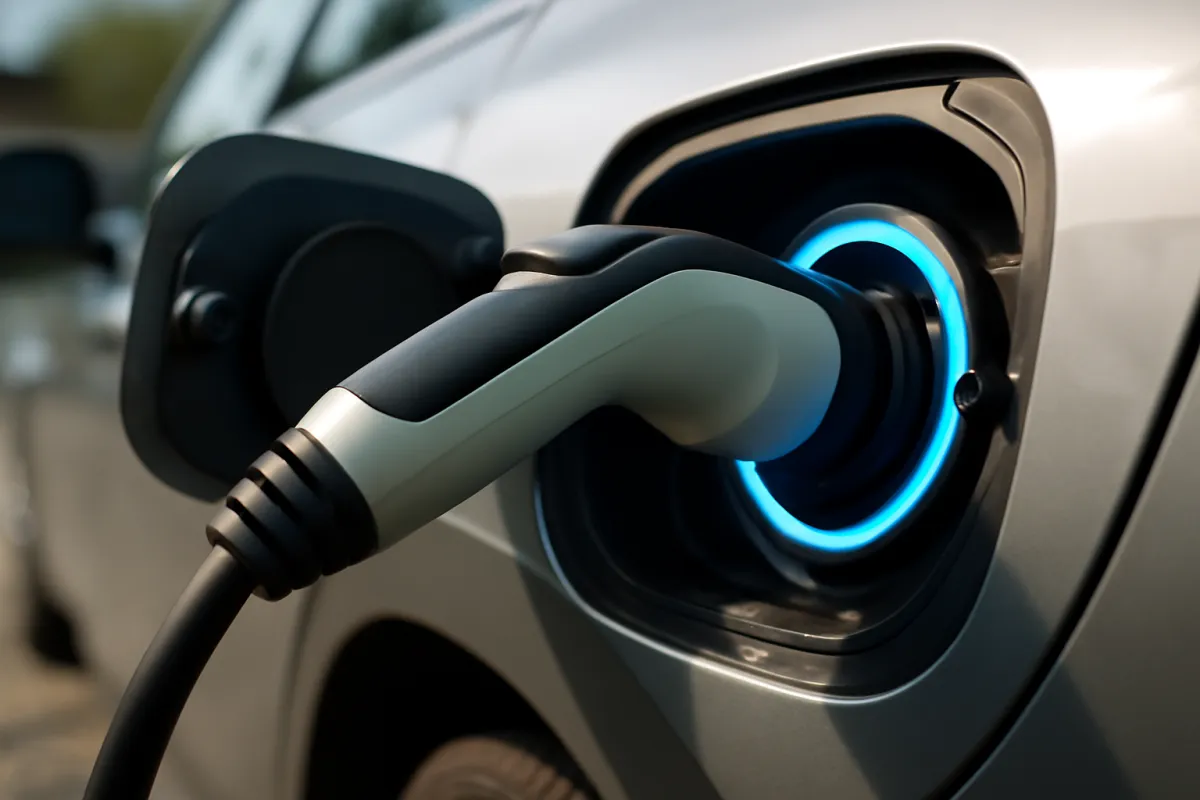
Charging speed is usually described in three tiers, and they follow directly from the AC-versus-DC idea. Level 1 is a standard household outlet, the slowest option, adding only a few miles of range per hour, useful as a trickle for low-mileage days or as a backup when nothing else is available. Level 2 is a 240-volt connection, the same kind of circuit a large appliance uses, and it is the workhorse of home and public AC charging, refilling most cars overnight. Both Level 1 and Level 2 are AC and run through the onboard charger.
DC fast charging, sometimes called Level 3, is a different animal. It delivers direct current straight to the battery at high power, capable of taking many cars from a low charge to most of a charge in a fraction of an hour, which is what makes long trips practical. The catch is that fast charging deliberately slows as the pack fills, because a nearly full battery can only accept charge so quickly, so the quoted headline speeds apply mainly to the lower part of the range. Which tier you can use, and how fast, depends on both the charger and your specific car’s limits. The full charging reference lays out the levels, connectors, and realistic times side by side.
Battery basics: kWh, range, and efficiency
Two units unlock most conversations about EVs, and they are worth getting straight. A kilowatt-hour, kWh, is a unit of energy, and it measures how much a battery holds, the electric equivalent of a fuel tank’s size in gallons. A kilowatt, kW, is a unit of power, the rate of energy flow, and it measures how fast a car charges or how much muscle the motor can deliver. Energy sets how far you can go; power sets how fast you get there and how quickly you refill. Mixing them up is the source of a lot of confusion.
Range comes from combining the battery’s energy with the car’s efficiency, usually stated as miles per kWh. If a car travels an illustrative 3.5 miles on each kWh and carries a 60 kWh usable pack, it can cover roughly 210 miles on a full charge. A bigger pack or a more efficient car both push that number up, while cold weather, high speeds, and heavy climate use pull it down, because they raise the energy each mile costs. This is why two owners of the same car report different range: efficiency is not fixed. Our teardown on maximizing EV range covers the levers that stretch a charge furthest.
Illustrative driving range by usable battery size
At an illustrative efficiency of about 3.5 miles per kWh. Real range varies with speed, temperature, terrain, and climate use.
The bar widths are the raw ratio of each illustrative range to the largest. More stored energy means more range at a given efficiency, which is why pack size in kWh is the first number buyers look at.
How far a charge takes you
The chart above shows the neat theory, but the range you actually see is a live negotiation between energy and effort. Every mile costs some energy from the pack, and how much it costs depends on how you drive and the conditions. Highway speeds raise the cost because air resistance climbs steeply with speed. Cold weather raises it because heating the cabin and warming the battery both draw power that does not turn the wheels. Hills, headwinds, roof racks, and a heavy right foot all add to the tally. Efficiency, in other words, is a moving target, not a sticker.
This is also why regenerative braking helps most in the city and least on the highway, the reverse of a gas car. In stop-and-go traffic you slow down constantly, and each deceleration returns a little energy to the pack, so an EV often goes further per kWh in town than on the open road. The practical takeaway is that the number on the window sticker is a reasonable average, not a promise, and that smooth, moderate driving in mild weather beats it while fast highway running in the cold falls short. Understanding that keeps range anxiety in proportion: the battery behaves predictably once you know what raises and lowers the cost of a mile.
Where a charge’s energy goes
It helps to picture where the energy from a full charge actually ends up on a mixed drive, because it shows that not every kilowatt-hour reaches the road. The large majority does the real job of propelling the car, but a meaningful share is spent keeping you comfortable and keeping the battery in its ideal temperature range, and a little is lost to the small inefficiencies of the drivetrain and the conversion between DC and AC.
Illustrative split of a charge's energy on a mixed drive
Rough shares only, for a moderate day with some climate use. Cold weather and highway speeds shift more toward propulsion and climate.
Illustrative only, and the segments sum to 100 percent. On a cold day the climate slice grows sharply, because heating the cabin and battery draws real power, which is why winter range drops.
The important reading is that the split is not fixed. On a mild day at moderate speeds, most of the energy propels the car and range is close to the rated figure. On a freezing day the climate slice swells as the car heats the cabin and warms the battery, so a larger share of the charge never reaches the wheels and range falls. This is the honest mechanism behind winter range loss, and it is why preconditioning the car while it is still plugged in, using wall power to warm things up before you drive, protects the miles stored in the pack.
BEV vs hybrid: two different drivetrains
People often lump EVs and hybrids together, but they work in fundamentally different ways, and the distinction matters. A battery electric vehicle, a BEV, is what this teardown has described: it has only an electric drivetrain, is powered entirely by a large battery you charge by plugging in, and burns no fuel at all. A hybrid keeps a gasoline engine and adds a small electric motor and a small battery, using the two together to improve efficiency. A conventional hybrid never plugs in; it charges its little battery from the engine and from regenerative braking, and it always ultimately runs on gasoline.
A plug-in hybrid sits between them, with a larger battery you can charge from the wall for a limited electric-only range, after which it behaves like a regular hybrid on gasoline. The practical differences are large. A BEV has no engine, no fuel system, and no gears, so it is mechanically simpler and needs a charging habit rather than a gas station. A hybrid carries two drivetrains, so it is more complex but never needs a plug. Which one fits depends on your driving and whether you can charge, a comparison our teardown on EVs versus hybrids works through in detail with the running-cost math.
What an electric car does not have
Sometimes the clearest way to understand a machine is by what is missing, and an EV is defined as much by its absences as its parts. There is no internal combustion engine, and with it go the pistons, valves, spark plugs, timing belts, and hundreds of other moving pieces that wear and need service. There is no multi-speed transmission and no clutch or torque converter to shift or slip. There is no fuel tank, fuel pump, fuel injectors, or fuel filter, and no exhaust system, catalytic converter, or muffler, because nothing is being burned.
There are also no routine oil changes, because there is no engine oil to circulate, and no engine air filter or emissions gear to maintain. What replaces all of that is a battery, a motor, an inverter, a single gear, and the software that ties them together. This is why an electric drivetrain needs so much less routine maintenance, though it trades that mechanical simplicity for sophisticated, expensive battery and power-electronics components. The tires still wear, sometimes faster because of the instant torque and extra weight, and the brakes, cabin filter, and coolant still get attention. But the long list of engine-era chores simply does not apply, which reshapes what ownership feels like.
The thermal system: keeping the battery happy
One supporting system deserves its own mention because it quietly determines how well everything else works: thermal management. Lithium battery cells have a temperature range they like, and they charge fastest, deliver power best, and age slowest when kept within it. Too cold and the pack accepts charge slowly and cannot deliver or absorb as much power, which is why regen and fast charging both weaken in winter. Too hot and long-term degradation speeds up. So most EVs actively heat and cool the pack using a liquid cooling loop, much like an engine’s cooling system repurposed for a battery.
The same thermal system usually handles the cabin heating and cooling, and increasingly it shares heat cleverly between the battery, the cabin, and the power electronics to save energy. This is also what makes preconditioning possible: while the car is plugged in, it can warm or cool the battery using wall power so that the pack is already at an ideal temperature when you set off or arrive at a fast charger, protecting both range and charging speed. You rarely think about the thermal system, but it is working constantly in the background, and it is a big reason a well-designed EV behaves consistently across seasons. Our coverage of how long EV batteries last treats heat as the main thing that ages a pack.
The 12-volt battery still matters
Here is a detail that surprises new owners: nearly every electric car still has a small, ordinary 12-volt battery, the same humble kind found in gas cars. The giant traction battery propels the car, but running the lights, the touchscreen, the computers, the door locks, and the low-power electronics directly off a high-voltage pack would be impractical and unsafe, so a conventional 12-volt battery handles all of that, exactly as it always has. The car keeps it topped up from the main pack through a converter, rather than from an alternator spun by an engine.
The practical consequence is that an EV can suffer the same annoyance as any car: a dead 12-volt battery. If it fails, the car may refuse to wake up or unlock, even though the big traction battery is full, because the low-voltage system that boots everything has no power. It is one of the more common causes of an EV being stranded in a driveway, and the fix is the familiar one, a jump or a replacement of the small battery. It is a useful reminder that an EV is not exotic in every respect; some of the least glamorous parts of a car carry straight over.
A day in the life of an EV’s energy
Tie it together with an ordinary day. You leave home in the morning with the car charged overnight on a Level 2 connection: while you slept, wall AC flowed through the onboard charger, was converted to DC, and refilled the pack slowly and gently. You press the accelerator, the inverter pulls DC from the battery, converts it to timed AC, and the motor makes instant torque that moves you off the line through a single gear with no shift. On the highway, air resistance raises the energy each mile costs, so the range estimate ticks down a little faster than it did in town.
Approaching a red light, you lift off, the motor becomes a generator, and the inverter sends recovered energy back into the pack while the drag slows you, so the friction brakes barely engage. In the afternoon cold, the thermal system spends some energy warming the cabin and the battery, which is why the range shows a bit lower than on a mild day. On a longer trip you stop at a DC fast charger, which sends direct current straight to the pack and refills the usable range in a fraction of an hour, slowing as the battery fills. Every one of those moments is the same handful of parts doing their jobs. Price your own version of that day in our cost calculator.
Common misconceptions about how EVs work
A few myths cling to electric cars, and clearing them up sharpens the picture. The first is that EVs are somehow mechanically fragile or crude because they are simple. The opposite is closer to true: the simplicity is in the drivetrain’s few moving parts, while the battery, inverter, and control software are highly sophisticated. Fewer moving parts means fewer things to wear out, not a cruder machine.
A second myth is that regenerative braking recharges the car for free, a kind of perpetual motion. It does not; it recovers a fraction of the energy you already spent, always less than you used to get up to speed, so it reduces consumption rather than eliminating it. A third is that all charging is basically the same, when in fact the AC-versus-DC distinction explains almost every difference in speed. A fourth is that an EV has no gears at all; it has one fixed gear, which is not the same as none. And a fifth is that the big battery means you never deal with a conventional battery again, when the small 12-volt battery is still there and still occasionally dies. Understanding the real mechanisms, rather than the folklore, is what makes an EV feel predictable instead of mysterious.
The component-by-component summary
If you remember one thing from this teardown, make it the map of parts and jobs. Each component has a single clear role, and the car is just those roles working in sequence. The table below lays them out so you can see the whole drivetrain at a glance.
| Component | What it does |
|---|---|
| Battery pack | Stores energy as DC electricity, rated in kWh; the largest, heaviest, most expensive part |
| Electric motor | Converts electricity into rotation to turn the wheels, and runs backward as a generator for regen |
| Inverter | Converts the battery’s DC into the AC the motor needs and meters speed and torque hundreds of times a second |
| Onboard charger | Converts AC from a home outlet or Level 2 station into the DC the battery stores |
| DC fast-charge path | Lets an external fast charger send DC straight to the pack, bypassing the onboard charger |
| Single-speed gearbox | A fixed reduction gear that passes the motor’s rotation to the wheels; no shifting needed |
| Regenerative braking | Uses the motor as a generator to slow the car and return energy to the battery |
| Thermal system | Heats and cools the battery and cabin to keep the pack in its ideal temperature range |
| 12-volt battery | Runs the lights, screens, computers, and accessories, just as in a gas car |
Read top to bottom, the table is the answer to how an electric car works: energy stored in the pack, shaped by the inverter, turned into motion by the motor, delivered through one gear, refilled by a charger, recovered by regen, and kept healthy by the thermal system, with the familiar 12-volt battery running the everyday electronics.
The bottom line
An electric car works by storing energy as electricity in a large battery pack, using an inverter to shape that energy on demand, and feeding it to an electric motor that turns the wheels through a single fixed gear. Press the accelerator and the flow runs battery to inverter to motor to wheels; lift off and it runs the other way, recovering energy through the motor as a generator. It charges by plugging in, with AC from home passing through the onboard charger while DC fast chargers feed the pack directly, which is why the two speeds differ so much. Range comes from the battery’s energy in kWh and the car’s efficiency in miles per kWh, and the instant torque and single gear both flow from the nature of an electric motor. Strip away the engine-era complexity and what remains is a simpler, quieter machine with a handful of parts doing clearly defined jobs. See what all of that costs to run for your own driving in our cost calculator.
This teardown is educational and independent, written by people who enjoy understanding how the machine works, not by any automaker or charging network. The range, efficiency, and energy figures above are illustrative and will vary widely with the specific vehicle, its battery size and software, your driving style, the terrain, and the weather, so treat them as typical ballparks rather than guarantees. How a given EV charges, how strong its regen feels, and how it manages temperature differ from model to model. Check your own vehicle’s manual and specifications for real numbers, and consult a qualified technician for anything concerning your battery, charging equipment, or high-voltage system.
Frequently asked questions
How do electric cars work in simple terms?
An electric car stores energy as electricity in a large battery pack, then uses that electricity to spin an electric motor that turns the wheels. When you press the accelerator, a device called the inverter draws power from the battery, shapes it into the form the motor needs, and the motor produces rotation almost instantly. There is no engine, no fuel tank, and no gears to shift, so the whole drivetrain is far simpler than a gas car's. To refuel, you plug in and refill the battery instead of stopping at a pump. That is the entire idea: stored electricity in, rotation out, repeat.
What are the main parts of an electric car?
The four parts that define an EV are the battery pack, the electric motor, the inverter, and the onboard charger. The battery pack stores the energy, measured in kilowatt-hours. The motor converts that electricity into the rotation that drives the wheels. The inverter sits between them, converting the battery's direct current into the alternating current the motor uses and controlling speed and torque hundreds of times a second. The onboard charger converts the alternating current from a wall outlet back into the direct current the battery stores. A single-speed gearbox, a thermal system, and a small 12-volt battery round out the essentials.
How does an electric car motor turn the wheels?
The inverter feeds carefully timed electricity into the motor's copper windings, which creates a rotating magnetic field inside the motor. That field pulls the motor's rotor around with it, and the spinning rotor is connected through a single fixed gear to the wheels. Because the motor makes its full turning force from a standstill, the car moves the instant electricity flows, with no clutch to engage and no revs to build. The more current the inverter sends, the more force the motor makes, which is how the accelerator controls speed. It is one moving assembly doing the job an engine, transmission, and clutch do together in a gas car.
Why do electric cars only have one gear?
A gas engine only makes useful power across a narrow band of engine speeds, so it needs a multi-gear transmission to keep the engine in that band as the car speeds up. An electric motor makes strong turning force from zero and spins usefully across a very wide range, so a single fixed reduction gear covers everything from a parking lot crawl to highway speed. That is why most EVs have no gears to shift and no neutral you ever need, just drive and reverse. The result is smoother acceleration with no shift shock and one less complex, wear-prone system to maintain. A few performance EVs add a second gear, but for the vast majority one is plenty.
How do electric cars charge?
You plug the car into a source of electricity, and it refills the battery, but the path depends on whether the electricity arrives as alternating current or direct current. Home outlets and most public Level 1 and Level 2 chargers supply alternating current, so the car's onboard charger converts it to the direct current the battery stores, which is why home charging is relatively slow. DC fast chargers do that conversion inside the charger itself and send direct current straight to the battery, bypassing the onboard charger, which is how they refill so much faster. Charging speed therefore depends on both the source and the car's own limits. In practice most owners charge slowly at home overnight and use fast charging mainly on long trips.
What does kWh mean for an electric car?
A kilowatt-hour, or kWh, is a unit of energy, and it is the electric equivalent of the size of a gas tank. A battery rated at 60 kWh can store 60 kilowatt-hours of energy, and the more kWh a pack holds, the farther the car can travel before it needs a charge. How far that energy takes you depends on efficiency, usually expressed as miles per kWh, so a car that travels an illustrative 3.5 miles on each kWh would go roughly 210 miles on a 60 kWh pack. Charging is also measured in kilowatts, which is the rate of energy flow, so a bigger number means a faster fill. Energy in kWh sets the range; power in kW sets the charging and acceleration speed.
What is regenerative braking and how does it fit in?
Regenerative braking is a feature that lets the same motor that drives the car also slow it down while recovering energy. When you lift off the accelerator or brake gently, the inverter reverses the motor's job so the turning wheels spin it as a generator, and the electricity it produces flows back into the battery. The drag of generating is what you feel as the car slowing, and the recovered energy slightly extends your range. It also means the friction brakes do far less work, so brake pads last much longer than in a gas car. Our teardown on how regenerative braking works covers the physics and the limits in full detail.
Is an electric car's drivetrain really simpler than a gas car's?
Yes, meaningfully so. A gas car needs an engine with hundreds of moving parts, a multi-speed transmission, a fuel system, an exhaust and emissions system, and regular fluid changes to keep it all running. An electric drivetrain replaces most of that with a battery, a motor, an inverter, and a single gear, with far fewer moving parts and no oil to change. That simplicity is why EVs tend to need less routine maintenance, though the battery and power electronics are sophisticated and expensive components in their own right. Simpler to operate does not mean crude; it means the complexity moved from mechanical parts into software and battery chemistry.