What's in this teardown
- The short answer: your car as a power outlet
- V2L, V2H, and V2G: three different things
- The onboard inverter: where the AC comes from
- Where the outlet actually lives
- The output limit is the first thing to check
- What that output actually runs
- Illustrative watts for common loads
- Surge versus continuous: the number spec sheets skip
- Runtime math: usable energy over the load
- The reserve floor and why it exists
- Where a pack’s energy sits during an outage
- A worked example: one two-day outage
- What the export costs in range and dollars
- Cords, adapters, and the charge-port route
- Extension cords and the wiring you already own
- Why you cannot backfeed a house panel
- What transfer equipment actually does
- V2L versus a portable generator
- Camping, job sites, and tailgates
- Charging another EV from your EV
- Battery wear: does exporting hurt the pack?
- Warranty, terms, and the owner’s manual
- Cold weather and other efficiency drains
- Safety habits worth building
- Common misconceptions about V2L
- How to check whether your car supports it
- The bottom line
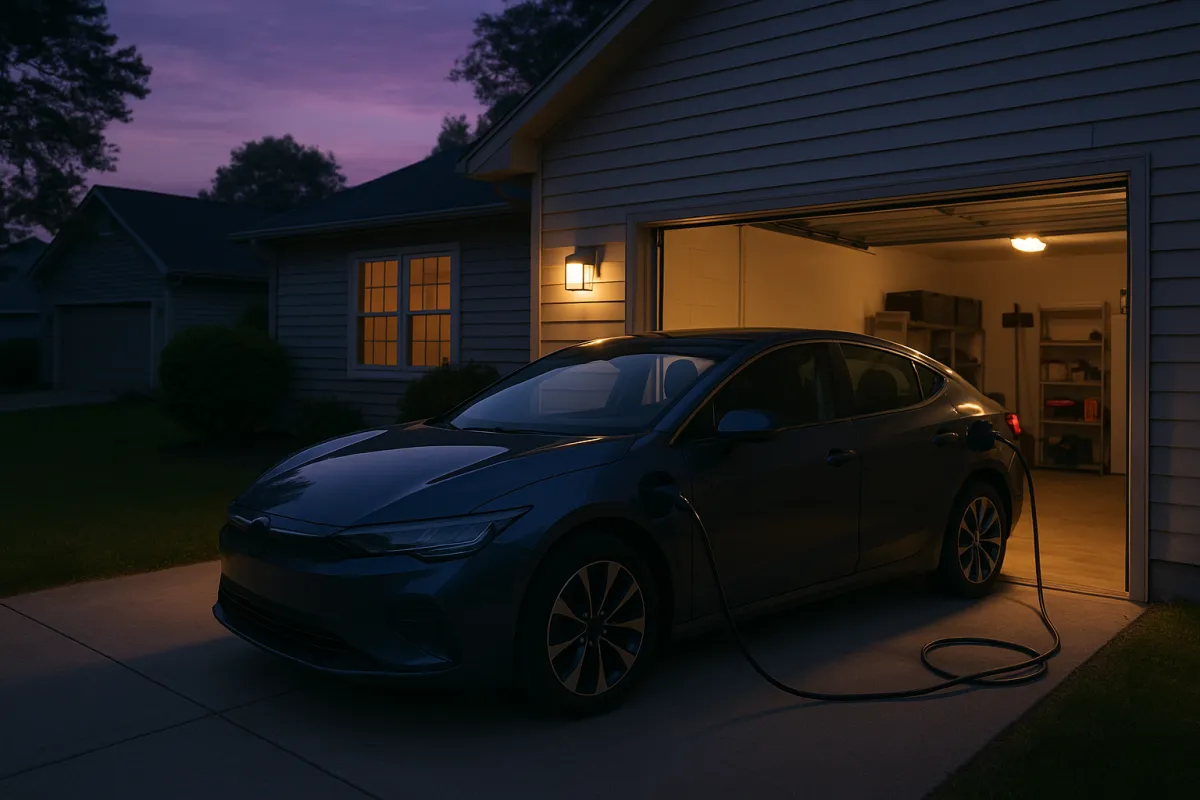
Vehicle-to-load is the feature that turns an electric car into a power outlet. An inverter inside the vehicle converts the pack’s direct current into the alternating current your appliances expect, and offers it at a socket you can plug into directly. Ask what vehicle-to-load is and that is the whole answer: the car becomes a very large, very quiet battery pack with a plug on it, and anything you would run from a wall socket can run from the car instead, up to a limit set by that inverter.
The interesting part is everything the one-line answer leaves out. How much power the socket can actually deliver, what that wattage runs and what it refuses, how long the charge lasts once you subtract the reserve the car keeps for driving, why the cord matters, and why you cannot simply run a line into your breaker panel and light the house. This teardown works through each of those in order, using mechanisms rather than model names, because export capability varies enough between vehicles that only your owner’s manual can tell you what your car does. It sits next to our electric truck breakdown, where power export gets its most dramatic treatment, and our charging levels and connectors reference, which maps the ports involved. The companion beside this article runs your own runtime numbers as you read, and the electricity behind them prices out in our cost calculator.
Key takeaways
- V2L means the car supplies household AC power to devices you plug in. It needs no extra equipment, unlike V2H, which feeds a house's wiring, or V2G, which exports to the utility grid.
- An onboard inverter sets the ceiling. Passenger EVs with the feature commonly advertise an illustrative 1.5 to 3.6 kilowatts, and a single 120 volt 15 amp socket caps out near 1,440 watts continuous regardless of that rating.
- Runtime is usable energy divided by load. An illustrative 75 kWh pack taken from 80 percent down to a 20 percent floor releases about 45 kWh, roughly 40 kWh after conversion losses, which runs a 300 watt essentials bundle for about 5.6 days.
- Exported energy is driving range spent. That same 45 kWh is roughly 160 miles of range and an illustrative $6.75 to put back at a 15 cent home rate.
- You cannot legitimately backfeed a breaker panel from a V2L socket. Powering a home's own circuits requires bidirectional hardware plus a transfer switch or interlock, installed by a licensed electrician.
The short answer: your car as a power outlet
An electric car carries more stored energy than almost anything else you own. A mid-size pack holds an illustrative 60 to 80 kilowatt-hours, which is several days of a household’s essential electricity and many times what a portable power station stores. Vehicle-to-load is simply the automaker deciding to let you spend some of that energy on something other than motion, by fitting an inverter and a socket and writing the software that governs both.
From the user’s side, nothing about it is exotic. You wake the export function through a menu, a button, or the app, wait for the car to close its contactors and bring the inverter up, and plug in. A lamp lights. A laptop charges. A pump runs. The car sits there silently doing the job a generator would do, with no fuel, no exhaust, and no noise beyond the occasional whir of a cooling fan. The complexity is all in the limits: how much at once, for how long, through what cord, and at what cost to the pack and to your remaining range. Those limits are what the rest of this teardown takes apart, because they are what turns a nice feature into a plan you can actually rely on.
V2L, V2H, and V2G: three different things
The three acronyms get used interchangeably in casual writing, and they should not be. They differ by what sits on the receiving end, and that difference decides the hardware, the cost, and the legality of each.
V2L, vehicle-to-load, sends power to a load you plug in. The appliance is the entire circuit. Nothing else is involved: no permit, no electrician, no interconnection paperwork, no equipment beyond the car and a cord. That is why it ships as a standard or optional feature on vehicles across the price range and why it is the version most owners will ever use.
V2H, vehicle-to-home, sends power into the house’s own wiring so that the outlets, lights, and hardwired appliances already in the walls come alive. Because the house is normally connected to the utility, that connection has to be broken first by transfer equipment, and the conversion has to happen in a device capable of forming a stable grid for the whole house rather than for one appliance. That means a bidirectional charger, a transfer switch or an interlocked panel, permits, and a licensed installer.
V2G, vehicle-to-grid, goes one step further and sells or returns energy to the utility while the grid is up. It needs everything V2H needs plus an interconnection agreement, grid-interactive certified equipment, and enrollment in a utility program that exists in some places and not others. Program rules and compensation vary so widely by jurisdiction that any specific figure would be misleading; check with your own utility for what, if anything, is offered where you live.
The onboard inverter: where the AC comes from
A battery pack stores direct current at a few hundred volts. Household appliances want alternating current at a nominal 120 or 240 volts, at 60 hertz in North America, with a clean enough waveform that motors and electronics behave. Something has to perform that conversion, and in a V2L-equipped car that something is an inverter built into the vehicle.
Some manufacturers add a dedicated inverter for export. Others reuse hardware the car already carries, running the onboard charger backward or borrowing capability from the traction inverter that normally drives the motor. The engineering choice matters less to an owner than the consequence: the inverter’s rating, not the battery’s size, is what caps how much power can leave the car at any instant. A 100 kilowatt-hour pack with a 1.9 kilowatt inverter is a very deep well with a narrow pipe. It will run modest loads for an extremely long time and refuse a large one outright.
That mirrors the relationship we describe in our Level 2 charger teardown, where the car’s onboard charger, not the wallbox, caps charging speed. Export is the same idea pointed the other way: the pack offers, the inverter decides. Worth knowing too is that the inverter itself consumes a little power just being awake, which is why very small loads are proportionally less efficient to run than moderate ones.
Where the outlet actually lives
Export reaches you through one of two physical routes, and which one your vehicle uses changes how convenient the feature is day to day.
The first is a socket built into the vehicle. Depending on the model that might sit in the rear of the cabin, in a cargo area, under a seat, in a pickup bed, or in a front trunk. Built-in sockets are the pleasant version: you open a flap, plug in, and the car does the rest. Vehicles designed around export, particularly pickups, tend to fit several sockets and sometimes a higher-voltage one alongside the standard ones.
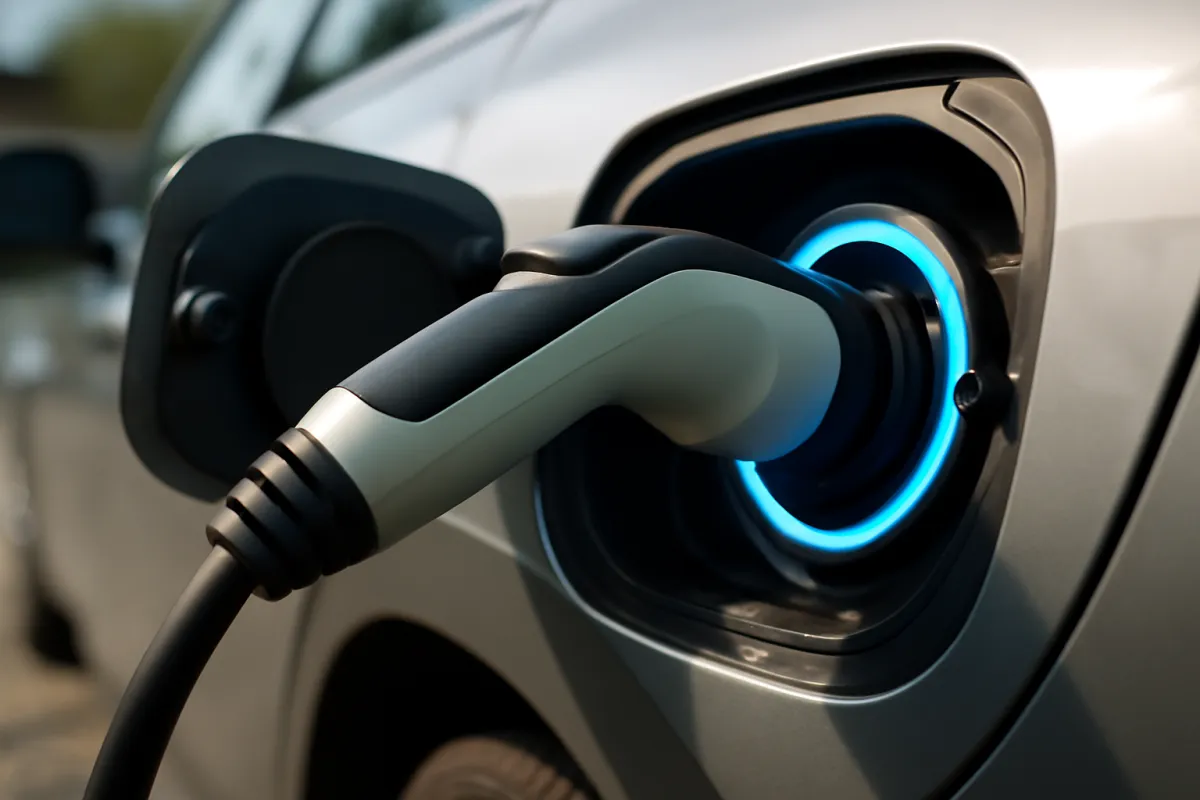
The second route is the charge port. An adapter plugs into the same port you normally charge through, and presents one or more household sockets on its other end. This is how many vehicles without built-in outlets deliver the feature, and it is the reason a V2L adapter is a real product category. The adapter is not a passive lump of copper: it communicates with the vehicle over the charging protocol’s signalling lines to tell the car to switch into export mode, which is why a generic connector shell will not do the job and why adapters are vehicle-specific in practice.
The output limit is the first thing to check
Before any runtime arithmetic, find your vehicle’s rated export output. It is the single number that decides whether a given appliance will run at all, and it is the number most likely to be misremembered or repeated wrongly online.
Two separate ceilings apply, and the lower one wins. The first is the inverter’s continuous rating, set by the automaker. Passenger EVs offering the feature commonly advertise something in the region of 1.5 to 3.6 kilowatts, and electric pickups built around export advertise considerably more, distributed across multiple outlets. Ranges like that are useful for orientation and useless for planning, which is why the manual matters.
The second ceiling is the socket. A standard 120 volt receptacle on a 15 amp circuit can pass 1,800 watts by definition, since watts equal volts times amps, and continuous-load convention derates that to about 1,440 watts for anything running more than a few hours. A 20 amp socket raises those figures to 2,400 and roughly 1,920. So a car rated at 3.6 kilowatts may still refuse a 1,600 watt appliance on one socket while happily supplying two 1,400 watt loads across two sockets, if it has two. Read the rating stamped near the outlet as well as the one in the brochure, and treat the smaller of the two as your real budget.
What that output actually runs
Wattage becomes intuitive once you sort household devices into three groups.
Group one is everything electronic and everything that makes light. Phone chargers, laptops, modems and routers, LED lamps, televisions, radios, and small fans all draw somewhere between a few watts and roughly 150. A dozen of them running together still sit comfortably inside even a modest export budget, and this group is why V2L covers a power cut so well: the things that make a dark house feel manageable are cheap to run.
Group two is motors and compressors. Refrigerators, freezers, sump pumps, well pumps, furnace blowers, and power tools draw from under a hundred watts to well over a thousand while running, and they briefly draw much more when starting. This group is where export budgets get interesting, and where the surge question below decides success or failure.
Group three is anything that makes heat. Kettles, toasters, coffee makers, microwaves, hair dryers, space heaters, portable air conditioners, and electric cooktops all sit between roughly 900 and 1,500 watts, and heating appliances are close to the socket’s limit almost by design. One of them at a time is usually fine. Two of them is usually not. That is not a limitation of electric cars; it is the same reason a kitchen circuit trips when the kettle and the toaster overlap.
Illustrative watts for common loads
Here is the spread on one chart. Every bar is an illustrative continuous draw, and every width is that value as a share of the largest bar.
Illustrative continuous watts, by household load
Typical running draw, not startup surge. Motor and compressor loads briefly pull several times these figures at the moment they switch on.
The first three bars are almost invisible, and that is the lesson. Lights, connectivity, and computing cost so little that an export budget barely notices them, while a single heating appliance can consume the entire socket on its own.
Two practical rules fall out of that picture. The first is that keeping a household comfortable and informed during an outage is nearly free in export terms, so the instinct to ration lamps is misplaced. The second is that cooking and heating are the decisions worth making deliberately: run the kettle, then the microwave, then the toaster, one after another rather than together, and the same socket handles all three without complaint. The companion beside this section will show what any load you type in does to your own runtime.
Surge versus continuous: the number spec sheets skip
Anything with a motor or a compressor asks for a large gulp of current at the instant it starts, because the rotor has to be dragged from rest. That inrush commonly runs several times the running draw and lasts a fraction of a second. A refrigerator averaging 150 watts across the day may momentarily demand six hundred or more at compressor start; a sump pump running at 800 watts may briefly ask for several times that.
Inverters handle this in one of two ways. Better ones tolerate a short overload above their continuous rating, which is exactly what surge headroom is for. Others simply see current above the limit and shut down to protect themselves, which presents to the user as a socket that goes dead the moment the fridge kicks in even though the fridge “only” draws 150 watts.
The practical response is to leave headroom rather than to plan to the edge. If the continuous budget is 1,440 watts, treating 1,000 watts as the working ceiling leaves room for a compressor start underneath a load already running. Stagger startups rather than switching several motor appliances on together. And if a device trips the export every time, the cause is far more often surge than steady draw, which is a diagnosis worth reaching before assuming the car is faulty. Manufacturers rarely publish surge tolerance for export, so this is an area where cautious loading beats confident arithmetic.
Runtime math: usable energy over the load
Runtime is one division, wrapped in two adjustments. Start with the energy the vehicle will actually release: pack capacity multiplied by the difference between your current charge and the floor at which the car stops exporting. Then subtract conversion losses, because the inverter does not deliver every stored kilowatt-hour to the socket. Then divide by the load.
Written out: usable kWh equals pack size times starting percent minus floor percent, divided by 100. Delivered kWh is usable kWh times inverter efficiency. Hours equals delivered kWh times 1,000, divided by the load in watts.
Take the illustrative case this teardown uses throughout. A 75 kWh pack at 80 percent, with a 20 percent floor, releases 45 kWh. At an illustrative 90 percent conversion efficiency, about 40.5 kWh reaches the socket. An essentials bundle drawing 300 watts consumes 7.2 kWh a day, so the runtime is roughly 135 hours, about 5.6 days.
Two cautions keep that honest. Real loads are not constant, so treat any single figure as a midpoint rather than a countdown clock. And efficiency is not a fixed 90 percent: it sags on very small loads because the inverter’s own consumption becomes a larger share, and it can sag in extreme temperatures when the pack’s thermal system runs alongside the export.
The reserve floor and why it exists
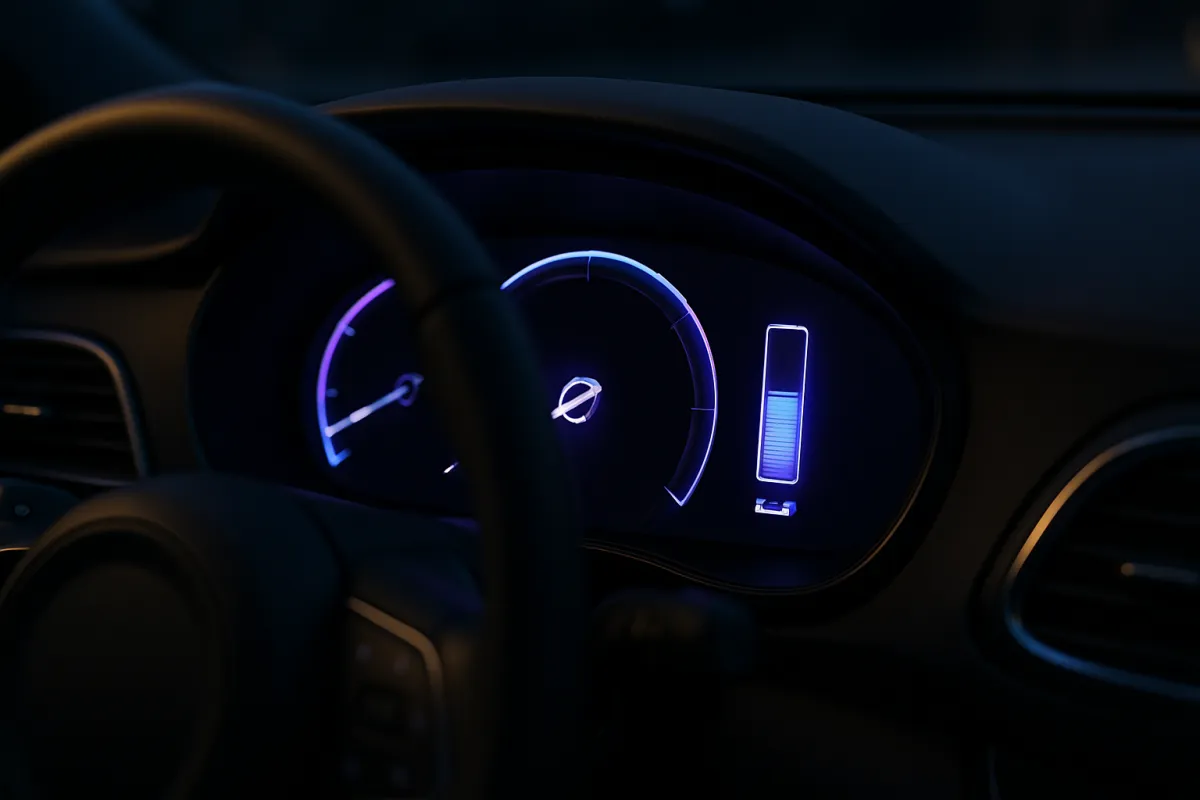
Every implementation of export stops well short of an empty battery, and the point where it stops is the single input people forget. Vehicles commonly let you set a cutoff state of charge, and often default it somewhere in the region of 20 percent, below which export shuts off automatically no matter what is plugged in.
The floor exists for good reasons. It protects the pack, since sitting at very low charge is one of the few storage conditions that genuinely accelerates degradation, a point our battery longevity teardown develops in detail. It protects you, because a car that powered your house perfectly and then could not reach a charger has solved the wrong problem. And it protects the car’s own systems, which need energy for the low-voltage electronics, the thermal management, and the wake-up cycle.
Setting the floor is a judgement rather than a rule. A driver whose nearest charger is a mile away can afford a low floor. A driver in a rural area during a regional outage, where the chargers are down too, should hold considerably more back. The right question is not how much energy you want, it is how far you would need to drive if the outage lasted longer than you expected, and what our running-out-of-charge teardown describes is exactly the outcome the floor is there to prevent.
Where a pack’s energy sits during an outage
The same illustrative case, drawn as one bar. The vehicle starts at 80 percent, holds a 20 percent floor, and everything between them is the export budget.
An illustrative 75 kWh pack at the start of an outage
Starting charge 80 percent, export cutoff 20 percent. The middle segment is the only part appliances can reach.
Sixty percent of 75 kWh is 45 kWh of stored energy, roughly 40 kWh once conversion losses are taken. The reserve segment is not wasted: it is the driving range that lets you leave.
The bar makes the planning lever obvious. Nothing about export capacity changes the pack, but the two percentages on either side change the budget dramatically. Arriving home at 45 percent instead of 80 cuts the export budget from 45 kWh to under 19, less than half. Dropping the floor from 20 percent to 10 adds 7.5 kWh, roughly a day of essentials, at the cost of most of your remaining mobility.
That is the argument for a habit rather than a gadget: in seasons when outages are likely, keeping the car above a comfortable threshold costs nothing and multiplies what the feature can do for you. It pairs naturally with a home charging setup, and if you generate your own electricity, our note on charging from solar covers the case where the pack refills even while the grid is down, which is the combination that turns days of backup into weeks.
A worked example: one two-day outage
Numbers land better as a story, so run one. A storm takes the power out on a Tuesday evening. The car is home at 80 percent on a 75 kWh pack, the owner has set the export floor to 20 percent, and the vehicle’s rated output comfortably exceeds what the household plans to run.
The essentials go on the car first. A full-size refrigerator averaging 150 watts, a chest freezer averaging 60, a modem and router at 25, four LED lamps at 40 between them, and phones and laptops averaging 25. That totals 300 watts, or 7.2 kWh a day. Against the 40.5 kWh that reaches the socket, the arithmetic says about 135 hours, roughly 5.6 days.
On Wednesday it turns cold, and a 1,500 watt space heater runs three hours in the evening to keep one room comfortable. That single appliance adds 4.5 kWh, more than half again what everything else used all day. Total daily consumption rises to 11.7 kWh and the projected runtime falls to about 3.5 days. Nothing broke; heat is simply expensive.
Power returns Thursday morning, roughly 36 hours in. The household consumed about 15 kWh of the budget, the car reads near 60 percent, and the owner plugs into the home charger that evening. The whole episode cost an illustrative $2.25 of electricity at a 15 cent rate, and the freezer never thawed. Run your own version in the companion beside this section, and price the replacement energy in our cost calculator.
What the export costs in range and dollars
Energy that leaves through the socket is energy that will not turn the wheels, and converting between the two units keeps expectations honest. At a typical 28 kWh per 100 miles, each kilowatt-hour is worth roughly 3.6 miles. The illustrative 45 kWh budget above is therefore about 160 miles of driving range, which is a serious amount of mobility to spend and the reason the floor conversation matters.
In money the picture flips, because electricity is cheap. Putting 45 kWh back at an illustrative 15 cent home rate costs about $6.75, and on an off-peak overnight rate near 8 cents it is closer to $3.60. Against the fuel a generator would burn over the same period, or against the cost of a freezer full of spoiled food, that is close to a rounding error. Our cost per mile teardown works through the same conversion from the driving side.
The asymmetry is worth internalising. Export is expensive in range and cheap in cash. That means the constraint on using the feature is almost never the electricity bill; it is whether you can afford to be 160 miles poorer in range at the moment you need to drive. Frame the decision that way and most of the anxiety around using V2L dissolves, because the answer at home with a charger in the garage is usually a comfortable yes.
Cords, adapters, and the charge-port route
If your vehicle delivers export through the charge port, the adapter is a real piece of equipment rather than a passive plug. It has to present the correct connector geometry for your port, whether that is the J1772 style, the NACS style, or a market-specific variant covered in our connectors reference, and it has to signal the vehicle correctly so the car enters export mode instead of waiting for a charge session that never begins.
That signalling requirement is why adapters are not universal and why an adapter sold for one manufacturer’s protocol may do nothing at all on another’s car. It is also why buying on price alone is a poor idea for a device that will carry over a kilowatt continuously, often outdoors, often unattended. Look for a unit the automaker lists or approves, a current rating that matches the socket it presents, weather sealing appropriate to where you will use it, and ground fault protection.
Vehicles with built-in sockets sidestep the whole question, which is a genuine convenience advantage worth weighing at purchase time if export matters to you. Either way, confirm before you rely on it: the presence of a charge port tells you nothing about whether the vehicle can push power out of it, and only the owner’s manual settles the question for your specific car and model year.
Extension cords and the wiring you already own
The cord between the car and the appliance is the part most likely to be wrong, because most households own cheap ones bought for lamps and hedge trimmers. A cord’s rating comes down to conductor gauge and length: thinner wire and longer runs mean more voltage drop and more heat, and a continuous kilowatt-plus load is exactly the condition that exposes an undersized cord.
Three habits cover almost all of it. Use the shortest cord that reaches. Use a heavier gauge than you think you need for anything above a few hundred watts over any distance, since a 12 gauge cord costs a little more and runs far cooler than a 16 gauge one. And never chain cords together, because each connection adds resistance and a failure point, and the joins are usually where cords overheat.
Two more cautions apply outdoors. Use cords rated for outdoor use and keep the connections dry and off wet ground, ideally elevated and under cover, since a car parked in a driveway during a storm is precisely the situation where this feature is most useful and most exposed. And check the cord by hand partway through a long session: warm is normal, hot is a signal to reduce the load or find a heavier cord.
Why you cannot backfeed a house panel
This is the section to read twice, because the appealing shortcut here is genuinely dangerous. The idea that surfaces in every outage discussion is to make or buy a cord with plugs on both ends, run it from the car’s socket to a wall receptacle, and let the house’s own wiring distribute the power. It sometimes appears to work. It should never be attempted.
The first reason is the utility. A panel connected to the grid is a two-way path, and power pushed into it does not politely stay indoors: it flows back through the service and into the transformer, which steps it up to distribution voltage on lines that crews may be working to restore. That is the hazard that transfer equipment exists to eliminate, and it is why the practice is prohibited rather than merely discouraged.
The second reason is the house itself. Power entering through a receptacle travels backward through a branch circuit that was never designed to be a supply, past a breaker that cannot protect in that direction, and the double-ended cord leaves live pins exposed at whichever end is unplugged first. The third is the source: a V2L inverter is designed to serve loads it can see, not to form and hold a stable grid for a whole building.

What transfer equipment actually does
The legitimate version of powering a home from a vehicle needs one thing above all: a guaranteed break between the house and the utility. That is the job of transfer equipment, and it comes in a few forms.
A manual transfer switch feeds a subpanel of chosen circuits, and physically cannot connect those circuits to both the utility and the alternate source at once. A breaker interlock kit achieves the same guarantee inside the main panel with a sliding plate that makes it mechanically impossible to close the backfeed breaker while the main is on. An automatic transfer switch does it without human intervention, sensing the outage, isolating the house, and starting the source.
Layered on top of that, the V2H path also needs a bidirectional charger, a device that can both charge the car and draw from it, and that can form a stable grid for the house rather than merely following one. Some systems pair that with a home battery so the vehicle tops up a buffer rather than serving the house directly.
The honest summary is that V2H is an electrical project with a permit and an inspection, priced accordingly, while V2L is a cord. Neither is a substitute for the other, and confusing them is how people end up disappointed by a feature that was never claiming to do the thing they wanted. If you are exploring the home side, the panel and permit realities in our home charger install walkthrough apply almost unchanged.
V2L versus a portable generator
The comparison people actually want is against the machine in the shed, and the answer splits cleanly by scenario.
V2L wins on everything to do with readiness. There is no fuel to buy, store, stabilise, or rotate. There is no engine that refuses to start after nine idle months. There is no oil change, no carburettor, no pull cord, and no annual test ritual. It makes almost no noise, which matters more than expected at two in the morning in a dense neighbourhood. And critically, it produces no exhaust, which removes the carbon monoxide hazard responsible for the deaths that make generator safety warnings so emphatic.
The generator wins on duration. Its energy store is a can you can refill indefinitely, while the car’s is fixed until it can charge again. In a multi-day regional outage where the chargers are also dark, that difference is decisive.
Output classes overlap enough that neither is categorically more powerful: many portable generators and many export-capable vehicles land in the same low-kilowatt band, though large generators and export-focused pickups both climb well above it. The sensible conclusion is not that one replaces the other, but that V2L quietly covers the short outages, the camping trips, and the driveway projects that account for the overwhelming majority of the times anyone reaches for portable power.
Camping, job sites, and tailgates
Outage backup gets the attention, but the recreational and working uses are where owners actually spend the feature. A campsite is a near-perfect match: lights, a fan, device charging, a small compressor fridge, and a coffee maker in the morning are collectively a few hundred watts, sit far inside any export budget, and run without the noise that makes generators unwelcome at campgrounds.
Work uses are more demanding and more transformative. A circular saw, a compressor, a work light, and a charger for tool batteries turn a driveway or a remote site into a functioning workspace, and the same capability on a pickup is the single most differentiating thing electric trucks do, as our electric truck breakdown sets out. The caution is the surge conversation above: motor tools start hard, so leave headroom and stagger the startups.
Two field habits are worth adopting. Watch the state of charge deliberately, because a day of tool use is a real bite out of range and the drive home is not optional. And be aware that most vehicles must be awake for export, which means the car is in an active state while it works; check the manual for whether yours can be locked while exporting, since an unattended vehicle sitting unlocked all afternoon is its own kind of risk.
Charging another EV from your EV
The rescue scenario comes up often, so it deserves a clear answer. Yes, a car with export can charge another electric car, by plugging the stranded vehicle’s portable Level 1 cord into the donor’s socket. No, it is not a practical way to move meaningful energy.
The arithmetic explains why. A standard Level 1 cord draws roughly 1.4 kilowatts, and after conversion losses on both sides, an hour of that adds an illustrative four or five miles of range to the stranded car. Getting a genuinely dead vehicle to the nearest charger might take several hours of sitting there. It is a roadside rescue, not a fuelling method, and our running-out-of-charge teardown covers what else to do in that situation.
Treat it as the automotive equivalent of a jump start with a very long cable. It is genuinely useful once, it costs the donor a proportional slice of its own range, and the person who plans road trips around it has misunderstood the tool. The honest use case is getting someone off the shoulder and to a charger, which is a real and worthwhile thing for a feature to do.
Battery wear: does exporting hurt the pack?
The strict answer is that every kilowatt-hour out of the pack, whether it turns a wheel or boils a kettle, counts toward the battery’s lifetime throughput. There is no version of export that is free.
The useful answer is that the wear is mild. Battery degradation responds most strongly to high current, to heat, to sustained very high or very low states of charge, and to accumulated cycles. Export at a few hundred watts to a couple of kilowatts is an extremely gentle current compared to acceleration or DC fast charging, and it happens with the car stationary and its thermal management free to keep the pack comfortable. Measured as stress per kilowatt-hour, it is one of the kindest things you can ask a pack to do.
The habit that matters is what happens afterwards. Leaving a pack sitting near its floor for days after a long export session is the part worth avoiding, so recharge to a moderate level once power returns rather than leaving the car low. That, and the other practices in our battery care teardown, keep occasional export invisible in the degradation curve. Heavy daily commercial export is a different conversation, and one to have with the automaker before building a business on it.
Warranty, terms, and the owner’s manual
Using a feature the manufacturer designed, documented, and advertised does not void a warranty on its own. Export is part of the vehicle as sold, and treating it as forbidden misreads how warranties work.
What can create friction is use outside the documented conditions. Exceeding the rated output, using adapters the automaker has not approved, modifying the vehicle’s electrical system, or running the car as a commercial power source in ways the terms exclude are all places where a claim can meet resistance. Battery warranties in particular carry their own conditions, and both those terms and the export feature’s own terms vary by automaker, by model year, and by market.

The practical instruction is short and applies to every claim in this teardown: read your own manual. It carries your vehicle’s rated output, its socket limits, its floor behaviour, its approved adapters, whether the car can be locked while exporting, and any restrictions on duration or ambient conditions. Every general figure here is orientation; the manual is the fact.
Cold weather and other efficiency drains
Export in winter is less efficient than export in mild weather, for the same reasons driving is, and outages tend to arrive in exactly the conditions that make it worse.
Two effects stack. Cold cells deliver energy less readily, so more of the stored charge is lost as heat inside the pack rather than reaching the socket. And the vehicle’s thermal management may run to keep the battery in its working window, which consumes energy from the same budget your appliances are drawing on. The combined result is that a runtime estimate calculated at a comfortable temperature can overstate what a freezing night actually delivers, sometimes noticeably. Our cold weather range teardown works through the underlying physics from the driving side, and the same mechanisms apply here.
Three responses help. Build a margin into any winter runtime estimate rather than planning to the arithmetic. Park where the car is sheltered from wind if you have the option, since ambient exposure drives the thermal load. And remember the perverse arithmetic of electric heat: a 1,500 watt space heater is the single most expensive thing most households will plug into a car, so heating one small room deliberately, rather than trying to heat a house, is the difference between days of backup and hours.
Safety habits worth building
Export is a mature, well-engineered feature, and the failure modes that remain are mostly about how people use it rather than how it works.
Ventilation is not the concern it is with a generator, since nothing is burning, but the vehicle should still be treated as active equipment. Keep the area around cords clear, keep connections dry and elevated, and do not run cords under doors or through windows in ways that pinch the insulation. Use ground fault protection outdoors, which is what the better adapters provide and what a GFCI-protected cord adds where they do not.
Load discipline is the other half. Know the socket’s continuous rating, keep a working ceiling below it, add loads one at a time, and stagger anything with a motor. If the export cuts out, reduce the load before assuming a fault. Check cords by hand during long sessions.
The last habit is planning. Decide the floor before the outage, not during it, and revisit it if the outage outlasts your expectations. Keep a short written list of what goes on the car first, because a dark house is a poor place to make decisions about wattage. And confirm that the people in the household know what is plugged in and why, so the freezer does not get unplugged to make room for a hair dryer.
Common misconceptions about V2L
Several beliefs distort what people expect, and clearing them is most of what understanding the feature amounts to.
The first is that V2L can power a house. It powers appliances you plug into it, one cord at a time. Powering a house through its own circuits is V2H and needs different equipment entirely.
The second is that a bigger battery means more power. Pack size sets duration, not output. The inverter and the socket set output, and a very large pack behind a modest inverter is a deep well with a narrow pipe.
The third is that every EV has it, or that every EV with a charge port can do it. Export is a designed-in capability with dedicated hardware and software, present on some vehicles and absent on others, and only the manual settles it for yours.
The fourth is that export will wreck the battery. The current involved is gentle and the wear per kilowatt-hour is low. The fifth is that any adapter will do, when the adapter has to speak the vehicle’s protocol. And the sixth is that a car can supply a big appliance because it is a big car: a 1,500 watt heater does not care what it is plugged into, and a 15 amp socket is a 15 amp socket whether it sits in a wall or a truck bed.
How to check whether your car supports it
Finish with the practical sequence, in the order that avoids wasted money.
Start with the owner’s manual, which is the authoritative source for your exact vehicle and model year. Search it for the terms the manufacturer uses, since not every automaker calls the feature vehicle-to-load; some brand it as power export, utility power, onboard power, or a proprietary name. The manual will state the rated output, the socket limits, the setup steps, and the cutoff behaviour.
Second, check the vehicle’s own menus. Export functions usually live in a settings or energy screen, and their presence, along with any adjustable cutoff percentage, is direct evidence of what the car will do.
Third, if the feature runs through the charge port, source the adapter from the automaker’s own accessory catalogue or its explicitly approved list, and match its rating to what you plan to run.
Fourth, test before you need it. Plug in a lamp on an ordinary afternoon, confirm the sequence, note how long the car takes to bring the inverter up, and set the floor where you want it. Discovering the workflow during an outage is the version of this that goes badly. Then price the energy in our cost calculator so the replacement charge is a known quantity rather than a surprise.
The bottom line
Vehicle-to-load is an EV supplying ordinary household AC power to devices you plug in, through an inverter the automaker fitted and a socket either built into the vehicle or presented by an adapter on the charge port. It is not V2H, which feeds a home’s own wiring through transfer equipment, and it is not V2G, which exports to the utility under a program and an agreement. Its ceiling is the inverter and the socket, commonly an illustrative 1.5 to 3.6 kilowatts on passenger cars with a hard 1,800 watt limit on any single 120 volt 15 amp outlet, and its duration is the charge above the reserve floor divided by the load, which for a 75 kWh pack taken from 80 percent to 20 is roughly 40 kWh at the socket and about 5.6 days of a 300 watt essentials bundle. That energy is cheap in money, an illustrative $6.75 to replace, and expensive in range, roughly 160 miles. Confirm your own vehicle’s numbers in its manual, keep the cord heavy and short, never send power backward into a panel, and the feature does something genuinely useful that no gas car has ever offered: it makes the thing in your driveway the most capable power source you own.
This teardown is an educational explainer written by people who enjoy energy arithmetic, not by electricians, electrical engineers, or your automaker, and nothing in it is professional electrical, safety, or purchasing advice. Every wattage, capacity, efficiency, runtime, and cost figure here is illustrative and will move with your specific vehicle, its inverter and socket ratings, its software behaviour, the ambient temperature, and your electricity tariff. Export capability, rated output, approved adapters, cutoff behaviour, and warranty terms differ by manufacturer, model year, and market, so treat your owner’s manual and warranty booklet as the only authority on your own car. Any work that connects a vehicle to a building’s fixed wiring must be designed and installed by a licensed electrician under local permit and inspection, and no arrangement described here should be read as approval to connect a vehicle to a panel without that equipment.
Frequently asked questions
What is vehicle-to-load in plain terms?
Vehicle-to-load, usually shortened to V2L, is an EV feature that turns the traction battery into an ordinary power outlet. An inverter inside the car converts the pack's direct current into household alternating current and offers it at a socket, either one built into the cabin, the bed, or the cargo area, or one on an adapter that plugs into the charge port. You plug an appliance straight into that socket the way you would plug into a wall, with no other equipment involved. The three things that decide whether it is useful to you are the output limit in watts, how much energy the pack will release before it stops, and whether your particular vehicle offers the feature at all, which only the owner's manual can tell you.
What is the difference between V2L, V2H, and V2G?
They differ by what receives the power. V2L sends power to individual devices you plug in, and the appliance is the entire circuit. V2H, vehicle-to-home, sends power into a house's own wiring so the existing outlets and lights come alive, which requires bidirectional charging hardware plus transfer equipment that isolates the house from the utility grid. V2G, vehicle-to-grid, sends power back out to the utility itself under a program and an interconnection agreement, so the car becomes a small dispatchable resource the grid can call on. V2L is the only one of the three that needs nothing beyond the car and a cord, which is exactly why it is the one most people actually encounter.
How many watts can vehicle-to-load supply?
There is no single figure, because it is set by the inverter each automaker fits and by the socket it feeds. Passenger EVs with the feature commonly advertise export capacity somewhere in the region of 1.5 to 3.6 kilowatts, and some electric pickups advertise considerably more through several outlets and a dedicated export system. One hard ceiling applies regardless of the inverter: a standard 120 volt outlet on a 15 amp circuit cannot pass more than 1,800 watts by definition, and continuous-load convention derates that to roughly 1,440 watts, so a single socket may be the real limit even on a generously rated car. Confirm your own vehicle's rated output, and the per-socket limit, in the owner's manual rather than from a spec summary.
How long can an EV power a refrigerator?
Longer than most people expect, because a refrigerator's average draw is small. A full-size fridge cycles its compressor on and off and averages an illustrative 150 watts across a day, which is about 3.6 kilowatt-hours in 24 hours. If a vehicle releases an illustrative 40 kilowatt-hours before hitting its reserve floor, that is roughly eleven days of refrigeration on its own, and still around five days when a freezer, a modem, several lamps, and device charging are added alongside it. The figures shift with the appliance's age and efficiency, the ambient temperature, and how often the door opens, so treat any runtime number as an estimate rather than a promise.
Can I plug vehicle-to-load into my house to run the whole home?
No, not through the electrical panel, and the attempt is genuinely dangerous. Feeding power backward into a panel through a receptacle, using a double-ended cord, energizes the home's wiring and can push voltage back onto the utility service where line crews are working, which is why the practice is prohibited and why the cords that enable it have no legitimate use. Connecting a vehicle to a house's own wiring legally requires bidirectional equipment plus a transfer switch or an interlock kit installed by a licensed electrician under permit, which is the V2H path rather than the V2L one. What V2L can legitimately do is run appliances you unplug from the wall and plug into the car instead, one extension cord at a time.
Does using V2L damage the battery?
Exporting is a discharge, and every discharge counts toward the pack's lifetime energy throughput, so in the strict sense it uses up a little of the battery's life in exactly the way driving does. The difference is that the rates involved are gentle: a few hundred watts to a few kilowatts is a small fraction of what acceleration or DC fast charging asks of the same cells, so the stress per kilowatt-hour is low. The habits that matter for pack health apply here too, mainly not parking at a very low state of charge for long stretches after a long export session. Occasional outage and campsite use is not the kind of thing that shows up in a degradation curve, while daily heavy commercial export is a different question worth raising with the automaker before you rely on it.
Does vehicle-to-load void the warranty?
Using a feature the manufacturer built and documented does not void a warranty on its own, because the export function is part of the vehicle as sold. What can create friction is use outside the documented conditions: exceeding the rated output, using unapproved adapters, or running the car as a commercial power source in ways the terms exclude. Warranty language varies by automaker, by model year, and by market, and battery warranties in particular can carry their own conditions about capacity and use. Read your own warranty booklet and owner's manual rather than relying on any general summary, and if you plan to lean on export heavily, ask the dealer to point at the specific clause in writing.
Is V2L better than a portable generator?
It depends on which failure you are protecting against. V2L wins on convenience and cleanliness: no fuel to store or stabilize, no engine to start after months idle, no maintenance, no noise, and no combustion, which removes the carbon monoxide hazard that makes generators dangerous when misused. A generator wins on duration and on refuelling, because you can pour in more fuel indefinitely while the car's energy is fixed until you can charge it again. Their output classes overlap enough that neither is obviously more powerful, so the honest framing is that V2L covers short outages and portable power effortlessly, while extended grid-down periods without any charging option still favour a fuel-burning machine.