What's in this teardown
- What an electric car costs per mile
- The per-mile cost, electric versus gas
- Calculating cost per mile for an EV
- The gas side: price per gallon divided by mpg
- The fuel cost per mile, electricity only
- The four ways to power a mile, compared
- Cost per mile: EV home charging vs public
- Electric car vs gas cost per mile at different gas prices
- The break-even gas price
- How your electricity rate changes the math
- Efficiency: mi/kWh and mpg by vehicle
- A per-mile comparison table at several prices
- Cold weather and towing: the per-mile hit
- The savings gap, in one bar
- Why cost per mile is not the whole story
- A worked example: one EV versus one gas car
- Common mistakes in per-mile math
- A quick per-mile checklist
- The bottom line
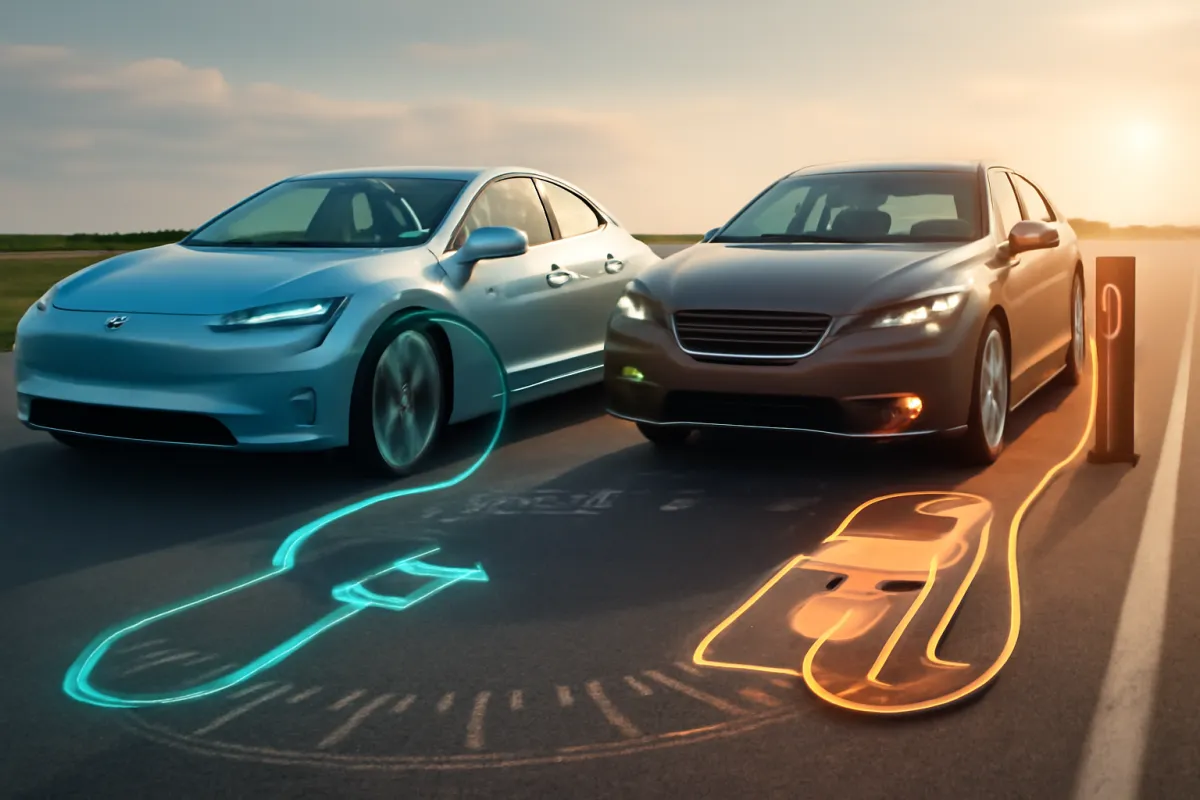
Short answer: Charged at home, an electric car commonly costs an illustrative 4 to 6 cents per mile in energy, against roughly 10 to 15 cents for a typical gas car, so the electric mile is often less than half the gas mile. The EV formula is your electricity rate divided by miles per kWh; the gas formula is pump price divided by mpg. Public DC fast charging can push the EV mile near a gas mile.
The honest way to compare electric car cost per mile vs gas is to run two small formulas rather than trust a slogan, and when you do, a home-charged EV usually costs roughly 4 to 6 cents per mile against about 10 to 15 cents for a typical gas car. That is the whole headline: charged at home, the electric mile is commonly less than half the gasoline mile, because an electric motor is a far more efficient way to buy motion than a combustion engine. The rest is knowing when that advantage holds and when it shrinks.
This teardown takes the per-mile question apart properly. It gives you both the EV formula and the gas formula, prices a mile at home against a mile on public fast charging, shows how the answer moves as gas prices and electricity rates change, and lays out a comparison table you can read your own case off. It also draws the line the per-mile number cannot cross: cost per mile is the fuel bill only, not the total cost of ownership our EV-versus-gas teardown assembles or the all-in figure our monthly-cost teardown adds up. Every dollar and cent here is illustrative and moves with your car and your rates, but the arithmetic is simple enough to own for good. Price your own numbers in about a minute with our cost calculator.
Key takeaways
- Charged at home, an EV commonly costs an illustrative 4 to 6 cents per mile in energy, against roughly 10 to 15 cents for a typical gas car, so the electric mile is often less than half the gas mile.
- The EV formula is your electricity rate divided by miles per kWh; the gas formula is the pump price divided by mpg. Two inputs each, and battery size never enters the EV one.
- Where you charge decides everything. Home charging produces the cheap mile; public DC fast charging can cost two to four times more per kWh and land the EV mile near a gas mile.
- Higher gas prices widen the EV's per-mile lead; a higher electricity rate narrows it. There is a break-even gas price, but for most home-charged EVs it sits implausibly low.
- Cost per mile is the fuel bill only. It ignores purchase, insurance, maintenance, and depreciation, so it is one input to the ownership decision, not the whole of it.
What an electric car costs per mile
The short, useful answer is that a typical electric car charged at home costs an illustrative 4 to 6 cents per mile in energy. That range is not a hedge, it is the honest spread you get once you account for how efficient the car is and what you pay for electricity, the only two things that move the number. An efficient EV that travels about 3.3 miles on a kilowatt-hour, charged on a middle-of-the-road home rate of 15 cents per kWh, lands right at about 4.5 cents a mile. A heavier or less efficient EV, or a higher local rate, pushes toward the upper end and beyond.
The reason to give a range rather than a single figure is that the honest number is personal. Someone in a region with cheap overnight power and an efficient car might genuinely see 3 cents a mile; someone in a high-rate area with a big, inefficient EV in winter might see 8. Both are correct for their own inputs, and neither invalidates the other. What stays constant is the shape: even the expensive end of the home-charging range usually undercuts a typical gas mile, and the cheap end undercuts it dramatically. To turn the range into your own single number, divide your electricity rate by your car’s miles per kWh, or use our cost calculator to do it for you.
The per-mile cost, electric versus gas
Charged at home, almost always, and usually by a comfortable margin. Put the two typical figures side by side: a home-charged EV around 4 to 6 cents per mile against a typical gas car around 10 to 15 cents, and the electric mile is frequently less than half the gasoline one. That gap is not a quirk of current prices, it is structural. An electric motor converts most of the energy it draws into forward motion, while a combustion engine sheds much of gasoline’s energy as heat out the exhaust and radiator, so electricity is simply a cheaper way to buy each mile of movement across a wide range of fuel and power prices.
The advantage is real but it is conditional, and the condition is where you charge rather than how cheap gasoline gets. A home-charged EV lives on the low end of the per-mile scale. The same car charged mostly in public on DC fast chargers can cost two to three times as much per mile, landing it beside or above a gas car. So the accurate statement is not “EVs are cheaper per mile” in the abstract, it is “home-charged EVs are much cheaper per mile, and public-charged EVs often are not.” That distinction, priced in detail in our home-charging teardown, is the difference between the two answers people give when they argue about this, and both can be right about different drivers.
Calculating cost per mile for an EV
The EV formula is short enough to do in your head. Cost per mile equals your electricity rate divided by the car’s efficiency in miles per kWh. If your rate is 15 cents per kWh and the car does 3.3 miles per kWh, that is 15 divided by 3.3, or about 4.5 cents per mile. Two inputs, one division, and you have the number. Notice what is absent: the battery’s size, the car’s total range, and the price you paid for the car all play no part. Per-mile fuel cost is about the rate at which the car turns electricity into distance, nothing else.

There is a second form of the same formula for when efficiency is quoted the other way, in kWh per 100 miles, as many EVs display it. In that case, multiply the kWh per 100 miles by your rate and divide by 100. A car rated at 30 kWh per 100 miles on a 15 cent rate is 30 times 15 divided by 100, which is again 4.5 cents per mile. The two methods are the same arithmetic wearing different clothes, so use whichever matches the number your car shows you. Feed your own rate and efficiency into our cost calculator and it runs this division for you and holds the result steady while you read the rest of this teardown.
The gas side: price per gallon divided by mpg
The gas formula is the mirror image and just as simple. A gas car’s fuel cost per mile equals the pump price per gallon divided by the car’s miles per gallon. A 30 mpg car at $3.50 a gallon costs $3.50 divided by 30, or about 11.7 cents per mile. A thirstier 22 mpg SUV at the same pump price costs about 15.9 cents, and a frugal 40 mpg compact costs about 8.75 cents. Two inputs again, the pump price and the mpg, and the same single division. Putting the EV and gas formulas next to each other is what makes the comparison honest rather than a duel of anecdotes.
The important structural difference is what each formula is sensitive to. The gas car’s per-mile cost rides directly on the pump price, a number that swings with the oil market from week to week and can move sharply, so a gas mile is a moving target. The EV’s per-mile cost rides on your electricity rate, which is generally far more stable and often known months in advance, so an electric mile is a steadier number. That stability is a quiet advantage of its own: the EV driver can predict the fuel budget with more confidence than the gas driver, whose per-mile cost jumps every time the sign at the corner changes. Both formulas belong in the same calculation, which is exactly what our cost calculator runs side by side.
The fuel cost per mile, electricity only
The fuel cost per mile of an electric car is just its electricity cost per mile, because electricity is the fuel. On an illustrative home rate of 15 cents per kWh and typical efficiency, that is the familiar 4 to 6 cents. The phrase “fuel cost per mile” matters because it draws a boundary: it counts the energy to move the car and nothing else. It does not include the loan payment, the insurance premium, the tires, or the depreciation. When someone compares this figure to the price on a gas pump, they are comparing like with like, energy against energy, which is the only fair per-mile comparison.
It is worth being explicit that the number assumes home charging, because that assumption is doing a lot of work. A public DC fast-charging session bills at a much higher rate per kWh, so the fuel cost per mile on public charging can be double or triple the home figure. A driver who charges at home for daily use and only fast charges on the occasional trip sees a blended cost close to the low home number, weighted by how rarely they use public chargers. A driver with no home charging at all, who fast charges as a matter of routine, sees a fuel cost per mile that can rival gasoline. Same car, same formula, very different answers, set entirely by the charging mix, which our home-charging teardown prices out in full.
The four ways to power a mile, compared
The clearest way to see where each option sits is to line the realistic ways of powering a mile up and let the widths do the talking. Every bar below is an illustrative cost per mile, drawn from its own value against the most expensive option at full width, so the picture is proportional rather than decorative.
Illustrative cost per mile, by way of powering the car
EV at 30 kWh/100mi; home 15 cents, public DC fast 45 cents per kWh; hybrid 50 mpg, gas 30 mpg, both at $3.50/gal.
Home charging sits far below the gas mile most drivers are used to, while public fast charging lands beside or above it. The EV's whole per-mile advantage is really the distance between the top bar and the gas bar.
The chart carries the single most misunderstood fact in the comparison. The same EV can be the cheapest bar or nearly the most expensive one, and the only thing that changed is where it plugged in. An owner who charges at home lives on the top bar and saves accordingly; an owner who defaults to public fast charging lives near the bottom and wonders where the savings went. The hybrid sits sensibly in the middle, a reminder that the choice is not purely electric versus gas. Match this chart to your own rate and efficiency in our cost calculator and the abstract gap becomes your number.
Cost per mile: EV home charging vs public
The gap between home and public charging is the widest and most decision-relevant swing in this whole teardown, so it earns its own section. Home charging bills you at your ordinary residential electricity rate, commonly in the low-to-mid teens of cents per kWh, and that is what produces the cheap 4 to 6 cent mile. The electrons arrive overnight while the car sits parked doing nothing anyway, and some utilities offer an even cheaper off-peak window that drops the per-mile cost further. This is the low bar on the chart, and almost the entire per-mile case for EVs rests on it.
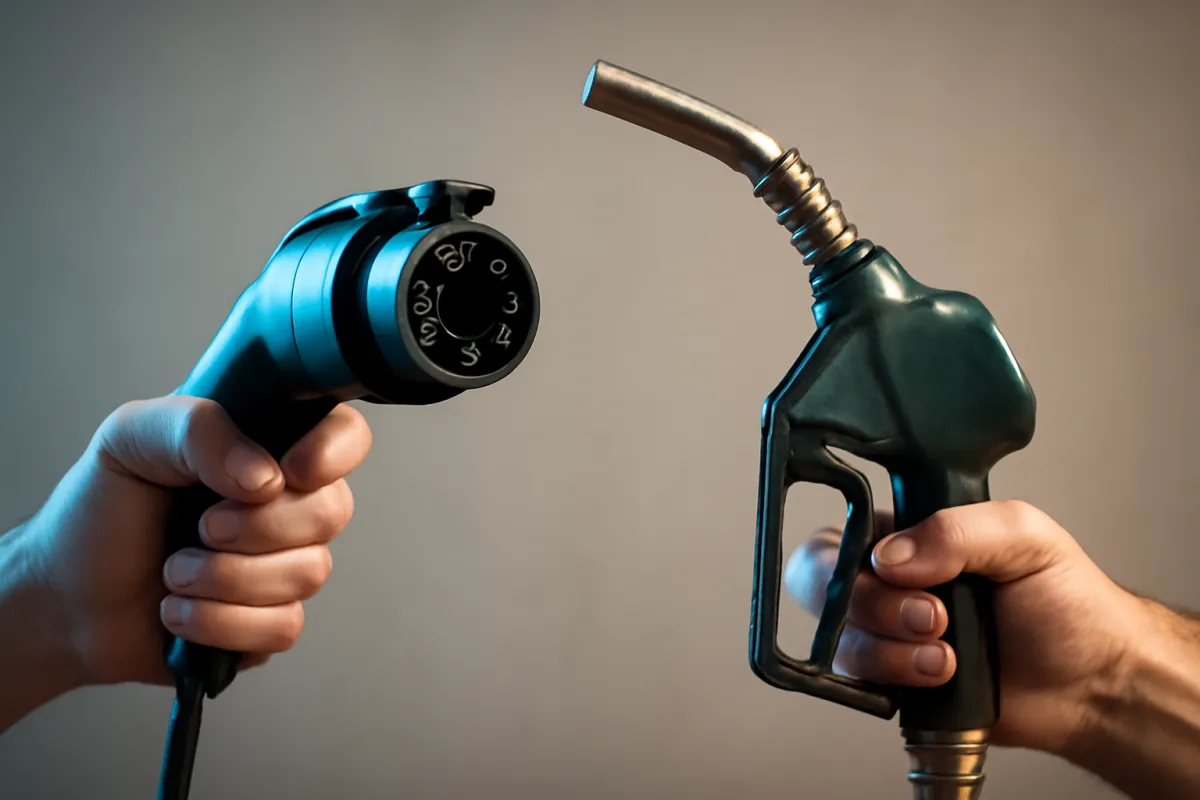
Public DC fast charging is a different economic animal. It often costs two to four times more per kWh than home charging, because the provider is paying for expensive high-power hardware, prime real estate, grid demand charges, and a profit margin, and it passes all of that through in the price. At those rates a fast-charged mile can cost as much as or more than a gas mile, which is why the chart puts public charging at the bottom beside gasoline rather than up with home charging. Our full teardown of the cost to charge an EV at a public station prices those sessions properly, per kWh, per stop, and network by network, including where public Level 2 quietly undercuts the fast chargers. The practical rule our home-charging teardown lands on is simple: charge at home for daily driving to live on the cheap mile, and treat public fast charging as a convenience for trips, priced accordingly. A driver who inverts that, fast charging by default, has quietly given back most of the per-mile advantage before the comparison even starts. Set your own charging mix in our cost calculator to watch the number move.
Electric car vs gas cost per mile at different gas prices
Because the gas car’s per-mile cost is the pump price divided by mpg, it moves in a straight line with the price of gasoline, while the home-charged EV’s per-mile cost does not move with gasoline at all. That asymmetry is the key to the whole comparison across prices. When gas is cheap, the gap between the electric mile and the gas mile narrows; when gas is expensive, the gap widens sharply. The EV mile just sits there at its steady 4 to 6 cents regardless, so every rise at the pump is a rise in the EV’s relative advantage and every fall is a small erosion of it.
Put illustrative numbers on the swing. On a 30 mpg gas car, gasoline at $3.00 a gallon is 10 cents a mile, at $4.00 it is 13.3 cents, and at $5.00 it is 16.7 cents. Against a home-charged EV at about 4.5 cents a mile, the per-mile saving grows from roughly 5.5 cents to 8.8 cents to 12.2 cents as the pump climbs. Multiply any of those by a year of driving and the gap becomes real money that widens every time gas gets more expensive. The gas driver’s per-mile cost is exposed to a volatile commodity; the home-charging EV driver’s is largely insulated from it. Slide the gas-price field in our cost calculator to see exactly how much each dollar at the pump changes your own comparison.
The break-even gas price
If higher gas prices widen the EV’s lead and lower ones narrow it, there must be a gas price low enough that a gas car matches a home-charged EV per mile. That is the break-even gas price, and finding it is a one-line calculation: multiply the EV’s cost per mile by the gas car’s mpg. At an EV cost of 4.5 cents per mile and a 30 mpg gas car, break-even is 4.5 cents times 30, which is $1.35 a gallon. In other words, gasoline would have to fall to about $1.35 before the 30 mpg gas car became as cheap per mile as the home-charged EV.
That number is the quiet knockout in the per-mile debate. Gas prices that low are rare to the point of nostalgia in most markets, which means a home-charged EV stays cheaper per mile across essentially the entire range of prices drivers actually encounter. The break-even gas price rises if the gas car is very efficient or the EV is inefficient or charged at a high rate, so a 40 mpg hybrid against a costly EV mile has a more reachable break-even, but for the typical efficient-EV-versus-average-gas-car matchup the crossover sits below any pump price you are likely to see. The lesson is not that gas prices do not matter, it is that they would have to collapse implausibly far to flip the per-mile result for a home charger.
How your electricity rate changes the math
The EV’s per-mile cost is insulated from gas prices, but it is fully exposed to one thing: your electricity rate. Because the formula is rate divided by miles per kWh, the per-mile cost scales in a straight line with what you pay per kWh. Double your rate and you double your cost per mile; halve it and you halve the cost. On a car doing 3.3 miles per kWh, a 10 cent rate is 3 cents a mile, a 15 cent rate is 4.5 cents, a 20 cent rate is 6 cents, and a 30 cent rate is 9 cents. The electricity rate is to the EV what the pump price is to the gas car, the single external number that moves the whole result.
This is why a national average is close to useless for your own decision, and why the two levers to pull are the rate and the charging schedule. Electricity rates vary widely by region and by utility, and many utilities offer time-of-use plans with a cheap overnight window designed for exactly this kind of load. Shifting charging into that window can meaningfully lower the effective rate and therefore the cost per mile, without changing the car or the miles at all. Even at a high rate, most home-charged EVs still come in under a typical gas mile, but the size of the win is set by your rate, so it is worth knowing yours precisely. Enter your real rate in our cost calculator rather than an average to see your true per-mile cost.
Efficiency: mi/kWh and mpg by vehicle
The second input on each side is efficiency, and it varies enough between vehicles to reshuffle the comparison. On the EV side, efficiency is miles per kWh, and it ranges roughly from around 2.5 miles per kWh for a large, heavy electric truck or SUV to well above 4 miles per kWh for a small, aerodynamic electric car. At a fixed 15 cent rate, that spread runs the per-mile cost from about 6 cents for the thirsty EV down to under 3.75 cents for the efficient one. So not all EVs cost the same per mile; a big electric pickup can cost meaningfully more per mile than a compact EV even on identical electricity.
The gas side has the same spread in mpg. A frugal compact at 40 mpg, a mainstream sedan at 30 mpg, and a large SUV or truck at 20 mpg produce very different per-mile costs from the same pump price, roughly 8.75, 11.7, and 17.5 cents respectively at $3.50 a gallon. The fair comparison is between vehicles of similar size and role, an electric SUV against a gas SUV rather than an efficient EV against a thirsty truck, because comparing across segments flatters whichever side you stacked the deck for. Even matched by segment, the EV usually wins on cost per mile when charged at home, but the margin depends on the specific efficiency of both cars, which is why plugging in your actual miles per kWh and mpg beats any generic figure.
A per-mile comparison table at several prices
Because the answer is a grid of two rates against two efficiencies, a small table shows the terrain better than any single figure. The rows below are illustrative EV costs per mile at three electricity rates and typical efficiency; the columns for the gas car are three pump prices. Read your own case off the cell nearest your inputs, then confirm it with the cost calculator.
| Scenario | Illustrative cost per mile |
|---|---|
| EV, 3.3 mi/kWh, 10¢/kWh (cheap home rate) | ~3.0¢/mi |
| EV, 3.3 mi/kWh, 15¢/kWh (typical home rate) | ~4.5¢/mi |
| EV, 3.3 mi/kWh, 20¢/kWh (high home rate) | ~6.1¢/mi |
| EV, 3.3 mi/kWh, ~45¢/kWh (public DC fast) | ~13.6¢/mi |
| Gas car, 30 mpg, $3.00/gal | ~10.0¢/mi |
| Gas car, 30 mpg, $3.50/gal | ~11.7¢/mi |
| Gas car, 30 mpg, $4.50/gal | ~15.0¢/mi |
| Hybrid, 50 mpg, $3.50/gal | ~7.0¢/mi |
The table makes the pattern impossible to miss. Every home-charging EV row sits below every gas row, and the highest home rate here still undercuts the cheapest gas price. Only the public-fast-charging row climbs into gas territory, sitting above even the $4.50 gas mile, which is the whole argument for keeping fast charging occasional. The hybrid row is a useful middle marker, cheaper per mile than the pure gas car but still above every home-charged EV. Your real numbers will differ from these exact cells, but the ordering, home EV cheapest, public EV and gas dearest, holds across almost every realistic combination, which is why the per-mile question has a stable answer even though the numbers move.
Cold weather and towing: the per-mile hit
Two situations temporarily raise an EV’s cost per mile, and both work by lowering efficiency rather than raising the electricity rate. The first is cold weather. A battery delivers less usable energy when it is cold, and the car spends extra electricity heating the cabin and warming the pack, energy that never reaches the wheels. The result is fewer miles per kWh for those weeks, so a car that normally manages 3.3 might drop noticeably in deep cold, nudging the per-mile cost up until it warms up. It is fair to note that gas cars also lose efficiency in winter, so the effect narrows the gap rather than reversing it, but the EV’s seasonal swing is usually the larger one.
The second is towing or hauling a heavy load. Pulling a trailer or carrying a heavy payload makes the motor work harder and drops miles per kWh sharply while the load is attached, sometimes cutting range substantially and raising the per-mile cost in proportion. Here too the gas car suffers from the same physics, burning more fuel per mile under load, so the comparison holds in relative terms even as both cars get more expensive to run. The practical takeaway is that the cheap 4 to 6 cent mile is a fair-weather, unloaded figure, and a driver who tows often or lives in a hard winter should mentally add a margin to the EV per-mile cost for those conditions rather than assume the best-case number applies year round.
The savings gap, in one bar
It helps to see the per-mile saving as a single proportion, because that framing is what turns a few cents into real annual money. The bar below splits a typical gas mile into two parts: the portion an EV still spends on electricity, and the portion the EV saves. The two segments sum to 100 percent of the gas mile.
A gas mile, split into the EV mile and the saving
Illustrative: gas at 11.7¢/mi (30 mpg, $3.50/gal) versus a home-charged EV at 4.5¢/mi.
On these illustrative numbers, the home-charged EV mile is only about 38 percent of the gas mile, so roughly 62 cents of every gas dollar spent on fuel is saved. Multiply that saving by your annual miles to see the yearly figure.
The bar reframes the comparison usefully. Instead of two numbers to hold in your head, there is one gas mile and a question of how much of it the EV keeps in your pocket. On these illustrative figures the EV spends only a bit over a third of the gas mile and saves the rest, and that saved fraction is what compounds. At 12,000 miles a year, a 7.2 cent per-mile saving is roughly $860, and at 20,000 miles it is over $1,400, before any maintenance or other differences enter. The proportion shifts with your rate, your efficiency, and the gas price, but the structure holds: the home-charged EV keeps most of the gas mile, which is the entire per-mile case in one picture. Set your own inputs in the cost calculator to size your saved slice.
Why cost per mile is not the whole story
Everything above is about fuel, and fuel is only one line of what a car costs. This is the most important boundary in the teardown, and ignoring it is how people reach confident wrong conclusions in both directions. Cost per mile counts the electricity or gasoline to move the car one mile and nothing else. It leaves out the purchase price and financing, the insurance premium, the maintenance, the tires, and the depreciation you eat when you sell. For most drivers those lines together dwarf the fuel line, so a car that clearly wins on cost per mile can still be the more expensive car to own once the rest is counted.
That is exactly the trap the per-mile number sets when used alone. An EV usually wins decisively on cost per mile, yet it often costs more upfront because of its battery, and whether the cheap mile repays that premium depends on how far and how long you drive. The full accounting lives in two sibling teardowns. Our EV-versus-gas teardown stacks purchase, fuel, maintenance, insurance, and depreciation into a five-year total cost of ownership and finds the break-even year where the EV overtakes. Our monthly-cost teardown adds every line into a single all-in monthly figure and compares it to a gas car head to head. Use the per-mile number from this teardown as one input to those bigger calculations, not as the answer to the ownership question. Our cost calculator starts you with the per-mile piece and the annual fuel saving it produces.
A worked example: one EV versus one gas car
Numbers land harder as a story, so here is one driver comparing two cars purely on fuel, with every figure illustrative. The gas car is a mainstream 30 mpg sedan, and gasoline in her area is $3.50 a gallon, so its cost per mile is 3.50 divided by 30, about 11.7 cents. The EV is a comparable electric sedan that does 3.3 miles per kWh, and her home electricity rate is 15 cents per kWh, so its cost per mile is 0.15 divided by 3.3, about 4.5 cents. Side by side, the electric mile is roughly 38 percent of the gas mile, and the per-mile saving is about 7.2 cents.
Now scale it to her driving. She covers 12,000 miles a year, so the gas car burns about $1,400 in fuel while the home-charged EV uses about $540, a fuel saving near $860 for the year, and that repeats every year she drives. Then change one thing: on a road trip she fast charges at about 45 cents per kWh, which lifts the EV mile for those miles to about 13.6 cents, briefly above the gas car, a vivid reminder that the cheap mile is a home-charging number. And change another: if her rate were 25 cents rather than 15, the EV mile would rise to about 7.6 cents and the annual saving would shrink, though the EV would still win. Every input, the rate, the efficiency, the gas price, the mileage, moves the result, which is precisely the calculation our cost calculator runs on your own numbers.
Common mistakes in per-mile math
A handful of recurring errors push people toward wrong per-mile conclusions in both directions.
- Pricing an EV at home rates but charging in public. The whole cheap-mile case rests on home charging. A driver who will fast charge by default should price the mile near gasoline, not near 4.5 cents, because public charging can cost two to four times more per kWh.
- Using the wrong efficiency, or mixing up the two forms. Miles per kWh and kWh per 100 miles are reciprocals, and swapping them wrecks the number. Divide the rate by miles per kWh, or multiply kWh per 100 miles by the rate and divide by 100, but do not cross them.
- Comparing across vehicle segments. An efficient compact EV against a thirsty gas truck flatters the EV; a heavy electric SUV against a frugal hybrid flatters the gas side. Compare like with like to get an honest per-mile gap.
- Treating cost per mile as total cost. The fuel line ignores purchase, insurance, maintenance, and depreciation. An EV can win per mile and still cost more to own, which only the full total-cost view settles.
- Assuming a single gas price forever. The gas car’s per-mile cost moves with the pump, so a comparison run at one price can mislead when prices swing. The EV’s home number is far steadier.
Each mistake isolates or misreads one input and treats it as the whole answer, which is exactly the habit the two simple formulas are meant to break.
A quick per-mile checklist
Before you settle on a per-mile figure for your own comparison, run through these.
- Find your car’s real efficiency, in miles per kWh for the EV and mpg for the gas car, using observed numbers rather than the sticker where you can, since real-world figures often differ.
- Use your actual electricity rate, including any cheaper off-peak window, rather than a national average, because the EV per-mile cost scales directly with it.
- Use a realistic gas price for your area, and remember it will move, so consider a range rather than a single point when the comparison is close.
- Decide your charging mix honestly, weighting home versus public, because a heavy public-charging habit can lift the EV mile toward a gas mile.
- Keep the per-mile number in its lane, as the fuel line only, then hand it to the total-cost view in our EV-versus-gas and monthly-cost teardowns for the ownership decision.
Run your own efficiency, rate, mpg, and gas price through our cost calculator to see your EV cost per mile, your gas cost per mile, the saving between them, and which is cheaper, side by side.
The bottom line
Electric car cost per mile vs gas has a clean answer once you drop the slogans and run the two formulas. Charged at home, an EV commonly costs an illustrative 4 to 6 cents per mile against roughly 10 to 15 cents for a typical gas car, so the electric mile is often less than half the gasoline one. The EV number is your electricity rate divided by miles per kWh; the gas number is the pump price divided by mpg. Higher gas prices widen the EV’s lead, a higher electricity rate narrows it, and the break-even gas price that would flip the result sits implausibly low for most home chargers.
The two caveats are the ones worth remembering. First, the cheap mile belongs to home charging; lean on public DC fast charging and the EV mile can climb to meet a gas mile. Second, cost per mile is the fuel bill only, not the total cost of ownership, so it is one input to the buying decision rather than the decision itself. Price your own per-mile figure with the formulas here, then carry it into the full accounting in our EV-versus-gas and monthly-cost teardowns, and let real numbers rather than a headline make the call.
This teardown is educational and independent, written by people who would rather run the arithmetic than pick a side. Every cost-per-mile, electricity-rate, gas-price, efficiency, and saving figure above is illustrative and general, and will shift with the specific vehicles you compare, their real-world efficiency, your local electricity and gasoline prices, where and how you charge, the season, and any towing or heavy loads. Public-charging prices, utility rates, and pump prices in particular vary by location and change over time, so confirm the current rate, gas price, and your car’s actual efficiency for your own situation before relying on any number here for a purchase decision.
Frequently asked questions
How much does an electric car cost per mile?
Illustratively, a typical electric car charged at home costs somewhere around 4 to 6 cents per mile in energy, driven by two numbers: how far it goes on a kilowatt-hour and what you pay for that kilowatt-hour. An EV that manages about 3.3 miles per kWh on a 15 cent home rate lands near 4.5 cents a mile. A less efficient EV, a colder climate, or a higher electricity rate can push that toward 7 or 8 cents. Charge in public on a DC fast charger instead of at home and the same car can cost two to three times as much per mile, so the honest answer depends heavily on where you plug in.
Is an electric car cheaper per mile than gas?
Charged at home, almost always yes, and usually by a wide margin. A home-charged EV commonly costs around 4 to 6 cents per mile against roughly 10 to 15 cents for a typical gas car, so the electric mile is often less than half the gas mile. The reason is efficiency: an electric motor turns most of its energy into motion while a gas engine loses much of the fuel's energy to heat. The one scenario that erases the advantage is not cheap gasoline, it is relying on public DC fast charging, which can cost as much per mile as gasoline. So the per-mile win is real and large, but it belongs to the driver who charges at home.
How do you calculate cost per mile for an EV?
There are two easy versions of the same formula. If you know efficiency in miles per kWh, divide your electricity rate by that number: a 15 cent rate divided by 3.3 miles per kWh is about 4.5 cents per mile. If you know efficiency the other way, in kWh per 100 miles, multiply that by your rate and divide by 100: 30 kWh per 100 miles times 15 cents is 4.5 cents per mile. Both give the same answer. The only two inputs that matter are how efficient the car is and what you pay per kWh, so battery size and range never enter the per-mile fuel math at all.
What is the fuel cost per mile of an electric car?
The fuel cost per mile of an electric car is simply its electricity cost per mile, since electricity is its fuel. On an illustrative home rate of 15 cents per kWh and typical efficiency, that is roughly 4 to 6 cents per mile of energy. That figure covers only the electrons, not the car payment, insurance, tires, or depreciation, which is an important distinction when comparing to a gas car's pump price. It also assumes home charging; public fast charging carries a premium that can double or triple the per-mile energy cost. To price your own car, divide your local rate by the car's miles per kWh.
Does cost per mile for an EV change with public charging?
Substantially, and it is the single biggest swing in the whole comparison. Home charging bills you at your ordinary residential rate, commonly in the low-to-mid teens of cents per kWh, which is what produces the cheap 4 to 6 cent mile. Public DC fast charging often costs two to four times more per kWh because the provider is paying for expensive high-power hardware, real estate, grid demand charges, and a margin. At those prices a fast-charged mile can land near or above a gas mile. The practical rule our home-charging teardown lands on is to charge at home for daily driving and reserve fast charging for trips, which keeps the per-mile cost near the low bar.
How does the gas price change the per-mile comparison?
The gas car's cost per mile moves in direct proportion to the pump price: its per-mile cost is the price per gallon divided by its mpg, so a 50 cent jump at the pump on a 30 mpg car adds about 1.7 cents to every mile. The EV's home-charging cost per mile does not move with gasoline at all, only with your electricity rate. That is why higher gas prices widen the EV's advantage and lower ones narrow it. There is a break-even gas price at which a gas car matches a home-charged EV per mile, but for most efficient EVs on ordinary home rates that price is implausibly low, which is why the electric mile usually stays cheaper across the range of prices people actually see.
Why do EVs cost more per mile in cold weather?
Cold weather reduces an EV's efficiency, so it uses more kWh to cover the same mile, which raises the energy cost per mile. Batteries deliver less usable energy when cold, and the car spends extra electricity heating the cabin and warming the pack, energy that never reaches the wheels. In deep cold, real-world efficiency can fall meaningfully, so a car that normally does 3.3 miles per kWh might do noticeably fewer, nudging the per-mile cost up for those weeks. It is worth noting that gas cars also lose efficiency in the cold. Towing or hauling heavy loads has a similar effect on the EV, raising kWh per mile while the load is attached.
Is cost per mile the whole story on EV versus gas?
No, and treating it that way is a common mistake in both directions. Cost per mile captures only the fuel, the electricity or gasoline it takes to move the car one mile. It leaves out the purchase price, financing, insurance, maintenance, and depreciation, which together dwarf the fuel line for most drivers. An EV usually wins decisively on cost per mile yet can still cost more overall if its higher sticker price is not repaid by those savings over the years you keep it. Our full EV-versus-gas teardown assembles the whole total cost of ownership, and our monthly-cost teardown adds up every line into a single figure, which is the number a buying decision should actually rest on.