What's in this teardown
- The question a truck buyer actually needs answered
- What electric pickups are genuinely good at
- Payload versus battery weight: the tension at the core
- How to read a payload rating honestly
- Where a payload rating actually goes, on one chart
- Tow rating versus payload: which limit binds first
- Why towing range falls further than buyers expect
- Towing range by what you are pulling, on one chart
- The usable leg is much shorter than the towing range
- Charging with a trailer still attached
- A worked example: 400 miles with a travel trailer
- What the same truck costs on a local work day
- Bidirectional power export is not a gimmick
- What exporting power costs you in range
- Midsize versus full-size electric pickups
- Cold weather stacks on top of the towing loss
- Bed space, frunk, and the packaging you actually get
- Maintenance and running cost over a working life
- Where an electric truck clearly wins
- Where an electric truck clearly loses
- How to test the fit against your own duty cycle
- What to check on the specification before you sign
- Buying used, and what depreciation is doing
- The bottom line
Every electric truck comparison starts in the same place, a table of headline numbers, and that table is close to useless for the decision you actually have to make. Rated range assumes an empty bed and no trailer. Payload assumes nobody is in the cab. Tow rating assumes you never asked what pulling that weight does to the other two numbers. Read the table on its own terms and an electric pickup looks like a gas pickup that costs less to run. Read the numbers against each other, which is what this teardown does, and a much more specific picture appears: a tool that is superb at some truck work and genuinely poor at other truck work, with a sharp line between the two.
So this article is not a ranked list of models. Naming the winner of a segment that changes every few months is not a service, and the specifications that matter are the ones printed on the truck in front of you rather than in any article. Instead this is a buyer’s framework: how battery weight fights payload, why towing range falls further than almost anyone expects and what physics is doing it, what charging with a trailer really involves, where power export earns its keep, and how to test the fit against your own week before you sign anything. It leans on our teardowns on towing with an electric vehicle, cold weather range, and cost per mile, and every figure below is illustrative rather than a specification for any product.
Key takeaways
- Towing is the decision. A trailer's shape and mass dominate energy use at highway speed, and an illustrative 300 mile electric pickup can plausibly cover 120 miles behind a tall travel trailer, with usable legs near 84 miles between charges.
- Payload and battery weight pull against each other. A large pack plausibly weighs around 1,800 pounds, and tongue weight from a heavy trailer can consume most of the payload rating before a single person climbs in.
- The charging network was built for cars without trailers, so plan on unhitching at most stops and treat pull through stalls as a bonus rather than a plan.
- Short radius work with overnight charging is where electric trucks are outstanding: an illustrative 6.8 cents per mile in energy against roughly 21.9 for a gas work truck, plus far less to service.
- Bidirectional power export is the real differentiator for trades and emergencies, and it is honest arithmetic: an illustrative 24 kWh job site day costs about 53 miles of range.
The question a truck buyer actually needs answered
The useful question is never which electric truck is best. It is whether an electric truck can do the specific work you bought a truck to do, at the pace you need to do it, without turning the week into a charging logistics problem. That question has an answer, and the answer differs enormously between two people who both describe themselves as needing a pickup. A landscaper running a loaded bed around one metro area and a family towing a travel trailer across three states are not in the same market, even though they are shopping the same vehicles.
The framework that separates them is simple to state and slightly uncomfortable to apply. Take your worst week, not your typical one. Write down the longest single day, the heaviest load, the longest towing leg, and where the truck sleeps. Then run the arithmetic in the sections below against those four facts. Most buyers discover one of two things: either the truck fits with room to spare, in which case the running cost advantage is substantial and the decision is easy, or one specific duty in the list breaks it, in which case no amount of battery solves the problem and a different tool is the honest answer for that duty.
What electric pickups are genuinely good at
Start with the strengths, because they are real and they are frequently understated by people fixated on the towing problem. An electric motor is close to an ideal truck powertrain in mechanical terms. Peak torque is available from zero rpm, which is exactly the moment a loaded truck needs it, so pulling a heavy trailer away from a standstill on a slope is a non event rather than a clutch slipping ritual. There is no gearbox hunting on a long grade. The pack sits low in the floor, which lowers the centre of gravity of a vehicle class that is otherwise tall and prone to feeling top heavy.
The ownership strengths compound that. Energy is cheap when it comes from a home or depot charger, and truck sized consumption makes the per mile saving bigger in absolute terms than it is for a compact car. There is no oil to change, no exhaust system, no transmission service, and brake wear falls sharply because regeneration does most of the slowing, all of which matters more on a vehicle covering high annual mileage. Our teardown on maintenance costs works through why that gap is structural rather than a warranty period illusion. The truck is also silent at low speed, which changes early morning work in residential streets more than any spec sheet suggests.
Payload versus battery weight: the tension at the core
Here is the engineering tension that shapes every electric truck. Payload is not a design goal you can simply choose. It is the arithmetic difference between the gross vehicle weight rating, the maximum the vehicle is engineered and certified to weigh fully loaded, and the curb weight, what it weighs empty. Payload equals rating minus curb. Every pound the vehicle carries as structure, motors, or battery is a pound that cannot be cargo, and a large battery is a lot of pounds.
Put an illustrative figure on it. At commonly cited pack level energy densities of roughly 150 watt hours per kilogram, a 125 kWh usable pack lands near 830 kilograms, which is about 1,800 pounds of battery before you add the structure that carries it and protects it in a crash. An illustrative gas half ton pickup might have a curb weight near 5,200 pounds and a rating near 7,000, giving 1,800 pounds of payload. Add 1,800 pounds of battery to that truck without changing anything else and the payload would fall to zero. Manufacturers do not accept that outcome, so they raise the rating and reinforce the vehicle, which is why electric pickups can advertise competitive payload figures. But that reinforcement adds weight of its own, and the total keeps climbing.
How to read a payload rating honestly
Payload figures in advertising describe the lightest configuration of the model line, and the truck you are looking at is almost never that configuration. Four wheel drive adds weight. A crew cab adds weight. Larger wheels, a sunroof, a bed cover, a factory hitch package, running boards, and a bed liner all add weight, and every pound goes straight out of what you can carry. This is not an electric truck problem specifically, it is a truck problem, but the electric versions start from a heavier baseline so the erosion bites sooner.
The fix is to ignore the brochure and read the sticker. Trucks carry a label, usually on the driver’s door jamb, stating the payload of that exact vehicle as built, and that number governs. If you are shopping and cannot see the sticker, ask for a photograph of it before agreeing to anything, because the difference between the marketing figure and the as built figure can be several hundred pounds on a well optioned truck. Then remember what counts as payload: everything not attached to the truck at the factory. People, dogs, tools, the toolbox bolted in the bed, the fuel in a generator you are hauling, and, if you are towing, the trailer’s downward force on the hitch. That last one is where most payload budgets die.

Where a payload rating actually goes, on one chart
The chart below spends an illustrative 1,700 pound payload rating on an illustrative towing day: a 9,000 pound trailer at a commonly cited twelve percent tongue weight, two adults in the front seats at 190 pounds each, and a modest kit of tools and tie downs. Every segment is drawn from its share of the 1,700 pounds and the four sum to the whole rating.
One towing day against an illustrative 1,700 lb payload rating
Tongue weight 1,080 lb (9,000 lb trailer at 12%), two adults 380 lb, tools and tie downs 150 lb, leaving 90 lb. Figures illustrative, not a specification for any truck.
The truck in this example is rated to pull 9,000 pounds and rated to carry 1,700, and it cannot do both while carrying anything else. The tow rating is real; the combination is what runs out.
That result surprises people every time, and it is not an electric quirk. A gas truck with the same tow rating and the same payload rating produces the same collision, and generations of trailer owners have run into it. What changes with an electric pickup is that the payload rating is harder won in the first place, because the battery already spent weight the gas truck did not have to spend. Two practical responses follow: choose the trailer whose loaded tongue weight leaves you room, or move up to a truck whose rating genuinely covers the combination. Buying tow rating alone, without checking the payload arithmetic, is the classic expensive mistake.
Tow rating versus payload: which limit binds first
Four numbers govern a towing rig and buyers usually watch only one. Tow rating caps the trailer’s loaded weight. Payload caps what the truck itself carries, including tongue weight. Gross vehicle weight rating caps the loaded truck. Gross combination weight rating caps the truck and trailer together. You are legal and engineered only when all four hold at once, and as the example above shows, the one that binds first is almost always payload rather than the headline tow rating.
Tongue weight is the reason. A conventional bumper pull trailer is normally loaded so that ten to fifteen percent of its weight presses down on the hitch, because too little tongue weight causes the trailer to sway dangerously. That is not optional loading advice, it is what keeps the rig stable. So a 9,000 pound trailer arrives with somewhere near 900 to 1,350 pounds of downward force that lands squarely in the truck’s payload budget. Gooseneck and fifth wheel arrangements shift a higher share of the weight onto the truck, which improves stability and consumes payload faster still. Our teardown on towing with an electric vehicle treats ratings as a certification rather than a boast, and the same reasoning applies with more force to trucks, because trucks are the vehicles people actually load to the limit.
Why towing range falls further than buyers expect
Now the number that decides whether an electric truck fits your life. Hitch a trailer and range does not fall a little, it falls a lot, and the mechanism is worth understanding because it tells you which of your choices actually move the figure. At highway speed the dominant energy cost of any vehicle is pushing air out of the way, and that cost scales with the frontal area, the shape’s slipperiness, and the cube of speed. A pickup is already a blunt, tall, high drag object. Put a taller, wider box behind it, disturb the airflow further, and the combined drag can roughly double.
Mass is the second charge, and it works differently. Extra weight costs energy in acceleration and on every climb, and it raises rolling resistance continuously, but on flat ground at steady speed a heavy load mostly rides along once moving, and regeneration refunds part of the climbing energy on the way down. That is why two trailers of identical weight can produce wildly different range: the low flat one hides in the truck’s wake, the tall boxy one presents a wall to the wind. It is also why speed is the most powerful lever a driver has. Cutting a towing cruise from 70 to 60 miles per hour can hand back a meaningful share of the loss, free, on every single trip.
Towing range by what you are pulling, on one chart
The bars below apply illustrative reductions to a single illustrative truck, a full size electric pickup with a 125 kWh usable pack and a rated range of 300 miles, so every figure is comparable. Widths are computed from each value against the 300 mile maximum. The final bar is the one that matters most for planning, and it is deliberately included alongside the raw towing range.
Illustrative range for a 300 mile electric pickup, by load
Reductions applied illustratively: 10% for a loaded bed, 25% low open trailer, 45% enclosed box trailer, 60% tall travel trailer. The last bar takes 70% of the tall trailer figure for a realistic 10 to 80 percent charging window.
The gap between the last two bars is the whole planning problem. A truck advertised at 300 miles drives 84 of them between charging stops behind a tall trailer, and no marketing figure prepares a buyer for that.
Read the chart as a shopping instruction, not a verdict. The trailer you choose is effectively part of the powertrain specification, and between two campers of similar weight and floor plan, the lower and rounder one can hand back an hour of driving every travel day for as long as you own it. Owners coming from gas trucks rarely think this way because a gas truck absorbs the difference invisibly at the pump. An electric truck itemises it. If towing is the plan, put frontal area on the trailer shopping list next to price and berth count, and price the resulting energy in the charging cost calculator before committing to either purchase.
The usable leg is much shorter than the towing range
The towing range figure is still optimistic, because nobody drives from a full battery to an empty one. DC fast charging slows dramatically once a pack passes roughly eighty percent, so the efficient practice is to charge in the ten to eighty percent window and drive the seventy percent in between. That single habit, which our teardown on planning an electric road trip treats as the core discipline, converts a 120 mile towing range into an 84 mile usable leg. The first leg of the day is longer, because you start at a hundred percent from an overnight charge and can run down to ten, giving roughly 108 miles.
Two further deductions apply on real trips. Arrival buffers matter more when towing, because a trailer removes the option of coasting into a station on hope and because backup chargers may not accept a rig. And terrain does not average out the way flat country driving does: a mountain leg can consume its budget well before the map says it should. Practically, plan towing days on the usable leg rather than the towing range, keep a genuine reserve, and treat any leg over about eighty miles behind a tall trailer as a leg that needs a confirmed charging stop at both ends, not just a hopeful one.
Charging with a trailer still attached
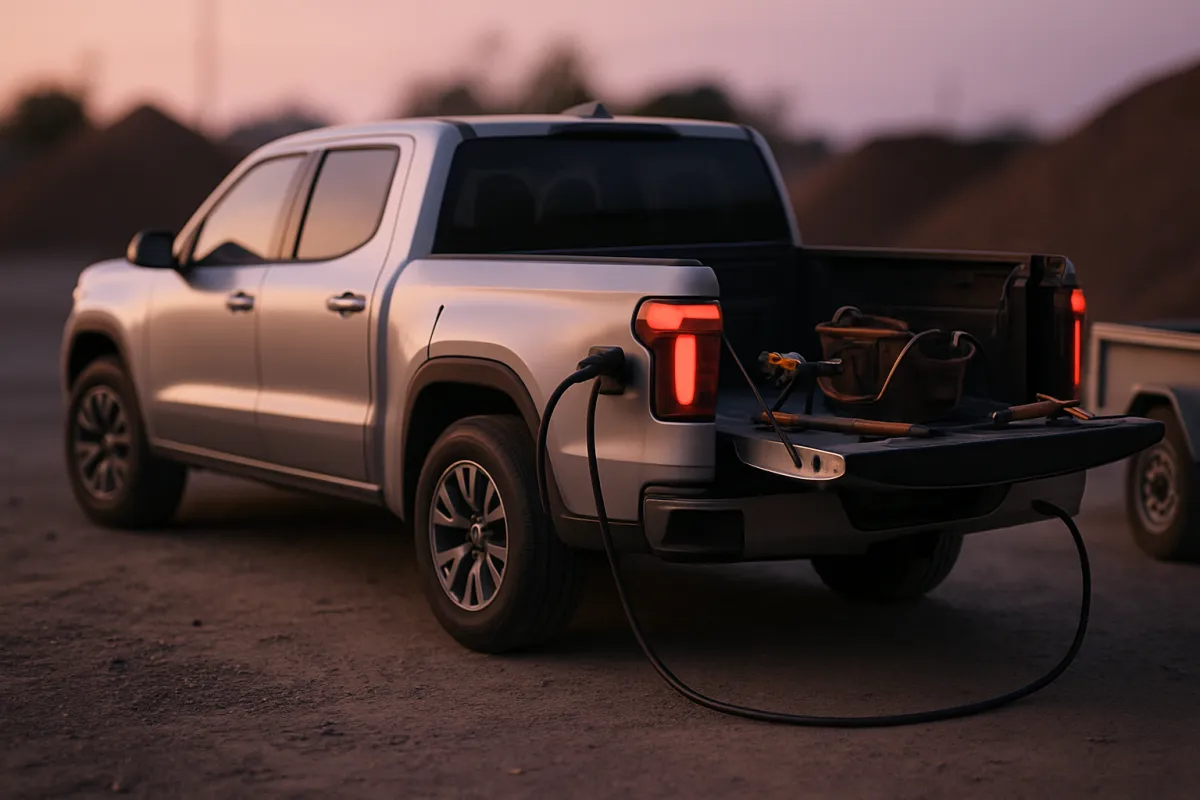
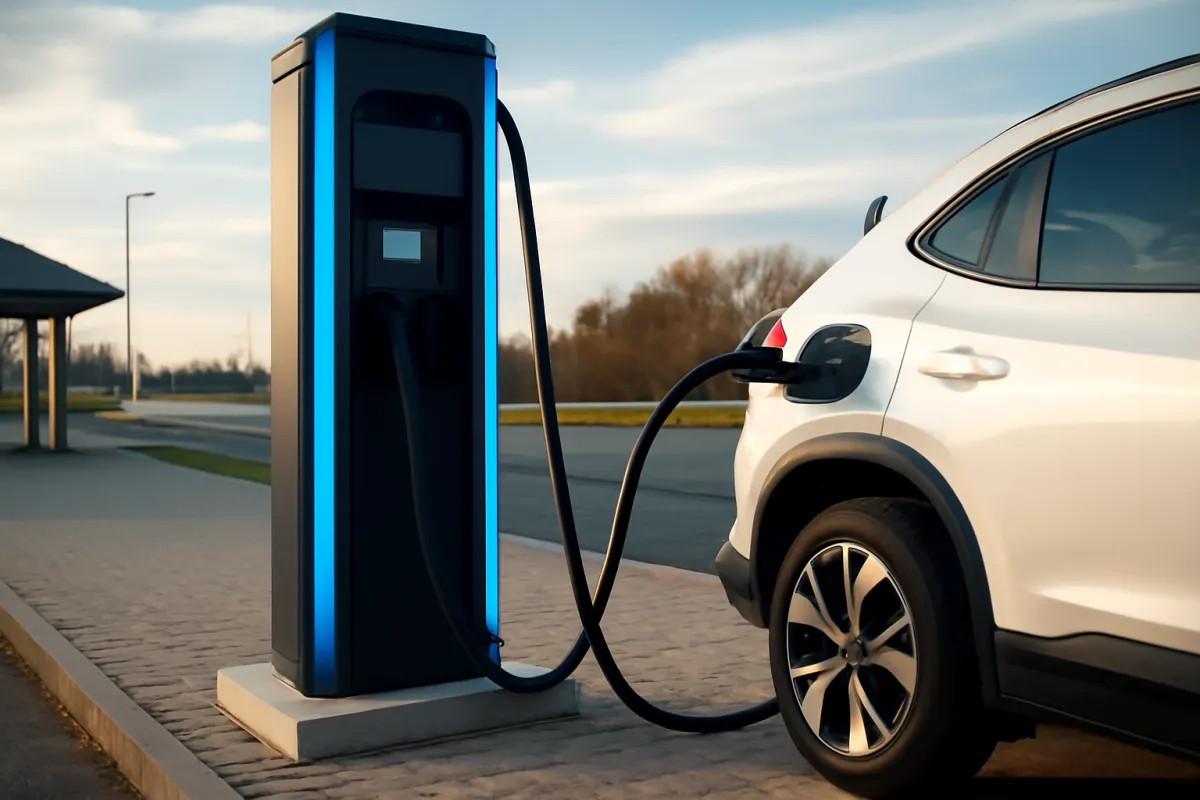
This is the part nobody mentions in the brochure and everybody discovers in the first month. The fast charging network was designed and built around cars, and most sites are laid out as parking bays that a vehicle noses or reverses into, with a stall length that assumes nothing is attached to the back. Arrive with thirty feet of trailer and there is frequently nowhere to put it. The workaround is routine but tedious: find a corner of the lot, unhitch, charge, and re hitch, an illustrative ten minutes added to every stop, in weather, sometimes in the dark, and sometimes while another driver waits for the stall.
Pull through stalls, laid out so a rig can drive in one end and out the other, solve the problem completely and are appearing at newer sites. Some route planning tools and network apps let you filter for them, and towing communities maintain informal lists. Treat all of that as a bonus rather than a plan, because coverage is uneven and a stall that exists may be occupied. The genuine offsets are destination based: campgrounds, job sites, and depots with electrical hookups will slowly charge the truck while it sits, which is the single biggest quality of life improvement available to anyone towing with electricity.
A worked example: 400 miles with a travel trailer
Put every piece together on one illustrative day. The truck is the 300 mile electric pickup from the chart, the trailer is a tall travel trailer inside its rating, and the destination is 400 miles away. Towing range at the illustrative sixty percent reduction is 120 miles. Leaving home at a hundred percent, the first leg runs about 108 miles down to a ten percent arrival. The remaining 292 miles divide into legs of about 84 miles, which is four more legs, so the day contains four charging stops.
Each stop moves roughly 87 kWh into the pack, the seventy percent window of a 125 kWh battery. At an illustrative average delivered rate of 150 kilowatts that is about 35 minutes, and at a more realistic shared or cold stall it can run past 50. Add the ten minute unhitch and re hitch where no pull through bay exists and an illustrative 50 minutes per stop is fair, so four stops add about 3.3 hours. Driving 400 miles at a towing average near 60 miles per hour takes 6.7 hours, giving a day close to 10 hours. The same trip behind a gas truck at an illustrative 10 mpg towing is roughly 7 hours and two short fuel stops. That three hour gap is the honest cost, and no framing removes it.
The energy ledger closes the picture. Consumption while towing is about 1.04 kWh per mile, so 400 miles takes roughly 417 kWh. The first 108 miles came from an overnight home charge at an illustrative 15 cents per kWh, about 113 kWh for $17. The remaining 304 kWh came from DC fast charging at an illustrative 45 cents, about $137. Total energy for the day is near $154, or 38.5 cents per mile, against roughly $140 of gasoline at $3.50 a gallon. Towing on the fast charging network is not the cheap option. It is roughly a wash on cost and clearly slower, and knowing that before you buy is worth more than any comparison table.
What the same truck costs on a local work day
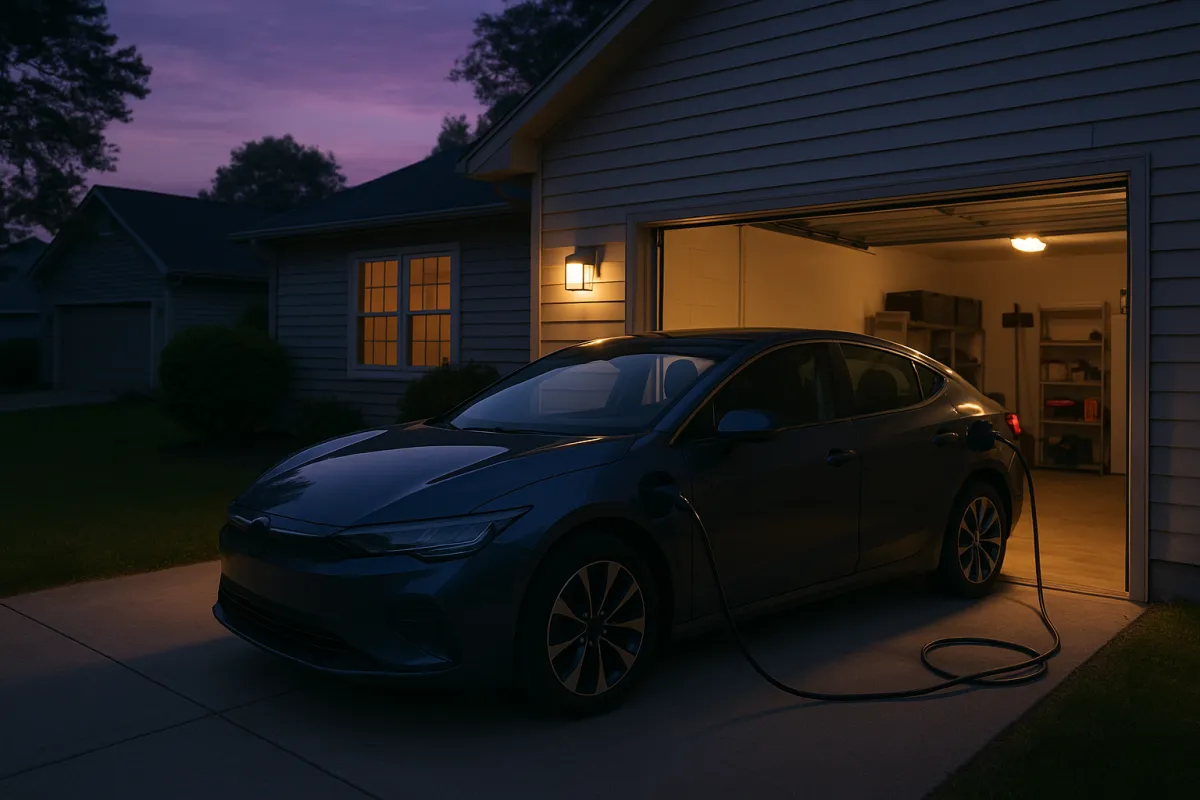
Now run the opposite duty cycle, and watch the verdict invert completely. A working electric pickup covering an illustrative 80 miles a day around one metro area, with a loaded bed and plenty of stop start driving, consumes something near 0.45 kWh per mile. That is 36 kWh a day, which a common 11.5 kilowatt home or depot charger replaces in a little over three hours overnight. At an illustrative 15 cents per kWh the day costs $5.40 in energy, which is 6.8 cents a mile.
The gas comparison is not close. A gas work truck returning an illustrative 16 mpg at $3.50 a gallon costs about 21.9 cents a mile. Over an illustrative 20,000 miles a year that is $4,375 of fuel against $1,350 of electricity, a difference near $3,000 every year, before counting the oil changes, exhaust work, and brake jobs that do not happen. Our teardown on cost per mile walks the same arithmetic for cars, and the truck version is larger in absolute terms precisely because trucks consume more of everything. Run your own rates through the charging cost calculator rather than trusting these figures, since electricity and fuel prices vary enormously by region.
Bidirectional power export is not a gimmick
Of everything electric trucks do that gas trucks cannot, power export is the capability most likely to change how someone works. A large traction battery is an enormous store of energy sitting in the driveway, and bidirectional hardware turns it into a silent generator. Export capacity is commonly advertised somewhere in the region of seven to ten kilowatts across the full size class, which is enough to run a compressor, a couple of saws, site lighting, and a kettle at the same time, or to carry a household’s essential circuits through an outage.
The practical differences from a portable generator are worth stating plainly. There is no fuel to carry, no starting ritual, no fumes, and no noise, which matters on residential jobs and in early morning hours where a petrol generator is effectively banned by neighbours. The truck is already there and already charged. The caveats are equally plain: whole home backup normally needs a properly installed transfer switch and, in most jurisdictions, a qualified electrician and a permit, because back feeding a house wrongly endangers utility workers. Confirm the specific truck’s export hardware, its outlets, and the rules where you live before treating it as a purchase justification.
What exporting power costs you in range
Power export is not free, and the arithmetic is simple enough to run in your head once you have seen it. Every kilowatt hour that leaves the truck is a kilowatt hour that will not move it. On the illustrative working figure of 0.45 kWh per mile, a job site day drawing an average of three kilowatts across eight hours consumes 24 kWh, which is about 53 miles of driving range. That is a fair trade for most trades, since a 53 mile deduction from a truck that started the day full is invisible on a local route, and the same energy at an illustrative 15 cents costs $3.60 against the fuel a generator would have burned.
Emergency backup runs the same sum at a different scale. Reserve an illustrative 100 kWh of the pack for the house and keep 25 kWh, roughly 60 miles, in hand for driving. A household consuming an illustrative 30 kWh a day runs about three and a bit days on that reserve. Trimmed hard to refrigeration, lighting, a furnace fan, and device charging, an illustrative 10 kWh a day stretches it to around ten days. Those are planning numbers rather than promises, and they depend on your own consumption, but they show why a truck in the driveway is a more serious backup asset than most owners realise.

Midsize versus full-size electric pickups
The class choice deserves more attention than it usually gets, because the honest answer for a lot of buyers is the smaller truck. A midsize electric pickup carries a smaller pack, plausibly around 90 kWh usable, which makes it lighter and more efficient, so an illustrative 250 miles of rated range comes from far less battery. Payload ratings in the class are commonly advertised somewhere in a 1,000 to 1,500 pound band and tow ratings commonly near 4,000 to 5,000 pounds, which covers bikes, garden and building materials, small utility trailers, boats, and light campers.
The compounding advantage is that the trailers matched to a midsize truck are smaller and lower, so the towing penalty is milder. An illustrative 3,500 pound low trailer at a thirty percent reduction leaves about 175 miles of towing range, and a usable leg near 122 miles, which is comfortably longer than the full size truck managed behind a tall travel trailer despite having a much smaller battery. That is the whole lesson of the physics section restated in shopping terms: the shape of what you pull governs more than the size of what pulls it. Buy the full size truck when your loads genuinely need it, not as insurance against a duty you perform twice a year.
Cold weather stacks on top of the towing loss
Winter is the multiplier people forget to apply, and it compounds rather than replaces the towing loss. Cold slows the chemistry inside the pack, cabin heating draws real power that a combustion engine got free from waste heat, and the truck spends energy warming the battery itself before it will accept a fast charge. Our teardown on cold weather range puts the commonly cited penalty in a twenty to thirty percent band for ordinary driving, deeper in severe conditions and on short trips that never let anything warm through.
Apply an illustrative twenty five percent winter reduction to the towing figures and the arithmetic gets stark. The 120 mile tall trailer range becomes roughly 90 miles, and the usable ten to eighty percent leg falls to about 63 miles. A winter towing trip is therefore a fundamentally different trip from the same route in July, and treating them as equivalent is how people end up stranded. The mitigations are real and worth using: precondition the pack and cabin while still plugged in, keep the trailer’s frontal area down, slow the cruise, and shorten the planned legs before departure rather than discovering the shortfall on the road.
Bed space, frunk, and the packaging you actually get
Electric architecture changes what a truck can physically hold, in both directions. Removing the engine frees the space under the hood, and most electric pickups turn it into a large lockable, weatherproof, and often drainable front compartment. For trades this is genuinely useful storage that a gas truck simply does not have: expensive tools locked out of sight without a bed box eating cargo space, wet gear kept away from the cabin, and in many trucks a set of power outlets right there at waist height.
The bed itself is where you should be sceptical of the imagery. Battery packaging affects floor height and bed length options, and a truck that looks enormous can have a shorter bed than a buyer expects because the cab grew and the wheelbase did not. Measure the bed of the exact configuration you are considering against the things you actually carry: sheet goods, ladders, a specific piece of equipment. Also check the load floor height, because a taller floor is a real ergonomic cost repeated dozens of times a day, and heavy things lifted higher are heavier still. None of this is unique to electric trucks, but the temptation to assume a big truck has a big bed is stronger when the truck is unfamiliar.
Maintenance and running cost over a working life
High mileage duty is where the maintenance difference stops being a talking point and starts being money. A gas work truck at an illustrative 20,000 miles a year runs through oil changes, filters, spark plugs, coolant service, exhaust components, and a transmission that is doing hard work under load. The electric equivalent has none of that. What remains is tyres, which wear faster because the truck is heavier and torquier, cabin filters, brake fluid, coolant for the battery system, and eventually brakes that have led a very easy life because regeneration handled most of the deceleration.
Two honest caveats sit alongside that. Tyres for heavy electric trucks can be expensive and can wear quickly if you use the performance, so budget more for them, not less. And the pack itself is the expensive component, covered by long warranties but not free forever. Our teardowns on battery lifespan and maintenance costs work through both. For a truck doing local, high mileage, home charged work, the combined running cost advantage over a decade is the strongest part of the entire case, and it is the part most comparison articles reduce to a sentence.
Where an electric truck clearly wins
Sort the verdicts by duty cycle rather than by enthusiasm and the winners are unambiguous. Short radius work with overnight charging is the flagship case: trades, deliveries, municipal fleets, farms with a depot, anyone whose truck runs a predictable daily distance and sleeps beside a plug. The energy saving is large, the maintenance saving is larger over time, the torque suits loaded work, and the silence is an underrated benefit in residential and indoor settings.
Towing short distances is the second clear win, and it is more common than the road trip imagery suggests. Moving a trailer of materials across town, hauling a boat to a launch twenty miles away, pulling equipment between two job sites: at those distances a sixty percent range penalty is arithmetically irrelevant, and the drivetrain’s calm, torquey, one pedal manners make it pleasant work. Third is anyone who wants the truck to double as a power source, whether for job sites, remote work, events, or household backup. In each of those cases the electric truck is not a compromise version of a gas truck, it is a better tool.
Where an electric truck clearly loses
The losing cases are equally specific, and pretending otherwise helps nobody. Long distance towing is the headline failure. A day that consists of 400 or 600 miles behind a tall trailer turns into a charging itinerary with legs under ninety miles, unhitching at most stops, and hours added to every travel day, at a fuel cost that is no better than gasoline. If that describes several trips a year you can plan around it. If it describes your work, it is the wrong tool today.
Remote work is the second. Charging infrastructure follows population and highways, so a truck that spends its life on forestry roads, remote sites, or long rural runs with no depot faces a genuine coverage problem that no amount of pack size fixes. The third is duty at the top of the payload rating, especially combined with towing, where the arithmetic in the payload chart bites hardest. And the fourth is anyone whose schedule cannot absorb charging stops at all, because the constraint is time rather than energy. None of these boundaries are permanent, and each of them has moved outward over recent years, but they are where the class sits now.
How to test the fit against your own duty cycle
The test costs nothing and takes three weeks, and it is more reliable than any review. Keep a log in whatever you already use. Record daily mileage, marking the worst day rather than averaging. Record what actually went in the bed and roughly what it weighed. Record every tow: the trailer, its approximate loaded weight, its shape, and the one way distance. Record where the truck sat overnight and whether a plug could plausibly reach it. Three weeks captures a real pattern; a memory of your driving does not.
Then run the arithmetic. Take the candidate truck’s real payload from a door sticker, subtract twelve percent of your heaviest trailer’s loaded weight, subtract the people who ride with you, and see what is left for cargo. Take the rated range, cut it by the loss band matching your trailer’s shape, take seventy percent of the result, and compare it to your longest towing leg. Check that a charger exists at both ends of that leg and that it is not a nose in bay if you cannot unhitch. If every line passes with margin, buy with confidence. If one line fails badly, you have learned something specific and useful rather than a vague worry.
What to check on the specification before you sign
A short list separates a good purchase from an expensive surprise, and each item is a number you should read yourself rather than accept from a salesperson. Payload on the door jamb sticker of that exact truck. Tow rating for that exact configuration, including whether it requires a factory tow package. Gross combination weight rating, because that is the ceiling the truck and trailer share. Usable battery capacity rather than the gross figure, since the two differ. Peak and, more importantly, sustained DC charging power, because average delivered power over the ten to eighty window decides stop length far more than a headline peak.
Then check the things that are easy to forget. Whether the truck supports the connector standard used by the charging networks on your routes, and whether an adapter is included or extra. What power export it actually offers, at what capacity, through which outlets, and what additional hardware whole home backup requires. What the warranty covers on the pack, in years and miles. And whether a real world towing test exists for that truck with a trailer resembling yours, because one honest test with a measured result outranks every illustrative percentage in this teardown, including all of them above.
Buying used, and what depreciation is doing
Used electric trucks are becoming a real market, and the depreciation curve that frustrates first owners is the second owner’s opportunity. Our teardown on electric vehicle depreciation works through why early electric values fell fast: rapid technology improvement, shifting incentives that reprice new stock, and buyer uncertainty about batteries. Trucks were not exempt, and some of the steepest drops landed on heavily optioned examples that had been ordered in a rush of enthusiasm.
If you are shopping used, the checks that matter are the pack and the duty it has led. Ask for a state of health reading rather than accepting a range estimate from a full charge, since the estimate reflects recent driving as much as the battery. Ask how the truck was charged, because a life of daily DC fast charging is harder on a pack than overnight home charging. Ask what it towed and how often, since heavy towing means sustained high power and heat, the two commonly cited accelerators of gradual capacity fade. Our teardown on buying a used electric vehicle covers the inspection process, and every item in it applies to trucks with the towing history question added on top.
The bottom line
An electric truck is not a better or worse pickup in general, because there is no such thing as a truck in general. It is an outstanding tool for short radius work with overnight charging, where cheap energy, low maintenance, and a battery that can power a job site turn it into a genuine upgrade over the gas equivalent. It is a poor tool for long distance towing today, where a trailer’s aerodynamics can cut an advertised 300 mile range to an 84 mile usable leg, where the charging network still expects you to unhitch, and where the fuel cost advantage disappears entirely at fast charging prices.
The arithmetic that settles it is short enough to do on the back of an envelope. Payload minus tongue weight minus people is what you can carry. Rated range times the towing loss times seventy percent is what you can drive between charges. Your own logged worst week is what those two numbers have to satisfy. Price your version of both in the charging cost calculator, read the payload sticker on the actual truck, and look for a real towing test with a trailer like yours before you sign. Do that and the decision stops being a debate about electric trucks and becomes a straightforward question about your work, which is the only version of the question with an answer.
Kaito writes these teardowns from the buyer’s side of the counter, not the manufacturer’s: nothing above is engineering, safety, legal, or purchasing advice for your situation. Every range, payload, weight, capacity, and dollar figure in this article is illustrative arithmetic built to show a mechanism, not a specification for any product, and real trucks differ by trim, model year, tyre choice, and market. Weight ratings, trailer brake requirements, licensing rules, and the electrical permitting needed for home backup vary by jurisdiction and change over time. Before buying or towing anything, read the ratings printed on the vehicle itself, weigh your loaded trailer, confirm local rules, and have hitches, wiring, and any backup connection fitted by qualified installers. Where a manufacturer’s documentation disagrees with this article, follow the documentation.
Frequently asked questions
How much range does an electric truck lose when towing?
More than most buyers expect, because a trailer adds frontal area to a vehicle that is already a blunt shape pushing a lot of air. Where cars towing modest loads commonly land in a thirty to fifty percent reduction, a full size pickup pulling a truck sized trailer commonly sits at the deep end of that band or past it, and a tall travel trailer at highway speed can plausibly cost sixty percent. Applied to an illustrative 300 mile electric pickup, that is roughly 120 miles of towing range, and the usable stretch between fast charging stops is shorter still. These are illustrative planning figures rather than specifications, so check the manufacturer's numbers for any truck you are considering and, better, look for a real world towing test with a trailer like yours.
Do electric trucks have less payload than gas trucks?
Not necessarily less, but the battery makes the number harder to win. A large pack is heavy, plausibly around 1,800 pounds for an illustrative 125 kWh battery at commonly cited pack level energy densities, and every pound of vehicle weight is a pound that cannot be cargo unless the gross vehicle weight rating rises to match. Manufacturers do raise the rating, which is why payload figures for electric pickups are competitive on paper, but the heavier vehicle can cross weight class thresholds that change registration, tolling, or parking treatment in some places. Read the payload figure on the door jamb sticker of the exact truck and trim, not the marketing range for the model line.
Can you charge an electric truck with a trailer attached?
Sometimes, but the honest planning assumption is that you will unhitch. Most fast charging sites were laid out as parking bays that a car noses into, which leaves a trailer nowhere to go, so the routine becomes dropping the trailer in a nearby space, charging, and re hitching, an illustrative ten minute tax on every stop. Pull through stalls sized for vehicles with trailers exist and are appearing at newer sites, and some route planning tools let you filter for them, but coverage is uneven enough that a trip should not depend on finding one. Campgrounds and job sites with electrical hookups partly offset the hassle by charging the truck slowly while it sits.
What is an electric truck actually good for?
Short radius work with a home or depot charger, which is a much larger share of truck use than the highway towing imagery suggests. A truck that runs an illustrative 80 miles a day around a metro area, hauls loads in the bed, and plugs in overnight plays to every electric strength: cheap energy per mile, low maintenance, quiet operation, and instant torque from a standstill. Add the power export capability that turns the truck into a job site generator or a household backup supply and the case gets stronger for trades. The weak cases are long distance towing, remote work far from charging, and duty cycles that live at the top of the payload rating.
How much does it cost to run an electric truck compared to a gas truck?
On home charged local work the gap is large, and on fast charged towing trips it can vanish entirely. At an illustrative 0.45 kWh per mile for a working electric pickup and an illustrative 15 cents per kWh at home, energy costs about 6.8 cents per mile, against roughly 21.9 cents for a gas work truck at an illustrative 16 mpg and $3.50 a gallon. Over an illustrative 20,000 miles a year that is a difference near $3,000. Towing on DC fast charging at an illustrative 45 cents per kWh flips the picture, because consumption roughly doubles and the energy price triples, which is why the plug you use matters more than the truck you buy.
Can an electric truck power a house or a job site?
Many can, through bidirectional power export, and it is one of the genuinely differentiating capabilities of the class rather than a marketing flourish. Export capacity is commonly advertised somewhere in the region of seven to ten kilowatts, enough to run power tools, a compressor, site lighting, or a household's essential circuits, though whole home backup usually needs a transfer switch and a qualified electrician to install it safely and legally. The energy comes out of the driving battery, so a day of moderate job site draw, an illustrative 24 kWh, costs roughly 53 miles of range on the same truck. Confirm the specific truck's export capability, the hardware it requires, and your local electrical rules before counting on it.
Is a midsize electric pickup enough truck?
For a large share of buyers, yes, and it is often the more honest purchase. Midsize electric pickups carry smaller packs, plausibly around 90 kWh usable, which makes them lighter, more efficient, and cheaper, while payload ratings commonly advertised in a 1,000 to 1,500 pound band and tow ratings commonly advertised near 4,000 to 5,000 pounds cover bikes, small utility trailers, garden loads, and light campers. Because the trailers matched to that class are smaller and lower, the towing range penalty is milder too. Buy the full size truck when your loads genuinely need it, not because a bigger battery sounds like insurance.
How do I know an electric truck fits my work before I buy one?
Log your own duty cycle for a few weeks rather than reasoning from the brochure. Write down your daily mileage, your worst day rather than your average, what you actually put in the bed, what you tow and how often, how far the longest towing trip runs, and where you park overnight. Then apply the arithmetic in this teardown: subtract tongue weight and people from the payload rating, cut the rated range by the towing loss for your trailer's shape, take seventy percent of that for a realistic charging window, and see whether the result matches your worst week. If it does not, the answer is not a bigger battery, it is a different tool for that part of the job.