
What's in this teardown
- The question behind the question: capacity, not hardware
- What a load calculation actually is
- What the calculation weighs, item by item
- Why the answer comes back in amps
- Reading your own panel before you call anyone
- 100 amp versus 200 amp service: what actually separates them
- Why a 100 amp home is not automatically disqualified
- Panel upgrade and service upgrade are two different projects
- The four routes out of a tight calculation
- Route one: buy the smaller charger
- Illustrative range added per hour, by charger size
- Route two: load management and circuit sharing
- How a load management device decides who gets the amps
- Route three: a subpanel or a panel swap
- Route four: the full service upgrade
- Where the amps go on a tight 100 amp service
- A worked example: one house, four routes
- What the utility controls and what you control
- Permits and inspection are on your side
- What the inspector is actually looking for
- What to ask the electrician before you sign
- Red flags in a panel or service upgrade quote
- Older panels and the discovery problem
- Why this teardown will not quote you a price
- Renters, condos, and shared meter buildings
- The bottom line
Every home charger walkthrough contains the same quiet assumption, and our own six step install teardown is no exception: somewhere in step two it says “check your panel,” and then moves on to mounting heights and wire runs. That single line is the whole project for a large share of readers. Whether your electrical service can carry another large load is not a footnote to the install. It is the fork in the road that decides whether you are booking an afternoon of work or opening a conversation with your utility.
This teardown is that fork, examined properly. What a load calculation actually weighs and why its answer is a number in amps. What separates a 100 amp service from a 200 amp one in practice rather than on the sticker. Why the modern answer to a tight calculation is usually a smaller charger or a load sharing device rather than a service upgrade. And what the permit and inspection process is really for. Every figure below is illustrative and internally consistent, and none of it is authorization to open a panel. For what the electricity costs once it is running, our home charging cost teardown has that side covered.
Key takeaways
- A load calculation, not a rule of thumb, decides this. It compares your service rating against your home's calculated demand plus the new circuit, and an electrician runs it in minutes.
- Service rating alone predicts nothing. A 100 amp home on gas heat and a gas range often has room; a 200 amp home with electric heat, a hot tub, and a shop can be tighter than it looks.
- A smaller charger is the cheapest fix and costs most drivers nothing real. Illustratively, about 24 amps adds roughly 19 miles of range per hour, close to 190 miles overnight.
- Load sharing devices pause the charger while other big loads run, which is what lets a charger be permitted onto a service a static calculation would call full.
- Panel upgrade and service upgrade are different projects with different costs and different gatekeepers. Make every quote say which one it is describing.
The question behind the question: capacity, not hardware
People arrive at this topic holding the wrong object. They have been shopping chargers, comparing amperages, reading about hardwiring versus a receptacle, and somewhere in that process a forum post says “you’ll probably need a panel upgrade” and the whole plan stalls. The stall happens because charger shopping and capacity are two unrelated questions that share a vocabulary.
The hardware question is about speed and convenience: how many miles per hour do you want back, and how do you want the box attached to the wall. Our Level 2 explainer handles that side, and it is genuinely the easier half. The capacity question is about whether the electrical service feeding your house has room for another large, long duration load without the total demand exceeding what the service was built to deliver.
Those are separable. You can answer the capacity question before you have looked at a single product page, and you should, because capacity constrains hardware and never the reverse. A house with generous headroom can install almost anything. A house without it has a narrower menu, and knowing that early saves you from falling in love with a unit your service cannot carry.
The mistake worth avoiding is treating capacity as a yes or no verdict about your house. It is not a grade. It is an arithmetic result about a specific proposed circuit, and changing the proposed circuit changes the result. That is the single most useful idea in this teardown, and almost every panicked “do I need an upgrade” question dissolves once it lands.
What a load calculation actually is
A load calculation is a worksheet. That is the deflating and useful truth. An electrician sits down with your home’s details and fills in a standardized form that estimates the largest demand the house realistically places on its electrical service at any one moment, then compares that estimate against what the service is rated to deliver.
The reason it is a worksheet rather than a measurement is that a house does not run everything at once, and a method that assumed it did would require every home to have absurd capacity. So the calculation applies demand factors: rules that discount the total, recognizing that the dryer, the range, the air conditioner, and every light in the house do not peak together. Different methods exist, some more optimistic than others, and part of an electrician’s judgment is choosing which one fits your situation.
We are not going to reproduce the worksheet or cite the code sections behind it, and you should be suspicious of any consumer page that does. The demand factors, the categories, and the accepted methods are code territory that changes over time and is adopted differently by different jurisdictions. What matters to you is the shape of the thing: specific inputs about your house, standardized discounts, one number out.
That output is the whole point. It is expressed in amps, it gets compared against your service rating, and the difference between the two is your headroom. Everything else in this teardown is a conversation about what to do with that difference.
What the calculation weighs, item by item
The inputs are mundane, which is reassuring. Square footage carries the general lighting and receptacle load, because the calculation cannot know how many lamps you own and instead assigns a per area allowance. Kitchen small appliance circuits and the laundry circuit get fixed allowances of their own.
Then the calculation counts the named large loads, the ones with nameplate ratings: the electric range or cooktop and oven, the electric dryer, the electric water heater if you have one, the dishwasher, the disposal, any pool or spa equipment, a well pump, a shop compressor. Heating and cooling get special treatment, because they rarely run simultaneously, so the method generally counts the larger of the two rather than both.
Notice what is doing the heavy lifting. Homes that heat with gas, cook with gas, and heat water with gas start the calculation with far less on the sheet than an all electric home of identical size. This is why two neighbours with the same panel label can get opposite answers.
Finally, the proposed EV circuit goes on the sheet, and it goes on as a continuous load, meaning one expected to run at close to its full draw for hours rather than in short bursts. Continuous loads are sized with a margin above their actual draw. Throughout this teardown we use a 25 percent margin for the illustrative arithmetic, which is the figure electricians commonly quote, but treat it as illustrative rather than as a code citation and let your electrician’s own calculation govern the real number.
Why the answer comes back in amps
Chargers are marketed in kilowatts and miles per hour, panels are labelled in amps, and the translation between them is where most confusion lives. It helps to hold one relationship: at a residential 240 volt circuit, amps multiplied by 240 gives you watts.
So a charger drawing 40 amps is pulling about 9.6 kilowatts. One drawing 32 amps is at about 7.7. One at 48 amps is around 11.5. Those kilowatt figures are the ones the product page advertises, and they are the same numbers our charging time teardown uses to work out how long a battery takes to fill.
Turning kilowatts into miles is one more step, and it depends on the car. Using the illustrative 30 kWh per 100 miles that runs through all of our cost work, every kilowatt of charging power is worth about 3.3 miles of range per hour. So 9.6 kilowatts is roughly 32 miles per hour, and 7.7 kilowatts is roughly 26.
The reason the calculation speaks amps rather than miles is that the panel does not care about your commute. It cares about current, because current is what heats conductors and trips breakers. Every consumer facing number in this topic is a translation of a current figure, and translating fluently in both directions is most of what it takes to hold your own in a conversation with an electrician.
Reading your own panel before you call anyone
You can gather most of the calculation’s inputs yourself in twenty minutes, without opening anything. Look at the main breaker at the top of your panel: the number stamped on its handle, commonly 100, 150, or 200, is your service rating. That is the ceiling everything else is measured against.
Then count breaker positions. A double pole breaker for a large 240 volt load takes two adjacent spaces, so “one open slot” is not the same as “room for a charger.” Note whether the panel appears physically full, and whether any positions are occupied by tandem breakers, the skinny ones that fit two circuits into one space.
Then inventory the big stuff by walking the house rather than the panel. Is the range gas or electric? The dryer? The water heater? Is there central air, a heat pump, electric baseboards, a pool pump, a well, a hot tub, a workshop? Write the list down with nameplate ratings where you can read them without moving anything.

Keep every panel cover closed. Reading a main breaker handle and counting slot positions is homeowner territory; removing a deadfront or probing anything inside is not, and the value of what you would learn does not come close to justifying the risk. Hand your list to an electrician and let the worksheet do the rest.
100 amp versus 200 amp service: what actually separates them
The two numbers get treated as a pass and a fail, which is unfair to both. What actually separates them is headroom, and headroom is the service rating minus the calculated demand of what is already connected.
Consider two illustrative houses. The first has 100 amp service, gas heat, a gas range, gas water heating, and a modest central air unit. Its calculated demand might land somewhere in the fifties, leaving a real margin. The second has 200 amp service, a heat pump, an electric range, an electric water heater, a hot tub, and a workshop subpanel. Its calculated demand can climb high enough that the second large charger it is asked to carry does not fit.
That is the honest version of the comparison. A 200 amp service is a bigger container, not an empty one. What people are really observing when they say 200 amp service handles EV charging easily is a correlation: newer homes tend to have both larger services and appliance mixes the calculation likes.
There is a second, quieter difference. Homes with 100 amp service are often older, which means the panel itself may be older, and age brings its own issues that have nothing to do with capacity: obsolete equipment, corroded connections, a full box, no room to work. Those problems can drive a panel replacement even when the arithmetic says there is capacity to spare. Keep the two concerns separate in your head, because a good electrician will keep them separate in the quote.
Why a 100 amp home is not automatically disqualified
If your main breaker reads 100 and you have been told by the internet that you are out of luck, push back with three questions.
First, what is the actual calculated demand? Not the service rating, the demand. A gas heated, gas cooking home can carry a surprising amount, and the only way to know is the worksheet.
Second, what is the smallest charger that meets my real need? This is the question almost nobody asks, and it dissolves more capacity problems than any other. A charger is not a fixed size; it is a dial. Reducing the circuit reduces what has to fit.
Third, does load sharing apply here? A device that prevents the charger and the range from peaking together changes the arithmetic the calculation is performing, because it makes the simultaneity the worksheet assumes impossible by design.
Between those three, a large share of “you need an upgrade” verdicts turn into “you need a slightly smaller charger and a device.” The verdicts that survive all three are real, and they deserve a service upgrade conversation, but they are a minority rather than the default. Run your own numbers through our calculator before you accept anyone’s verdict, including a confident one.
Panel upgrade and service upgrade are two different projects
This distinction is the single most useful thing you can bring to a quote conversation, because the two get named interchangeably and priced very differently.
A panel upgrade, more precisely a panel replacement, swaps the breaker box for a new one, usually a larger one with more spaces. It solves a physical space shortage, an obsolete or damaged enclosure, or an equipment type nobody wants to add circuits to. Crucially, it does not by itself change how much power the utility delivers to your house. A new panel on the same service conductors is a nicer box with the same ceiling.
A service upgrade raises that ceiling. It typically involves new service entrance conductors, a new meter enclosure, work at the connection point where the utility’s wires meet yours, coordination with the utility, and almost always a new panel as part of the same job. It is a bigger project with more parties, and the utility’s own schedule becomes part of your timeline.
There is a third option that gets forgotten: a subpanel. If the main service has capacity but the existing box has no room, feeding a small subpanel near the charger location can be a tidy answer to a physical space problem without touching the service at all.
When a quote says “upgrade,” ask which of these it means. The word alone tells you nothing about scope, cost, or who else has to say yes.
The four routes out of a tight calculation
When the worksheet comes back and the new circuit does not fit inside the headroom, there are four honest responses, and they are worth ranking by disruption rather than by preference.
Route one is to shrink the charger. Fewer amps requested, smaller circuit, possibly a fit where there was not one. Cheapest, fastest, and for most drivers genuinely costless in daily life.
Route two is to share capacity with a load management device, which lets a larger charger coexist with loads it would otherwise conflict with by never letting them peak together. Modest hardware cost, no service work.
Route three is to solve a physical rather than an electrical shortage: a subpanel, or a panel replacement where the existing box is full or unfit. Real work, contained inside the house, no utility involvement in most cases.
Route four is the full service upgrade. Largest scope, longest timeline, most parties involved, and the right answer when the house genuinely needs more power for reasons that go beyond the charger.
Most readers land in routes one and two. The important discipline is to work down the list rather than starting at the bottom, and to make any electrician who jumps straight to route four explain why routes one through three were ruled out.
Route one: buy the smaller charger
The strongest argument for a smaller charger is that overnight is longer than you think. A car that arrives home at seven and leaves at seven has twelve hours of plugged in time, and almost nobody arrives home empty.
Work it through illustratively. At 30 kWh per 100 miles, a charger drawing 24 amps at 240 volts delivers about 5.8 kilowatts, which is roughly 19 miles of range per hour. Ten hours of that is about 190 miles. For a driver covering 40 daily miles, the charger is finished before midnight and idle for the rest of the night. Buying a unit that would have finished at nine instead of eleven changes nothing about the morning.

Two caveats keep this honest. High mileage drivers, people with genuinely unpredictable schedules, and households charging two EVs on one circuit do feel the difference, and for them the smaller unit is a real compromise rather than a free one. And your car’s onboard AC limit caps the top end regardless, so on some models a larger charger was never going to deliver its rated speed anyway.
Many chargers are also adjustable, letting the installer set the maximum draw to match the circuit. That flexibility means a smaller circuit does not always mean smaller hardware, and it leaves the door open if capacity changes later.
Illustrative range added per hour, by charger size
Seeing the tiers side by side is what turns the amperage decision from anxiety into arithmetic. Every bar below comes from the same formula: amps times 240 volts gives kilowatts, and kilowatts divided by 0.30 kWh per mile gives miles of range per hour.
Illustrative range added per hour, by charger draw
240 volt circuits at 30 kWh per 100 miles; Level 1 shown at about 1.4 kW on a standard 120 volt outlet.
The gap that matters is between the top bar and the second one. Everything from 24 amps upward refills a normal day's driving several times over in one night, which is why capacity constraints rarely cost a driver anything real.
Read the chart as a diminishing returns curve rather than a ranking. Moving from Level 1 to 24 amps changes what the car can do. Moving from 32 amps to 48 changes when a job finishes that you were asleep for anyway. The steepest part of the value curve sits well below the amperage that triggers capacity trouble, which is the whole reason route one works so often.
Hold this chart next to your own daily mileage rather than next to the product tiers. If your typical day is 40 miles, every bar from the third down completes it in under three hours.
Route two: load management and circuit sharing
Load management is the idea that made the panel upgrade question far less scary than it was a decade ago. Instead of proving that the charger and every other load can peak together, you install something that guarantees they will not.
The devices come in a few shapes. Some are built into the charger itself and monitor the incoming service with current sensors. Some are separate modules installed at the panel. Some work by pairing two circuits so that only one may energize at a time, an approach often used when a dryer and a charger share a location. And some manufacturers offer panel level systems that manage several large loads together.
The common thread is measurement plus authority. The device knows what the house is drawing, and it has the ability to reduce or stop the charger’s draw. Because the charger is the one large load with genuinely flexible timing, giving it the lowest priority costs almost nothing.
What this buys you is a permitted install on a service that a static calculation would have refused. That is the practical result, and it is why the question to ask an electrician is not “do I need an upgrade” but “does a load management approach work here.”
Confirm two things before counting on it: that your jurisdiction’s inspectors accept the approach for your situation, and that the specific product is listed for the use. Both vary, and neither is something a consumer page can promise you.
How a load management device decides who gets the amps
The behavior is easier to trust once you can picture it. Imagine an illustrative limit set at 80 amps of total household draw, on a house whose charger is happily pulling 40.
Someone starts the dryer. Total demand climbs toward the limit. The device sees it and reduces the charger’s draw, or pauses it outright. The dryer runs normally, nobody in the house notices anything, and the charger sits idle or slowed for the forty minutes involved. When the dryer finishes, demand falls, and the charger resumes at full draw.
The cost to you is measured in charging minutes deferred, not in kilowatt hours lost. The energy still arrives; it arrives slightly later. On an overnight window with hours of slack, later is indistinguishable from on time.
Two design details are worth asking about. First, how quickly the device responds, since the whole safety argument rests on it acting fast enough. Second, what happens when the device fails or loses communication: a well designed system fails toward the charger being off rather than toward the charger ignoring the limit.
The arrangement also plays well with time of use rates, since the same scheduling intelligence that shifts charging away from the dryer can shift it away from peak pricing. Our home charging cost teardown covers what that shift is worth on the bill.
Route three: a subpanel or a panel swap
Sometimes the arithmetic is fine and the box is the problem. This is a distinct failure mode and it deserves a distinct response.
The mildest version is simply no free spaces. A panel with capacity to spare but no room for a double pole breaker can often be solved with a small subpanel fed from the main, placed near the charger. That also shortens the run to the charger, which is where much of the install labor lives in our six step install teardown.
The more serious version is a panel nobody wants to work in: an obsolete brand or model with a poor reputation, visible corrosion, evidence of overheating, or an enclosure so crowded that adding anything is a fight. Here a replacement is a safety improvement that happens to also solve your charger problem, and it is worth doing on its own merits.
The important framing is that a panel replacement is contained. It usually does not require the utility to change anything, it happens over a day or so, and the disruption is a power outage rather than a trench. That makes it a very different decision from route four, and it is why insisting on the vocabulary distinction pays.
If an electrician recommends a panel replacement, ask them to say plainly whether they are solving a space problem, a condition problem, or a capacity problem. Those three answers point to three different scopes.
Route four: the full service upgrade
A service upgrade is the right answer when the house genuinely needs more power, and pretending otherwise helps nobody. All electric homes with heat pumps, electric water heating, electric cooking, and now a charger can legitimately outgrow a 100 amp service. So can homes adding a workshop, a pool, an accessory dwelling, or a second EV.
Expect more parties. The utility is involved because the service conductors and the metering are theirs to coordinate. The local authority is involved through the permit and inspection. Depending on how the service reaches your house, there may be work on a mast, a weatherhead, or an underground lateral, and the answers differ enough between overhead and underground that they are effectively separate projects.
Expect a longer timeline for the same reason. The electrician’s own work may be a day or two; scheduling the utility around it is what stretches the calendar. Ask for a realistic sequence in writing rather than a single completion date.
The one genuinely good thing about route four is that it is durable. A service sized for the way your house is heading rather than the way it was built removes this conversation permanently, and it tends to be viewed kindly at resale. If you are already planning electrification beyond the car, doing it once is more sensible than doing it three times.
Just make sure you arrived here by elimination rather than by default.
Where the amps go on a tight 100 amp service
To make the arithmetic concrete, here is an illustrative breakdown of one tight house: 100 amp service, all electric kitchen and laundry, central cooling, and a calculated demand of 68 amps before any charger is considered.
Illustrative calculated demand on a 100 amp service
One example house, before any EV charger is added. Segments are shares of the 100 amp service rating.
Sixty eight amps of calculated demand leaves about 32 amps of headroom. That single number is what every charger option in this teardown has to fit inside.
The chart makes the negotiation visible. Nothing on the left is optional, and none of it is where you have leverage. The only movable quantity in the picture is the width of the circuit you are proposing to add, which is exactly the lever route one pulls.
It also shows why the general lighting and receptacle allowance surprises people. It is the largest single block and it is computed from floor area rather than from anything you own, which is why a big house with modest appliances can still start the sheet with a substantial number on it.
A worked example: one house, four routes
Take that house and shop a charger for it. Service rating 100 amps, calculated demand 68 amps, headroom 32 amps. The owner wants a 40 amp charger, because that is what the reviews recommend.
At our illustrative 25 percent continuous load margin, a 40 amp charger asks for a 50 amp circuit. Fifty does not fit inside 32. On a static calculation, this house cannot have that charger, and this is the moment most people are told they need an upgrade.
Route one: drop to a 24 amp charger, which at the same margin asks for a 30 amp circuit. Thirty fits inside 32 with a little to spare. Speed becomes about 5.8 kilowatts, roughly 19 miles of range per hour, about 190 miles across a ten hour night. The owner drives 40 miles a day. The compromise is invisible.
Route two: keep the 40 amp charger and add load management, so the charger yields whenever total demand rises. The calculation now describes a scenario that cannot occur, and the install becomes permittable. The owner gets 32 miles per hour when nothing else is running, which is most of the night.
Route three: only relevant here if the panel is also full or unfit. The arithmetic did not require it.
Route four: the service upgrade. It is the only route that would let this house add a charger, an electric water heater, and a heat pump later without revisiting the question. That is a real argument, and it is a different argument from the charger.
Run your own version of this in our calculator, changing the service rating and the demand estimate to match what your electrician tells you.
What the utility controls and what you control
A surprising amount of this decision sits outside your property line, and knowing the boundary keeps expectations sane.
The utility owns the service drop or lateral, the meter itself, and the connection to their network. Anything that changes the capacity delivered to your house involves them: scheduling a disconnect, approving equipment, sometimes assessing whether the transformer serving your street can support the change. That last one is rare for a single home but not unheard of in older neighbourhoods with several new EVs on one transformer.
You control everything from the meter enclosure inward, through your electrician and under your permit. You also control the timing of your own decisions, which is worth more than it sounds when a utility’s calendar is the long pole.
Utilities are also where the money sometimes is. Many run rebate programmes for chargers, wiring, or panel work, and many offer EV specific or time of use rate plans that change what charging costs you every night thereafter. Both are worth a phone call before you sign anything, and both change often enough that we will not describe any specific programme here; check your own utility’s current page and confirm eligibility in writing.
What the utility does not do is tell you which charger to buy or run your load calculation. That remains an electrician’s job.
Permits and inspection are on your side
The permit is not paperwork friction. It is the mechanism that puts a second set of qualified eyes on work that is invisible once the wall closes.
A new 240 volt circuit for a continuous load is the kind of work permits exist for, and panel or service changes even more so. In most jurisdictions the electrician pulls it as part of the job and folds the fee into the quote. The fee is small next to labor, which means skipping it saves very little and costs a great deal of certainty.
Think about the asymmetry. Permitted work that is later implicated in a problem is a repair conversation. Unpermitted work in the same situation becomes an insurance conversation and possibly a liability one, and it reliably resurfaces at resale when a buyer’s inspector asks about the charger circuit and there is no record of it.
The permit also protects you from your contractor. An inspection is an independent check that the person you hired did what they said, sized correctly, terminated properly, and left the installation in a condition someone else is willing to sign off on. That is a service you are receiving, not a hurdle you are clearing.
Confirm the requirement with your local building department rather than assuming, since rules genuinely differ by jurisdiction, and confirm that your quote includes the permit rather than leaving it to you.
What the inspector is actually looking for
Knowing roughly what gets checked demystifies the visit and helps you read your own quote.
Broadly, an inspection is interested in whether conductors are appropriately sized for the overcurrent protection and the load, whether terminations are correct and tight, whether grounding and bonding are properly established, whether the equipment is listed and used the way its listing intends, and whether working space and clearances around the panel are adequate.
For a charger specifically, the outdoor or indoor rating of the equipment, the mounting, the physical protection of the cable run, and the way the circuit is labelled in the panel all come into it. For a panel or service change, the scope widens to the enclosure, the grounding electrode system, and the service equipment itself.
We are deliberately not listing rule numbers or specific dimensional requirements, because those are code details that change between editions and between jurisdictions, and a homeowner reciting a half remembered figure to an electrician creates confusion rather than confidence. The useful posture is to know the categories, ask questions in those categories, and let the professional supply the specifics.
One practical habit: photograph the work before anything is closed up. It costs nothing, it helps the next electrician, and it is quietly persuasive at resale.
What to ask the electrician before you sign
A good quote conversation is short if you ask the right five things.
Will you run a load calculation on this house, and can I see the result? This is the anchor question. An electrician who is willing to answer the capacity question without one is guessing.
Does this quote describe a panel replacement, a service upgrade, or neither? Make them say which. If it is a service upgrade, ask what utility coordination is included and who schedules it.
What is the smallest charger you would recommend for my driving, and what circuit does it need? This invites route one onto the table explicitly rather than hoping it appears.
Would a load management approach work here, and do local inspectors accept it? This invites route two. If the answer is no, ask whether the objection is technical, product related, or jurisdictional.
Is the permit included, are you licensed and insured, and will you be present for the inspection? Boring questions, and the ones that matter most when something goes wrong later.
Get two or three quotes on one identical written scope. Prices for the same work vary widely, and a vague scope is an invitation to price a bigger job than you need.
Red flags in a panel or service upgrade quote
Most electricians are straight with people. A few patterns still deserve suspicion.
A capacity verdict delivered without a load calculation is the biggest one. If nobody filled in a worksheet, nobody knows, and a confident answer is a sales position rather than a finding.
A quote that jumps straight to a service upgrade without discussing a smaller charger or load sharing is worth a second opinion. The upgrade may still be correct, but you want to hear why the cheaper routes were ruled out.
Vague scope language is a red flag in both directions. “Panel work as required” protects the contractor and exposes you. Ask for line items: what equipment, what circuit, what permit, what is excluded.
Pressure to skip the permit, however it is framed, should end the conversation. So should reluctance to provide a license number or proof of insurance.
Finally, be wary of a quote that assumes the worst about what is behind the wall without saying so. Older homes do produce surprises, and the professional way to handle that is a written allowance or a stated exclusion, not a padded number nobody explains. Ask what happens to the price if the surprise does not materialize.
Older panels and the discovery problem
Panel work has an inherent uncertainty that no quote fully removes: nobody knows exactly what is in there until it is open.
Common discoveries include aluminum branch wiring from certain eras, connections that show heat damage, undersized or missing grounding, circuits that turn out to be shared in ways nobody documented, and equipment types that are hard to source parts for. None of these are your fault and all of them can change the job.
The right way to handle this is to talk about it before work starts. Ask the electrician what they expect to find given the age and style of the equipment, what the likely contingencies are, and how a change in scope will be priced and approved. A written change order process is worth more than a low headline number.
It is also worth separating the charger from the discovery. If opening the panel reveals a condition that needed fixing anyway, that repair is a house expense that the EV happened to surface, not a cost of driving electric. People mentally charge the whole bill to the car and then conclude EVs are expensive, which is the same accounting error our ownership math teardown works through in a different context.
Finally, this is a strong argument for the permit and inspection. If a surprise gets fixed, you want the record.
Why this teardown will not quote you a price
You came here partly for a number, and we are going to explain why you are not getting one instead of inventing it.
Panel and service work is priced by conditions this teardown cannot see. Whether your service is overhead or underground. Where the meter sits and how far the service run is. Whether the utility has to be scheduled. What the walls and the existing equipment hide. Local labor rates and local permit fees. Whether the job is a clean swap or a repair project wearing a swap’s name.
Those variables move the total across a range wide enough that any single figure we published would be wrong for most readers and misleading for the rest. Worse, a published number becomes an anchor: readers argue with legitimate quotes because a webpage told them what it should cost.
What we will say is structural, and it holds. Route one usually costs less than route two, which usually costs less than route three, which usually costs less than route four. Labor and distance dominate the charger circuit itself. Utility rebates sometimes offset a meaningful share, and they are worth checking before you commit.
Take that structure to two or three electricians, get real numbers for your real house, and use our calculator to sanity check the speed and capacity side while they price the labor side.
Renters, condos, and shared meter buildings
If you do not own the panel, this whole topic changes shape, and it deserves saying plainly rather than being left out.
Renters can rarely authorize panel or service work, and landlords rarely fund it. The realistic options are a Level 1 cord from an existing outlet where one reaches the parking spot, a portable unit on an existing 240 volt receptacle if one happens to exist and the landlord agrees, or leaning on charging away from home. Our apartment charging teardown works through that menu properly.
Condos and shared buildings add a governance layer on top of the electrical one. The building’s service, not your unit’s panel, is often the binding constraint, and the decision runs through a board rather than an electrician. Buildings that handle this well usually do it with a shared, load managed system rather than a string of individual circuits, for exactly the capacity reasons this teardown has been describing.
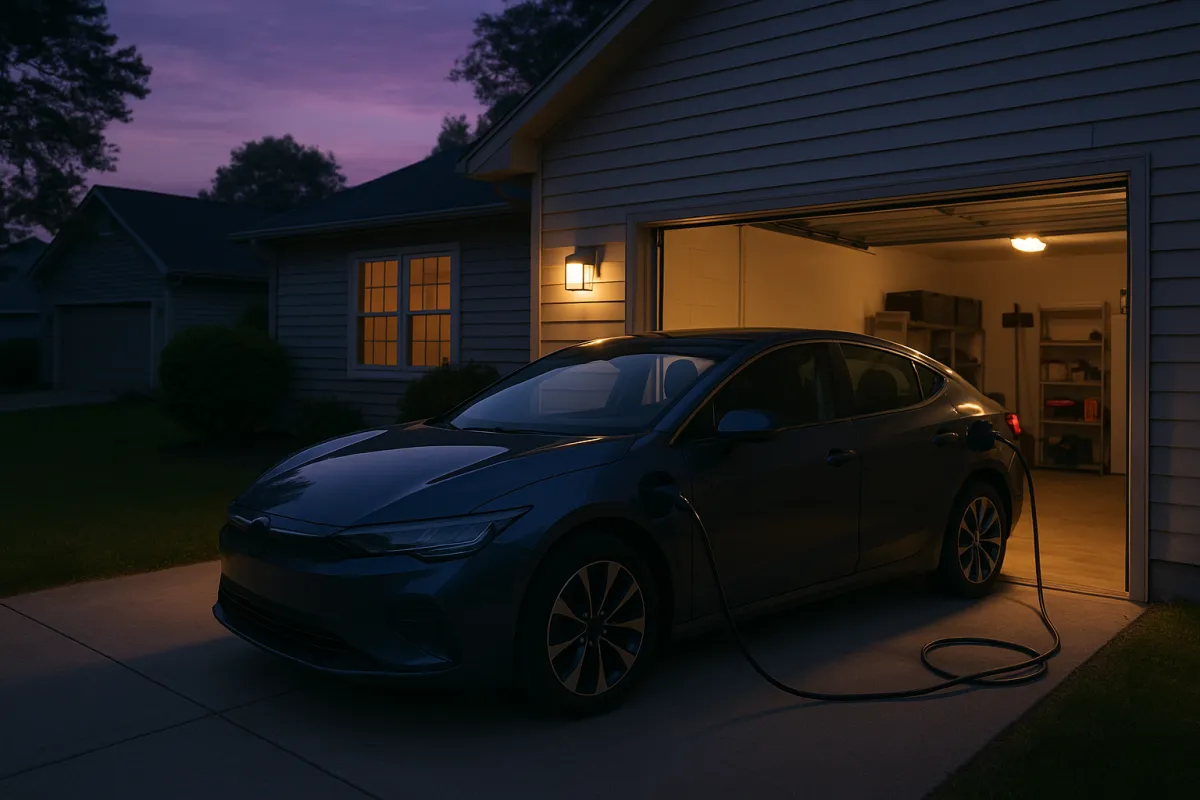
If you are house hunting with an EV in mind, this is a cheap thing to check early: the main breaker rating, the appliance mix, and whether the panel has room. Two minutes of looking can be worth a great deal later.
The bottom line
The panel question is smaller than its reputation, and it is smaller because it is not a verdict about your house. It is arithmetic about a circuit you are proposing, and you control the circuit. A load calculation gives you the headroom, the charger you choose sets what has to fit inside it, and load sharing changes the rules of the comparison entirely.
Work down the routes in order rather than starting at the bottom. Ask for the calculation. Ask which kind of upgrade any quote is describing. Ask whether a smaller charger or a load management device closes the gap, and make anyone recommending a service upgrade explain why those did not. Get the permit, keep the inspection, and photograph the work before the wall closes.
For most readers the honest ending is undramatic: a modest circuit, a unit that finishes charging while you sleep, and no service upgrade at all. Price your own version with our calculator, take the numbers to a licensed electrician, and let the worksheet rather than the forum post decide.
Consider all of the above educational reading rather than an electrical specification. AmpLoft writes for EV owners, not as your electrician, and the amps, kilowatts, ranges, and demand figures used here are illustrative examples chosen to be internally consistent, not measurements of your home. Load calculations, circuit sizing, equipment approval, permitting, and utility rules vary by jurisdiction and change over time, so every number that matters must come from a licensed electrician working on your actual house, your local building department, and your own utility. Nothing here authorizes anyone to open, modify, or work on an electrical panel.
Frequently asked questions
Do I need a panel upgrade to install an EV charger?
Often no. A load calculation answers it, and the honest answer is that many homes already have room. The calculation compares your service rating against your home's calculated demand plus the new charger circuit. If the headroom covers it, nothing about the panel changes. If it does not, a smaller charger or a load sharing device usually closes the gap for far less than a service upgrade. Only an electrician running the actual worksheet on your actual house can tell you which case you are in, so treat any answer given without one as a guess.
What is an electrical load calculation?
It is a standardized worksheet an electrician fills in to estimate the largest demand your home realistically places on its service at one time. It counts square footage, the fixed appliances, heating and cooling, and any new circuit being added, then applies demand factors that reflect the fact that a house never runs everything simultaneously. The output is a number in amps that gets compared against the service rating. The worksheet is short, the inputs are specific to your home, and it is the cheapest useful thing you can buy before shopping for a charger.
Can a 100 amp service handle an EV charger?
Sometimes, and more often than the internet suggests. A 100 amp home without electric heat, with a gas range and gas water heating, can carry a meaningful charger on paper. A 100 amp home with electric heat, an electric range, an electric dryer, and central cooling is where the calculation gets tight. Even then the usual outcome is a smaller charger or a load sharing device rather than a service upgrade. The service rating alone does not decide it; what is already connected to that service does.
What is the difference between a panel upgrade and a service upgrade?
A panel upgrade replaces the breaker box, which solves a shortage of physical breaker spaces or an unsafe or obsolete enclosure. A service upgrade raises the capacity actually delivered to the house, which usually means new service conductors, a new meter enclosure, coordination with the utility, and often the panel too. The first is contained inside your wall. The second involves the utility and the local authority. People use the words interchangeably in quotes, which is exactly why you should ask which one a quote is describing.
How does a load management device let a charger share capacity?
It measures what the home is drawing, then throttles or pauses the charger when total demand approaches a set limit, resuming when the dryer or range finishes. Because the charger is the one large load that genuinely does not care when it runs, giving it last priority costs you almost nothing overnight. That behavior is what allows a charger to be permitted on a service that a static calculation would say is full. Availability, approval, and the exact rules vary by jurisdiction and by product, so confirm both with your electrician and your local authority.
Do I need a permit for an EV charger circuit?
In most places, yes. A new 240 volt circuit carrying a large continuous load is squarely the kind of work electrical permits exist for, and a service or panel upgrade is even more clearly so. The electrician normally pulls the permit as part of the job. The value to you is the inspection: an independent check on conductor sizing, terminations, grounding, and clearances, plus a paper trail that keeps your insurance and your future buyer comfortable. Confirm the requirement with your local building department, since rules genuinely differ.
How much does an EV charger panel upgrade cost?
We are not going to quote you a market price, because panel and service work is priced by conditions this teardown cannot see: the state of the existing equipment, the meter location, the length of the service run, whether the utility must be involved, local labor rates, and what the walls hide. Quotes for the same house vary widely. The honest move is to get two or three written quotes on one identical scope, insist each one names whether it is a panel swap or a service upgrade, and ask each electrician to price the load sharing alternative alongside it.
Will a smaller charger really be enough?
For most drivers, yes. Illustratively, a charger drawing about 24 amps at 240 volts adds roughly 19 miles of range per hour at a typical 30 kWh per 100 miles, which is close to 190 miles across a ten hour overnight window. A larger unit finishes sooner, but the car is still parked either way. The only drivers who genuinely feel the difference are those with very high daily mileage, an unpredictable schedule, or two EVs on one circuit. Size the charger to your driving, not to the biggest number the panel might tolerate.