What's in this teardown
- What cold weather actually does to EV range
- Mechanism one: a cold battery has less to give
- Mechanism two: cabin heat comes out of the same pack
- Resistive heaters versus heat pumps
- Mechanism three: the pack warms itself before it fast charges
- Mechanism four: denser air, winter tires, and cold running gear
- Why short trips lose the most range
- How much range you actually lose, by condition
- A worked example: a 280 mile car on a cold morning
- Where the lost miles go
- Preconditioning while plugged in is the biggest lever
- Heat the seats and the wheel before the cabin
- Why a cold car charges slowly, and how to fix it
- Planning a winter road trip around real numbers
- Why the last 20 percent matters more in winter
- Overnight cold soak, garages, and where you park
- Winter tires and the pressure that drops with the temperature
- Regenerative braking fades when the pack is cold
- Does cold weather permanently damage the battery?
- Charging habits that make winter easier
- Common winter range mistakes
- What changes when spring arrives
- The bottom line
Cold weather is the objection that stops more people buying an electric car than charging time, price, or anything else, and the reason it lands is that the concern is genuinely true. An EV really does go fewer miles on a freezing morning than the window sticker promises, and the gap is large enough to matter for planning. What almost nobody explains is that the winter loss is not one effect. It is four separate things happening at the same time, each with a different size, a different cause, and a different fix, which is why generic advice to “just precondition” helps some drivers a lot and others barely at all.
This teardown pulls the four mechanisms apart and prices each one against a single illustrative car so the arithmetic stays visible: what the cold does to the battery itself, what the cabin heater draws from the same pack, why a cold car will not accept a fast charge until it warms, and what denser air and winter tires add on top. Then it moves to the practical half, which is preconditioning, seat heat, charging stops, and the reserve you should carry in winter. Our range-maximizing teardown covers the habits that help year round; this one is strictly about the cold. Size your own winter number in about a minute with the companion estimator.
Key takeaways
- The winter loss is four mechanisms stacked, not one: a cold battery that temporarily gives less, a cabin heater drawing from the same pack, denser air with winter tires, and slower charging until the pack warms.
- Commonly reported losses run from around a tenth of range on a cool day to roughly a third in genuine cold, with the equipment in the car and the length of the trip mattering as much as the temperature.
- Cabin heating is the largest single slice on most winter drives, and the gap between a resistive heater and a heat pump is illustratively the difference between a 33 percent and a 26 percent loss on the same car.
- Short trips are punished hardest because warming a cold cabin is close to a fixed cost spread over very few miles, illustratively around 45 percent below rated on a 12 mile errand.
- Preconditioning while plugged in, seat and wheel heat over cabin air, and a larger arrival reserve turn a real problem into a planned one; the loss is temporary and it returns in spring.
What cold weather actually does to EV range
Start with the honest framing, because it is what most winter coverage skips. Your battery holds a fixed budget of energy, and every mile spends some of it. Cold weather attacks that arrangement from both ends at once. It shrinks the budget, because a cold pack cannot deliver all of its stored energy at full willingness, and it raises the price of every mile, because you are now paying for cabin heat, denser air, and stiffer running gear on top of the driving itself.
That two-sided attack is why winter losses feel worse than any single effect would predict. If only the battery were affected, a cold morning would cost you a slice and nothing more. If only the heater were running, a long drive would barely notice it. Both happening together, on a short trip, in a car with a resistive heater, is the worst case, and it is also the case most people experience first, which is how the reputation formed.
The useful consequence is that the fixes are separable too. You cannot argue with physics about air density, but you can shift most of the heating load onto the wall before you leave, you can warm the pack before you charge, and you can plan legs around a lived winter number rather than a rated one. The rest of this teardown takes each mechanism in turn and then puts the fixes back together.
Mechanism one: a cold battery has less to give
The first mechanism is the battery itself, and it has nothing to do with heating. A lithium ion cell works by shuttling ions through an electrolyte between two electrodes. When the cell is cold, that electrolyte is more viscous and the chemistry is simply slower, so internal resistance rises. Higher internal resistance means more of the energy you draw is lost as heat inside the pack rather than delivered to the motor, and it means the pack cannot push or accept current as readily as it would when warm.
The practical effect an owner sees is that some of the pack’s capacity is temporarily out of reach. The energy has not disappeared and the battery has not degraded; it is behind a door that opens as the cells warm. This is why range often improves during a winter drive rather than declining linearly, and why the first few miles of a freezing morning look alarming on the efficiency readout. The pack is warming itself through use, and the numbers improve as it does.
Two consequences follow. First, a car that has sat outside all night starts every trip in the worst version of this state, which is the argument for a garage or a preconditioning schedule. Second, permanent capacity loss and temporary cold loss look identical on the dashboard but are entirely different things. Our battery lifespan teardown covers the permanent kind, and a cold snap is not it.
Mechanism two: cabin heat comes out of the same pack
The second mechanism is the one that surprises people who have only driven petrol cars, and on most winter trips it is the largest. A combustion engine is an inefficient heat machine that produces far more waste heat than it needs, so cabin heating is essentially free: the car pipes warmth it was throwing away into the interior. An electric drivetrain is efficient, which is wonderful for range and terrible for heating, because there is almost no waste heat to recycle. Warming the cabin means running an electric heater off the traction battery.
That heater is a real load, comparable in scale to the energy needed to move the car at moderate speed. An illustrative resistive system averaging around 4 kilowatts on a cold drive is spending 4 kilowatt hours for every hour the car is switched on, whether you are moving at 70 miles per hour or crawling in traffic. At an average 56 miles per hour that works out near 0.07 kilowatt hours per mile, added directly on top of the driving energy, which is why the heater’s share of the loss is so visible.
The important structural point is that heating is a cost per hour while driving is a cost per mile. Anything that lowers your average speed, traffic, town driving, a short errand, raises the heater’s share of the trip without changing its draw at all. That single asymmetry explains most of what follows in this teardown.
Resistive heaters versus heat pumps
The equipment in your specific car changes the size of this mechanism more than any habit does, so it is worth understanding which one you have. A resistive heater is the simple version: current passes through an element, the element gets hot, a fan blows air across it. A kilowatt of electricity produces roughly a kilowatt of heat, and there is no clever way around that ceiling. It is cheap to build, reliable, and expensive to run in winter.
A heat pump does something smarter. Rather than creating heat, it moves heat from one place to another using a refrigerant cycle, pulling warmth out of the outside air and out of the car’s own components and delivering it into the cabin. Because it is moving heat rather than manufacturing it, a kilowatt of electricity can deliver noticeably more than a kilowatt of warmth. In practical terms, the same comfort costs a much smaller draw, illustratively closer to 1.5 kilowatts than to 4 on a cold drive.
The honest caveat is that a heat pump’s advantage narrows as the outside air gets very cold, because there is less ambient heat available to move. Many systems fall back on resistive elements below a certain temperature, or blend the two. So a heat pump is a real and meaningful advantage in ordinary winter weather and a smaller one in extreme cold. If you are shopping and you live somewhere genuinely cold, it is worth asking which system a car uses before anything else on the spec sheet.
Mechanism three: the pack warms itself before it fast charges
The third mechanism is not about range at all, which is exactly why it confuses people. A cold battery cannot safely accept a high charging current, because forcing ions into cold, resistive cells risks plating lithium on the anode rather than intercalating it properly. Battery management systems know this, so they limit charging power until the pack reaches a suitable temperature. That is a protection working correctly, not a fault, and it is the reason a fast charger that would normally deliver a rapid session can crawl when you plug in a cold car.
The result is a winter road trip failure mode that has nothing to do with miles. You drive a cold leg, arrive at a charger with a cold pack, and then sit far longer than you planned because the car is spending the first stretch of the session warming itself before it will accept real power. The trip took longer, but not because the range was short.
The fix is preconditioning the battery, which most cars will do automatically if you set the charger as a navigation destination, and manually on some through a menu. The car spends a modest amount of energy warming the pack during the last part of the drive so it arrives ready to charge at a useful rate. It costs you a few miles of range to save a much larger number of minutes, which on a road trip is almost always the right trade. Our charge time teardown covers how the rate curve behaves once the pack is actually ready.
Mechanism four: denser air, winter tires, and cold running gear
The fourth mechanism is a collection of small, unglamorous physical effects that add up to a real slice. Cold air is denser than warm air, and aerodynamic drag scales with air density, so the same car at the same speed is pushing through more mass of air on a freezing day than on a mild one. The effect is modest, a few percent at highway speed, but it is permanent for the whole trip and there is nothing you can do about it.
Rolling resistance rises too, from several directions at once. Tire pressure falls as the temperature drops, and softer tires deform more and cost more energy per revolution. Winter tires, which are genuinely worth having where you need them, use softer compounds and more aggressive tread patterns that trade a slice of efficiency for grip. Lubricants in the drive unit and wheel bearings are more viscous when cold, so the drivetrain itself is slightly stiffer for the first miles. Snow, slush, and standing water on the road add drag directly.
None of these is dramatic alone. Together they are a meaningful fraction of the winter loss, and they are the part that a heat pump and a preconditioning schedule cannot help with. This is the portion you simply plan around rather than fight, and it is one of the reasons a winter buffer is not pessimism but arithmetic.
Why short trips lose the most range
Here is where the mechanisms combine into the effect owners actually complain about. Heating a cold cabin is close to a fixed cost. The first several minutes are the expensive part, because you are warming a large volume of air plus the seats, the dashboard, the glass, and everything else the air touches. Once the interior is warm, the heater settles to a much lower maintenance draw. So the heavy spending happens exactly when you have covered the fewest miles.
Work an illustrative example. Take a 12 mile errand that takes about half an hour of stop and start driving, with the heater averaging around 4.5 kilowatts because it is starting from a fully cold soaked cabin. That is roughly 2.25 kilowatt hours of heat. The driving itself, at an illustrative cold weather town efficiency of 3.0 miles per kilowatt hour, spends about 4 kilowatt hours. Total, 6.25 kilowatt hours for 12 miles, which is an effective 1.9 miles per kilowatt hour against a rated 3.5. That is roughly 45 percent below rated.
The same car, same weather, on a two hour highway leg would look far better, because the fixed warm-up cost is spread across many more miles and the cabin spends most of the drive in cheap maintenance mode. This is why two owners in the same city, in the same car, in the same week, honestly report completely different winter losses. They are not disagreeing about the car; they are driving different trip lengths.
How much range you actually lose, by condition
Any single percentage is a lie by omission, because the loss depends on temperature, trip length, and equipment together. What is honest is a set of scenarios that show the shape. The chart below prices a handful of them against the same illustrative rated efficiency, so you can find the row that resembles your winter and start from there rather than from a headline number.
Illustrative winter range loss by condition
Approximate percentage below rated range for one illustrative car; every figure varies with temperature, trip length, and equipment.
These are illustrative scenarios for one hypothetical car, not measurements of any model. The ranking is the point: trip length and heater type move the number as much as the thermometer does.
Read the spread rather than any one bar. The distance between the top row and the bottom row is enormous, and almost all of it is explained by two things you can identify about your own situation in a minute: how long your typical winter trip is, and whether the car has a heat pump. A driver doing 40 mile commutes in a heat pump car in a mild winter is living near the bottom of that chart, and the popular reputation for catastrophic winter loss simply is not their experience. Put your own conditions into the companion estimator to see which row you land on.
A worked example: a 280 mile car on a cold morning
Numbers land harder when they are worked all the way through, so here is one illustrative car followed end to end. Give it a rated range of 280 miles and 80 kilowatt hours of usable battery, which works out to a rated efficiency of 3.5 miles per kilowatt hour. Every figure here is a placeholder chosen to show the arithmetic, not a specification for any vehicle.
Now put it in genuine cold, before any heating. The battery, the denser air, the winter tires, and the cold drivetrain together cost an illustrative 20 percent of efficiency, so 3.5 miles per kilowatt hour becomes 2.8. That alone turns 280 miles of rated range into 224 miles, a loss of 56 miles with the heater still switched off.
Switch on a resistive heater averaging 4 kilowatts, at an average speed of 56 miles per hour. That is 4 divided by 56, or about 0.071 kilowatt hours per mile of heating, added to the 0.357 kilowatt hours per mile the driving now costs. Total, about 0.429 kilowatt hours per mile. Divide 80 kilowatt hours by that and you get about 187 miles, which is 93 miles below rated, a loss of roughly 33 percent.
Run the same car with a heat pump averaging 1.5 kilowatts instead. Heating now costs about 0.027 kilowatt hours per mile, total about 0.384, and the range lands near 208 miles. That is a loss of about 26 percent, and the 21 mile difference between the two versions of the same car is entirely the heater. Change the inputs to match your own car in the companion estimator and watch both figures move.
Where the lost miles go
Ninety three miles is an abstraction until you see where they went. The chart below splits that loss for the resistive heater case, and the shares are of the loss itself rather than of the range. This is the picture that tells you which fix is worth your attention.
Splitting a 93 mile winter loss into its causes
Illustrative breakdown for the 280 mile car above on a cold drive with a resistive heater; shares of the loss, not of the range.
On a shorter trip the heating slice swells because the fixed warm-up cost is spread over fewer miles; on a long highway leg it shrinks and the other two dominate. The split moves with the trip, not just the temperature.
The chart makes the strategy obvious. The heating slice is the biggest single piece and the only one a habit can meaningfully shrink, which is why preconditioning and seat heat get the attention they do. The battery slice shrinks on its own as the pack warms during the drive, and shrinks faster if the car started warm. The last slice is physics you accept and plan for. Effort spent on the first two returns something; effort spent arguing with the third does not.
Preconditioning while plugged in is the biggest lever
Preconditioning is the habit that turns the largest winter loss into a much smaller one, and it works for two reasons rather than one. The obvious reason is that the energy comes from the wall instead of the battery, so the pack starts the drive full rather than immediately spending miles on heat. The less obvious and arguably more valuable reason is that the expensive warm-up phase finishes before you unplug, so the on-road heater settles straight into cheap maintenance mode instead of fighting a cold soaked interior for the first fifteen minutes.
Put numbers on it using the same illustrative car. If preconditioning plus a modest cabin setting pulls the average on-road heater draw from roughly 4 kilowatts down to roughly 2.5, then heating costs about 0.045 kilowatt hours per mile instead of 0.071. Total energy per mile falls to about 0.402, and range rises from about 187 miles to about 199. That is roughly 12 miles recovered, and the loss falls from about 33 percent to about 29 percent.
Do the same on the heat pump car, dropping its average draw from 1.5 kilowatts to about 1, and range moves from about 208 miles to about 213. The recovery is smaller in absolute terms precisely because the heat pump had already collected most of that saving. This is the honest shape of the fix: real, worth doing every cold morning, and not a way to make winter disappear.
The caveat matters as much as the technique. Preconditioning off the battery, unplugged, still warms the cabin but spends pack energy to do it, so in that case it is a comfort choice rather than a range one. It is still often worth it for safety, because clearing frost and fog from glass before you drive is not negotiable. Just do not expect a range benefit from it when the cable is not connected.
Heat the seats and the wheel before the cabin
Once you are moving, the cheapest warmth is the warmth delivered directly to you rather than to the air around you. A seat heater and a heated steering wheel warm skin through contact, using a small fraction of the energy needed to raise the temperature of a whole cabin and everything in it. The comfort is not a compromise; direct heat often feels better in deep cold than warm air does, because it works faster and does not dry the air out.
The practical routine that works is layered. Precondition on the charger to a livable temperature so the interior is not hostile when you get in. Set the cabin heat modestly rather than high, enough to keep glass clear and the air pleasant. Then carry the rest of the warmth on the seat and wheel heaters. That combination keeps the average cabin draw low without ever asking you to be cold, which is why it survives contact with real winter mornings where more austere advice does not.
There is one absolute limit. Defogging and defrosting are safety functions, not comfort features, and range is never a reason to drive with compromised glass. Run whatever heat and airflow you need to keep the windscreen and mirrors clear, every time, and treat the saving as something you collect after visibility is handled rather than instead of it. Our range-maximizing teardown makes the same point about the habits that apply year round.
Why a cold car charges slowly, and how to fix it
Winter changes charging in two directions, and it helps to keep them separate. At home on a slow charger, cold barely matters for your routine, because an overnight session has hours of slack and the car will warm the pack as needed. You may notice slightly more energy going in than the miles you drove suggest, since some of it went into thermal management rather than the wheels, which is normal.
Public fast charging is where cold bites. The car limits charging power until the pack is warm enough to accept it safely, so arriving cold means the first part of your session is slow while the battery brings itself up to temperature. Two habits fix most of this. First, set the charger as a navigation destination so the car preconditions the pack on approach. Second, if you have a choice, charge after a longer driving leg rather than at the start of the day, because a pack that has been working is already warm.
The state of charge you arrive at matters too. Charging is fastest at lower states of charge and tapers as the pack fills, so arriving at 15 percent and leaving at 60 is far quicker per mile added than crawling from 70 to 95 in the cold. Our charging levels and connectors reference covers what each level of charging can actually deliver, which is the other half of planning a winter stop properly.
Planning a winter road trip around real numbers
A winter road trip is not harder than a summer one, it is just planned from a different number. The mistake is planning legs from the rated range, or from the range figure the car showed in October, and then discovering in February that the arithmetic no longer holds. Plan from your winter number instead, and the trip becomes ordinary.
Take the illustrative car at 187 miles of cold weather range. The planning question is not “can I do 187 miles between chargers”, it is “what leg length leaves me comfortable”. With a sensible 20 percent arrival reserve, that becomes about 149 miles of usable leg, and that is the figure you should be measuring gaps between chargers against. Anything shorter is relaxed. Anything approaching it deserves a backup charger identified in advance.
Three winter specific additions belong in the plan. Build in battery preconditioning before each stop so the sessions stay short. Prefer charging locations with more than one working stall, because a queue in the cold is worse than a queue in the warm in every way. And add time rather than subtracting it, since winter stops are simply longer. Our road trip planning teardown covers the general method, and winter is that method with a smaller leg number and a larger reserve.
Why the last 20 percent matters more in winter
Reserve is not a superstition, and in winter it earns its keep several times over. The obvious reason is that your range estimate is less reliable when conditions are moving. Temperature drops through the evening, wind picks up, a detour appears, traffic stops, and every one of those events costs more range in winter than it would in summer because the heater keeps running whether the wheels turn or not.
The second reason is that arriving very low in the cold is when everything gets worse at once. The pack is at its coldest and least willing, charging will be slowest, and your options shrink exactly when you need them widest. A reserve is not miles you failed to use, it is the buffer that keeps a slow charging session from becoming a stressful one.
The third reason is comfort and safety. If traffic stops in genuine cold, the heater is what keeps the cabin habitable, and it will happily run for hours on a modest state of charge. An EV is actually a reasonable place to be stuck, because you can hold cabin heat without an idling engine, but only if you have not driven the state of charge down to nothing first. Keeping 20 percent in reserve is a plan for the unremarkable case and an insurance policy for the rare one.
Overnight cold soak, garages, and where you park
Where the car sleeps changes the first part of every winter drive. A car left outside overnight cold soaks all the way through: pack, cabin, seats, glass, tires, lubricants. It starts the morning at the worst point of every mechanism in this teardown at once. A car in an unheated garage is typically several degrees warmer and, more importantly, sheltered from wind and clear sky radiative cooling, which means it starts closer to the top of the curve.
If a garage is not available, the substitutes are still worth something. Parking out of the wind, facing the windscreen away from the prevailing weather, and using a windscreen cover cut the frost clearing job substantially, which cuts the heaviest early heating draw. Plugging in overnight matters more than the state of charge it reaches, because a plugged in car can keep the pack in a healthy temperature band using wall energy rather than its own.
Scheduled departure is the feature that ties this together. Set the time you actually leave, leave the car plugged in, and let it warm the cabin and the pack from the wall in the last stretch before you unplug. It costs nothing except remembering to set it, and it converts the worst starting condition into something close to the best one.
Winter tires and the pressure that drops with the temperature
Winter tires cost efficiency and are still usually the right choice where winter is real. Their softer compounds stay pliable in cold that turns an all season tire hard, and their tread patterns evacuate snow and slush. The price is more rolling resistance and slightly more noise, which shows up as a few percent of range. Grip is not a category where you trade safety for miles, so if you need them, fit them and account for the loss in your planning number instead.
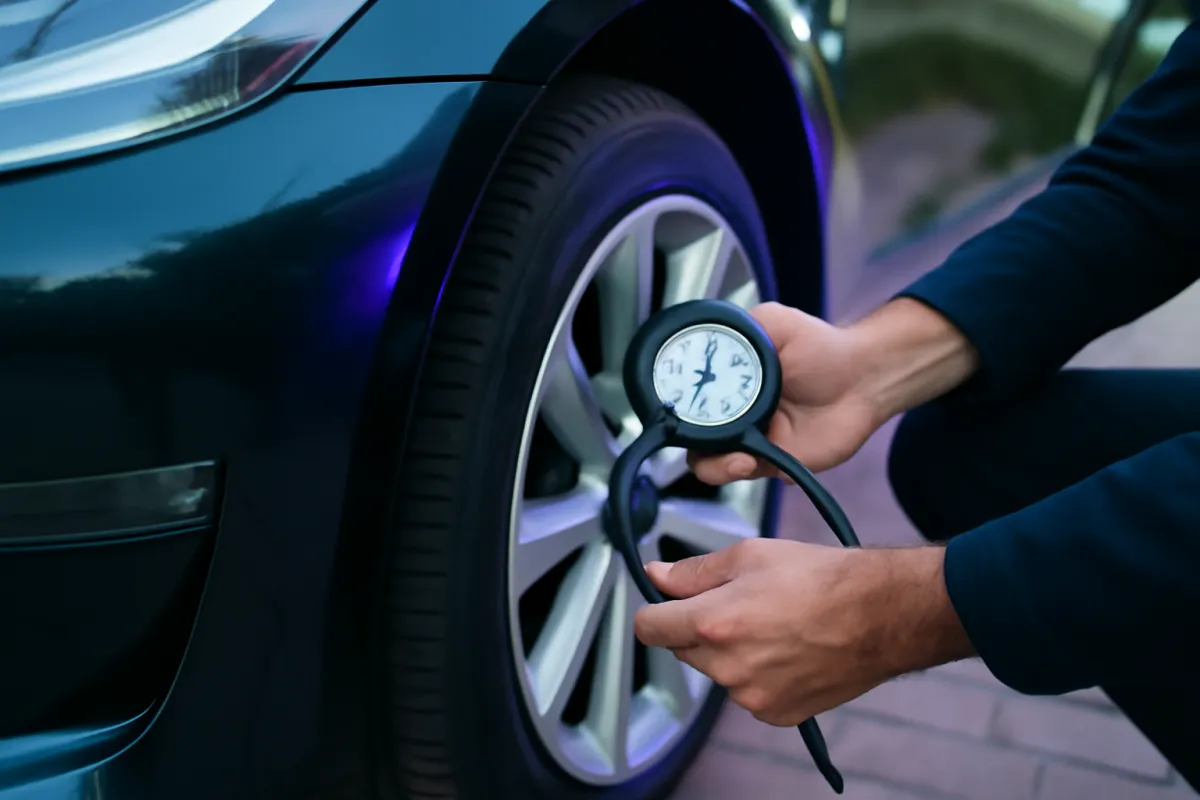
Pressure is the part people miss, and it is free to fix. Air pressure falls as temperature falls, so a set of tires inflated correctly in warm weather will read low on a cold morning without anything leaking. Underinflated tires deform more, roll harder, wear unevenly, and quietly tax every mile. Check pressures cold, against the figure on the driver’s door jamb, more often in winter than you would in summer.
One related habit belongs here. Clearing snow off the whole car, not just a porthole on the windscreen, removes weight and restores the aerodynamics the car was designed around. A roof full of snow is drag and mass you are carrying for no reason, and it is a hazard to the driver behind you when it comes off.
Regenerative braking fades when the pack is cold
Regeneration is the other winter surprise, and it is a direct consequence of the first mechanism. A cold pack cannot accept a high charging current, and regenerative braking is charging: the motor becomes a generator and pushes energy back into the battery. So on a freezing morning the car will often limit or disable regen until the pack warms, usually with a symbol or a message on the display.
The driving experience changes noticeably. Lifting off the accelerator produces much less deceleration than you are used to, the car coasts further, and you have to use the friction brakes more. This catches people out on the first cold morning of the season, so the practical advice is to expect it, leave more space, and brake earlier until the regen indicator shows normal service.
The range consequence is real but modest and self correcting. You recover less energy on the early part of a cold drive, then progressively more as the pack warms through use. Preconditioning while plugged in helps here too, since a pack that starts warmer accepts regen sooner. Our teardown on regenerative braking covers how the system works when conditions are normal.
Does cold weather permanently damage the battery?
This is the question underneath the anxiety, and the answer is reassuring with two genuine caveats. Ordinary winter cold is a temporary performance effect. The chemistry slows, capacity becomes harder to access, and both reverse as the pack warms. The range you lose in January is not gone, and nobody’s battery is meaningfully smaller in April because it was cold in January.
The first real caution is charging a very cold pack at high power, which is precisely what battery management systems exist to prevent. Left unmanaged it is the condition associated with lithium plating and permanent capacity loss, which is why the car slows the charge rather than letting you have your way. Treat the slow cold charge as the protection working, not as an inconvenience to engineer around.
The second is storage. Leaving a car parked for a long period at a very low state of charge, in deep cold, is not kind to it, and manufacturers generally advise a mid range state of charge and, where possible, a plugged in car for long winter parking. Follow your own manual on this, since chemistries and recommendations differ. Our battery life teardown covers the habits that actually drive long term health, and heat and time feature far more heavily than cold does.
Charging habits that make winter easier
A handful of routine changes remove most winter friction, and none of them require new equipment. Charge overnight and set a scheduled departure so the car finishes charging and preconditions close to when you leave, which means the pack is warm at the start of the drive rather than at three in the morning. If your electricity rate has cheap overnight hours, this costs less as well as working better.
Consider a slightly higher daily charge limit through the cold months. If you normally sit at 80 percent, moving to 85 or 90 in deep winter restores the absolute miles that the cold is taking away without changing anything else about your habits. This is a seasonal adjustment, not a permanent one, and returning to your usual limit in spring keeps the long term battery care intact.
Finally, expect your home charging energy to rise a little in winter for the same miles driven. Some of that energy is going into thermal management and cabin preconditioning rather than into the wheels, which is exactly what you want it doing. Our home charging cost teardown covers how to price that, and the seasonal bump is usually smaller than owners fear.
Common winter range mistakes
A short list of recurring errors accounts for most of the bad winter experiences people describe.
- Trusting the rated range on a cold morning. The sticker figure is a comparison tool produced in moderate conditions. Planning a February leg from it is planning from a number that does not exist that day.
- Preconditioning while unplugged and expecting a range saving. It warms the cabin, which is worth doing for safety, but the energy comes from the pack. The range benefit only exists when the cable is connected.
- Arriving at a fast charger with a cold pack. Set the charger as a navigation destination so the car preconditions the battery on approach. Otherwise the first stretch of the session is spent warming rather than charging.
- Blasting cabin heat instead of layering seat heat under a modest cabin setting. Cabin air is the expensive way to be warm. Direct heaters cost a fraction and often feel better in deep cold.
- Cutting the arrival reserve to make a leg work. Winter is exactly when estimates drift and options narrow. A 20 percent reserve is the difference between a routine stop and a stressful one.
- Reading a cold morning as battery degradation. Temporary cold loss and permanent capacity loss look identical on the display and are entirely different things. Judge degradation across seasons, not across a cold snap.
Each of these is a default rather than a decision, which is why they persist until a trip forces the issue.
What changes when spring arrives
The last thing worth saying about winter range is that it ends. As ambient temperatures rise, every mechanism in this teardown unwinds. The pack warms and delivers its capacity freely again, the heater switches off and stops taking a share of every hour, the air thins, the winter tires come off, and the drivetrain loosens up. Range returns to something close to the rated figure on gentle drives, and drivers who were anxious in January stop thinking about it entirely by April.
That seasonality is worth internalising because it changes how you should judge the car. Measuring your EV against its rating in the worst week of the year and concluding it underdelivers is the same error as measuring it on a mild spring back road and concluding it overdelivers. The truth is a band, and your real annual experience sits somewhere in the middle of it.
It also changes how you should judge the battery. Look for a slow trend across several years and across comparable seasons, not for a scary number on a freezing morning. Compare February to February and August to August, and the picture that emerges is a genuine one. Anything else is measuring the weather. Track your own seasonal numbers against the companion estimator and the band becomes obvious within a single year of ownership.
The bottom line
EV range in cold weather really does fall, and the honest range of commonly reported losses runs from around a tenth on a cool day to roughly a third in genuine cold, with short trips worse and mild days much better. That spread is not vagueness, it is the actual answer, because four separate mechanisms are involved and they scale differently. A cold battery temporarily holds back some capacity. The cabin heater draws real power from the same pack, and it draws it per hour rather than per mile. A cold pack will not accept a fast charge until it warms. Denser air, winter tires, and stiff cold running gear take a slice on top.
The practical response is small and boring and it works. Precondition while plugged in so the expensive warm-up is paid from the wall. Carry the rest of your warmth on seat and wheel heaters under a modest cabin setting, without ever compromising clear glass. Precondition the pack before a fast charge so winter stops stay short. Plan legs from your winter number with a 20 percent reserve rather than from the sticker. On the illustrative car in this teardown those habits move a 33 percent loss to something nearer 29, and a heat pump car nearer 24.
None of that makes winter free, and pretending otherwise would be as unhelpful as the people who say an EV is useless in the cold. The loss is real, it is temporary, it returns in spring, and it is entirely plannable once you know which mechanism is taking which slice. Run your own rated range, battery size, heater type, and conditions through the companion estimator, write the resulting leg length on a note in the car, and winter stops being a worry and becomes a number.
This teardown is educational and independent, and it exists because winter range deserves an explanation rather than either a shrug or a scare. Every range, efficiency, percentage, kilowatt, and mile figure above is illustrative and internally consistent for one hypothetical vehicle, chosen to show how the arithmetic behaves rather than to describe any real car; no measurement, test result, or fleet data is being reported here, and your own numbers will differ with your vehicle, its heating system, its battery chemistry, your climate, your trip lengths, your speed, and your tires. Charging, preconditioning, and cold storage behaviour vary between manufacturers, so follow your own owner’s manual where it gives model specific instructions. Nothing here is safety advice, and no range figure is ever a reason to drive with obscured glass, unsuitable tires, or a reserve too thin for the conditions you are actually in.
Frequently asked questions
How much range does an EV lose in cold weather?
There is no single number, because the loss depends on how cold it is, how long the trip is, and what kind of cabin heater the car has. Commonly reported figures sit somewhere between a tenth and roughly a third of range on a steady drive in genuine cold, with short errands running worse and mild days running much better. On the illustrative 280 mile car used throughout this teardown, a cold day with a resistive heater lands near 187 miles, a loss of about 33 percent, while the same car with a heat pump lands near 208 miles, a loss of about 26 percent. Treat any percentage you read, including these, as a shape rather than a specification, and learn your own car's winter figure over a season.
Why does an electric car lose range in the cold?
Four separate things happen at once, and they are usually blurred into one complaint. The battery's electrochemistry slows when it is cold, so internal resistance rises and some of the pack's energy is temporarily out of reach until it warms. The cabin heater draws real electricity from that same pack, energy that never reaches the wheels. Cold air is denser, so aerodynamic drag rises slightly, and winter tires, cold lubricants, and slush or snow on the road all add rolling resistance. Each mechanism is modest on its own, but they stack, and the heater is usually the largest single contributor on a short trip.
Does the cabin heater really use that much battery?
Yes, and it is the loss most owners underestimate because a petrol car gave them heat for free from waste engine heat. An electric car has almost no waste heat to recycle, so warming the cabin means running an electric heater off the traction battery. An illustrative resistive system averaging around 4 kilowatts on a cold drive, at an average 56 miles per hour, works out near 0.07 kilowatt hours per mile on top of the driving energy itself. On the illustrative car in this teardown that heater alone accounts for roughly 37 of the 93 lost miles, which is why seat heaters and preconditioning matter more than any other habit.
What is the difference between a heat pump and a resistive heater for winter range?
A resistive heater turns electricity into heat directly, so a kilowatt of electricity buys roughly a kilowatt of heat. A heat pump instead moves heat from the outside air, and from the car's own waste heat, into the cabin, so a kilowatt of electricity can deliver more than a kilowatt of warmth. The practical result is a noticeably smaller cabin heating draw for the same comfort, illustratively closer to 1.5 kilowatts than 4 on a cold drive. Heat pump efficiency does fall as the outside air gets very cold, and many systems fall back on resistive elements in extreme conditions, so the advantage narrows rather than disappears at the bottom of the thermometer.
Why does my EV charge so slowly when it is cold?
A cold battery will not safely accept a high charging current, so the car deliberately limits the rate until the pack reaches a suitable temperature. That is a protection, not a fault, and it is why a fast charger that would normally deliver a rapid session can crawl for the first stretch when you arrive with a cold pack. Most cars can warm the battery on the way to a charger if you set that charger as a navigation destination, which is what battery preconditioning means in this context. Arriving warm rather than cold is usually the single biggest difference between a quick winter stop and a long one, and our teardown on charge times covers how the rate curve behaves once the pack is ready.
Does preconditioning while plugged in actually save range?
It does, because the energy used to warm the cabin and the pack comes from the wall rather than from the battery, and because the heavy warm-up load is finished before you unplug. Once you are moving, the heater settles to a lower maintenance draw instead of fighting a cold soaked interior. On the illustrative car in this teardown, pulling the average heater draw from roughly 4 kilowatts down to roughly 2.5 kilowatts by preconditioning and then leaning on seat heat lifts winter range from about 187 miles to about 199 miles. Preconditioning while unplugged still warms the cabin, but it spends pack energy to do it, so it is a comfort choice rather than a range one.
Why do short winter trips lose so much more range?
Because heating a cold cabin is largely a fixed cost, and a short trip spreads that cost over very few miles. Warming an interior that has soaked overnight takes the most energy in the first several minutes, exactly when you have covered the least distance. An illustrative 12 mile errand taking half an hour, with the heater averaging around 4.5 kilowatts from cold, spends roughly 2.25 kilowatt hours on heat and around 4 kilowatt hours on driving, which works out near 1.9 miles per kilowatt hour against a rated 3.5. That is about 45 percent below rated, on a trip where a longer drive in the same weather would have looked much better.
Does cold weather permanently damage an EV battery?
Ordinary winter cold is a temporary performance effect rather than permanent damage, and the range comes back when the weather does. The genuine cautions are different ones: charging a very cold pack at high power is what battery management systems limit for a reason, and leaving a car at a very low state of charge in deep cold for a long period is not a kind way to store it. Most modern cars manage pack temperature themselves and will refuse or slow a charge that would be harmful. Our teardown on battery lifespan covers what actually drives long term degradation, and heat, high states of charge, and time feature far more heavily than winter does.